Handling a client who will not pay comes down to one thing: a written, time-boxed escalation ladder that starts polite and gets firmer on a fixed calendar. Send a short reminder with the invoice attached, follow it with a second note at around a week, set a written deadline, then escalate in writing until the cost of ignoring you exceeds the cost of paying. Most unpaid invoices resolve in the first two steps.
Most of these situations are process failures, not malice. An invoice goes to a personal inbox that gets filtered, a purchase order never gets approved, or an accounts payable department never received it. The client is not refusing to pay you; they simply have not paid you yet. Your job is to make it easy for the right person to act, and to keep a record of every attempt.
This guide covers freelancers, stylists, photographers, consultants and small studio owners who invoice clients directly and have no accounts receivable department doing the chasing for them. It is general information about how unpaid invoices are usually resolved, not legal advice. Rules, dollar thresholds and deadlines vary by country and state, so check your own local rules or ask a qualified attorney in your jurisdiction before filing anything.
Table of Contents
- What You Need
- Step-by-Step: How to Handle a Client Who Will Not Pay
- Step 1: Review the Agreement and Confirm the Balance
- Step 2: Build a Complete Paper Trail
- Step 3: Send a Clear Payment Reminder
- Step 4: Set a Deadline and State the Next Step
- Step 5: Offer a Reasonable Payment Resolution
- Step 6: Escalate Professionally if the Balance Remains Unpaid
- Common Mistakes
- Frequently Asked Questions
- When a client won’t pay, what should I do first?
- How long should I wait before sending a demand letter?
- Can I stop work or withhold final files if a client hasn’t paid?
- Should I use a collection agency or file in small claims court?
- What if the client disputes the amount or the quality of the work?
- Do I need a contract to collect an unpaid invoice?
- Conclusion: Start With a Professional Paper Trail
What You Need
Before you contact anyone, assemble the facts. Ten quiet minutes on this step saves you from sending a confident message about the wrong number, which is how good relationships end badly.
- The agreement. Your contract, signed proposal, or the email thread where the client accepted your quote and terms. A written email agreement counts in most places; it just carries less weight than a signed document.
- Scope of work. The deliverables you agreed on, plus any approved changes you billed for.
- Every invoice. Number, date issued, amount, due date, payment terms such as net 15 or net 30, and which payment methods you offered.
- Proof of delivery. The sent files, the live site, the published photos, the delivered report, the dated handover email.
- Approval records. Replies where the client signed off on the work or asked for changes.
- Receipts. Paid deposits, subscriptions, stock, props, assistants, mileage, any expense you fronted.
- Payment history. Whether this client has paid you on time before, and how long their own process takes.
- The right contact. For an agency or company, the accounts payable or finance contact and the person who actually approved the work.
Step-by-Step: How to Handle a Client Who Will Not Pay
Here is the ladder I would follow, with the timing attached. Adjust the calendar to your payment terms and your own cash flow, but keep the order.
| Day mark | Action | Tone | Attach or send |
|---|---|---|---|
| 1 to 3 days past due | Friendly payment reminder | Warm, assumes a process mix-up | Invoice PDF, payment link |
| 7 to 10 days past due | Second reminder with a response request | Firm, still courteous | Invoice, due date, ask for a payment date |
| 20 to 30 days past due | Formal demand with a specific deadline | Businesslike, no emotion | Demand letter, contract, statement of account |
| Around 27 to 30 days | Escalate to accounts payable or the decision maker | Neutral, cc the right person | Same packet, forwarded internally |
| 40 days past due | Final notice stating intent to sue | Clear, calm, dated | Final demand letter |
| 60 days past due | File in small claims court if the amount justifies it | Procedural | Contract, invoices, proof of delivery, correspondence |
| 60 to 90 days | Hand it to a collection agency or write it off | Decisional | Agency agreement or write-off note |
Step 1: Review the Agreement and Confirm the Balance
Confirm the exact amount owed before you write a word to the client. Pull up the contract and check the payment terms, the deposit, the kill fee or termination clause, and which expenses were agreed as billable. Add up approved extras separately so the total is defensible.
Write the figure down as a single number, then check it twice. If you are owed late interest and your contract actually says so, calculate it and state it as a separate line rather than folding it into the total.
Step 2: Build a Complete Paper Trail
Create one folder with everything in date order. Screenshots beat memory, and a message thread someone else might delete is not evidence of anything. Save email as PDFs, not just screenshots of the interface.
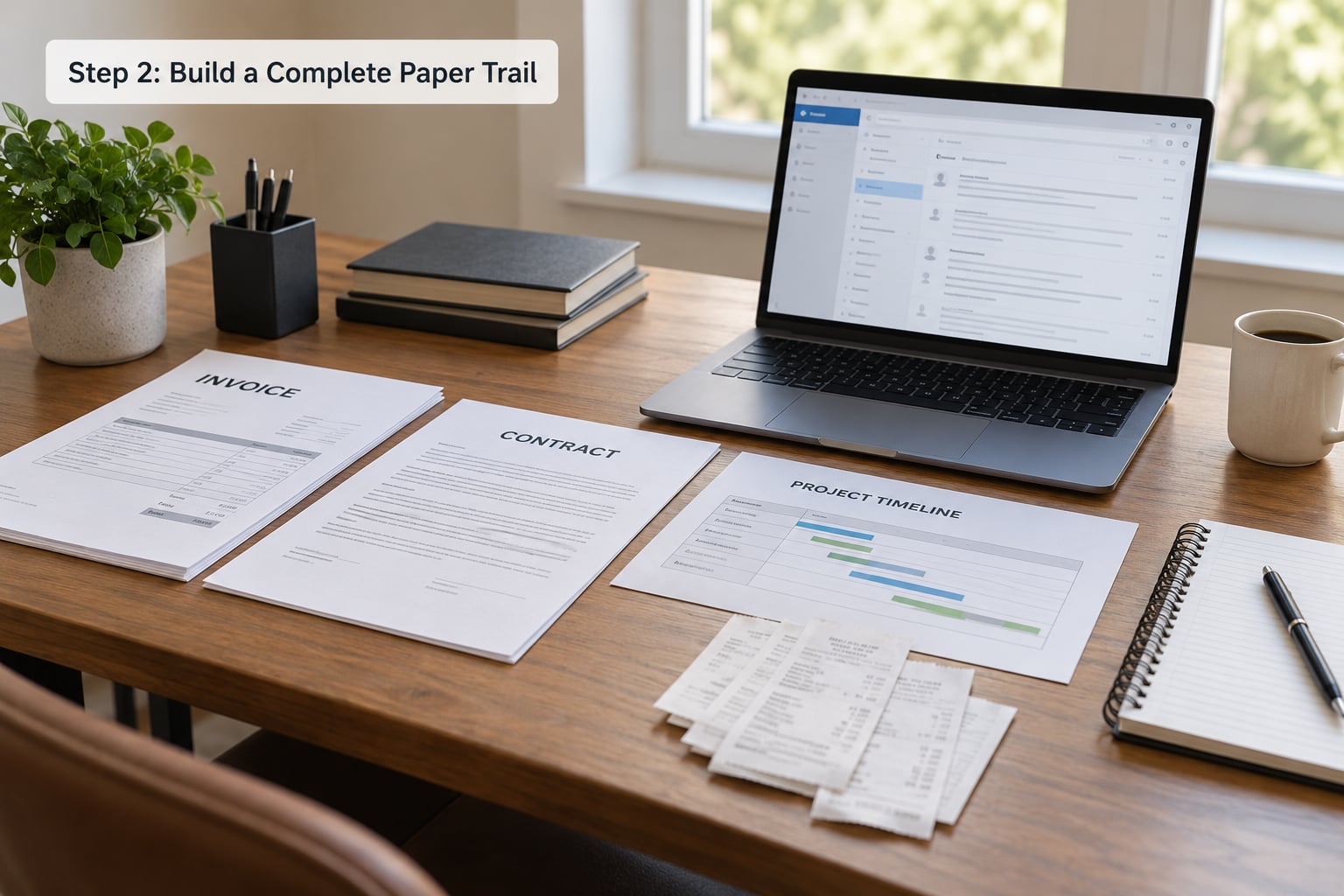
Include your contract, the proposal as the client approved it, every invoice, proof that the work was delivered, every approval or change request, your receipts, and the full message history. If the client disputed quality at any point, keep that exchange too.
Organize it now and you will never have to reconstruct it later. Most disputes collapse the moment the other side sees a dated record of exactly what was agreed and delivered.
Step 3: Send a Clear Payment Reminder
Keep the first reminder short. One message, one ask, no history of your frustration. Put the invoice number, the amount, the original due date and a payment link in the body so they do not have to open anything to act.
Hi [Name],
Invoice [number] for [amount], due [date], is showing as outstanding on my end and I have not received payment yet. It may have been caught in an approval queue on your side.
You can pay here: [payment link]. If it is already scheduled or sitting with accounts payable, could you let me know the expected payment date and who is handling it?
Thanks,
[Your name]
Send it from the same email address you have always used with this client, not a new one. A new sender address makes your own record harder to follow.
Step 4: Set a Deadline and State the Next Step
A reminder without a date gets the same non-reply. State a specific day and name what you will do next, in plain and lawful terms. Pausing work, holding final files, or ending the engagement are all legitimate when a contract lets you do so. Destroying their site, threatening to expose them or posting about them publicly is not.
Following up on invoice [number] for [amount], still outstanding since [date]. If I have not received payment or a confirmed payment date by [specific date], I will pause work on the current scope and move the final deliverables to a hold pending payment.
Happy to sort this out directly if there is an issue on my side.
Give at least a week of lead time and pick a real business day, not a Sunday. Then actually do what you said on that date. Consistency is the only thing that makes the next step credible.
Step 5: Offer a Reasonable Payment Resolution
Before assuming the worst, work out which problem you are dealing with. Clients who argue about quality or scope are disputing something, and that is a conversation. Clients who go quiet with no explanation are usually avoiding a payment conversation, and that is a deadline problem.
| Symptom | Likely cause | Response |
|---|---|---|
| Questions about quality or scope | Dispute | Reply in writing with the agreed scope and delivery proof. Offer a documented correction round. |
| Honest message about cash flow | Genuine hardship | Offer a written payment plan or split across two or three installments with dates. |
| Silence, or vague promises with no date | Stonewalling | Do not negotiate. Move to the written deadline and escalate on schedule. |
| Renegotiating the agreed rate after delivery | Attempted reduction | Point to the accepted quote. Offer payment in full for the agreed amount as the only path. |
If you do agree to a payment plan, put every new term in writing: total amount, number of payments, dates, method, and what happens if a payment is missed. A verbal agreement to pay later is worth much less than the original invoice, because now you have to prove a second deal.
Step 6: Escalate Professionally if the Balance Remains Unpaid
When reminders stop working, escalate in writing and keep records at every stage.
Check the statute of limitations. How long you have to sue on a debt varies widely by state or country, commonly around three to six years for contracts, and some places allow much less. This deadline is the real reason not to sit on an unpaid invoice: when it passes, your options shrink.
Use internal escalation. For agency or company clients, contact accounts payable directly and ask for their vendor onboarding and invoice submission process. Get yourself set up as an approved vendor, confirm the billing address and purchase order number, and copy the person who approved the work. Large organizations routinely pay slowly for process reasons alone.
Send a final notice. A final demand letter states the amount, the dates, the attempts made, the deadline, and what you will do next, with a date. It stays factual. A letter that a lawyer wrote usually produces a faster response than one you wrote, and the cost may be worth it for a larger balance.
File in small claims court. In the United States, small claims limits commonly run from roughly 2,000 to 25,000 dollars depending on the state, and the process is designed to be simple: usually no jury, no attorney required. Filing fees exist and are often capped or refunded if you win or settle. Expect to bring the contract, invoices, proof of delivery, approval messages and your correspondence. If the client does not appear, a default judgment is usually granted, but collecting on that judgment is a separate process that can involve wage garnishment or liens.
Try a collection agency. Agencies usually charge a contingency fee, commonly somewhere between 20 and 50 percent of what they recover, so the math only works on larger balances. Your client will also be contacted by someone who is not you, which changes the tone of the conversation.
Consider a write-off. Below roughly 2,000 dollars, most freelancers are better off writing the debt off than spending money and time to chase it. From a tax perspective, uncollectible amounts are generally deductible as bad debt under tax and treasury rules, though you need documentation and the deduction generally reflects income you already reported. Ask an accountant rather than guessing.
There is no way to guarantee collection. What you can guarantee is a clean record and a professional process, which is usually what gets people paid.
Common Mistakes
Most unpaid invoices are lost to avoidable errors. These are the ones I see repeatedly, with the fix for each.
- Arguing publicly. Posting about the client on social media, in industry groups or on review sites. It rarely produces payment and it can expose you to a defamation claim. The fix: keep every dispute in writing, one to one, and factual.
- Working with no written agreement. A verbal deal is much harder to enforce, and a friendly chat about scope is not a contract. The fix: get terms in writing before you start, even a short email stating scope, dates and fees.
- Accepting vague promises. “Payment is coming next week,” repeated four times, is not a payment date. The fix: ask for a specific day and a written confirmation, and treat a missing answer as an answer.
- Continuing unpaid work. Doing revisions or starting the next phase while money is outstanding turns one lost invoice into two. The fix: pause at the next milestone until the prior invoice clears.
- Threatening things you cannot legally do. Promising to take down a site you own, or to report a client, and then doing it can leave you the one facing a lawsuit. The fix: state only actions you are actually entitled to take under the contract and the law.
- Deleting records. Clearing your inbox or losing the file after an argument destroys the evidence you will need most. The fix: export and archive everything now.
- Waiting past the deadline. Assuming you can chase it whenever you have energy. The fix: set the calendar dates the moment the invoice goes overdue, before you are angry.
- Negotiating with someone who never approved anything. The contact who forwarded your work is often not the one who can release payment. The fix: ask directly who at their company authorizes vendor payments and copy them from the start.
A related habit pays off here: raise prices or change terms for clients who have repeatedly paid late. Slow payment is a signal about their process, not about your work, and a deposit or shorter terms with a past-slow payer is a normal business decision.
Frequently Asked Questions
When a client won’t pay, what should I do first?
Send one short written reminder that names the invoice number, the amount, the original due date and a payment link, and ask whether payment is scheduled. Most non-payments are process failures, and a clear message often fixes them within days. Keep a copy of everything you send and note the date you sent it, because that record becomes the timeline for later steps.
How long should I wait before sending a demand letter?
Most freelancers send a friendly reminder at one to three days past due and a firmer follow-up at seven to ten days. A written demand with a specific deadline usually comes at twenty to thirty days, and a final notice stating intent to file in small claims court around forty days. Adjust for your payment terms and check the statute of limitations in your area, which can be considerably shorter.
Can I stop work or withhold final files if a client hasn’t paid?
Usually yes, if your contract allows it and you follow it correctly. Pausing services, ending a retainer and holding final deliverables until payment clears are common and generally accepted tactics. State the action and its date in writing before you take it, and check your contract and local law first. Destroying or sabotaging work is a different matter and can expose you to a claim.
Should I use a collection agency or file in small claims court?
Small claims court is usually better when the amount is large, your documentation is strong and you are willing to spend a day or two in court. Collection agencies charge a contingency fee, commonly around 20 to 50 percent of what they recover, so they mainly make sense on bigger balances. Below roughly 2,000 dollars, writing the debt off is often the cheapest option. This is general information, not legal advice.
What if the client disputes the amount or the quality of the work?
Answer the dispute in writing, point to the agreed scope and your delivery records, and keep the conversation factual. If the disagreement is real, offer a documented correction round rather than arguing about blame. Do not trade a discount for silence, because a payment with no written agreement about the scope leaves you exposed the next time.
Do I need a contract to collect an unpaid invoice?
A signed contract is the strongest position, but it is not the only one. A written email agreement, an accepted proposal and a clear invoice history are all evidence a small claims court can consider. What matters is being able to show what was agreed, what was delivered and what was invoiced. Without any written record, recovery becomes far harder regardless of how clearly the work was performed.
Conclusion: Start With a Professional Paper Trail
If you take one thing from this guide, take the first step: verify the agreement, confirm the number, build the paper trail and send one calm written reminder with a real date attached. How to handle a client who will not pay is mostly a matter of doing the boring documentation early, then escalating in writing on a schedule you set in advance. Work up the ladder one step at a time, keep every message, and escalate lawfully only when the step before it fails.