
If you want the short version of how to handle an unpaid internship offer: do not answer it the same day you receive it. Read the terms, check the placement against the Department of Labor’s primary beneficiary test, price what the hours actually cost you, then pick one of three responses — accept with the terms in writing, counter with a request for a stipend, credit, or a paid conversion, or decline in writing with real notice. In fashion especially, the answer changes completely depending on whether the role comes with credit, a named supervisor, and portfolio rights.
Most people get this wrong in one of two directions. They say yes on enthusiasm alone, then three weeks in they are doing production-level work at 9 a.m. six days a week. Or they panic and refuse an offer that was genuinely structured, because nobody ever told them what to check. Both are avoidable, and handling it takes maybe an hour of careful reading before a single email goes out.
We spend a lot of time on the fashion side of this — editorial internships, showroom and styling assistant roles, boutique and brand placements — and the same pattern shows up every season: the offer arrives with a vague description and a silence on pay. What follows is the process I would use, and the language I would actually send.
Table of Contents
- What You Need Before You Answer
- Step-by-Step: How to Handle an Unpaid Internship Offer
- 1. Pause Before Sending a Final Answer
- 2. Learn How to Handle an Unpaid Internship Offer Professionally
- 3. Check Whether the Internship Is Eligible to Be Unpaid
- 4. Put the Scope and Terms in Writing
- 5. Ask About Credit, Supervision, and Career Value
- 6. Negotiate When the Terms Are Not Acceptable
- 7. Accept, Decline, or Negotiate With a Clear Message
- Common Mistakes to Avoid
- Tips for Protecting Your Time and Reputation
- Frequently Asked Questions
- Are unpaid internships a red flag?
- What are my rights as an unpaid intern?
- Is an unpaid internship ever worth it?
- How do people afford unpaid internships?
- How do I ask an employer for an internship stipend?
- Do unpaid internships look good on a resume?
- What to Do First
What You Need Before You Answer
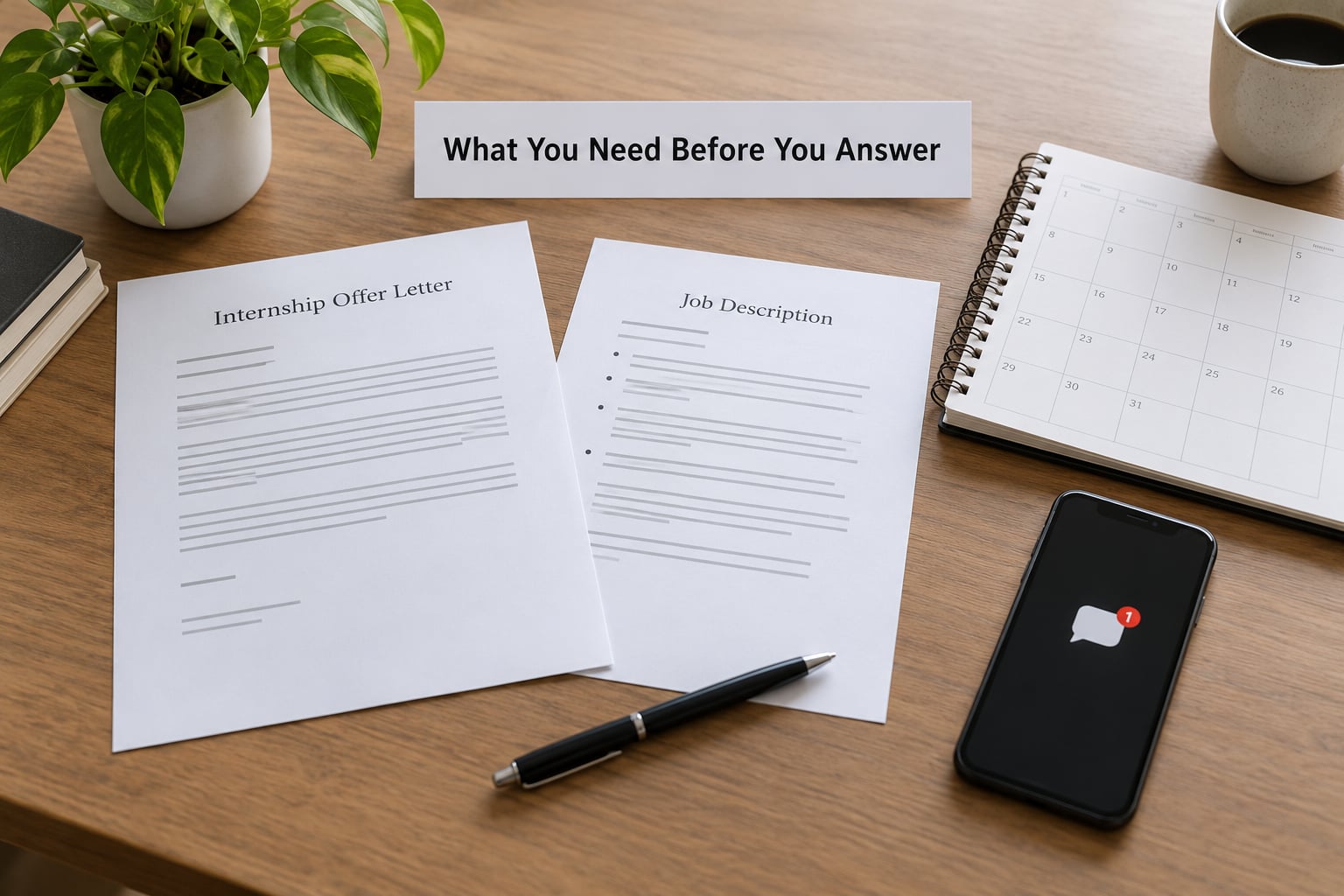
You cannot evaluate an offer you have not fully read. Most panic replies happen because a reader is reacting to the title, not the terms. Gather these six things first, and the decision usually makes itself.
- The offer letter or email, in full. Read every line, including anything about hours, start date, and confidentiality. Scroll past the exciting part.
- The job description. Look for specific deliverables — a photo edit, a lookbook, a database cleanup, a research memo. Vague titles like “creative team” tell you nothing.
- The contact details of whoever supervises you day to day. Not the recruiter. The person you would email on a Tuesday.
- The schedule, stated in hours. “Flexible” and “full-time availability” are not the same thing, and the gap between them is where unpaid overtime lives.
- The compensation terms. If the letter is silent on pay, silence is information. Ask about it directly.
- Your school’s internship credit requirements. Hours per week, minimum duration, graded versus ungraded, and whether an advisor has to approve the employer in advance. Get this from your career center, not from a classmate’s guess.
Also reopen the earlier emails. Recruiters often say something about hours or timeline in passing that never made it into the formal document. That line is useful leverage later.
Step-by-Step: How to Handle an Unpaid Internship Offer
1. Pause Before Sending a Final Answer
Give yourself 48 hours before replying, and write down every question while the excitement is still warm. Separating excitement from logistics is the single most useful thing you can do here.
Put the practical questions on paper: how many hours, which days, who supervises me, is there credit, what do I get to show at the end, who pays for transit, what happens to the work I produce. If a question has no answer, that gap is the negotiation. A satisfactory outcome here looks simple — you have a list of concrete questions rather than a feeling.
2. Learn How to Handle an Unpaid Internship Offer Professionally
Write one email that confirms interest, asks for clarification, and sets a deadline. Tone matters: grateful, specific, not accusatory. Here is a template that works for fashion and creative placements.
Subject: Follow-up on the [brand] internship
Hi [name], thank you for the offer — I’m genuinely interested in the [specific project] work. Before I confirm, could you help me with a few details so I can plan around them: the expected weekly hours and days, the end date, who would be my day-to-day supervisor, whether the role can be taken for academic credit, and whether there’s a stipend or expense budget for transit and supplies? I want to make sure I can commit properly rather than half-finish the term. Could you let me know by [date]? I need to give my career center an answer by then. Thanks so much.
Notice what that does: it accepts the offer in principle, asks six specific questions, gives a real deadline tied to an external constraint, and never says the word unpaid. If they already told you it is unpaid, leave it out of the email anyway and let the questions do the work. Ask in writing, because a written answer is the one you can point to.
3. Check Whether the Internship Is Eligible to Be Unpaid
In the US, an unpaid internship is only lawful when the intern — not the employer — is the primary beneficiary of the arrangement. The Department of Labor uses a seven-factor test for this, and it is worth knowing each factor by name because it gives you seven specific things to ask about.
- The intern should benefit educationally. Ask: is there a learning objective, and did anyone write it down?
- The experience should be part of a course or a structured program. Ask: does this map to a class, a credit sequence, or a supervised practicum?
- It should not displace existing employees. Ask: was this role previously a paid position, and is it being filled because someone left?
- No productive work is expected in exchange. Ask: am I producing anything a paid employee would produce? If the answer is quietly yes, stop.
- There should be no expectation of future employment. Ask: does the offer mention hiring me later, and is there anything in writing implying it?
- The internship should not provide the employer with a benefit greater than it gives the intern. Ask: who is getting more from this arrangement?
- There should be mutual understanding that there is no contractual obligation to complete the internship. Ask: can I leave at any point and still get credit for what I did?
The weights differ by court and by state, so a placement can be lawful federally but still questionable where you live. Many states and cities apply stricter pay rules on top of the federal test, and several paid internships are common simply because a company decided to avoid the argument. Check your own state’s labor department guidance, and if the hours are full-time and the deliverables are senior-level, treat the legality question as a reason to negotiate rather than as settled fact.
If it fails the test, you are not obliged to keep your mouth shut. Employers understand the exposure, and interns have won back pay on group claims in entertainment and publishing — the Fox Searchlight and Hearst matters are the names that come up most. You do not need a lawyer to ask good questions, and you do not need a lawyer to decline.
4. Put the Scope and Terms in Writing
Never start a placement on a verbal description. Ask for a short written agreement, and expect it to cover all of the following: the legal employer name and your day-to-day supervisor, start and end dates, weekly hours and days, work location and remote expectations, dress code and any uniform or kit provided, your specific tasks, the learning objectives, how often you will meet with a supervisor, whether academic credit is issued and by whom, breaks and time off, who pays for transit and supplies, whether you are covered by the employer’s liability insurance, what happens to your portfolio rights, and any reimbursement.
A one-page document with those answers is worth more than a flattering phone call. Satisfactory looks boring: a document you could show an employer in three years and still be proud of.
5. Ask About Credit, Supervision, and Career Value
For anyone in fashion, the value of a placement is not the hours you put in — it is whether you leave with evidence. Four questions tell you most of it: can the school count this placement toward credit, will one named person supervise you weekly, will you produce something you can show, and will they write you an honest reference or make an introduction.
Then run the numbers on yourself. A ten-week placement at thirty hours a week is three hundred hours of work. Compare that to what a comparable entry-level role pays at the hours you would otherwise be working — mid-20s an hour is roughly where the NACE employer benchmark has sat in recent annual surveys, so those three hundred hours represent a real number in the thousands. Once the total is written down, the decision stops being about passion and starts being about value. That is the honest comparison, and it is the one most readers never make.
6. Negotiate When the Terms Are Not Acceptable
Most people only ask for salary and then accept the silence. Ask for something else instead — plenty of organizations have budget lines that are not payroll. Reasonable asks include academic credit, a shorter weekly schedule, a named supervisor, an expense stipend, a transit pass, a meal per diem on shoot days, reimbursement for fabric or supplies, professional dues or membership fees, equipment or a laptop, tuition credit, a written learning plan, permission to show approved work in your portfolio, or a defined review date at which the role converts to paid.
Frame it as a problem you are solving together, not a demand. “I’m genuinely excited about this project. The practical constraint on my end is that I’m covering rent and transit out of pocket, so I wanted to ask whether there’s flexibility on the schedule, a small expense budget for transit and supplies, or a path to a paid conversion at the end of the term.”
That last one matters most. Asking about a paid conversion at a defined review date is realistic in a way that asking to be paid on day one is not. Several people report that a stipend request made once they had started — and could point to work already delivered — was granted quickly. Being the low-risk candidate who produces on time is genuine leverage.
And if the numbers do not work, say so plainly. “After working out the hours and my costs, this isn’t something I can take on right now” is a complete answer. A career centre, a trade publication, and a nonprofit board will all understand it.
7. Accept, Decline, or Negotiate With a Clear Message
Three endings, and each one is short. Conditional acceptance once the terms are documented: “I’m confirming my acceptance as of today, on the terms in the attached agreement. Please confirm receipt.” Attach the document. This one protects you.
Respectful decline: “Thank you for thinking of me. After reviewing the hours and my own commitments, I’m not able to take this on at the moment, but I’d be glad to stay in touch for openings that fit my schedule.” Decline early, in writing, with as much notice as you can. Small creative industries are smaller than they look, and the note costs you nothing to send.
Request for changes: “I’d like to move forward. Can we confirm the weekly hours, the supervisor’s name, and whether a stipend or expense budget is available before I commit?” Then stop talking and wait. The pause is theirs to fill.
Common Mistakes to Avoid

Almost every bad outcome traces back to one of these, and all of them are avoidable before day one.
- Trusting a verbal promise. “We’ll hire you if a job opens up” has no expiry date and no obligation. Treat it as a nice sentiment, not a plan.
- Starting without a written schedule. If hours are not on paper, scope creep is inevitable and you have no way to prove when it started.
- Agreeing to open availability. “Whenever the team needs you” quietly converts a placement into a second job.
- Ignoring the expense question. Transit, meals on shoot days, supplies, and a required kit all come out of your pocket. Ask what is covered before you start.
- Doing employee-level work quietly. If your hours, direction, and output match a paid role, the arrangement is the problem, not your attitude.
- Leaving before documenting why. If you plan to exit, send one short written note about the reason while the facts are current. Months later, nobody can reconstruct them.
- Trying to correct everything at once. A short call, then one written summary, resolves more than three agitated emails.
Tips for Protecting Your Time and Reputation
Keep a daily log — date, hours, tasks — from day one. It is your evidence, and it takes two minutes. Save every email, message, and shared document in a folder you control rather than one that disappears when a contract ends.
Set boundaries in writing, not in your head, and say them early: “I am available Tuesday through Thursday until five.” Ask about publishing and portfolio permission before you produce anything you want to show later, and treat the answer as a workflow — a named approval step — rather than a vibe. Name the internship on your resume as what it was, with hours and dates, and describe the projects rather than the title. Treat it as professional work in every way that does not cost you access to lawful compensation.
Frequently Asked Questions
Are unpaid internships a red flag?
Sometimes, and the pattern is specific rather than about pay itself. Walk away when the role replaces a paid position, when there is no named supervisor, when the deliverables are senior-level production work, when the offer depends on an unspoken promise of future hiring, or when the hours are full-time with no end date. A placement with credit, a learning plan, defined deliverables, and a named mentor is a different situation entirely, even with no wage attached.
What are my rights as an unpaid intern?
You keep the rights any worker has, and you can ask questions before you start. If the placement fails the Department of Labor primary beneficiary test, the work may have to be paid at minimum wage plus overtime for every hour, and the employer may owe you that money regardless of what a letter says. State and city rules can be stricter than federal law. Document everything from day one, and get advice before you start if the hours are full-time.
Is an unpaid internship ever worth it?
Yes, when it is genuinely hard to get into the field, part-time and local enough that your costs stay low, tied to a specific skill, supervised by someone senior, and it ends with portfolio work, credit, or a defined review for a paid role. If you need the money, cannot afford the commute, or could get equivalent experience somewhere that pays, the same placement is poor value. The deciding question is what the three hundred hours buys you that a paid role would not.
How do people afford unpaid internships?
Mostly by shrinking the cost, not by earning more. Take the placement locally rather than relocating, work a shorter week, live at home or with roommates, ask the school about internship grants and financial aid that allows outside earnings, and look for credit-bearing placements that count toward tuition. Some combine it with tutoring, freelance, or shift work. A clear budget with the hours priced in is the honest test of whether you can do it.
How do I ask an employer for an internship stipend?
Ask for something other than a wage first, because many organizations have budget that is not payroll — a transit pass, expense budget for supplies, meal per diem on shoot days, professional dues, or a defined paid conversion review. Keep it warm and brief: thank them, name the project, explain the practical constraint, offer two or three options, and give a date you need an answer by. Written requests get answered more often than verbal ones.
Do unpaid internships look good on a resume?
They can, but only when described precisely. List the employer, dates, weekly hours, and the projects you delivered rather than relying on the job title. Reviewers care about named deliverables, a supervisor who will vouch for you, and evidence you can show. A vague unpaid title under no supervisor reads as nothing at all. Confirm before you start whether you may describe client work and show approved pieces in your portfolio.
What to Do First
Write down every term the offer leaves unanswered, then send one written email that asks those questions and sets a date for your reply. Before you hit send, put the placement through the seven-factor test and price the hours against what you would otherwise be paid — if it fails the test, or the number is too big, that email is your counter-offer. Either way, you answer the offer deliberately rather than reactively, which is the entire difference between handling an unpaid internship offer well and badly.