An invoice that gets paid fast is specific, numbered and easy to approve. Itemised line items somebody can match to the signed agreement, an explicit due date, payment terms written out in plain words, and remittance instructions that take one click. Ten minutes on the layout saves weeks of chasing.
That is the whole trick. Clients rarely delay because they dislike the work. They delay because nobody inside the company can justify approving a vague invoice, or because it sat in one inbox and never reached the person who can press the button. I run my own invoicing for creative work, and the same four fixes keep coming up.
Below is the sequence: what to gather first, seven steps from blank page to sent, the follow-up cadence with wording you can paste, and the mistakes that quietly add weeks. Tax and late-fee rules vary by country and state, so confirm your own obligations with a qualified professional before you rely on any of them.
Table of Contents
- What You Need
- Step-by-Step: How to Write a Freelance Invoice That Gets Paid Fast
- 1. Use a Clear Template: How to Write a Freelance Invoice That Gets Paid Fast
- 2. Describe the Services and Agreed Price
- 3. Add the Invoice Number and Payment Details
- 4. State Payment Terms That Prevent Questions
- 5. Check the Math Before Sending
- 6. Send It in a Professional, Trackable Way
- 7. Follow Up Without Damaging the Relationship
- Common Mistakes
- Quick Tips for Faster Payment
- Frequently Asked Questions
- When should a freelancer send an invoice?
- Should every freelance invoice have a unique number?
- How do I politely ask a client to pay an overdue invoice?
- What payment method should I offer on my invoice?
- Should I charge a late fee if a client pays late?
- How do I write a freelance invoice that gets paid fast without sounding pushy?
- Conclusion
What You Need
Gather these before you open a template. Ten minutes of setup is what stops an invoice from bouncing back with questions, and it is the part most first-time freelancers skip.
An invoice tool. A Word or Google Docs template is genuinely enough for one or two clients a month. Once you are sending ten or more, free tiers such as Wave or Zoho Invoice handle numbering and reminders for you, while QuickBooks or FreshBooks suit you if bookkeeping and tax time matter more than the monthly fee.
Your business details. Legal name or trading name, business address, email, phone number, and your tax ID (an EIN in the US). Missing tax paperwork does not stop you sending an invoice, but clients without your tax ID on file will queue you behind a request for a W-9 or the local equivalent.
Your client’s billing details. The legal entity name, billing address, accounts payable email, and a named billing contact. Ask for the AP address in writing at the start of the project, because the day-to-day contact is often not the person who approves payment.
Project scope. The signed agreement, statement of work or quote, plus any purchase order number the client requires on paperwork. Line items come straight from here.
Payment records. Any deposit already received, previous invoices, and credits or discounts you agreed. Without this you double-bill, and a double bill is the fastest way to lose a good client.
Tax information. Whether you charge sales tax, VAT or GST depends entirely on where you and your client are registered. Confirm your position with a qualified professional and state on the invoice whether the amount shown includes tax.
Step-by-Step: How to Write a Freelance Invoice That Gets Paid Fast
1. Use a Clear Template: How to Write a Freelance Invoice That Gets Paid Fast
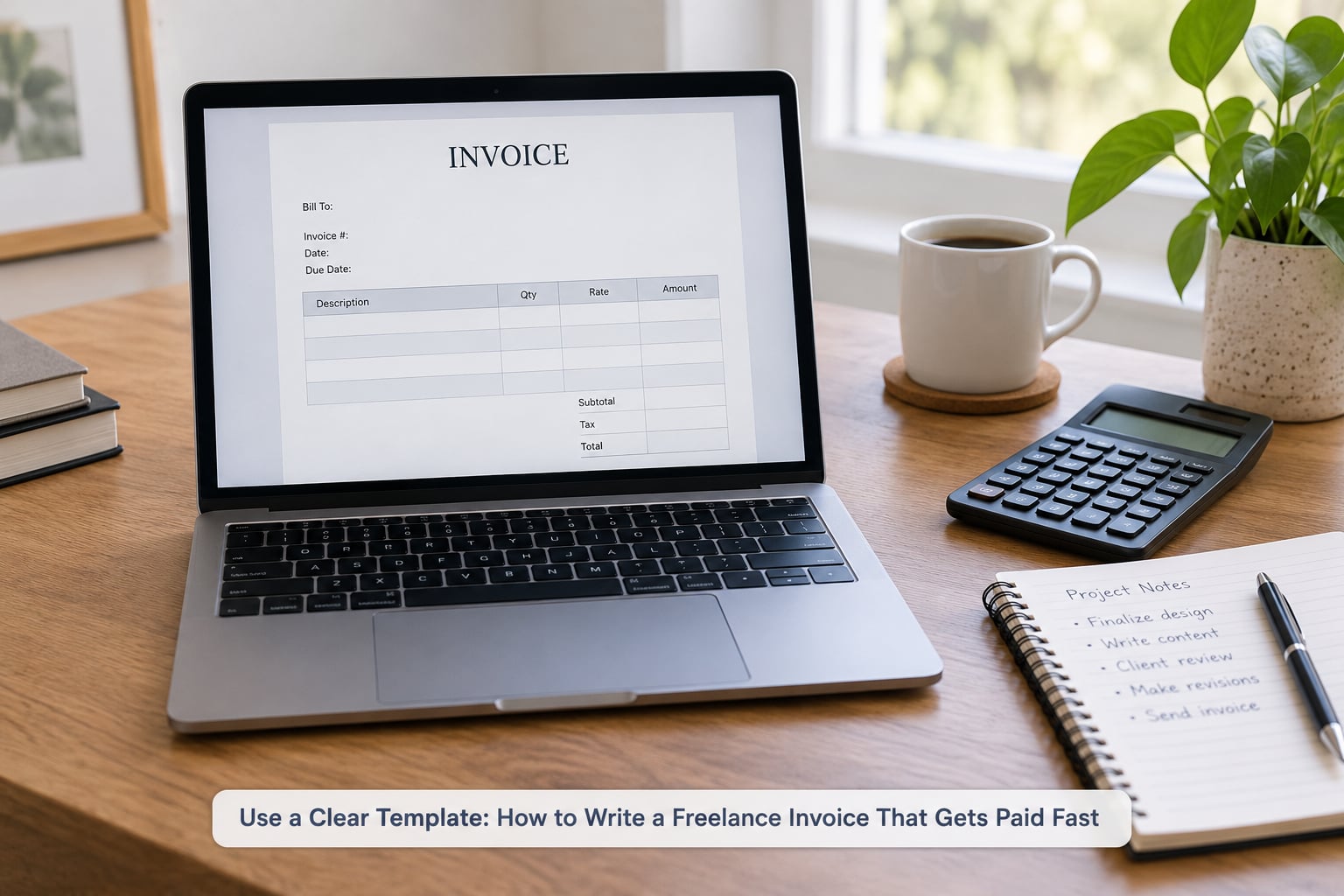
Start from one template and stop redesigning it every month. A spreadsheet works if you are comfortable with formulas, a word processor works if client work is your only income, and dedicated software works if you want numbering, automated reminders and a record of what has cleared.
Fill in your details once and save the file as a reusable master, then duplicate it per invoice. The layout matters more than people expect: your logo or name top corner, the client block directly beneath, the invoice number and dates where the eye lands next, line items in the middle, totals at the bottom right, and payment instructions at the very bottom.
Export as a searchable PDF rather than sending an editable Word file. You want the text selectable so their accounts payable team can copy your invoice number and routing details instead of typing them from a screenshot.
Done when: the PDF opens on a phone, every field is legible, nothing is cut off at the edges, and someone outside your business could fill it in correctly without asking you a question.
2. Describe the Services and Agreed Price
Write line items that a stranger could match to the contract. “Design services” tells an approver nothing, so it gets forwarded twice and then parked. “Brand identity: primary logo, two refinement rounds, colour palette and font pairing, delivered 14 March” can be approved on the first pass.
Each line should carry the deliverable, the milestone or billing period, the quantity, the rate and the line total. When a project has phases, bill by phase rather than by a single lump sum at the end.
Before / after, on one line:
- Vague: “Creative services, March — 1,800.”
- Specific: “Art direction and styling for spring lookbook shoot, 2 shoot days, 900 per day — 1,800.”
Done when: every line traces back to a line in the signed agreement, and the sum of the lines equals the amount in that agreement.
3. Add the Invoice Number and Payment Details
Give every invoice a unique sequential number and never reuse one. A simple scheme such as INV-2026-001 works; what matters is that numbers run in order, appear on the document, and appear in your file name when you email it. If your client ever disputes a payment, an unbroken sequence is what proves what you sent and when.
Print two dates, never one. The invoice date is when you issued it. The due date is when payment is expected. Clients who receive an invoice on the 28th of a month need a due date that reflects their own process, which is why Net 15 and Net 30 exist.
Then make paying effortless: bank transfer or ACH details with the account name matching your invoice, any purchase order number the client needs, and short remittance instructions such as “please reference INV-2026-001 with your transfer”. Add a payment link when your tool provides one, and keep the method count small. Three options produce more delay than one clear option, because the client has to make a decision.
Done when: the client can locate their own AP email, find their PO number, and pay without needing a single reply to you.
4. State Payment Terms That Prevent Questions
Payment terms belong on the invoice in plain language, not in legal shorthand. “Net 15” is widely understood but costs nothing to expand into “Payment due within 15 days of the invoice date”. Choose the term that fits how the client actually pays, not the one that feels most generous.
| Payment terms | Best for | Risk to you | How to word it on the invoice |
|---|---|---|---|
| Due on receipt | Small, established businesses; anyone paying instantly | Low | Payment due on receipt of this invoice. |
| Net 7 | Small creative projects and fast-moving clients | Low to medium | Payment due within 7 days of the invoice date. |
| Net 15 | Regular retainers and repeat creative work | Medium | Payment due within 15 days of the invoice date. |
| Net 30 | Corporate and agency clients with formal accounts payable | Medium to high | Payment due within 30 days of the invoice date. |
| 50% upfront deposit | Projects over a few thousand in value; new clients | Very low | 50% due on signing to begin work, balance on delivery. |
| 30/30/40 milestones | Longer projects where scope could drift | Low | Three stage payments tied to named deliverables and dates. |
On top of the term, state the currency you are billing in, your late-payment position, and your deposit or milestone structure. If the client is abroad, write the currency explicitly; converting later creates an argument you do not need.
One practical note from the forums: terms printed only on the invoice are far harder to rely on than terms agreed in the quote or contract before work starts. Put them in both places.
Tax obligations differ by location, so confirm whether you should be adding sales tax or VAT, and whether the amounts on your invoice are tax-inclusive, before you lock the total.
Done when: a reader who has never seen your contract could state, from the invoice alone, the exact date payment is due and what happens after it.
5. Check the Math Before Sending
Reconcile the totals in a fixed order: line items, then subtotal, then any discount, then deposit already received, then credits, then tax, then the final amount due. Work through it in that sequence and it takes under a minute.
Then proofread the human parts, which is where errors actually live. Names get transposed, a date reads as the previous month, a client’s entity name is abbreviated wrongly, or an invoice number duplicates last month’s.
Send it to yourself first and read it as the client. If any figure needs your memory to interpret, it needs another sentence.
Done when: the figures tie back to the contract, and a second reader understands the invoice without asking you anything.
6. Send It in a Professional, Trackable Way
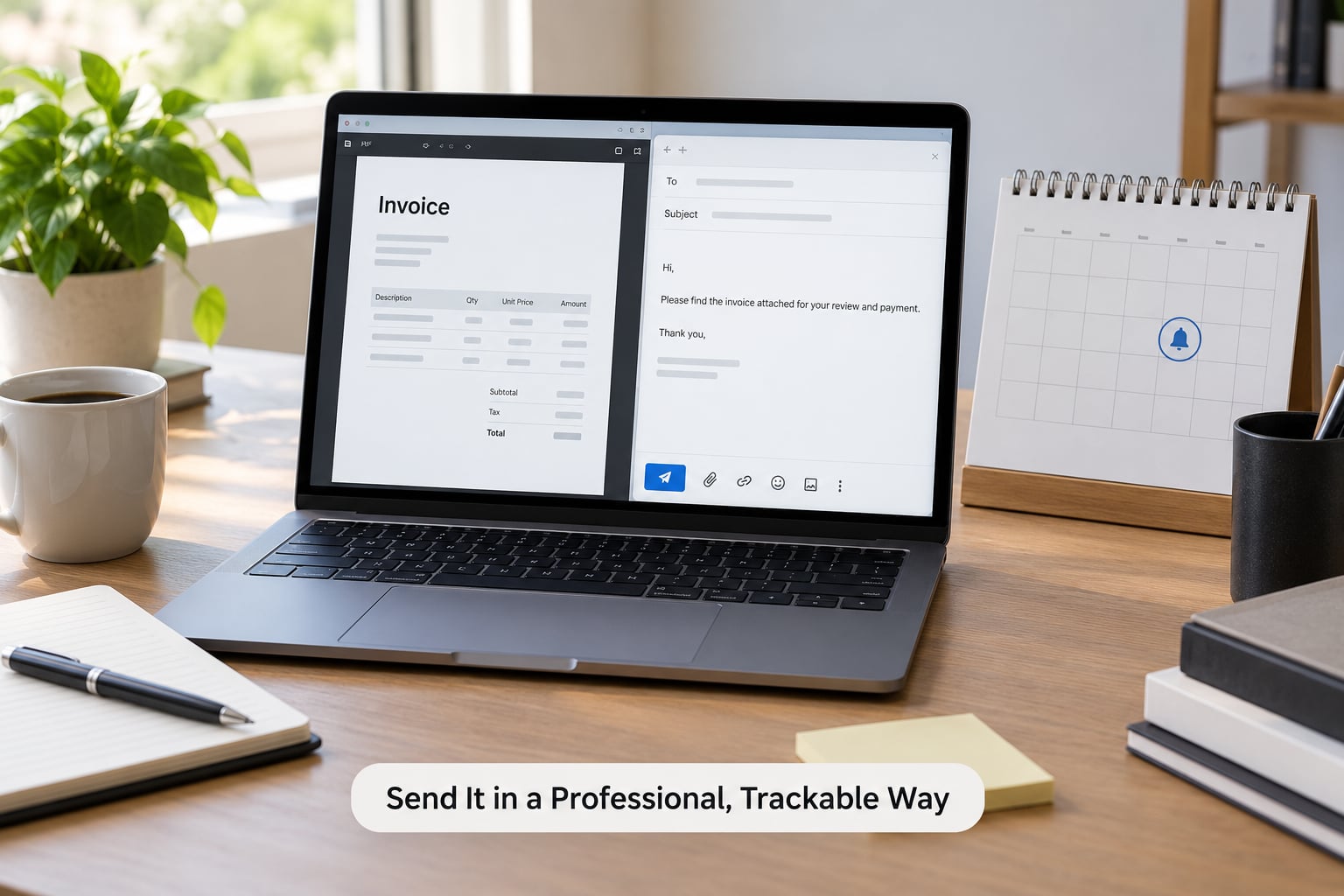
Email it the same day the work is approved, not at the end of the month when you feel ready. Prompt sending is the single biggest lever on how quickly you get paid, and it costs nothing.
Address the email to the named billing contact you collected, and copy their accounts payable address. Two recipients means the invoice does not depend on one person remembering to forward it.
Keep the message short. Confirm the project, the amount, the due date and how to pay, then attach the PDF. Something like this works well:
Subject: Invoice INV-2026-001 — spring lookbook styling, due 14 April
Hi Marcus, invoice attached for the spring lookbook art direction and on-set styling, covering two shoot days in March. Total 1,800, due 14 April, payable by bank transfer using the details on page one. Could you confirm it has reached your accounts payable team? Happy to re-send in any format your AP system needs.
That last request is not small talk. It gives you proof of delivery and catches a forwarding failure within hours instead of weeks. Then set a calendar reminder two days before the due date, and file the sent email in the same folder as the invoice using the invoice number as the file name.
Done when: you can show, without guessing, exactly when the invoice arrived and who received it.
7. Follow Up Without Damaging the Relationship
Follow-up is a process step, not an apology. Waiting three weeks in silence is what turns a small delay into a real problem, and over-apologising is the mistake that quietly weakens your position.
A cadence that works for most freelance work:
- Day 0: the confirmation email above, asking them to acknowledge receipt.
- Two days before the due date: a one-line nudge with the amount and date. No accusation, just a heads-up.
- Day 3 late: a friendly reminder asking whether the invoice reached the right person or needs anything from you.
- Day 10 late: a firmer note restating the due date, your late-payment terms, and the payment link.
- Day 21 late: a final notice stating the total now outstanding, any late fee, and the date by which you will consider small claims court or a collections referral.
Friendly, day 3:
Hi Marcus, invoice INV-2026-001 for 1,800 was due on 14 April and I have not seen it clear yet. Could you check whether it reached your accounts payable team, or whether they need a copy in a different format? Happy to help it move.
Firm, day 10:
Hi Marcus, following up on invoice INV-2026-001 for 1,800, now 10 days past the due date of 14 April. Our terms state payment is due within 15 days, so I would appreciate payment this week. The payment link is on page one of the invoice. If the delay is a budget or approval issue on your side, tell me and we can look at a payment plan.
Final notice, day 21:
Hi Marcus, invoice INV-2026-001 for 1,800 remains unpaid, now 21 days past due, and 1,800 plus the late fee of 27 now stands at 1,827. If payment is not received by 30 April I will refer the matter to a collections process. If you dispute any part of this invoice, tell me now and I will send the supporting agreement and deliverables.
If your agreement lets you pause work when an invoice goes unpaid, say so in the firm note rather than acting silently. If you do not have that clause, add it to your next contract.
Done when: you know what you send on each of those days, and the wording already exists rather than being written in a frustrated mood at midnight.
Common Mistakes
Vague line items, then the chase. “Consulting” or “creative services” cannot be approved by someone who has never met you. Fix: name the deliverable, the period, the quantity and the rate on every line.
No invoice number. Without one, the client’s system may reject the document outright and nobody will tell you why. Fix: sequential numbers on every invoice, never reused.
A vague due date. “ASAP” and “within two weeks of completion” are the same phrase with less clarity. Fix: print an actual calendar date, derived from a stated term like Net 15.
One recipient. Sending only to your project contact is the most common cause of a lost invoice. Fix: ask for the AP address at kickoff and copy it every time.
No purchase order number. Corporate AP teams reject anything that does not match their PO. Fix: request the PO number before invoicing and print it in the reference field.
Inconsistent branding. A different layout each month looks careless and invites questions. Fix: one master template, reused.
Math and date errors. A single wrong total resets the whole approval chain. Fix: reconcile in order, proofread names and dates, send a copy to yourself.
Sending an editable file. Word documents get edited and lost in version history. Fix: send a searchable PDF.
Waiting weeks to follow up. Silence for a month is read as indifference. Fix: nudge two days before the due date, then at day 3, day 10 and day 21.
Quick Tips for Faster Payment
- Take a deposit up front on new clients and any project above a few thousand. It converts the cash-flow risk from your side to theirs.
- Bill by milestone rather than on completion, so payment is never tied to a single moment at the end.
- Offer one payment method clearly. Bank transfer with matching account details beats a menu of five options.
- Ask the AP email at kickoff, in writing, and add it to your client notes permanently.
- Send on approval, not on payday. A day-of-month habit means small projects wait weeks for no reason.
- Name your files by invoice number so you can find any invoice in seconds when you need to chase it.
- Keep a simple ledger with invoice number, date sent, due date, date paid and status. A spreadsheet column is enough.
- Schedule reminders automatically where your tool allows it, so reminders happen on the days you actually forget.
- Tie new work to cleared invoices for clients with a history of paying late. That conversation goes better than any reminder email.
Frequently Asked Questions
When should a freelancer send an invoice?
Send it the day the work is approved or delivered, not at the end of the month. Prompt sending shortens the gap between approval and payment, and many clients will not process anything that arrives without warning. For ongoing work, invoice on a fixed schedule, such as the first of each month, and agree that schedule in the contract so nobody is surprised by it.
Should every freelance invoice have a unique number?
Yes, always, and never reuse a number. A sequential scheme such as INV-2026-001 keeps your records consistent and gives you proof of what you issued and when. It also matters practically: a client’s accounts payable system tracks invoices by number, and duplicates or gaps can cause payments to be held or rejected while someone works out what happened.
How do I politely ask a client to pay an overdue invoice?
Reference the invoice number and amount, give the due date, and ask a specific question about whether it reached accounts payable. Avoid apologising, because that frames the delay as your fault. A short friendly note at day three past due and a firmer note at day ten solve the majority of cases without any damage to the relationship.
What payment method should I offer on my invoice?
Bank transfer or ACH is the most reliable default because it costs you nothing and clears quickly. A payment link from your invoicing tool is even better, since it removes typing errors from routing numbers. Offer one method clearly rather than several, and confirm the account name matches your invoice so reconciliation on their side is instant.
Should I charge a late fee if a client pays late?
It helps to state a late-payment position in your contract or quote, and a monthly percentage of 1.5% is a commonly cited figure. Be aware that a term printed only on the invoice is often difficult to rely on, so agree it before work starts. Whether a late fee is enforceable against a particular client depends on your location and the contract, so check with a qualified professional.
How do I write a freelance invoice that gets paid fast without sounding pushy?
Clarity does most of the work. Specific line items, an explicit due date, the client’s purchase order number and clear payment instructions remove the questions that cause delay in the first place. Then send on time, follow up two days before the due date with one friendly line, and keep the tone factual. Firm and polite is entirely possible because you are stating facts, not making accusations.
Conclusion
Four things move the needle: line items somebody can approve without a phone call, the invoice reaching accounts payable rather than sitting in one inbox, a stated due date derived from a clear payment term, and a payment method that takes one click. Everything else is detail.
So here is your order of operations. Confirm the scope against the signed agreement before you write a word. Pick one template and reuse it forever. Set the term, print the actual due date, and check the math twice. Send it to both your contact and their AP address on the day the work is approved. Then put the reminder in your calendar for two days before it is due, and again at day three if it has not cleared.
Update this guide for 2026 practice as payment methods and rules shift. Clear documents and prompt follow-up do most of the work in reducing days to payment, and the chasing stops being the stressful part of freelancing.