
If you are searching for how long lead time magazines need for pitches, the short answer is three to four months for a print feature, six to eight weeks for a digital-only outlet, and 24 to 72 hours for a story tied to a dated event. That lead time is the notice an editor needs before a story can run, not how long you wait for a reply.
The distinction matters more than anything else in this guide. Freelancers tend to plan around response time, the silence after they hit send, and then get blindsided when a print story they agreed to in June does not appear until November.
Editors schedule backward from a fixed publication date. Your pitch has to enter that pipeline before slots are assigned, not after. If you want to run in a spring issue, the honest answer is that you pitch in the previous autumn.
Table of Contents
- What Does Magazine Lead Time Mean for Pitches?
- Lead time versus response time
- How Long Lead Time Magazines Need, in Weeks and Months
- How long lead time magazines need, by outlet type
- Print versus digital, side by side
- How to Calculate Your Magazine Pitch Deadline
- Worked example
- Which Magazine Departments Have Different Timelines?
- What Should You Include in a Fashion or PR Magazine Pitch?
- Time peg templates
- How Do You Pitch a Magazine on a Tight Deadline?
- How Many Follow-Ups Should a Magazine Pitch Get?
- Frequently Asked Questions
- How far in advance should I pitch a magazine?
- How long do magazine editors take to respond to a pitch?
- Should I pitch print magazines earlier than digital publications?
- Can I pitch a magazine if I do not have a completed story yet?
- What should I do if I do not hear back after a pitch?
- How do I find a magazine’s editorial deadline?
- Conclusion
What Does Magazine Lead Time Mean for Pitches?

Magazine pitch lead time is the gap between the moment an editor could commission your story and the moment a reader sees it printed or published online. It covers commissioning, reporting, writing, copyediting, fact-checking, photography or illustration, and the print production schedule itself.
It is not the same thing as a deadline you set yourself, and it is not a submission deadline. Most magazines do not have a “pitch closes” date. What they have is a production schedule, and the pitch window is really the space before that schedule locks.
Lead time versus response time
Response time is how long an editor takes to answer you: commonly a few days to two weeks for a clear fit, much longer for a story with no obvious slot. Lead time is how much total notice the story needs to appear somewhere. One is about the inbox. The other is about the issue.
The inbox rule of thumb among editors is roughly this: a clear yes can come back the same afternoon, a clear no within a day, and a maybe can sit indefinitely. The maybe is usually a slot problem, not a verdict on your writing.
How Long Lead Time Magazines Need, in Weeks and Months
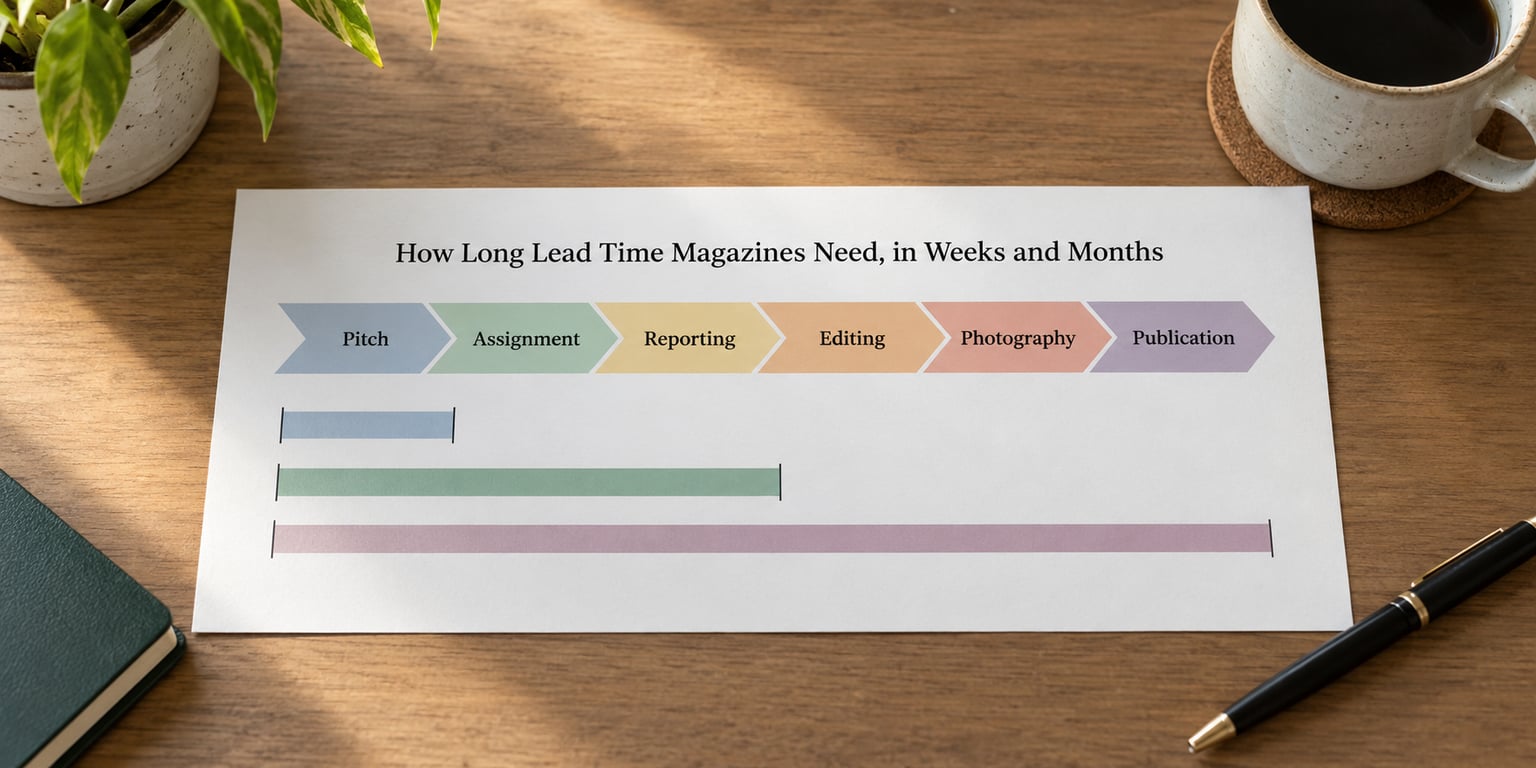
Here are the working lead-time ranges. Treat them as planning bands rather than promises, because no two publications run the same production cycle.
- Three to four months for a print feature in a monthly consumer magazine, especially fashion, beauty or lifestyle.
- Eight to twelve weeks for a print feature that is already written and mostly pre-reported, or a shorter news feature with limited photography.
- Six to eight weeks for a digital-only essay or service piece on a title that publishes on a rolling basis.
- Four weeks for a first-time contributor pitching a smaller independent or community magazine, where the pipeline is shorter and approval is faster.
- 24 to 72 hours for a news peg, a breaking story, or commentary attached to a dated event happening this week.
The wide range is not hedging. A 3,000-word reported feature with original photography genuinely needs three months. A 400-word opinion piece reacting to an announcement that landed this morning genuinely needs a day.
How long lead time magazines need, by outlet type
| Outlet type | Typical lead time | How they plan | What gets fast-tracked |
|---|---|---|---|
| Consumer glossies (fashion, beauty, lifestyle) | 3 to 4 months | Seasonal calendar locked well ahead of the issue | Runway reports, beauty launches, awards coverage |
| Trade titles and business publications | 1 to 3 months | Rolling coverage with quarterly specials | News analysis, executive moves, market data |
| Digital-native and online-first magazines | 6 to 8 weeks | Continuous commissioning, weekly or twice-weekly publishing | Timely essays, trend explainers, opinion |
| Independent and community magazines | 4 to 8 weeks | Small team, looser schedule, more direct access | Almost everything, if the fit is right |
Print versus digital, side by side
| Stage | Print feature | Digital feature |
|---|---|---|
| Commission to assignment | 1 to 4 weeks | 3 to 10 days |
| Reporting and writing | 3 to 6 weeks | 1 to 2 weeks |
| Editing, fact-check, copyediting | 2 to 3 weeks | 2 to 5 days |
| Photography or illustration | Scheduled shoot, 1 to 3 weeks | Usually existing assets |
| Production and printing | 3 to 5 weeks before it ships | None |
| Total, assignment to publication | 8 to 12 weeks | 2 to 4 weeks |
How to Calculate Your Magazine Pitch Deadline
Work backward from the publication date, not forward from today. The publication date is the one fixed point on any editorial calendar, and every other date derives from it.
- Confirm the publication date. For print, find the issue date on the cover or on the newsstand listing. For digital, find how often the section updates and whether a stated schedule exists.
- Subtract the production buffer. Allow 8 to 12 weeks for print, 2 to 4 weeks for digital. This is the part writers forget, and it is the part the publisher controls.
- Subtract editing and fact-check. Two to three weeks in print, a few days online. Assume your fact-checker will request source notes, so have them ready.
- Subtract the writing window. Three to six weeks for a reported print feature. Longer if interviews have to be scheduled around people who are travelling.
- Subtract the editor’s review window. Leave two to four weeks for a decision, including a follow-up and a revised proposal if needed.
- Add a one-pitch cushion. Editors batch-review pitches in scheduled windows, sometimes only once or twice a week for longer stories, so a pitch that misses a window waits for the next one.
Worked example
A magazine issue goes to press on March 10. Subtract a 10-week production buffer and you get January 5 as the copy-freeze. Subtract three weeks for editing and fact-check and you get December 15. Subtract five weeks of reporting and writing and you get November 10. Subtract three weeks for the editor’s decision and you get October 20.
So the pitch needs to be out roughly four and a half months before the issue date. Sent in mid-October, it has landed with room to spare. Sent in February, it is already too late for that issue even if the editor loves it.
Long lead times have a second effect people rarely account for: they change how you pitch. Editors working with a nine-month horizon do not care what happened yesterday, so a pitch that leads with something urgent reads as stale. Name the season or the issue instead.
Which Magazine Departments Have Different Timelines?
Departments differ less in speed than in what they need before they can place a story. A news desk can run on hours because the event supplies the timeline. A fashion desk cannot, because the calendar is set by collections and advertising.
- News and breaking desks work on hours to days. They commission from people they already know or can reach quickly, and they rarely want a pre-written take. The pitch here is almost always about access and speed.
- Fashion and runway desks plan a full season ahead, driven by show calendars. Their fastest lane is live coverage during fashion week, but even that needs a named writer and an agreed format in advance.
- Beauty desks split into launch-driven coverage, which is fast and promotional-adjacent, and science or ingredient stories, which move at service pace and often need expert interviews arranged before commissioning.
- Career and work-life desks run closer to service magazine rhythm. These places commission personal essays and reported features on a two-month cycle and care more about the reader’s problem than about a date on a calendar.
- Culture, books and opinion desks often commission long ahead but move fast once commissioned. A signed essay can be agreed in a week and delivered in a month.
- Department store and in-house titles publish to a retail calendar, so lead time follows the selling season rather than the news cycle.
Two periods distort everything. From late December through early January, many desks are closed or lightly staffed. The same is true for parts of August. Pitches that land in those windows often sit untouched until everyone is back, which adds three to four weeks you did not plan for.
What Should You Include in a Fashion or PR Magazine Pitch?
A pitch is a business document that happens to be creative. It should tell an editor what the story is, why their readers need it now, and what it will cost them in time and attention.
- One sentence on the story. The angle, not the topic. “Shoppers are buying less but trading down harder” is an angle. “Shopping trends” is a topic.
- Why this publication. Name a specific recent piece and explain how yours extends or responds to it. Generic flattery is visible from across the room.
- The time peg. The dated event, season, or issue moment that justifies placing it. This is the single most useful line in the pitch.
- Evidence you have already gathered. Interviews lined up, data found, access confirmed. Pre-reporting depth is what moves a pitch from the maybe pile to the yes pile.
- Visual thinking. Whether you have subjects, images, or a clear visual concept, since print desks plan shoots months out.
- Your turnaround. Freelancers report that offering a specific readiness line, such as offering a draft within two weeks, works as a trust signal.
- Length and format. Front-of-book pieces run 150 to 600 words, service pieces 800 to 1,400, and features 1,800 to 4,000. Saying which one you are proposing saves an email exchange.
Keep the whole email under 250 words. Longer pitches get skimmed, and the reason editors take time is volume. Editors at large titles describe an inbox that holds hundreds of emails a day, with press releases and PR pitches sitting alongside genuine freelance submissions.
Time peg templates
Print feature: “This is written for the [month] issue, tied to [collection drop, launch, or event] on [date].”
Digital feature: “I can have this to you within ten days, in time for your [section] refresh on [date].”
News peg: “This is tied to [announcement] today and can be filed within 24 hours if you want it for tomorrow morning.”
How Do You Pitch a Magazine on a Tight Deadline?
Sometimes you have a story that is timely right now and no room in a print calendar. Direct contact is appropriate when there is a genuine dated reason: a collection dropping, a launch, an announcement, a court ruling, or a trend hitting the public record.
Flag the urgency in the subject line or the first sentence, not in a paragraph of explanation. Something like “Timely for this week” tells an editor whether to triage or archive. Then make the work self-contained: you know the angle, you can reach the sources, and you can deliver on a stated timeline.
What kills a tight-deadline pitch is a story that needs a month of pre-reporting. If your piece depends on three interviews that have not happened yet, it is not a fast story, however good the idea is.
There is also a fair trade available here. Some editors will offer a writer a quick 500-word news piece after a longer pitch process that did not land, as a way to open the door. A fast, complete offer on a tight deadline can do what a perfect feature pitch could not.
How Many Follow-Ups Should a Magazine Pitch Get?
Two. One after 48 to 72 hours, one about a week later, then stop. Anything beyond that reads as pressure rather than persistence.
Silence is not rejection. It usually means the pitch has not been read yet, or that it landed in a maybe bucket without a slot. Editors who do batch-review longer features may set aside an hour or twice a week to go through the inbox, so a pitch sent Friday evening can wait a full week by design.
Fast-responding desks generally try not to leave a pitch unacknowledged for more than a few hours, with a carve-out for anything arriving late on a Friday afternoon. When you get silence elsewhere, it usually reflects volume rather than judgment, and it is volume on a very large scale: hundreds of emails a day, mixed with press releases and PR pitches that look like freelance submissions.
Keep your follow-up to a few sentences. Reference the original subject line, add one new detail that strengthens the idea, and ask a yes-or-no question that is easy to answer. Editors like being asked directly. Some freelancers have advocated that editors simply state a follow-up window, such as two weeks, so writers know when silence means no.
Because lead times run long, keep several pitches in flight at once. If you are targeting print features on a three-to-four-month cycle, eight to twelve live conversations is a reasonable working number. Chase the aging ones and add new ones at the top of the funnel.
One last practical point: if an editor goes quiet after a long exchange, it is acceptable to send one short note asking whether the story is still on their radar, and to say plainly that you will close it out if they have moved on. It costs you nothing and it keeps your pipeline honest.
Frequently Asked Questions
How far in advance should I pitch a magazine?
Pitch three to four months ahead for a print feature, six to eight weeks for a digital-only outlet, and 24 to 72 hours for a story attached to a dated event or breaking news. The number depends on the outlet tier: consumer glossies lock their seasonal calendars first, trade titles run on a rolling cycle, and independent magazines move faster. Work backward from the publication date rather than counting forward from today.
How long do magazine editors take to respond to a pitch?
A clear fit often gets an answer within a few days to two weeks. Stories without an obvious slot can sit far longer, sometimes months, because editors reviewing longer features batch-read the inbox in scheduled windows. If you hear nothing after a week, send one short follow-up, then one more the following week, then move on. Silence usually reflects volume, not a verdict on your work.
Should I pitch print magazines earlier than digital publications?
Yes, considerably earlier. A print feature needs an assignment, reporting, editing, fact-checking, a photography plan and roughly three to five weeks of printing before it ships. A digital piece often skips the shoot and the print buffer entirely. The gap between the two is large enough that one pitch strategy rarely fits both, which is why you should decide which format you are writing for before you contact anyone.
Can I pitch a magazine if I do not have a completed story yet?
Yes, pitching an idea rather than a draft is the standard workflow for features, essays and reported pieces at most consumer magazines. Some publications, particularly independent and essay-driven titles, ask for completed submissions instead, so read the guidelines before you write. What matters either way is how much evidence you bring: interviews lined up, data found and sources named make an idea much easier to commission.
What should I do if I do not hear back after a pitch?
Send one follow-up after 48 to 72 hours and a second about a week later, keeping each to a few sentences and adding one new detail rather than repeating yourself. After that, close the loop quietly and count the pitch as pending, not as a yes. Keep several pitches in flight so one silent editor never stalls your whole calendar, and treat silence as a scheduling outcome rather than a judgment.
How do I find a magazine’s editorial deadline?
Start with the publication itself. The masthead lists editors and their beats, the issue date appears on the cover or newsstand listing, and the website often carries a media or submissions page with guidelines and word counts. For seasonal titles, map the lead-time tiers backward from the issue date and check when that season’s collections or events land. Trade publications usually publish tentative editorial calendars for upcoming specials.
Conclusion
Find the publication date first, subtract the production and editing buffer, and subtract the editor’s decision window. Whatever is left is your pitch date, and that is the answer to how long lead time magazines need: earlier than most people expect.
Once you know that number, everything gets simpler. You stop measuring response time, which you do not control, and start planning around lead time, which you do. That is the whole game, and in 2026 it has not changed much.