
The honest answer to how to build a personal brand from nothing is simpler than most guides make it sound: pick one specific problem you are known for, talk about it in a voice people recognize, and give your audience one obvious way to reach you. That is the whole mechanic. The version nobody mentions is how to do it before you have clients, results, or even an audience — and how long the awkward part lasts.
I’d plan on 6 to 12 months of steady work before inbound opportunities become a regular thing. Not because you need that long to be good, but because the compounding happens in month three and most people quit in month five.
This guide is built for creative and fashion-adjacent professionals — stylists, photographers, costume designers, brand consultants, freelance creatives — plus anyone else starting from an empty profile. If you want a step-by-step system rather than another pep talk, here is one.
Last updated: October 2026.
Table of Contents
- What You Need to Build a Personal Brand From Nothing
- Step-by-Step: Build a Personal Brand From Nothing
- Step 1: Choose a specific audience and problem
- Step 2: Define your point of view and brand promise
- Step 3: Choose a recognizable visual and verbal identity
- Step 4: Create a small body of useful content
- Step 5: Add proof that makes the promise believable
- Step 6: Build relationships and distribute the work
- Step 7: Review, improve, and protect the brand
- Common Mistakes
- Frequently Asked Questions
- How long does it take to build a personal brand from nothing?
- Do I need a logo and a website to build a personal brand?
- How often should I post to build a personal brand?
- What should I post when I have no clients or results yet?
- How do I choose a niche for my personal brand?
- Does personal branding work if you are introverted?
- Conclusion
What You Need to Build a Personal Brand From Nothing

You need four things: a narrow audience, one promise you can keep, a content rhythm you can survive for months, and a way to show proof. That’s it. A logo, a website redesign, and a color palette are optional and come later, if at all.
A personal brand is not a logo. It’s also not a social account — plenty of people have ten thousand followers and no recognizable point of view. And it is not constant self-promotion; posting every day about how great you are is the fastest way to make people tune out.
Here is a personal brand in one line: the reputation that builds around you when you repeatedly help the same people solve the same problem in a recognizable way. That reputation is the asset. Everything else is packaging.
Before you publish anything, get these four things clear on paper:
- Who you serve. A named group of people with a real problem. “Women in their 30s who want to dress for a job change” beats “women who like fashion” every time.
- The problem you solve. One sentence, in plain language. If it needs a paragraph, it’s two problems.
- Why you can solve it. Experience, training, obsession, or a pattern you’ve noticed for years. Credentials help; a distinctive obsession helps just as much.
- Where your audience already gathers. Mostly one platform for the first 90 days, plus an email address you actually own.
Everything else — the templates, the color story, the content calendar — is downstream of those four answers.
Step-by-Step: Build a Personal Brand From Nothing
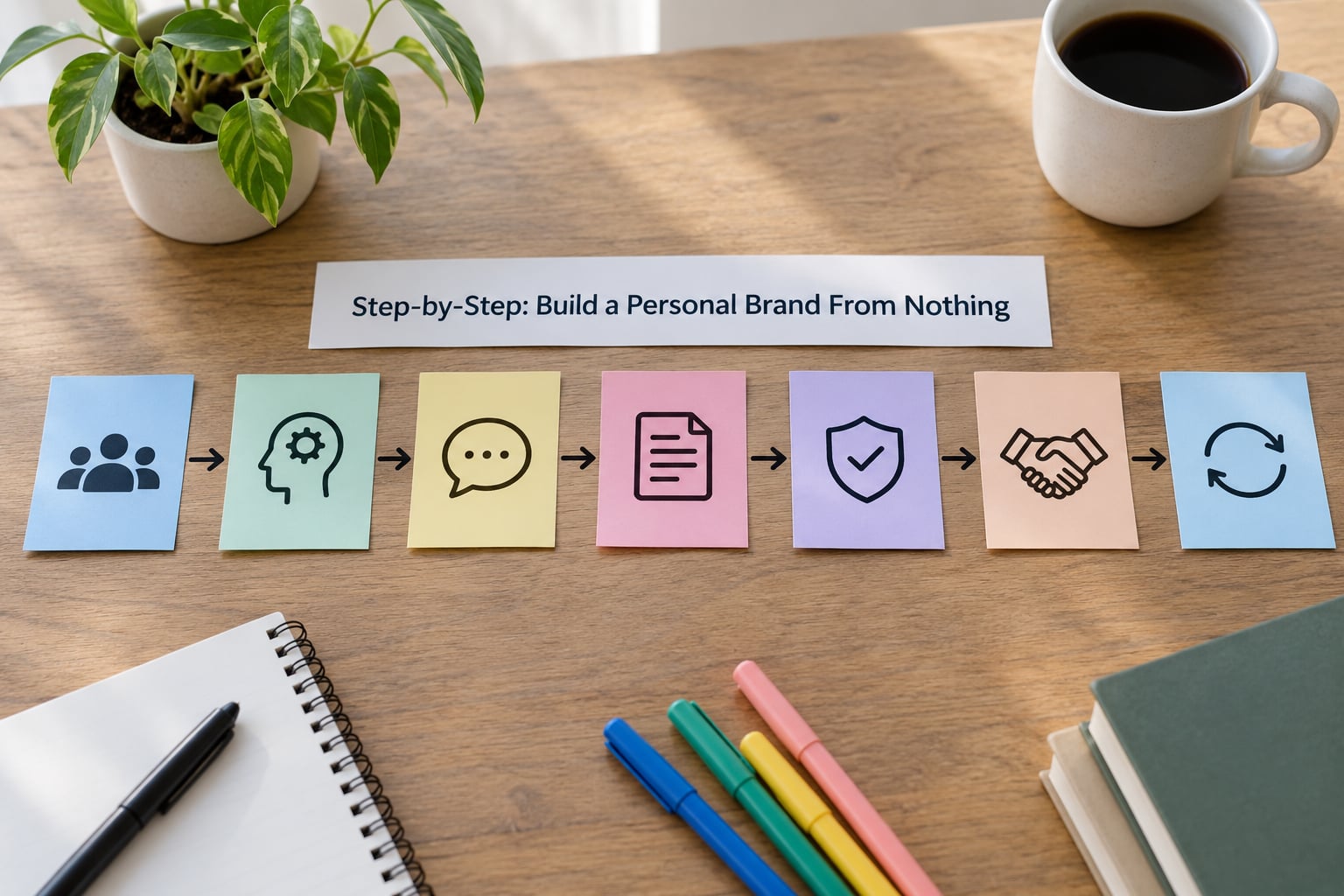
The process below runs in order, and each step has a completion test you can check honestly. If you can’t tick the test, stay on that step. Moving ahead early is how people end up with a beautiful profile and no message.
Step 1: Choose a specific audience and problem
Write one sentence naming who you help and what you help them do. “I help freelance photographers get their first commercial bookings” is a positioning. “I share tips for creatives” is not — it’s a topic, and topics don’t stick in anyone’s memory.
The narrowing test: if three different people could each say “yes, that’s me” after reading your sentence, it isn’t narrow enough yet. On r/personalbranding the same framing keeps surfacing — be known for one outcome. Stylists who narrow to a specific group, like brides or sample-sale shoppers, report pulling clients faster than generalists do the same amount of work.
Now the credibility question. What do you know that this person would find useful? A decade in the wardrobe room, six years of retouching, a failed line you can describe honestly. Specific beats impressive.
Completion test: you can name the person without using a demographic stereotype, and you can list three real questions they ask you.
Step 2: Define your point of view and brand promise
Turn your experience, values, personality, and goals into one promise you can keep for a year. A point of view is a stance, not a topic — it’s what you believe about that problem, and what you’ll say that other people in your field won’t.
Use this formula: I help [audience] achieve [outcome] by [your method], and I believe [the stance that makes you different].
Vague: “I’m passionate about fashion and helping people look their best.” Specific: “I help plus-size women find tailoring that fits, and I think most fit problems are a pattern problem, not a shopping problem.” The second version tells someone exactly whether to follow you.
The belief clause matters more than it looks. It’s the part people quote, argue with, and remember you by when your work is no longer in the room.
Completion test: a stranger could repeat your promise back to you correctly after one read.
Step 3: Choose a recognizable visual and verbal identity
Consistency is recognition, not polish. Pick one color you use everywhere, two fonts, and one photo treatment — then stop fiddling. The goal is that someone scrolling sees your post at the edge of the screen and knows it’s you before reading a word.
For voice, write down three sentences that sound like you at your most honest, then define your tone in plain words: direct, warm, a little dry, no hype. Write your bio in that tone. A bio that sounds like a press release actively costs you trust.
One warning from the forums worth repeating: the most common early mistake is spending weeks perfecting a website and grid while posting nothing. Several people described exactly that — hours on assets, zero replies, no sales. Make branding look like the work already is, never more finished than the work itself.
Completion test: your profile photo, name, headline, and bio all say the same thing in the same tone.
Step 4: Create a small body of useful content
Choose three or four content pillars — the recurring problems your audience has that you can speak to for years — and rotate them. Three pillars done consistently beats seven pillars abandoned in a month.
Each idea should earn more than one post. Write one detailed answer, then cut it into a short post, a few one-line opinions, and a story with a lesson in it. That’s how solo creators keep a cadence without a team or a content machine.
For a starting rhythm, try one substantial post a week for four weeks: a how-to, a mistake you made, an opinion with a reason behind it, and a behind-the-scenes look at your process. That’s four posts, one theme each, and it survives contact with a full-time job.
Completion test: you have four posts live and someone who knows you would recognize your voice in at least one of them.
Step 5: Add proof that makes the promise believable
Claims are cheap, so proof is what closes the gap. With no clients yet, proof comes from process, drafts, lessons, and small completed things — not from awards you’ve already won.
Start a proof library now. Save screenshots of before-and-after work, notes on what you tried, small wins like a styling that finally fit or a layout that stopped breaking, and any kind words from real people, with permission. When someone asks what you’ve done, you want answers that aren’t from memory under pressure.
Describe results accurately. “Helped one client stop second-guessing every purchase” is honest. “Transformed her entire wardrobe” is not, and it costs you more than it earns. Specific and modest reads as experienced; inflated reads as untrained.
Completion test: you have at least three proof pieces you can show, and every claim you make can survive a follow-up question.
Step 6: Build relationships and distribute the work
Posting puts your work in front of strangers. Relationships are what turn strangers into referrals. Most of your first opportunities will come from about a dozen people, not from an algorithm.
Spend the time you’d spend scrolling on replies instead — thoughtful comments on peers’ work, useful answers in the communities where your audience already hangs out, and the occasional guest spot where someone else has a newsletter, podcast, or audience you want. Send a short, specific note to ten people a week whose work you genuinely like, telling them what you liked and why. No pitch attached to the first message.
Keep an eye on signals that mean something: replies from strangers, saves and shares on your best posts, profile visits, referrals, and qualified inquiries. Follower count sits on that list, somewhere near the bottom.
Completion test: you have had one real conversation with someone who isn’t a friend or family member.
Step 7: Review, improve, and protect the brand
Set 30 minutes at the end of every month. Look at what you posted, what got replies or saves, and who showed up — then ask whether those people are the audience you chose in Step 1.
Judge it on four things: message clarity (can a stranger say what you do), consistency (did you actually keep the rhythm), signal quality (are the inquiries relevant), and boundaries (what did you share that you didn’t want to). Fix the weakest one. Not all four.
Revise your positioning when you notice the same three sentences getting replies and nothing else does, or when people consistently misunderstand what you do. Expand only when your current promise is comfortably full — a brand that says too much reads like nobody in particular.
Completion test: you can name one thing to change next month and one thing to leave alone.
Common Mistakes
Most personal brands stall for the same handful of reasons, and most of them are fixable this month.
Copying a competitor’s positioning. You end up with the same audience they already serve well. The fix: pick the problem you actually know cold, even if it feels smaller. Familiar beats bigger at the start.
Changing direction every few weeks. Two weeks of styling content, then freelancing, then fashion history, and nobody learns what you do. The fix: commit to one promise for 90 days minimum before you judge it.
Treating visibility as credibility. Large numbers prove nothing about your skill. The fix: measure replies, saves, and qualified conversations instead.
Posting only personal wins. A feed of announcements reads like a company, not a person, and nobody replies to it. The fix: publish at least half teaching or process content.
Buying followers. Fake numbers wreck your engagement rate and attract the wrong opportunities. The fix: grow at 50 relevant people who actually open your posts.
Relying on one platform alone. Platforms change, and reach you never own disappears with them. The fix: keep your primary platform plus one email list you control from day one.
Waiting until you have proof before you show up. Proof is a byproduct of being visible, so waiting is circular. The fix: document your process from the first week.
Perfectionism as a delay tactic. It feels like progress and produces nothing. The fix: publish the version you’re 80 percent happy with, then improve next month.
Two habits cover most of the rest: protect your reputation by checking what your name returns before you apply for anything, and stay consistent long enough for the compounding to show up. Most people underestimate how close they were around month four.
Frequently Asked Questions
How long does it take to build a personal brand from nothing?
Expect 6 to 12 months of consistent effort before inbound opportunities become predictable, and about three months before anyone recognizes what you do. The first month feels unproductive because almost everything you post gets little response. By month three, a few posts start pulling replies from strangers. By month six, qualified inquiries and referrals usually appear. Quitting in week four is the most common reason people conclude personal branding does not work.
Do I need a logo and a website to build a personal brand?
No. A logo and a website help, but they are packaging, not the substance. Most people starting from zero should put their effort into a clear promise, a consistent voice, and a publishing rhythm on one platform. If you already have a business and want a one-page site with a booking link, that is enough. Hiring a full identity early usually buys polish that outpaces the work and leaves you hiding until it is ready.
How often should I post to build a personal brand?
Once or twice a week, done reliably, beats daily posting you abandon in a month. For the first 90 days pick one platform and publish one substantial piece a week. You can turn that single piece into a short post and a story afterward, which roughly triples your output without extra research. Consistency matters more than volume here, because the algorithm and your network both reward a predictable signal from you.
What should I post when I have no clients or results yet?
Post the four things that exist before results: your process, your opinion, a lesson from a mistake, and a teaching answer to a real question someone asked you. Screenshots of work in progress count as proof. So does a well-reasoned disagreement with common advice in your field. What does not work is announcing that you are starting a brand and then going quiet, because you are waiting for something impressive to say.
How do I choose a niche for my personal brand?
Write down the questions people already ask you, then count which ones repeat. That pattern is your niche. Then narrow by audience, not by topic: styling for plus-size brides beats styling, and photography for small food brands beats photography. Keep the niche for at least 90 days before you reassess. People who stay with one specific outcome usually see traction sooner than generalists working the same hours.
Does personal branding work if you are introverted?
Yes, and writing-based formats suit introverts better than video ever will. Most of the work here happens in private: researching, writing, deciding what to say. The public part is smaller than it looks: a few comments a week and a handful of real conversations. Choose written formats, batch your writing in one sitting, and skip the daily-livestream approach entirely. Quiet consistency produces the same result as loud consistency.
Conclusion
Four things to do this week, in order: choose one audience and one problem, write your promise in a single sentence, publish one piece of genuinely useful work, and save one proof example somewhere you can find it again.
That’s the whole start. The hard part is not any single step, it’s repeating them for four months after the novelty wears off — and being specific enough that people can repeat your name and what you do back to you. Pick a useful point of view, say it consistently, and let the proof accumulate.