A fashion buyer focuses on choosing and securing the product itself, from which suppliers to buy, at what cost and in what quantity. A fashion merchandiser focuses on what happens to that product next: the assortment, the pricing, the open-to-buy budget, the inventory allocation and the sales analysis behind it. In short, the buyer decides what the company puts on the order, and the merchandiser decides how well it performs once it lands.
The confusion is real and it costs people interviews. On The Fashion Spot, candidates describe job listings where “buyer” and “merchandiser” appear to describe the same week of work. Reddit commenters make a similar point: each company puts its own responsibilities on the title, so the only reliable way to tell the two apart is to read the tasks, not the label.
This guide breaks both roles down the way a hiring manager would: what the job involves day to day, the numbers both roles share, what each pays in the US, the skills each needs, and how to decode a posting that does not tell you which one it really is.
Table of Contents
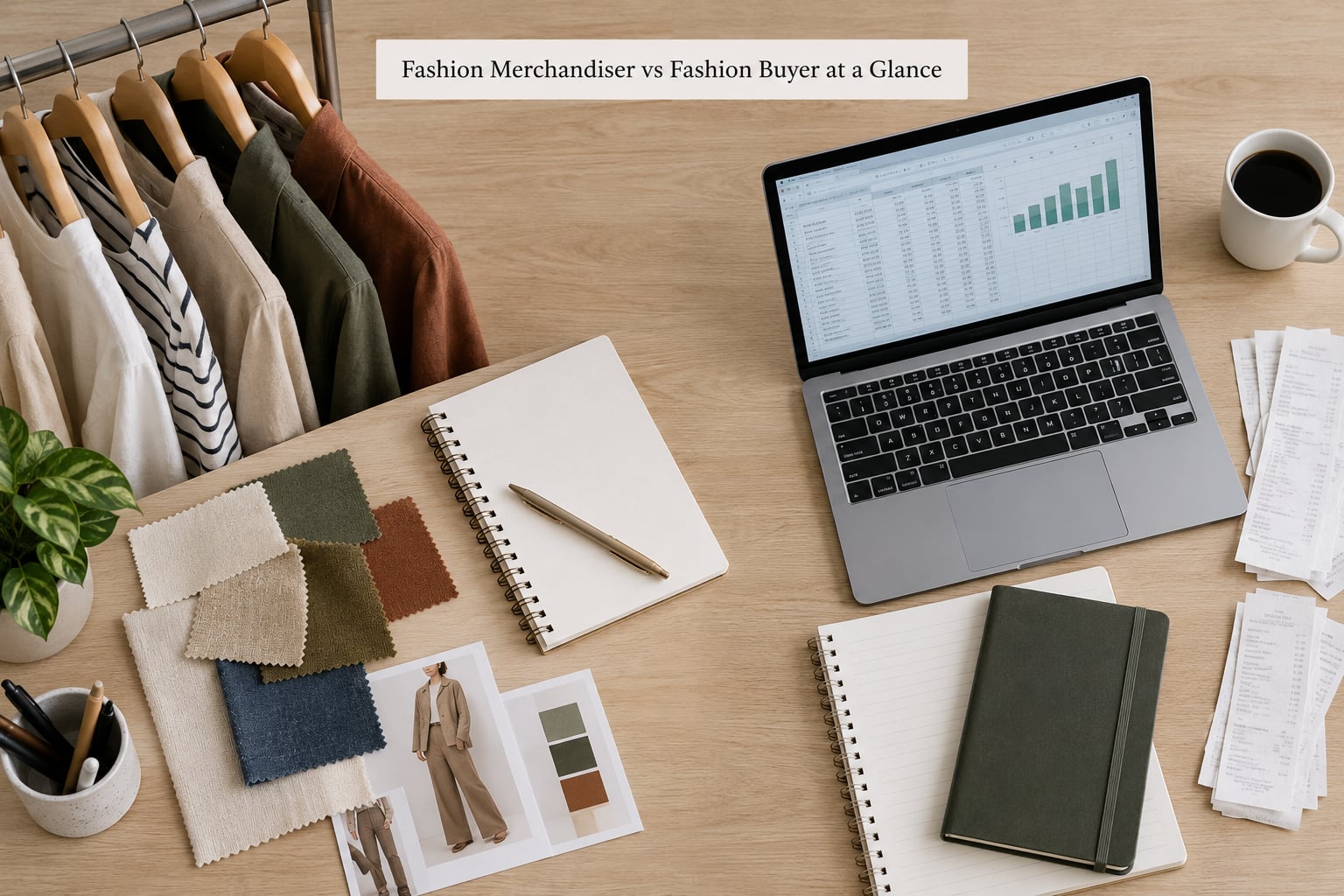
- Fashion Merchandiser vs Fashion Buyer at a Glance
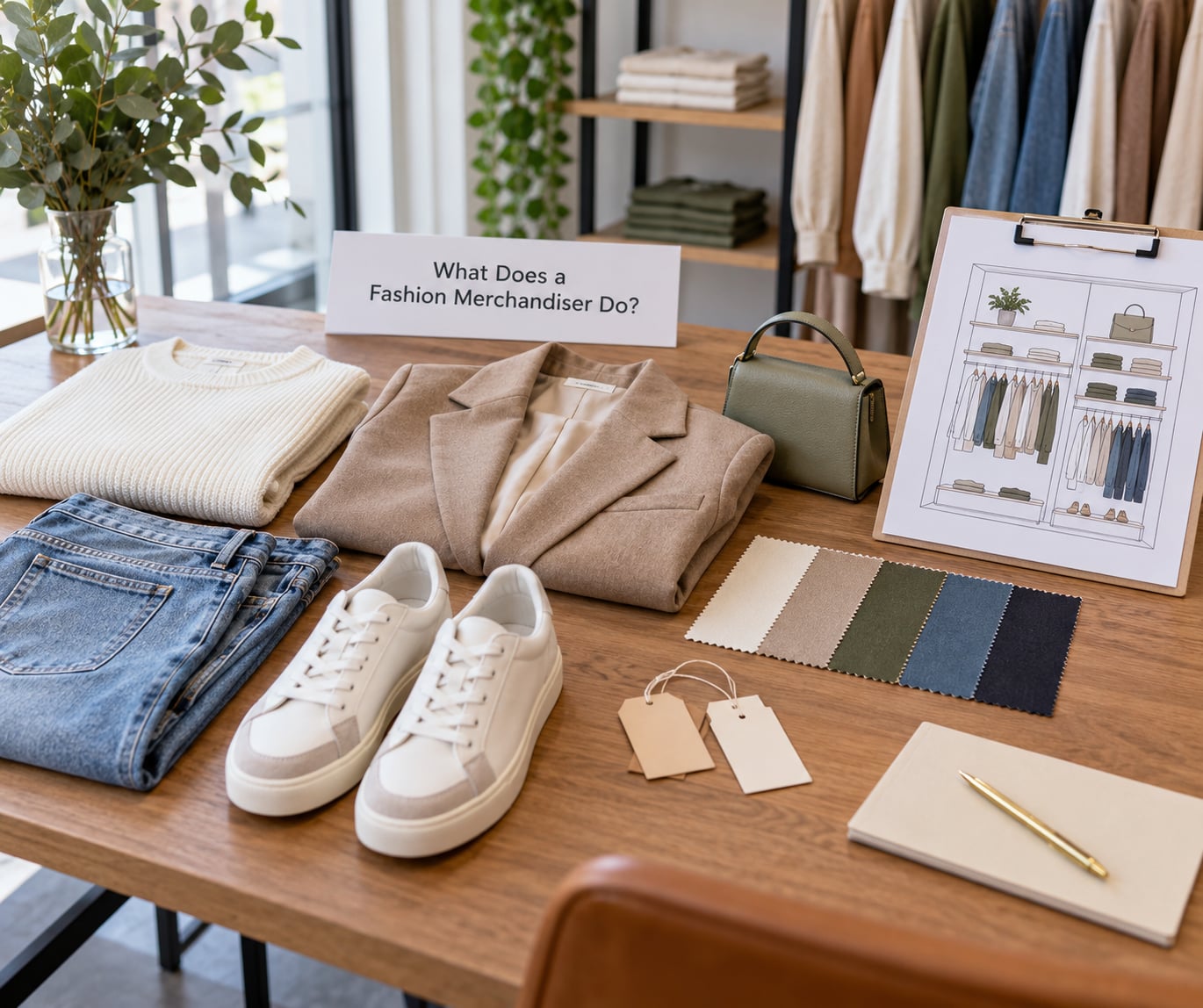
- What Does a Fashion Merchandiser Do?
- Merchandiser vs visual merchandiser
- The merchandiser role ladder
- What Does a Fashion Buyer Do?
- The buyer role ladder
- How Fashion Merchandising vs Buying Differs Day to Day
- How to tell which role a posting really is
- Which Role Has More Creative Control?
- Fashion merchandiser vs fashion buyer: which one gets the final call
- Skills and Education: Fashion Merchandiser vs Fashion Buyer
- How Merchandisers and Buyers Work With Each Other
- The 5 R’s of fashion merchandising
- Pay, Job Outlook, and Career Advancement
- Which Should You Choose?
- Frequently Asked Questions
- Is merchandising easier than fashion buying?
- Is a merchandiser a buyer?
- Can a fashion merchandiser become a buyer?
- How much do fashion buyers and merchandisers make in the US?
- What are the 5 R’s of fashion merchandising?
- Is fashion merchandising a good career?
- Choose Your First Fashion Career Step
Fashion Merchandiser vs Fashion Buyer at a Glance
| Criterion | Fashion Buyer | Fashion Merchandiser |
|---|---|---|
| Core objective | Select the right product, supplier and terms | Plan the assortment and make it sell through at target margin |
| Main deliverable | A purchase order and a supplier agreement | A line plan, price ladder and allocation plan |
| Time horizon | Long: seasonal buys committed 6 to 12 months ahead | Shorter and continuous: weekly trading, monthly resets |
| Primary metric | Gross margin, sell-through of the buy, supplier reliability | Sell-through rate, gross margin, inventory turn, markdown rate |
| Key relationships | Vendors, factories, agents, product development | Store or regional teams, planning, allocation, marketing, e-commerce |
| Typical employer | Multi-brand retailer, brand-side buying office, wholesale label | Brand, multi-brand retailer, department store, e-commerce platform |
| Travel pattern | Frequent: showrooms, trade shows, factory visits | Occasional: store visits, market visits, exhibitions |
| Creative expression | Product choice, colour and fabric direction | Presentation, story, styling and site or store layout |
| Career ceiling | Head of Buying, Buying Director, Chief Commercial Officer | Head of Merchandising, Merchandising Director, Commercial Director |
Both roles work from the same vocabulary of retail math, and you will be expected to know it in either interview. Here are the terms that come up in almost every posting and conversation.
- Open-to-buy (OTB):the pot of money a merchandiser has left to spend against a season or month once committed purchases are subtracted. It is the budget you can still move.
- Sell-through rate:the share of what you received that sold within a given window. A handbag line that moves 60 percent of what it shipped in eight weeks has a strong sell-through rate.
- Gross margin:the gap between what the customer pays and what the product cost, expressed as a percentage. Buyers defend margin at the negotiation stage; merchandisers protect it at the price and markdown stage.
- Markdown:the planned reduction used to clear ageing inventory. Merchandisers build a markdown calendar into the season from day one.
- Size curve:the ratio of sizes within a style, for example 1:2:3:2:1. Buyers set it, merchandisers use it to split inventory across stores and channels.
- Line plan:the full range laid out by category, colour, price and launch month. It is the merchandiser’s main document.
What Does a Fashion Merchandiser Do?
A fashion merchandiser owns the commercial performance of a range they did not necessarily choose. The buyer hands over a set of products, and the merchandiser decides which ones go in which store, at what price, in what size ratio, and when they come off the table.
Day to day, that usually means building and maintaining the line plan, setting and reviewing prices, allocating inventory across stores and channels, and reading weekly sales reports to decide what gets replenished and what gets promoted. At a multi-brand retailer such as Net-a-Porter or Mytheresa, the merchandiser curates the edit: which designers appear, how the site is categorised, what the homepage features this week. At a single brand, the role shifts toward internal coordination across stores, regional teams and e-commerce.
Four areas take up most of the job.
- Assortment planning: deciding the mix of brands, categories, price points and novelty versus core pieces.
- Pricing and margin: setting launch prices, planning promotional periods, and holding the margin line.
- Allocation and inventory flow: moving inventory between stores, regions and online channels so the right product sits where demand exists.
- Analysis and reporting: tracking sell-through, conversion, basket size and return rates, then acting on the numbers rather than filing them away.
Merchandiser vs visual merchandiser
This is the most common mix-up in the field, and they are genuinely different jobs. A visual merchandiser arranges physical space: window displays, mannequins, fixtures, floorsets. A fashion merchandiser works with the commercial plan behind the range. Visual merchandising lives closer to the store floor and the brand aesthetic; fashion merchandising lives closer to the spreadsheet and the buying office. Some small brands combine them. Most retailers do not.
The merchandiser role ladder
Assistant Merchandiser or Merchandising Assistant handles reporting and allocations. Merchandiser owns a category or a channel. Senior or Lead Merchandiser manages a wider range and a junior. Regional Merchandiser covers a group of stores or markets. Merchandising Manager runs a full department, and Head of Merchandising sits with the commercial leadership team. Titles vary; the scope usually grows with you.
What Does a Fashion Buyer Do?
A fashion buyer selects the product and secures it from the supplier. That means choosing vendors and styles, negotiating price, volume, payment terms and delivery windows, then placing the order and staying responsible for how it performs once the season ends.
A buyer’s week is weighted toward the front of the product lifecycle. They attend showrooms and trade events, review line sheets from wholesale brands, assess fabric and quality, sit in on fittings, and argue over cost. The work at luxury houses such as Bottega Veneta or Saint Laurent is closer to creative curation with a hard commercial edge. At fast-fashion groups such as Zara or Uniqlo, the buyer runs a much higher-volume, much shorter cycle and copies the winner from last season within weeks.
Retail buyers at a department store or multi-brand retailer work differently again. They are buying from many external brands, which makes supplier relationships and delivery reliability a bigger share of the job than fabric and fitting expertise.
The buyer role ladder
Assistant or Junior Buyer handles samples, orders and admin. Buyer or Associate Buyer owns a category with its own open-to-buy. Senior Buyer runs a wider assortment and a junior buyer. Category Buyer manages a full department across brands. Buying Manager and Head of Buying sit above, owning the season’s budget and the vendor relationships that come with it. Fabric and raw-materials buyers sit on the manufacturing side and source mills and trims rather than finished styles.
How Fashion Merchandising vs Buying Differs Day to Day
Take a contemporary apparel brand with a spring collection of 60 styles going to 40 stores and one e-commerce site. Here is the same week seen from both roles.
Monday for the buyer: a showroom session with three wholesale brands, checking new arrivals against last season’s sell-through by style, taking notes on which fabrics are repeating, then a supplier call about a delivery date that has slipped by three weeks.
Monday for the merchandiser: a weekly trading pack showing what sold over the weekend, a reallocation of four styles from stores that sold through to stores that did not, and a price review on the two pieces sitting below a 30 percent sell-through rate.
The buyer works forward from an assumption about what will sell. The merchandiser works backward from what did sell, and adjusts fast. The buyer’s mistake is expensive and slow to unwind. The merchandiser’s mistake is visible within days, which is why the reporting rhythm is faster.
How to tell which role a posting really is
Job descriptions for both roles tend to reuse the same boilerplate, so read for verbs rather than adjectives. Words like “strong communication and Excel skills” appear on every listing and tell you nothing.
- Look for sourcing language. Vendor negotiation, supplier meetings, line sheets, cost negotiation, orders, purchase orders and showroom all point to buying.
- Look for planning and allocation language. Open-to-buy, allocation, line plan, size curve, inventory allocation, replenishment and reporting point to merchandising.
- Check who owns the price. If the listing says “set pricing” or “own margin”, it is merchandising. If it says “negotiate cost” or “secure terms”, it is buying.
- Check the travel expectation. Regular international travel and factory visits suggest buying. Occasional store visits suggest merchandising.
- Check the systems named. Line sheets and supplier portals on one side; retail management systems, ERP and merchandising dashboards on the other.
- Ask in the first call. A direct question, “does this role own the open-to-buy and the allocation, or the supplier relationships and the orders”, answers it in thirty seconds.
Which Role Has More Creative Control?
Neither role is the creative one and the analytical one. They are creative in different places, and the confusion here causes people to pick the wrong first job.
Merchandising is where creativity becomes visible. What appears on the homepage, how a rail is styled, which colours sit together, how a campaign is staged across a season: that is merchandising judgement, not decoration. Merchandisers shape how a customer experiences the brand.
Buying is where creativity shapes what exists at all. The buyer’s choice of fabric, colour story, silhouette and supplier sets the boundaries of the collection. No amount of good merchandising rescues a range built on product nobody wanted.
Fashion merchandiser vs fashion buyer: which one gets the final call
If you measure creative control by how many decisions you own, buying wins on product, supplier and budget. If you measure it by how many people see your work, merchandising wins by a wide margin. Buyers decide in showrooms and costing meetings where nobody applauds. Merchandisers decide in stores, on sites and in campaigns where the result is the brand’s face.
Control also depends on the employer. At a buying office the buyer has enormous control and almost no presentation role. At a D2C brand the founder-merchandiser controls everything and the buyer is often a freelance contractor sourcing production.
Skills and Education: Fashion Merchandiser vs Fashion Buyer
Both roles want analytical rigour and communication. They differ on where the analytical rigour is applied.
| Skill | Fashion Buyer | Fashion Merchandiser |
|---|---|---|
| Negotiation | Core: cost, terms, delivery, exclusives | Useful: vendor terms, promotional support |
| Forecasting | Demand prediction at product level | Demand prediction at category and channel level |
| Spreadsheets | Cost sheets, order tracking, vendor terms | Line plans, allocation models, KPI reporting |
| Product judgement | Fabric, quality, silhouette, construction | Mix, price ladder, size curve, seasonal balance |
| Presentation | Buying reviews, showroom storytelling | Range reviews, site and store presentation |
| Systems | Line sheets, PLM, supplier portals | Retail management systems, ERP, analytics dashboards |
| Stakes under pressure | A wrong order cannot be unwound | A wrong allocation shows up the same week |
On education, there is no single required degree and employers do not treat one as decisive. A business degree with a retail or operations module is often a better fit for merchandising because the skills are analytical and financial. A fashion merchandising or design degree helps for buying, where product judgement is the screening factor. Candidates weighing the two ask this constantly on The Fashion Spot forums, and the honest answer is that the degree matters far less than the evidence underneath it.
What does matter is proof. Recruiters consistently treat real retail experience as a genuine green flag: candidates who have worked a shop floor outrank candidates with classroom knowledge only. On Excel, be honest about your level. Both roles expect intermediate ability with pivot tables, lookups and clean data before anyone trusts you with a range. Buyers and merchandisers at the entry level are often asked to build the very reports their managers use.
How Merchandisers and Buyers Work With Each Other
The handoff is the whole game. A buyer negotiates a delivery window of weeks W32 to W36 and a cost that supports a target margin. That information becomes the merchandiser’s planning frame, and if it is vague, the range breaks.
Then the loop runs the other way. The merchandiser sees which colours, fabrics and size ratios actually sold, and those signals shape the next buy. Good buying without merchandising means an expensive range that sits in the wrong stores at the wrong price. Good merchandising without good buying means a beautifully presented range that nobody wanted. Both roles are judged on outcomes neither of them fully controls alone, which is why the handoff quality shows up in the numbers.
Company size changes how this looks. At a large corporation such as a department store group or a fast-fashion chain, buying, merchandising, planning and allocation are separate departments with their own reporting lines and their own data handoffs. At a small label or a D2C startup, one person routinely does both, and the “job title” is whatever the founder decided to call it. Knowing which kind of company you are joining tells you more than the title will.
The 5 R’s of fashion merchandising
The 5 R’s are a framework used to describe what a merchandiser is expected to manage: the Right product, in the Right quantity, delivered at the Right time, to the Right customer, in the Right place. It comes up repeatedly in interviews and candidate questions, and it is a fast way to describe the whole job in five words.
Pay, Job Outlook, and Career Advancement
The figures below are typical US ranges, and they vary by region, employer type and company size. Treat them as orientation rather than a quote, and check current postings in your city before you anchor on a number.
| Level | Fashion Buyer (USD) | Fashion Merchandiser (USD) |
|---|---|---|
| Assistant / Junior (0 to 2 years) | 48,000 to 62,000 | 46,000 to 60,000 |
| Mid-level (3 to 6 years) | 65,000 to 95,000 | 60,000 to 90,000 |
| Senior / Category (6 to 10 years) | 90,000 to 140,000 | 85,000 to 130,000 |
| Head of Department (10+ years) | 130,000 to 200,000 | 120,000 to 190,000 |
The two ladders overlap closely at the base, and the gap narrows as you rise. Where buyers pull ahead is the commission and profit-share element that some buying roles carry, particularly in wholesale and multi-brand retail, and the faster growth available at a brand that scales. Where merchandisers pull ahead is multi-brand and e-commerce retail, where the role carries a larger revenue number and a bigger team.
Four factors move the number more than the title does: employer type, whether the role is brand-side or retailer-side, the size of the range you own, and whether you work in a major fashion market city. On the outlook, neither role is shrinking, but both are changing. Buyers spend less time in showrooms as virtual line-shoots become normal, and more on data. Merchandisers spend more time in systems and less in spreadsheets, as allocation and replenishment move into planning software. The judgment part of both jobs is becoming the valuable part.
The career-switch question comes up constantly, and the answer is that the roles are adjacent rather than separate. Merchandisers move into buying when they build strong product judgement and supplier experience, which usually means taking a step sideways in level while moving up in responsibility. Buyers move into merchandising when they want less travel and more analysis. The Fashion Spot and Reddit threads on this are consistent: moving across is normal, and it is easier than starting over.
Which Should You Choose?
Choose buying if your instinct is to decide what should exist. You enjoy evaluating fabric, colour and construction, you are comfortable saying no to a sales representative, and you can live with decisions that lock in months ahead. You will travel more and think about products rather than shops.
Choose merchandising if your instinct is to decide how something should perform. You like the mix, the price ladder, the story a range tells, and you would rather correct a plan in week three than defend one in week nine. You will spend more time in data and less in showrooms.
Neither is the back-office role and the glamorous role. Buyers get judged on margin and sell-through, merchandisers get judged on the same numbers, and the public profile of one is not a measure of the work in either. Both roles carry real pressure: buying carries the risk of a wrong commitment, merchandising carries the grind of weekly reporting that never quite ends.
Two exceptions worth knowing. At a small brand you may end up doing both, which is a fast way to learn the whole business if you can handle it. And in some retailers the roles blend into category management, where one person owns selection, pricing and delivery for a category end to end. If a posting blurs the two, judge it on the seniority and the size of the number you would own.
Frequently Asked Questions
Is merchandising easier than fashion buying?
Neither role is universally easier. Merchandising often demands more visual trend analysis, coordination across stores and channels, and presentation work, plus a steady reporting rhythm. Buying demands sharper commercial judgement, tolerance for negotiation and pressure, and comfort committing money months before you know if it sells. Judged purely on commercial risk, buying is harder to do well.
Is a merchandiser a buyer?
Not usually, though the titles overlap at smaller companies. A merchandiser plans the assortment, sets prices, allocates inventory and analyses sales. A buyer selects products and suppliers, negotiates cost and terms, and places orders. A person can legitimately hold both hats in a small brand or D2C company, but in a large retailer or brand the two are separate roles with separate reporting lines and different performance targets.
Can a fashion merchandiser become a buyer?
Yes, and it is a common move. The merchandising years build assortment judgement, size curve knowledge and vendor contact, which is most of what a buyer needs. The gap is product judgement: fabric, construction and costing. Take on product development or technical work alongside your merchandising role, ask to join showroom sessions, and target an internal transfer rather than applying to the open jobs.
How much do fashion buyers and merchandisers make in the US?
In the US, entry-level buying and merchandising roles sit close together, generally in the high 40,000s to low 60,000s. Mid-level ranges run roughly 60,000 to 95,000 for both, with senior and category roles reaching 130,000 to 140,000 plus. Head-of-department roles can pass 180,000. Multi-brand retail, e-commerce and buying roles with commission pay at the higher end of each band.
What are the 5 R’s of fashion merchandising?
The Right product, in the Right quantity, delivered at the Right time, to the Right customer, in the Right place. Interviewers use it to test whether you can describe a range decision in those terms. A merchandiser who cannot name the customer or the place usually has the quantity wrong, which is where most of the lost margin hides.
Is fashion merchandising a good career?
It is, if you enjoy the mix of judgement and analysis. The work is varied, the numbers are visible, and the skill set transfers to e-commerce, category management and brand-side roles. The honest drawback is the reporting grind: weekly trading reviews, allocation decisions and constant adjustment to sales data do not stop when the season does. Ask candidates what their last three Mondays looked like.
Choose Your First Fashion Career Step
The distinction is short. If you want to decide what the company buys, look at buying. If you want to decide how well that product sells, look at merchandising. Everything else on this page is detail hanging off that one sentence.
Here is what I would do first. Pick one real brand, open its best-selling category, and reverse-engineer it: the price ladder, the size curve, the colour story, the launch timing, the gaps where nothing sits. Write two pages on what you would change and why. That exercise tells you more about which role you want than a week of job posting research, and it is exactly the kind of thinking both hiring teams look for.
Then take the retail route recruiters actually trust. Candidates who have worked a shop floor consistently outrank candidates with classroom knowledge alone, because selling to a real customer teaches you price, fit and demand in a way no case study does. Start there, keep the writing sample, and apply with evidence instead of adjectives.
Whichever way you go, the fashion merchandiser vs fashion buyer question stops mattering the moment you know which decision you want to be making on a Tuesday afternoon.