New York Fashion Week is a twice-yearly calendar of runway shows, presentations and showrooms where designers present collections months before those clothes reach stores. Behind the scenes, teams spend a year planning the calendar, months building sample garments, and a single chaotic day running the show. Here is how New York Fashion Week actually works behind the scenes, from invitation to runway.
The photographs make it look like a party. In practice the week runs on spreadsheets, headsets and garment steamers, and the people moving down a runway are usually the last to know what is going to happen next.
Table of Contents
- How New York Fashion Week actually works from invitation to runway
- Who creates the New York Fashion Week calendar?
- How do fashion week invitations and guest lists work?
- What happens backstage before a runway show?
- How models and dressers keep a New York Fashion Week show on time
- How do models, designers, and production teams run the show?
- How New York Fashion Week actually works on press day
- How designers prepare for a New York Fashion Week show
- Can visitors attend New York Fashion Week without an invitation?
- What roles do buyers, stylists, and publicists play?
- What does a typical New York Fashion Week day look like?
- Frequently Asked Questions
- Do you need an invitation to attend New York Fashion Week?
- How do you get press access to New York Fashion Week?
- Are any New York Fashion Week shows open to the public?
- Where do designers and models go before a runway show?
- How early do designers and crews arrive for Fashion Week?
- How do fashion publicists know which shows and events to attend?
- What to do first if you want to attend New York Fashion Week
How New York Fashion Week actually works from invitation to runway
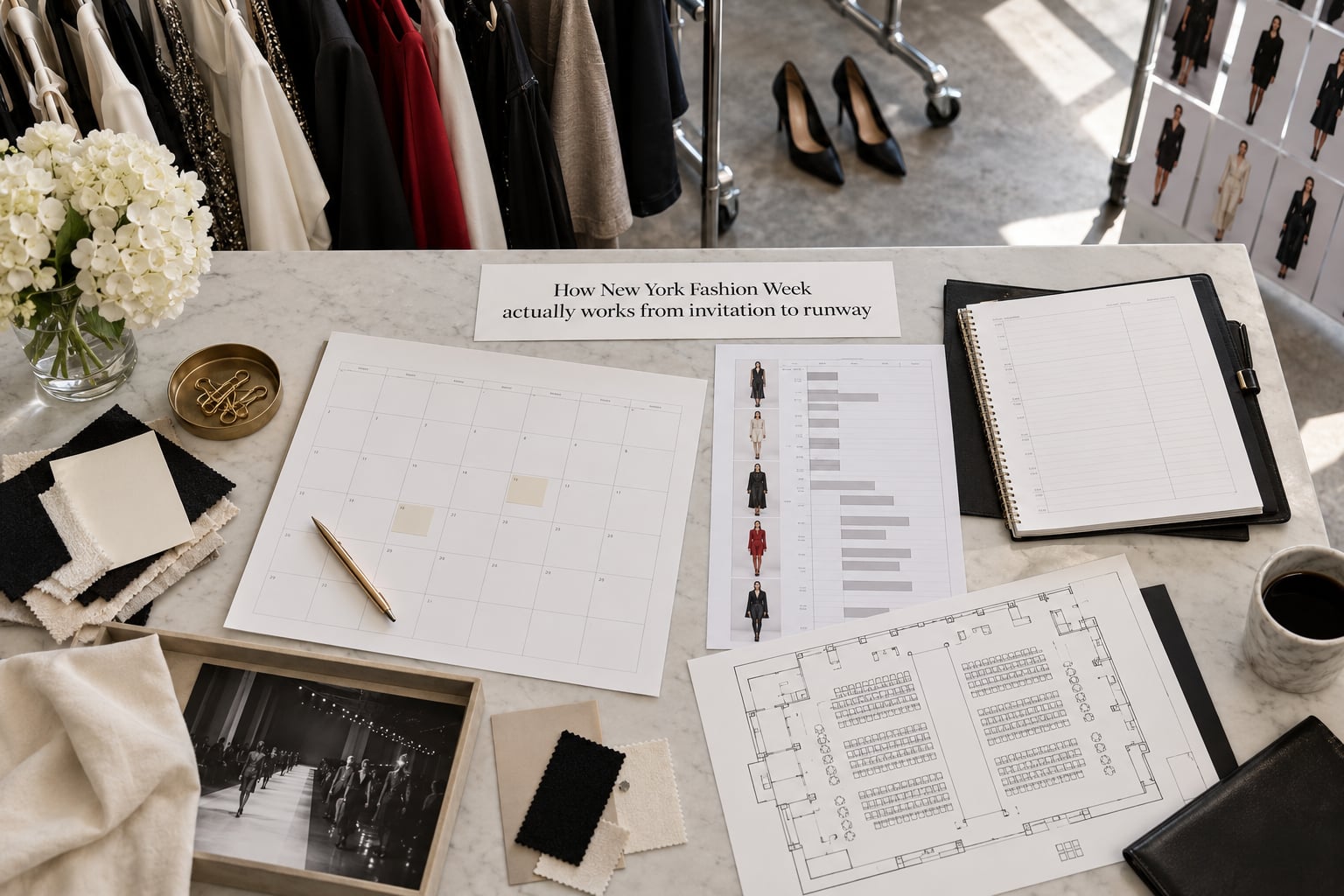
New York Fashion Week is not one event. It is dozens of overlapping events spread across Manhattan over roughly a week, twice a year, and each one is a separate production with its own guest list, budget and backstage.
Four types of event make up the calendar. A runway show sends models down a catwalk in timed sequence. A presentation has models stand, turn and walk a short distance while the room looks at the clothes. A showroom is an appointment-only trading floor where buyers handle the garments one at a time. A digital show replaces the room entirely with a filmed or livestreamed presentation.
Layer those on top and you get the rest of the week: showroom appointments across the Garment District, brand pop-ups, press previews, sample sales, benefit dinners, after-parties and the street-style photographers working the arrivals outside each venue. Any one of those gives you a very different New York Fashion Week depending on which door you came through.
Who creates the New York Fashion Week calendar?
The Council of Fashion Designers of America and IMG produce the official New York calendar, and designers have to earn a slot on it. A brand applies roughly a year ahead, submits a concept, and is placed on the schedule once the production company has confirmed the venue and the date.
That is the official layer. It sits on top of a much wider set of dates: independent designers who rent their own rooms, production companies selling shows to emerging labels, retailers hosting in-store events, and brands celebrating anniversaries in restaurants. The result is a calendar that no single body controls, which is exactly why the official week and the public-facing week drift apart so often.
Dates move. A venue loses a booking, a show space needs a three-day build instead of one, a designer fires a creative director in August and the whole presentation changes. Schedules get revised in the final weeks, so a calendar PDF you saved in September can be wrong by February.
How do fashion week invitations and guest lists work?
Guest lists are built from a fixed number of seats, and the person assembling that list is usually a publicist working for the brand rather than the designer. The order is predictable: the brand’s own VIPs first, then buyers, then press, then clients and celebrities, and then a handful of names that came in through relationships or partnerships.
| Access type | How you get in | Who is actually in the room |
|---|---|---|
| Brand invitation | Direct from the house or its PR team | Clients, celebrities, VIPs, invited partners |
| Press credential | Outlet accreditation, applied for weeks ahead | Editors, stylists, critics, photographers |
| Buyer access | Department store or boutique buying office | Merchandisers, planners, sales agents |
| Showroom appointment | Booked with a brand representative | Buyers, press, agents, a few plus-ones |
| Brand-hosted event | Guest list, sometimes with a charity tie-in | Mix of press, clients, influencers |
| General admission | Bought at an independent or ticketed show | Students, enthusiasts, first-timers, photographers |
Notice that the two groups that matter commercially, buyers and editors, are not on the same kind of invitation. They arrive through their employers, and their employers apply for them. That is the single biggest reason a regular person struggles to get in.
What happens backstage before a runway show?
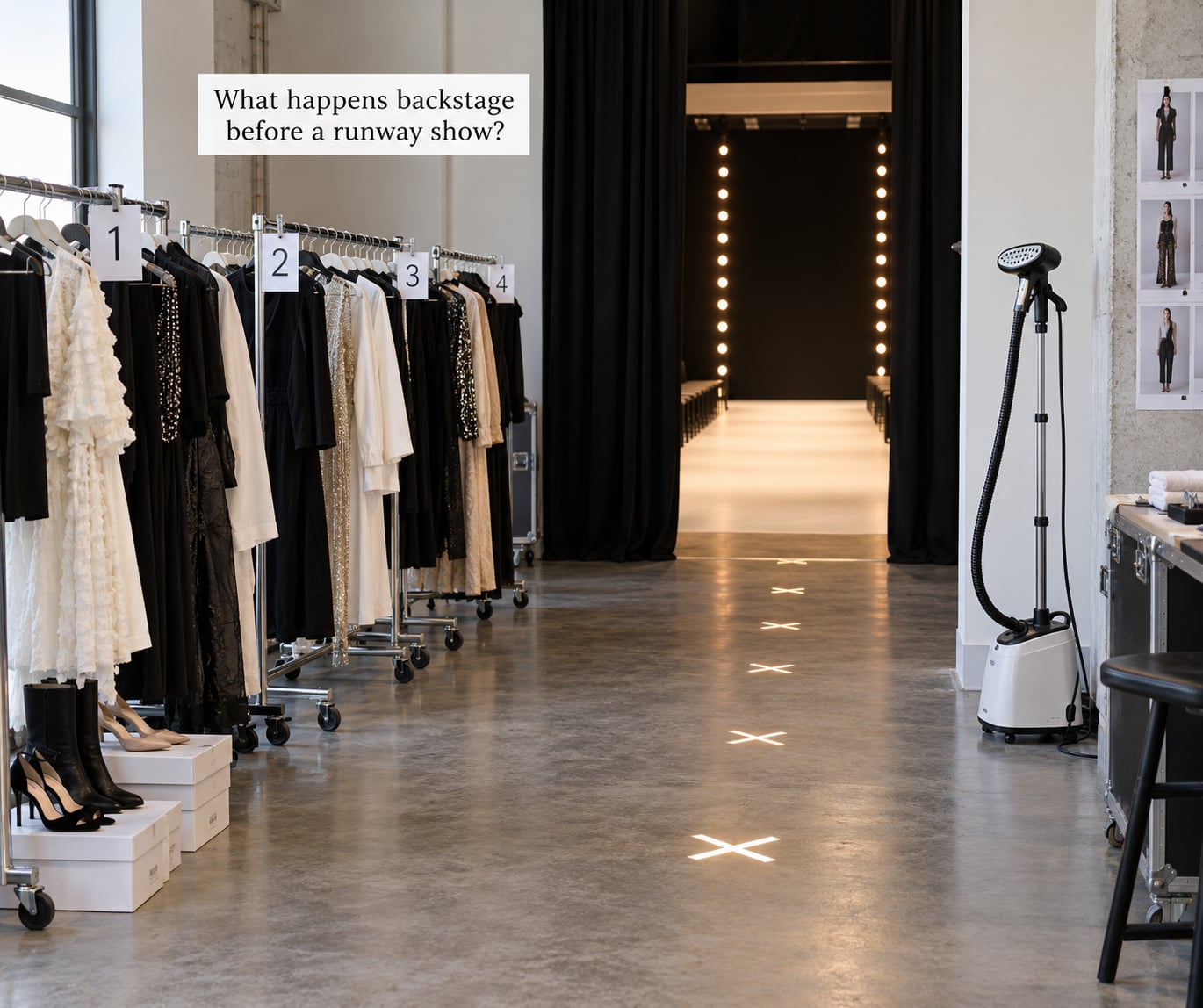
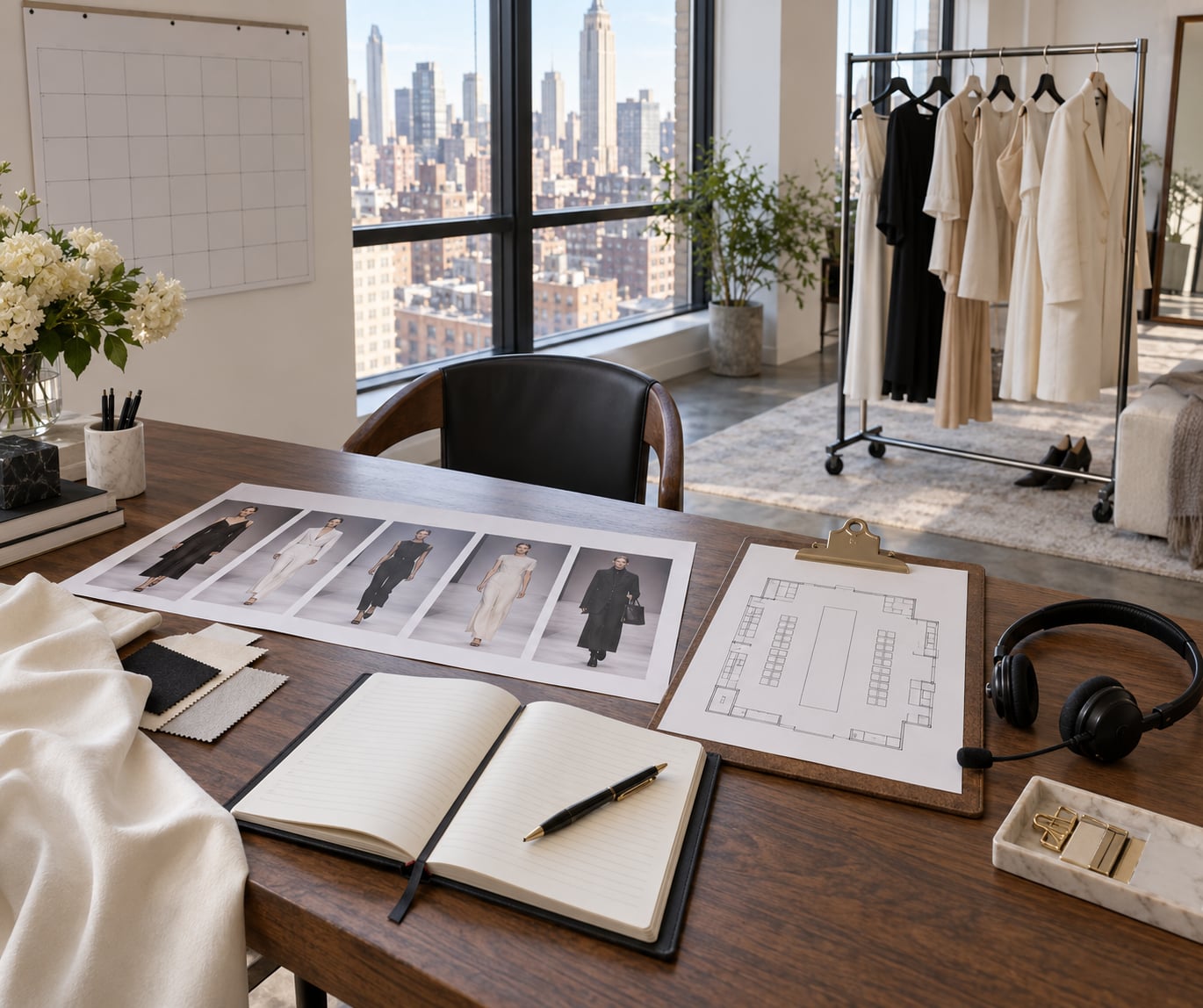
Backstage is a controlled, mostly invisible workspace where everyone wears all black and nobody talks above a headset. Models are lined up and numbered in a specific walking order hours before a guest sees a single look.
How models and dressers keep a New York Fashion Week show on time
The show caller is the person doing it. They stand at the top of the stairs with a headset and call each look by number and by name, one at a time, adjusting the pace to the music. Dressers stand in a row backstage with numbered garment racks, and a model’s exit is a chain: the caller names the look, a dresser has it in hand, shoes go on, and the model walks.
Everyone in that room is on a clock. A look that is not zipped does not wait. A seam that opens mid-walk is fixed backstage the moment the model clears the runway exit, and it is still steaming when the next look is called. Ground crew describe the same core pattern across houses and decades: you stand for hours, you rush constantly, and nobody in the audience knows your name.
Two rules explain most of the culture. First, headsets rank. Anyone wearing a headset outranks anyone without one, and instructions come from the top down through the show producer and stage manager. Second, backstage is deliberately invisible. Staff do not pose, do not post and do not appear in press photography, which is why the images you see are of the clothes and the front row, not the crew.
How do models, designers, and production teams run the show?
A show has a division of labour that is wider than most visitors expect. The designer makes decisions and attends fittings, but usually does not call the show.
The show producer owns the budget, the venue and the creative direction. The stage manager keeps the running order and the clock. The show caller cues the models. Dressers handle garments, steaming and quick repairs. Hair and makeup artists build the look that finishes under the runway lights, sometimes in a lineup that must be reset between every exit. Photographers work the entrance, the runway and the detail shots of each look. A front-row coordinator manages the guest list in real time, moving names, handling walkouts and keeping the aisle clear.
Public relations runs the layer above that: invitations, seating requests, press relationships, embargoes and the party schedule. It is the least visible job in the room and the one that decides who was in it.
How New York Fashion Week actually works on press day
Press day is a business, and it runs on embargoes. A show at a set time is not covered live; it is covered after an agreed moment, which is why reviews and collection galleries appear in a wave the next morning rather than during the show.
Editors are selecting what to shoot and what to write about. Stylists are pulling looks for red carpet and editorial bookings for the season ahead. Photographers are negotiating access, shooting the runway, the arrivals, the detail shots and the back-of-house images that sell the story. Publicists are pitching specific lines to specific outlets so the story lands where the brand wants it.
Creators arrived more recently and changed the texture of the room. The criticism you hear in fashion forums, usually that the front row is now mostly celebrities and creators rather than working editors, is really a complaint about where the commercial value has moved. Editors bring credibility, buyers bring orders, and creators bring attention. Most brands seat a mix, then argue about the mix.
How designers prepare for a New York Fashion Week show
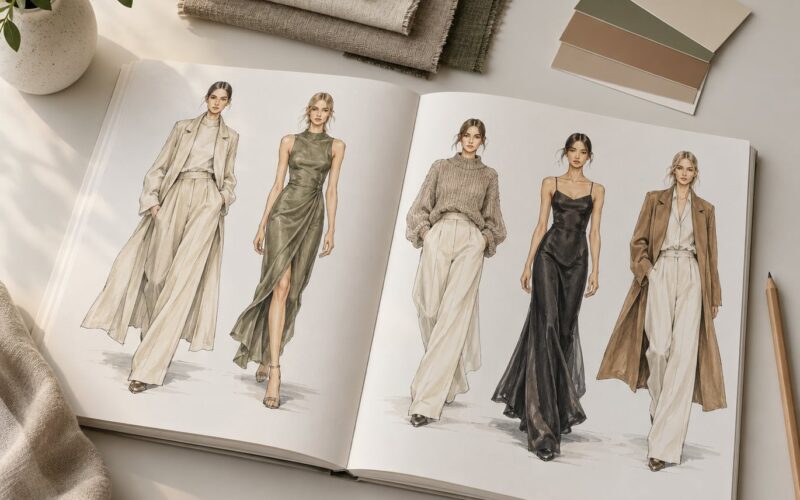
Preparation runs about a year, and the last six weeks are the only part most people ever see. The full sequence looks like this.
Calendar application. The brand applies to the official calendar or books an independent show, confirms a date, and signs a venue or show space. Choosing a space often dictates the date, because the big New York show spaces only sell certain days.
Concept and design. A creative director sets the idea, the designer draws, and the team works out a look count. A ready-to-wear collection runs somewhere around 25 to 45 looks, which sets the length of the walk and the number of models needed.
Sample making. Production and pattern cutters build the actual garments from first samples. This is the longest and least glamorous phase, and the first samples are frequently wrong. Designers are their own worst critics, and looks get dropped or rebuilt repeatedly.
Fittings and casting. Models are booked through agencies or an independent producer, then fitted in the showroom so hems, shoulders and proportions match the intended silhouette. Fitting is also where the designer decides who walks first and who walks in the finale, because a model’s presence changes how a look reads.
Delivery and build. Finished garments go to the show space days ahead, get steamed, hung and tagged in walking order, and the set is built. Runways get laid, lighting is rigged, the sound test happens, and the music is cued.
Show day and strike. The show runs, the room empties, and the set is struck. For an independent show with no permanent venue, strike can mean clearing the space overnight, which is often budgeted as its own line item.
Financing shapes all of it. Small labels fund shows out of sales and investors; larger houses have sponsorship and media partnerships that pay for production and buy visibility. Either way, someone is counting seats against returns, which is why the guest list is treated as a business document.
Can visitors attend New York Fashion Week without an invitation?
Yes, but not the shows that generate the photographs. The official New York calendar is invitation-based and credential-based, and there is no general ticket desk. Independent designers and producers do sell tickets, and those shows are genuinely open to anyone who buys a seat.
The other public route is a brand-hosted event, a showroom opening or a sample sale, all of which publish a guest list and sometimes accept names through a link. A third route is working: casting, styling, makeup, photography, production and press all have open doors, and none of them require a degree or a family connection.
What stays closed is the big runway room, and there is no clever workaround. The honest answer is that if your name is not on a list or your hands are not needed on a crew, that particular show is not available to you.
What roles do buyers, stylists, and publicists play?
These three groups are in the room for different reasons, and confusing them is a common mistake.
Buyers work for retailers and are evaluating whether to stock the collection. They are handling the garments for construction, checking measurements, comparing delivery windows and negotiating order quantities. A buyer is the person most likely to skip the walk entirely and go straight to the showroom.
Stylists work for magazines, celebrities or their own clients. They are pulling looks to photograph, planning red carpet outfits several months ahead, and building relationships with publicists who control which looks are available. Stylists are the reason a specific coat from a runway exists a year later on a celebrity.
Publicists represent the brand. They build the guest list, place press, coordinate interview requests, handle the press preview and manage the fallout when a show is rescheduled. Their job is the room’s narrative: who sees it, who writes about it and what the story becomes by the following morning.
Editors sit between buyers and stylists, deciding what the collection means rather than whether it sells or who wears it.
What does a typical New York Fashion Week day look like?
Show days overlap, which is why scheduling is the survival skill for anyone attending. The below is a typical cluster of activity, not a fixed agenda, and times move by show.
| Approximate time | What is happening |
|---|---|
| 8:00 to 10:00 | Showroom appointments for buyers, sample and fabric review with the design team |
| 9:00 to 12:00 | Backstage call times begin; models arrive for hair, makeup and fittings |
| 10:00 to 12:00 | Press previews and showroom walkthroughs, often in small groups |
| 12:00 to 2:00 | Daytime presentations and brand appointments; street style outside the venues |
| 2:00 to 5:00 | Final fittings, lineup confirmation, garment steaming and rehearsal walks |
| 5:00 to 6:00 | Guest arrival, press check-in, seating; backstage run-through in full |
| 6:00 to 7:00 | Runway show; the walk itself is usually 10 to 20 minutes |
| 7:00 to 8:00 | Guests exit, front row moves to photographs, media files embargoed copy |
| 8:00 onward | Parties, dinners and after-parties; the set is struck in parallel |
A runway show itself is short. Most collections run between 10 and 20 minutes from first look to finale, while the total time you spend as a guest, from arrival to escaping the arrivals line, is closer to 90 to 120 minutes.
Frequently Asked Questions
Do you need an invitation to attend New York Fashion Week?
For the official New York calendar, yes. Seats at the established runway shows are invitation-based and credential-based, and there is no general ticket desk. The workable routes are a brand invitation, a press credential through a verified outlet, a buyer placement through an employer, or a ticketed seat at an independent show. That last category is real and open to anyone, and it is where most first-time attendees actually go.
How do you get press access to New York Fashion Week?
Accreditation comes from a publication, not from a publicist. If you write or shoot for a recognized outlet, you apply through that outlet and submit a portfolio of published work. Independent creators rarely qualify for accredited seats at major shows, though they often get into independent and ticketed events without any credential at all. Apply weeks ahead, because the deadline is usually weeks before doors open.
Are any New York Fashion Week shows open to the public?
Yes. Independent designers and producers sell general admission seats, and several New York shows run a multi-day, multi-show ticketed circuit. Brand pop-ups, showroom openings and sample sales also publish public guest lists. What remains closed is the big official runway week, where every seat is allocated by the brand before doors open.
Where do designers and models go before a runway show?
Models report backstage to a specific call time listed on their call sheet, often three to four hours before doors. They are fitted, styled with hair and makeup, and then stand in a numbered lineup waiting for their name to be called. Designers and their teams use the time for final fittings, a run-through and a full rehearsal walk, usually in a green room or the show space itself.
How early do designers and crews arrive for Fashion Week?
The show space is usually handed over one to three days ahead for build, lighting and garment delivery. On show day, production crew and the show team arrive early morning, dressers and hair and makeup arrive around 8 or 9, models are called mid-morning, and guests arrive in the hour before the show. Strike, the teardown, happens immediately after guests leave and often runs through the night.
How do fashion publicists know which shows and events to attend?
They build their own week first, from the official calendar and their own clients’ schedules, then map it against the events and dinners those clients and partners are hosting. Most publicists arrive with a ranked list rather than a plan, because two invitations can land in the same hour. The trade-off is constant: a presentation for a client or a designer talk usually beats a party when the client is in the room.
What to do first if you want to attend New York Fashion Week
Start with the calendar, not the party list. Check which dates you can actually reach, then pick the layer that fits you: buy a ticket to an independent show, apply for accreditation through a publication, or offer to volunteer or intern on a show team where you already have one useful skill. Casting, photography, styling and production are the four doors that are actually open to newcomers.
Then work on the unglamorous part. Repost, get published, take the calls when they come, and learn the vocabulary in this article well enough to hold a conversation at a showroom appointment. People who describe the industry as a closed club are describing the front row, which is closed. The work behind it is staffed by people who got there by being useful at something specific.