Most runway shows take six to nine months to plan from first concept to final strike, and a fashion week slot or a large multi-look production needs nine to twelve. The schedule itself is not built forward from a start date. It is built backward from a date you cannot move.
That single idea explains nearly every production problem people describe: the collection is late, the venue booked too late, the fittings ran short, and show day arrives anyway. A runway show production timeline is a reverse-mapped list of deadlines, each with an owner, each sitting far enough ahead of the show to absorb a missed delivery.
Table of Contents
- What Is the Fashion Show Production Timeline?
- Presentation, showroom, or runway?
- Why the date runs backward
- How Far in Advance Should a Fashion Show Be Planned?
- The fashion show production timeline explained by show size
- What Happens During the Pre-Production Phase?
- How Do Samples, Casting, and Fittings Fit Into the Schedule?
- How Do Venue, Runway, and Technical Production Work Together?
- When Should Marketing, Invitations, and Guest Communications Launch?
- How Should Rehearsals and Show-Day Run of Show Be Planned?
- Run of show: show day, minute by minute
- What Are the Main Fashion Show Deadlines and Milestones?
- Which deadlines move and which do not
- What Happens After the Fashion Show?
- Frequently Asked Questions
- How far in advance should I plan a fashion show?
- How long does it take to produce a fashion show?
- How long before the show should I book the venue?
- How early do models need to be fitted?
- How long should rehearsals take?
- What do I do when the collection is late and the date is fixed?
- Conclusion: Start With the Show-Day Backward Plan
What Is the Fashion Show Production Timeline?
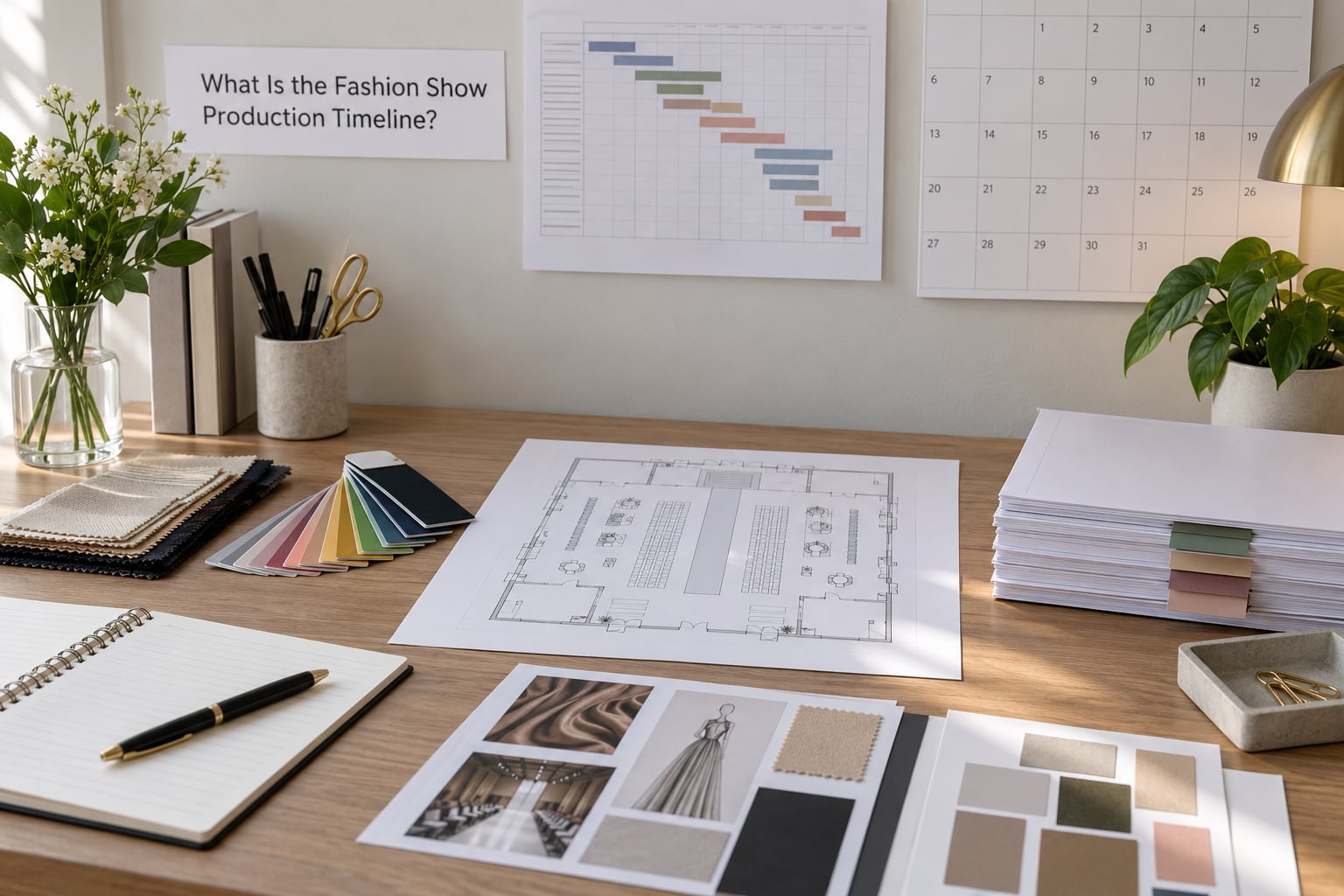
The fashion show production timeline is the master schedule for every task needed to stage a show, counted backward from the locked show date in minutes. It covers five phases: pre-production, casting and fittings, technical build, show week, and the post-show wrap.
The phrase people search for most often, fashion show production timeline explained, usually means one of two things. Either they want the sequence of phases, or they want to know how far ahead of the show to start. Both answers live in the same document.
Presentation, showroom, or runway?
Format changes the length of the timeline more than budget does. A showroom presentation in a rented space, where guests circulate among racks, needs four to six months and mostly depends on garments, a guest list and a photographer. A runway show with lighting, sound, choreography and a built set needs six to nine. A fashion week appearance, where the calendar date is fixed by someone else, needs nine to twelve and gives you almost no room to negotiate.
Why the date runs backward
Everything about a runway show is immovable except the work you do to prepare for it. Press schedules print, buyers book travel, and the calendar belongs to the fashion week body or the venue. So you fix the date first, list every deliverable, look up how long each one really takes, and work backward to a start date that has slack in it.
How Far in Advance Should a Fashion Show Be Planned?
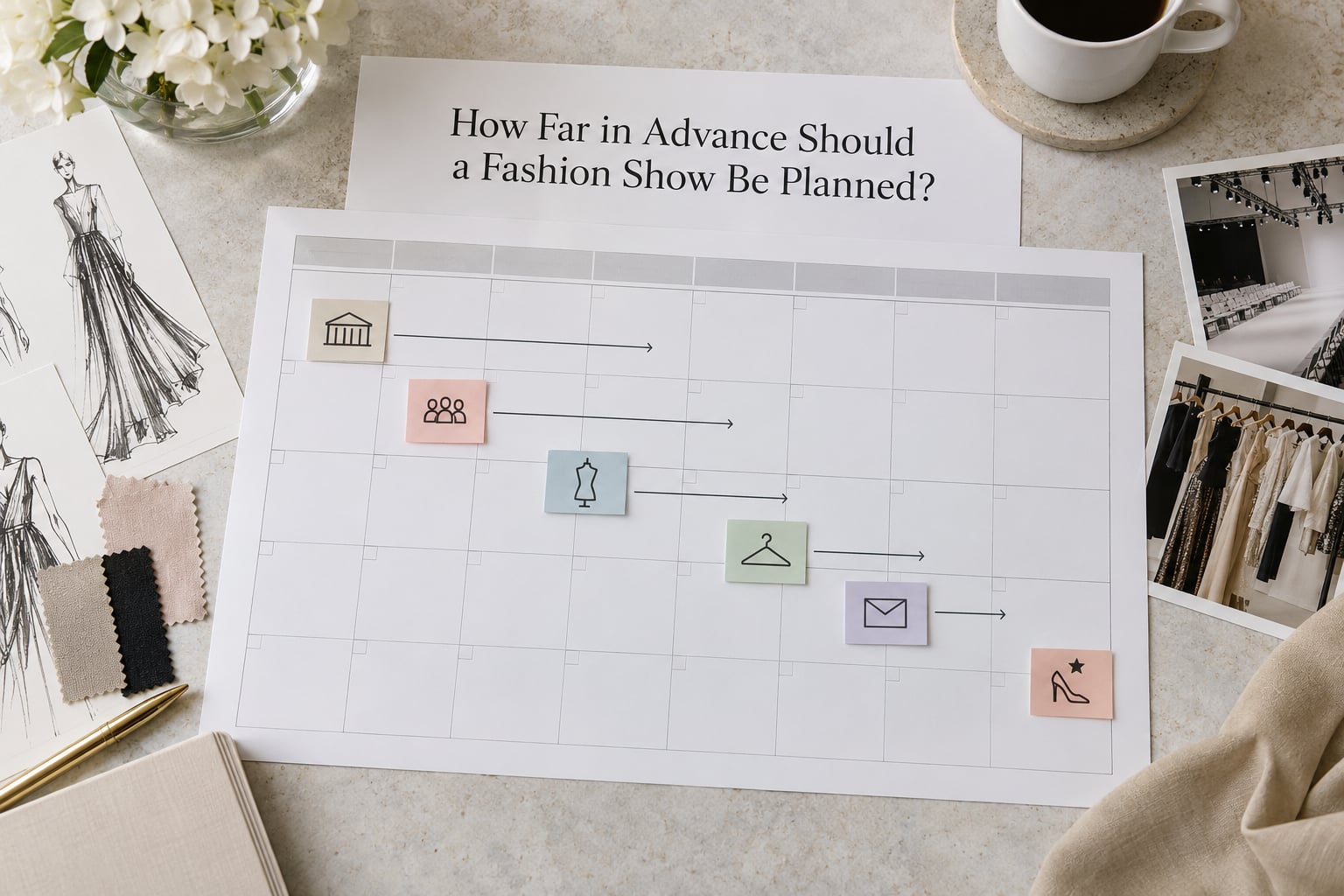
Plan a simple showroom presentation four to six months out, a seasonal runway show six to nine months out, and a larger production nine to twelve months out. First-time designers on a tight budget can compress a runway show to about four months, but only by cutting scope rather than cutting phases.
The four things that move those numbers are the venue calendar, the number of looks, whether you are building a set or renting one, and who you need in the room. Press and buyers sitting front row means a longer guest-communications runway. A custom-built runway means a vendor with a four to eight week lead time.
The fashion show production timeline explained by show size
- Showroom presentation: 4 to 6 months. Twenty looks or fewer, no set, one camera team, guest list under 150.
- Independent runway show: 6 to 9 months. Thirty to fifty looks, rented staging, lighting and sound package, small press list.
- Fashion week runway slot: 9 to 12 months. Embargoed schedule, buyer and press appointments, sponsor obligations, venue and technical riders.
- Virtual or hybrid show: 5 to 8 months, but front-loaded. Filming days, edit review and platform testing sit on the critical path before show day, not after.
What Happens During the Pre-Production Phase?
Pre-production is the longest phase and the one most often started too late. It runs from the moment you decide to show until the first vendor deposit lands.
Start with the concept, because everything downstream inherits from it. A concept you can say in one sentence, with a mood, a palette and a clear reference, saves weeks of arguing about staging later.
Next is the budget. Build it from the venue and production quotes outward rather than from a guess inward, and hold back ten to fifteen percent as contingency from the first day. Then set the show format, which determines everything technical: runway walk, seated speech, performance, or a mixed evening.
You also lock the core team here, and each person needs a named deliverable rather than a vague involvement. A producer who owns the budget and the calendar, a show director who owns the creative and the choreography, a production manager who owns the venue and every vendor on site, a stage manager who owns the run of show, a casting director, a stylist lead, a hair and make-up lead, a front of house manager for guests and press, and a press lead. On a small show several of these collapse into one person, which is fine as long as the list says who.
Finish pre-production with permits, insurance, and the first draft of the master schedule. Permit and insurance lead times are routinely underestimated. Public assembly permits, liquor service, pyrotechnics, and union or venue labour rules can each add two to four weeks that you did not plan for.
How Do Samples, Casting, and Fittings Fit Into the Schedule?
Garment work sits on the same critical path as production, and this is where most first shows go wrong. Samples should be finished and fitting-ready four to six months before show day for a runway show, not three. Designers who are still cutting patterns when they announce the show date have already lost the schedule.
The order is fixed. Samples are made and reviewed first, because a look that does not work on a body cannot be cast. Then the casting director selects models from comp cards or a direct booking list, models are measured, and fittings run roughly six to eight weeks out with a second fitting four to five weeks out.
Send looks to the fitting in order of show order, not order of confidence. The pieces you are least sure about should be tested earliest, while there is still time to change the styling or drop the look.
Alterations need their own calendar. A standard hem or take-in is two to three days once it reaches the alteration room. Anything involving beading, corsetry, or a specialty finish can run two weeks. Set the alteration cutoff at fourteen days before show day, after which only emergency repairs get accepted.
If a sample is late, the recovery is to reduce scope rather than compress show day. Cut the look, simplify the styling, or re-cut the piece from an existing block. Producers who quietly push fittings into the final week end up with a show day that starts two hours late, and nobody notices but the crew.
How Do Venue, Runway, and Technical Production Work Together?
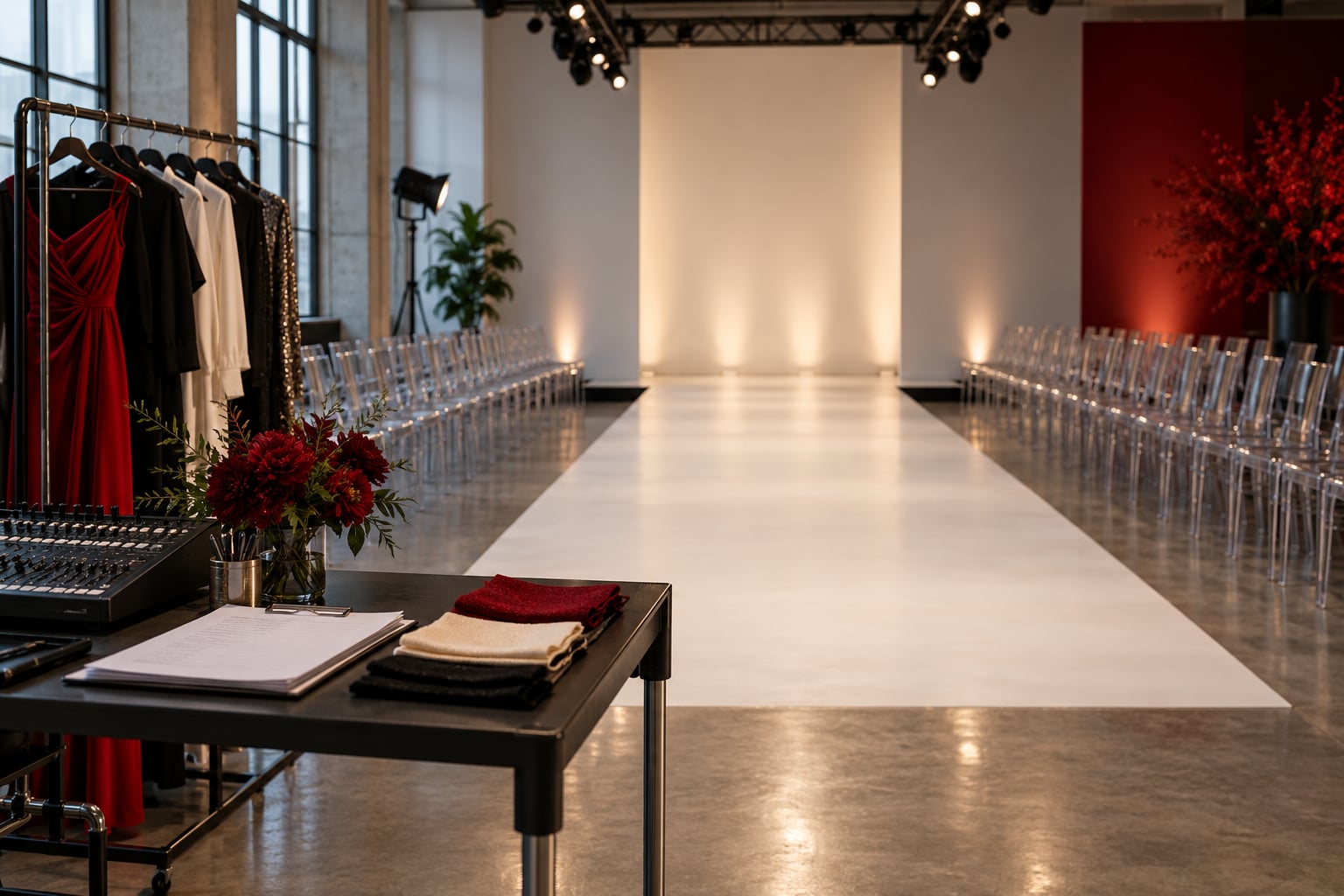
Venue selection is a creative decision and a logistics decision at once. Look at sightlines from the last row, ceiling height for rigging, power capacity, load-in access, backstage space, and whether there is a private room large enough for models to change.
Book the venue three to six months out for a runway show, and get the site plan in writing before you design anything. The site plan dictates where the runway sits, where the FOH (front of house) desk goes, where cameras can stand, and how many metres of cable you are running.
Technical production usually starts in the four to six weeks before the show. The production manager coordinates a load-in window, often the evening before or early morning of the show day, and vendors work to a written schedule rather than arriving when they feel like it.
The build itself follows an order people tend to reverse. Staging and runway go in first, then power and lighting positions, then sound, then video and scenic elements, then dressing rooms, then signage. Cue testing follows the build, not the other way round.
Run a cue-to-cue session, which tests lighting and sound state changes without the models walking, at least a week out. Then run the dress rehearsal, which tests the full sequence with garments, hair and make-up, at the venue if at all possible. Sightlines should be checked from the back of the room, not from the stage, because the seat that looks fine from the runway is usually not.
When Should Marketing, Invitations, and Guest Communications Launch?
Guest communications follow the concept, not the schedule. As soon as the story and the date are firm, you can begin building the list.
A workable sequence: build the guest list and tier it at four to five months out, send save-the-dates at three to four months, send formal invitations six to eight weeks out, and confirm attendance two to three weeks out. Buyers and press get separate tracks with their own timing, because they book travel earlier than anyone else.
Lock the guest list seven to ten days before the show. Every seat you leave open after that is a seat you cannot fill in the last hour. Front row placement is a production decision, not a social one, and it should be written into the seating plan before invitations go out.
Marketing content that needs the collection to look finished should be scheduled after the samples are locked. Announcing a show date early is good. Announcing the specific looks before they exist is how you create a deadline you cannot meet.
How Should Rehearsals and Show-Day Run of Show Be Planned?
A rehearsal is either a cue-to-cue, which walks the technical transitions, or a dress rehearsal, which walks the full show with people in the clothes. You need at least one of each, and for anything with choreography, two dress rehearsals.
Run rehearsals in show order, always. The models learn the order once, and a schedule that changes the sequence between rehearsals resets everyone’s body memory.
Run of show: show day, minute by minute
| Time | Activity | Owner |
|---|---|---|
| Show day minus 4 hours | Load-in opens, staging and rigging signed off by venue | Production manager |
| Show day minus 3 hours | Lighting focus, sound line check, video playback tested end to end | Technical team |
| Show day minus 2 hours | Models on site, hair and make-up call begins | Hair and make-up lead |
| Show day minus 90 minutes | Final garment check, steam, accessories laid out in show order | Stylist lead |
| Show day minus 60 minutes | Doors open to guests, press and photographers positioned | Front of house manager |
| Show time minus 15 minutes | Models lined backstage in show order, house lights to half | Stage manager |
| Show time | Show runs, approximately 8 to 15 minutes for a 30-look show | Show director |
| Show time plus 5 minutes | Designer walk, house lights up, applause hold | Stage manager |
| Show time plus 20 minutes | Guests depart, strike begins, content capture continues | Production manager |
| Show time plus 4 hours | Venue handover complete, equipment collected | Production manager |
Build this document the day you lock the show time, not the week of. Circulate it as a call sheet with names and phone numbers, not job titles. On show day, the person who matters is the one who can be reached.
Assign contingency ownership explicitly. One named person decides when to shorten the walk, when to hold the show, and when to cut a look. If that decision sits with the designer, the designer will be backstage mid-hair and unable to answer.
What Are the Main Fashion Show Deadlines and Milestones?
Here is the range most producers work inside. Treat the middle column as the planning baseline and adjust for your show size.
| Time before show | Small presentation | Seasonal runway show | Larger production |
|---|---|---|---|
| 9 to 12 months | Not required | Not required | Concept, date, budget framework, calendar slot confirmed |
| 6 to 9 months | Concept, date, budget | Venue shortlist and hold, casting director booked | Venue signed, core team hired, samples in production |
| 4 to 6 months | Venue booked, models cast | Venue signed, lookbook and line sheets, first fittings | Save-the-dates, sponsorship package, production design locked |
| 2 to 4 months | Garments final, invitations sent | Invitations sent, technical suppliers booked, second fittings | Press and buyer outreach, technical riders submitted |
| 4 to 6 weeks | Styling and hair plan | Guest list closes, load-in scheduled, music licensed | Rehearsals scheduled, livestream tested, sponsor deliverables confirmed |
| 2 to 3 weeks | Final garment checks | Cue-to-cue on site, dress rehearsal | Dress rehearsal on site, press briefing materials due |
| Final 7 days | Confirm and go | Call sheets circulated, alteration cutoff applied | Full show-week schedule, strike plan and vendor closeout drafted |
Which deadlines move and which do not
The show time, the venue access window, and the alteration cutoff are fixed. Vendor bookings, marketing content, and the guest list can move by days. Marketing content can move a week, the guest list can move until seven days out, and vendor bookings can move only if the supplier holds a date option rather than a booking.
Garment completion is the one deadline most people wrongly treat as movable. It is not. Once the look count is set, every downstream date depends on it.
What Happens After the Fashion Show?
The wrap starts the moment guests are out. The production manager runs strike with a floor plan, vendors are checked out against what came in, and the venue is handed back within the contracted window.
Money follows. Every vendor invoice goes out within a week, deposits and final payments are logged, and the budget is closed so you know what you actually spent against the quote.
Garments need a decision written down. Standard practice for runway shows is that garments go back to the house archive or are retained for resale, loan, or rental, while the model keeps accessories unless the contract says otherwise. Put that in writing in the model agreement, because an unstated assumption becomes an argument in the strike.
Then capture the work. Content from show day should be edited and posted within 48 hours while the audience is still watching. Buyers and press get follow-up within a few days, with line sheets and availability.
Close with a debrief within two weeks, while it is still honest. What ran long, what the venue could not handle, which cue failed, and what you would cut. Write it down and keep it, because next season you will be tempted to plan the same show again from memory.
Frequently Asked Questions
How far in advance should I plan a fashion show?
Plan a small showroom presentation four to six months ahead, a seasonal runway show six to nine months ahead, and a fashion week or large production nine to twelve months ahead. Start from the locked show date and work backward. If your date is fixed by a fashion week calendar, treat twelve months as the minimum and assume garment production will run late.
How long does it take to produce a fashion show?
Six to nine months end to end is the usual range for a runway show, measured from concept and budget through venue, casting, fittings, build, rehearsals, show day and strike. A showroom presentation can compress to four months. A fashion week slot with sponsor and buyer obligations typically needs nine to twelve months because the calendar date is set by someone else.
How long before the show should I book the venue?
Three to six months out for a runway show, and six months for anything with custom staging or a fashion week calendar. Get the site plan in writing as part of the booking, because it determines where the runway sits, where cameras can stand, and how much cable you are running. Changing the design after the site plan is signed off is expensive.
How early do models need to be fitted?
A first fitting around six to eight weeks before show day, a second fitting four to five weeks out, and an alteration cutoff at fourteen days. Send looks to fittings in show order and test your least confident pieces first. After the cutoff, accept emergency repairs only, because an alteration started late will still be unfinished when the show begins.
How long should rehearsals take?
Run one cue-to-cue session at least a week out to test lighting and sound transitions without models walking, then one dress rehearsal at the venue with garments, hair and make-up. Anything with choreography needs two dress rehearsals. Every rehearsal runs in show order, because changing the sequence between rehearsals resets the models and the crew both.
What do I do when the collection is late and the date is fixed?
Cut scope, not time. Reduce the look count, simplify the styling, or re-cut a difficult piece from an existing block. Protect the four things you cannot recover: the alteration cutoff, the rehearsal, the venue handover window, and the cue-to-cue. Then tell your team immediately in writing, with the revised look count, so nobody keeps working to the old number.
Conclusion: Start With the Show-Day Backward Plan
Choose the show date first, then work backward. List every deliverable, check the real lead time for each one, place it against a deadline with a named owner, and add buffer between dependent tasks so one slipped phase does not cascade into show day.
That backward plan is the whole job. A fashion show production timeline only works when each milestone has an owner, a date, and enough slack to absorb the one thing that is guaranteed to go wrong.