
To start a personal styling business from home, you need three things: a defined niche, a short list of clearly priced services, and a way to reach a specific group of people who already ask you for outfit advice. Most stylists run the whole thing from a spare room, a laptop and a phone, and most begin part-time while they still have other income.
The honest part is the ramp. Expect three to six months before styling income covers much, and expect your first clients to come from people you already know rather than from an audience you have not built yet. This guide walks through what you need first, then the seven steps that turn the idea into a business that can actually be booked and invoiced.
Table of Contents
- What You Need
- Step-by-Step: How to Start a Personal Styling Business From Home
- 1. Choose a Styling Niche You Can Own
- 2. Create a Simple Service Menu
- 3. Set Up Your Home-Based Styling Business
- 4. Build a Portfolio Before You Have Paying Clients
- 5. Price Your Services Without Guessing
- 6. Market Yourself to a Specific First Client Group
- 7. Deliver Excellent Service and Ask for Referrals
- Common Mistakes
- Frequently Asked Questions
- Do you need a license to be a personal stylist?
- How much should I charge for personal styling?
- How do personal stylists make money?
- How much does it cost to start a personal styling business?
- Can you run a virtual stylist business with no experience?
- How long does it take to get your first styling client?
- Your First Week
What You Need
You do not need a storefront, a fashion degree, or a walk-in closet full of designer pieces. You need a defined niche, a service menu, basic equipment, simple software, a portfolio, and a plan for talking to clients. Here is the short list before you start booking anyone.
- A niche. A specific group of people with a specific styling problem, such as working professionals who want a smaller wardrobe, or clients rebuilding a closet after a major life change.
- One or more services. Decide what you actually sell: a closet edit, a virtual consultation, a capsule wardrobe build, personal shopping, or a retainer. Not all five on day one.
- A business structure. Most stylists start as a sole proprietor, but register the business properly and open a separate bank account. Rules differ by state, so check yours.
- A workspace. Even a corner of a table works. You need good light, a quiet room for video calls, and somewhere a client can stand and see a full-length mirror.
- Equipment. A laptop or tablet, a phone, a good webcam or camera, and a lighting setup that makes clothes look accurate rather than dim.
- Software. Booking, contracts, invoices and payment collection. Free tiers exist for all of these, so this is the cheapest part of the setup.
- A portfolio. Sample edits, styled looks, or practice projects that show your eye before you have a paying client.
- A way to handle money correctly. Separate accounts, a simple record-keeping habit, and a portion of every payment set aside for self-employment tax.
Liability insurance is worth adding early too. It is inexpensive, it protects your savings if a recommendation goes wrong, and some commercial venues and marketplaces ask for proof of it.
Step-by-Step: How to Start a Personal Styling Business From Home
Seven steps, in the order that saves you the most time. You can start each one before the previous one is finished, because a part-time stylist usually builds this over several months rather than in a single launch week.
1. Choose a Styling Niche You Can Own
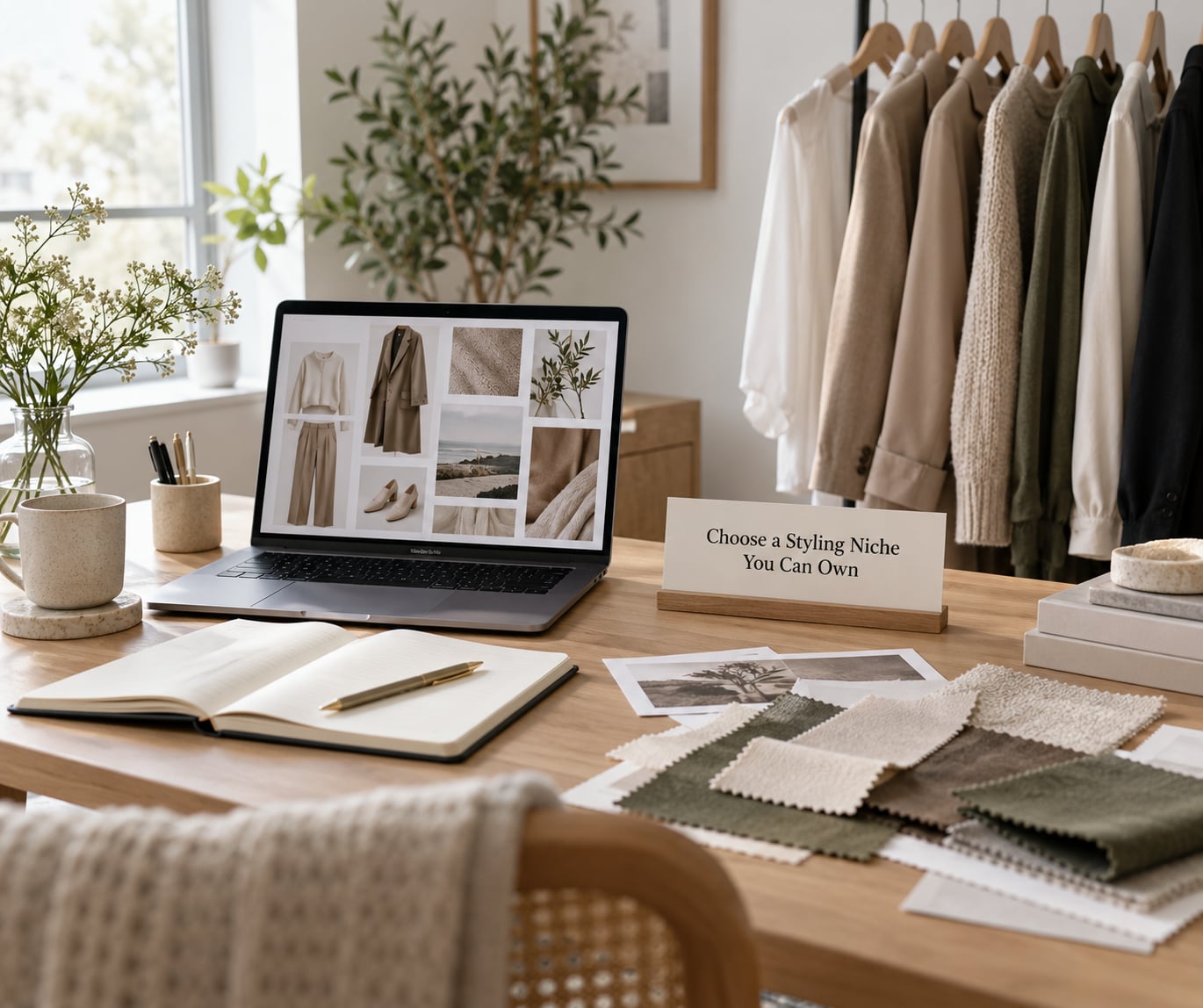
The fastest way to get clients is to stop being general. A stylist who offers everything ends up competing on nothing, because there is no single reason a client would pick her over the next one. Pick the client you understand best and the problem you can solve repeatedly.
Niches that tend to work include working professionals building a 40-piece wardrobe, clients shopping second-hand and resale, plus-size clients who have given up on department stores, brides and wedding parties, people returning to work after a career break, and empty nesters downsizing decades of clothes. The r/sewing community is a good example of a niche nobody is serving: people with handmade garments, years of no-buy, and no idea how to build an outfit around their own work.
Test your niche by writing down five real people you could style and what you would change about their wardrobe. If the sentence is vague, keep narrowing. Once you can describe your client in a couple of sentences, your marketing writes itself.
2. Create a Simple Service Menu
Turn your niche into three or four named services, each with a duration and a clear deliverable. A closet edit might be a two-hour in-home session ending with a written summary and outfit formulas. A virtual consultation might be 60 minutes over video, followed by a lookbook. An ongoing package might be a monthly retainer with a set number of styling hours.
Scope is where new stylists get burned. Write down what is included and, more importantly, what is not. Editing the closet is not the same as washing the closet. Shopping is not the same as shipping and returning forty items for a client in another state. Put those boundaries in writing before you quote anything, and put them in your agreement too.
The old in-person sequence practitioners describe on thefashionspot still works well: meet the client first to read their personality, then visit their home and work through the wardrobe. Ask about their real life before you open a single drawer.
3. Set Up Your Home-Based Styling Business
Register the business, get an EIN from the IRS, and open a separate business bank account. Those three steps take an afternoon and they keep your tax return from becoming a puzzle. Whether you form an LLC is a separate question, and worth a quick check with your state, because the answer is usually yes when you work in spaces other than your own home.
Then build the minimum professional setup: a signed client agreement, an intake questionnaire, an invoice template and a way to take payment by card. Put your booking link on one page of a simple site, and let clients pay a deposit at booking so you are not chasing people who never show.
Decide early what your business looks like in a client’s home or on a call. A private room, a closed door and a clear no-children policy matter more than any equipment. Some of the best stylists I know work from a spare bedroom and have never owned a studio.
4. Build a Portfolio Before You Have Paying Clients
Nobody hires a stylist with an empty gallery. Practice edits fill that gap honestly, as long as you label them as practice work. Style a friend or a family member and photograph every outfit before and after. Build a sample capsule wardrobe for a client type you chose in step one, and show the reasoning, not just the pictures.
Paid shoots are the fastest credible proof. Book a local model or photographer for a half day, treat it as a real session, and you get content you can use for months. Sourcing garments locally and styling thrift finds also shows prospective clients you can work with what they actually own.
Testimonials come later, and they come faster than people expect. A short written note from a practice client is enough for the first few months.
5. Price Your Services Without Guessing

Price the outcome and the time it takes, then adjust. A flat rate per project is easier for clients to say yes to than an hourly rate, and it protects you when a session runs long. Hourly works when the scope is genuinely open-ended, such as shopping that keeps expanding.
Build your number from real inputs: the hours a service takes including prep, travel and follow-up, your software and insurance costs, the tax portion you set aside, and what you need to earn per hour to make it worth your time. In-person work in the client’s home costs more than virtual work because of travel, so charge for it or build a travel fee into the rate. Time spent ordering, shipping and processing returns is billable work too, and it quietly destroys margins when you forget it.
Raise your rates at regular intervals and every time a service gets more popular. Charging the same for year one and year three is how stylists end up resenting the business.
6. Market Yourself to a Specific First Client Group
Your first clients are almost always within travelling distance or in your existing network. The r/fashionadvice question that comes up most often, whether it is worth becoming a stylist, usually ends in advice about who did it for free first: friends, family, colleagues, and people in local groups. Do those first, label them clearly as discounted or free, and give them a great experience so they talk about you.
Post work publicly, even when it is unpaid practice. Short videos of a before-and-after, a three-item formula, or a colour analysis explain an idea in seconds and reach people a local group never will. Pair that with a simple call to action: a limited number of opening client spots at a set rate, with a booking link.
Partnerships are underrated. Photographers, postpartum doulas, career coaches, personal trainers and boutique owners all talk to your exact client. Offer a referral swap instead of cold pitching strangers. Direct outreach works too, but keep it specific: mention one thing you noticed about their wardrobe and offer a short paid session, not a free consultation.
7. Deliver Excellent Service and Ask for Referrals
The business lives on repeat clients, and repeat clients come from small professional habits. Send an intake questionnaire at least a week ahead, covering work schedule, dress code, budget, body comfort, colours they avoid and what has frustrated them before. Confirm the appointment, the fee and the scope in writing.
On the day, listen first and edit with them, not at them. People buy into a plan they helped shape, and many will push back on a garment that would flatter them. Give yourself a closing routine: a written summary, three or four outfit formulas, a shopping list if they asked for one, and a check-in message two weeks later.
Then ask. A simple request at the end of a session, or a message after a week, works far better than a discount. Confidentiality matters just as much, especially when you style friends. Set that boundary early and in writing, because a stylist who keeps confidences gets recommended to whole friend groups.
Common Mistakes
Most home styling businesses do not fail because the stylist lacked taste. They stall on the same handful of habits.
- Staying too general. Offering styling to everyone means being remembered by no one. Fix: pick one niche for your first six months and say it out loud in your bio.
- Undercharging out of fear. Cheap feels safe when you have no clients, then you get stuck. Fix: price by project and by hour, and change rates for new clients while keeping them for existing ones.
- Treating exposure as experience. Counting unpaid practice as years of work leads to bad pricing and false confidence. Fix: keep practice clearly labelled, and use it to refine your process rather than to inflate your bio.
- Mixing personal and business money. Fix: separate bank account from day one, simple spreadsheet, and a set-aside percentage for self-employment tax that you do not touch.
- Promising results you cannot deliver. A confidence promise turns into a dispute. Fix: describe what you do, not how the client will feel afterwards.
- Forgetting travel, purchasing and return time. Fix: treat those hours as billable, set a travel policy, and write purchasing responsibilities into the agreement.
- Styling friends without boundaries. Fix: set a rate, keep the schedule in shared booking tools, and refer them to each other rather than absorbing their last-minute requests.
Frequently Asked Questions
Do you need a license to be a personal stylist?
No. Most US states do not require a license or certification for personal styling, image consulting or personal shopping. Rules vary by state and city, though, and some localities require a general business license or tax registration even for home-based work. Cosmetic services such as makeup are a separate matter with their own requirements. Check your state Secretary of State and your city clerk before you invoice your first client.
How much should I charge for personal styling?
Charge by project or package rather than by hour, because a closet edit has a start and a finish while shopping does not. Price from the total hours the service takes, including preparation, travel, follow-up and any returns processing, then add your software, insurance and tax set-aside. In-person work at a client’s home usually carries a higher rate than virtual work. Raise prices every few months and for new clients.
How do personal stylists make money?
Most styling income comes from one of four places: flat-fee projects such as a closet edit or capsule build, hourly rates for personal shopping and on-call sessions, monthly retainers with a set number of hours, and commissions from affiliate or e-commerce links. Most stylists combine two of these. Retainers give steadier income, project work pays more per booking, and commission work scales without extra hours.
How much does it cost to start a personal styling business?
The costs are smaller than most people expect. Registration, an EIN and a separate bank account are inexpensive. Booking, invoicing, contracts and payments all have usable free tiers. Bigger line items are optional: a styling course, liability insurance, a paid camera and lighting setup for content, and a paid website. Many stylists start with the free stack and reinvest revenue into better equipment later.
Can you run a virtual stylist business with no experience?
Yes, with two adjustments. First, be honest that the work is new, and show practice edits and a clear process rather than a claim of experience. Second, virtual work shifts part of the work onto the client: they photograph their wardrobe, answer the intake well and share honest measurements. Choose a narrow niche, book short paid sessions first to build case studies, and ask for a written testimonial after each one.
How long does it take to get your first styling client?
For most new stylists, between one and six months, depending on whether they market at all. People who actively post work and reach out to a specific group usually book a paid client within the first month or two. Those who wait for a website or a following to be ready often wait much longer. The first client is rarely the business. Treat it as the first case study that makes the next five easier.
Your First Week
Start small and finish something. Write your niche in one sentence, pick two services and their boundaries, register the business and open the bank account. Then do one practice edit, photograph it, and put it online. That is a real launch, and everything after it gets easier.