To answer why do you want to work in fashion, give three things: one concrete moment that started your interest in a specific part of the industry, one detail you learned researching this particular company, and one skill or result that proves you can do the job. Interest alone reads as filler. Interest plus evidence reads as a candidate who has done the homework.
It is usually one of the first questions asked in a fashion interview, whatever the title. Buyers, merchandisers, designers, stylists, PR people and e-commerce managers all get asked some version of it, and most candidates answer it the same generic way. Hiring managers in this industry are unusually blunt about the answer they don’t want. If you tell them you just love shopping, the interview is effectively over.
The good news is that the question is answerable by anyone who prepares for about twenty minutes. You do not need an industry background, a luxury wardrobe or a cousin who works in styling. You need one true detail, one researched detail, and one skill you can defend with an example.
Table of Contents
- What You Need to Answer Why Do You Want to Work in Fashion
- Step-by-Step: Building Your Answer
- Start with the part of fashion that genuinely interests you
- Connect your motivation to something you have done
- Name the value you can bring to the team
- Tailor the answer to the company and the role
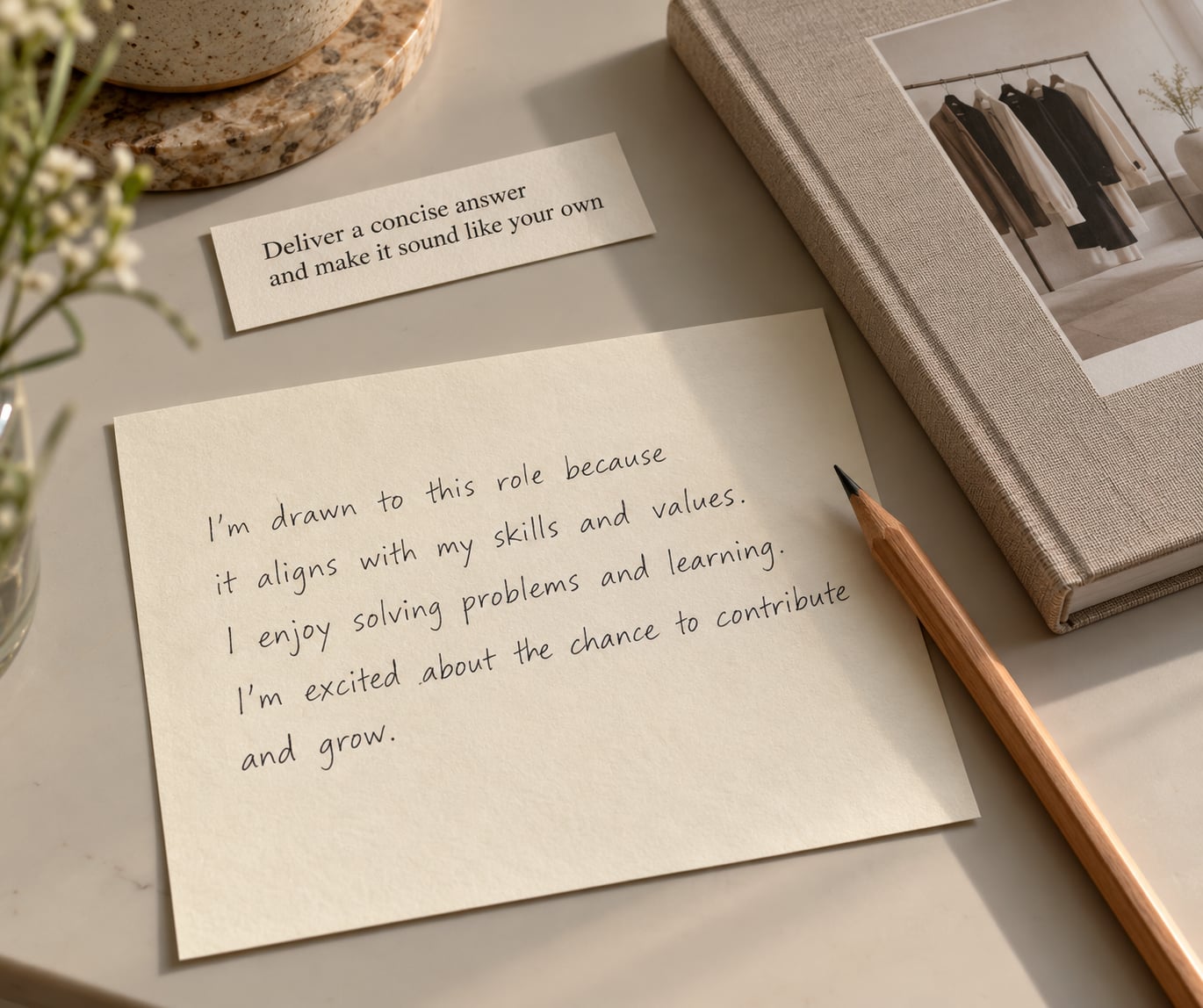
- Deliver a concise answer and make it sound like your own
- Swap the weak line for something specific
- Sample Answers for Fashion Careers
- Fashion publicist or communications assistant
- Fashion stylist
- Design or studio assistant
- Fashion buyer or merchandiser
- Fashion editor or content writer
- Content creator or brand-facing creator role
- If you have no fashion experience at all
- If you are switching industries
- Common Mistakes That Get You Screened Out
- Quick Tips for a Stronger Answer
- Frequently Asked Questions
- How do I answer why do you want to work in fashion with no experience?
- How long should my answer to why do you want to work in fashion be?
- What if fashion is not my lifelong dream?
- How do I answer why fashion and not hospitality, tech or another industry?
- What questions should I ask a fashion company at the end of an interview?
- Should I follow up after a fashion interview?
- Conclusion
What You Need to Answer Why Do You Want to Work in Fashion
Four ingredients make an answer credible. Most candidates supply one of them and hope enthusiasm covers the rest.
- A specific part of the industry. Merchandising is not the same as design, and neither is the same as buying or communications. Say which one you are applying for and why.
- One genuine motivation with a date attached. “I have always loved fashion” is a mood. “I watched a buyer explain why a delivery got pushed a season” is a story with a shape to it.
- Evidence you have done something. A class project, an internship, a freelance styling job, a thrift flip you sold, a shift you worked in retail, or a trend report you actually read.
- One detail only you could know. A campaign the brand ran, a piece in the current range, a move they made in the last year. This is what separates you from the template.
If you are switching from another industry, you also need one honest bridge sentence. Retail, hospitality, events, marketing, photography and admin work all map onto fashion jobs, and interviewers are more receptive to a career change framed as a deliberate move than one framed as a sudden calling.
Step-by-Step: Building Your Answer
Start with the part of fashion that genuinely interests you
Narrow the interest until it is arguable. If you love fashion, an interviewer cannot do anything with that. If you are fascinated by how a trend moves from a street photograph to a sample room to a delivery calendar, that is a point of view, and a buyer will recognise it.
Pick one of these and commit to it for the length of the answer:
- Styling and editorial. The craft of shaping an image, casting, working to a deadline, translating a mood into clothes on a body.
- Design and development. The technical problem of turning a sketch into something that can actually be manufactured at scale.
- Buying and merchandising. The commercial side, where sell-through rate, stock turn, margin and delivery timing decide whether a collection succeeds.
- Public relations and communications. Managing how a brand is seen, seeded, announced and defended when something goes wrong.
- Production and supply chain. The operational reality behind a delivery date, cost of goods and factory relationships.
- Sustainability and materials. Where the industry is heading on waste, sourcing and claims that can be proved.
The part you pick has to match the job. Saying you want to design clothes while interviewing for a buying administration role is the single most common mismatch hiring managers report.
Connect your motivation to something you have done
This is where the answer stops sounding like a mood and starts sounding like a career. Use the STAR method if you have a real situation: Situation, Task, Action, Result. Ten seconds is enough for the first three, and the Result is where the credibility comes from.
Interviewers react well to anything with a number attached, even a small one. How many pieces you styled, how many followers the account had at the time you pitched it, how many units you sold, how many weeks the internship lasted, how much revenue the event raised. Numbers are hard to fake and easy to verify.
Be honest about what the work actually was. If it was unpaid, say so plainly. If it was a course, say that. Claiming an internship was a job is the fastest way to lose a technical interview, because the follow-up questions get very specific very fast.
Name the value you can bring to the team
The second half of the answer shifts from what you want to what you give. Even an entry-level candidate can be specific about what they would take off the team’s plate. Sample and shipment tracking, competitor research, social listening, size and spec data cleanup, first-week customer email triage, styling support on shoots, keeping the line plan spreadsheet honest.
Here is how common non-fashion experience transfers, if you are changing careers:
- Restaurant or hospitality gives you service recovery, working under time pressure and reading a customer in seconds.
- Retail sales floor gives you visual merchandising instincts, product knowledge under pressure and experience with stock handling.
- Events or hospitality operations gives you logistics, supplier contact and the habit of working a fixed deadline.
- Marketing or comms gives you copywriting, campaign reporting and brand voice.
- Graphic design or photography gives you a working eye for proportion, colour and layout.
- Admin or project coordination gives you the calendar discipline that buying and merchandising live or die by.
Pick one bridge, not all six. Naming two or three real skills with a one-line example each is plenty for a first interview.
Tailor the answer to the company and the role
Before the interview, spend twenty minutes on the brand. Look at the current range, the last two campaigns, who the customers appear to be, and any news from the past year about the founder, a new location, a price change or a sustainability claim. Twenty minutes is genuinely enough for a small or emerging label, and candidates who admit they did a crash course the night before look more prepared than candidates who pretend they have followed the brand for years.
Then connect your motivation to something real about them. If they sell modest, repeat-wear pieces, your interest in the commercial mechanics of pricing and reorders is more relevant than your interest in runway spectacle. If they are a luxury house, the scale and the pacing of the work matter more. If they are a small label, wearing many hats matters more.
One warning: do not fake enthusiasm for a label you have never heard of. Interviewers at small brands frequently know the role better than the candidate does, and a confidently wrong detail ends the conversation faster than an honest “I had not heard of you before I looked, and here is what I found.”
Deliver a concise answer and make it sound like your own
Thirty to sixty seconds is the right length. Under twenty seconds and you have given a headline. Over two minutes and the interviewer is wondering what else you padded. Practise it out loud, because most people write a tight answer and then speak a rambling one.
Four beats, in this order: the specific reason you are in this corner of fashion, the thing you did about it, the value you bring, and one sentence tying it to this role. Pause a beat before the final sentence. That silence is where the emphasis lives, and on a video call it gives the other person room to lean in.
Sound like a person. Candidates worry about sounding generic, and the fix is not a cleverer script, it is a specific detail that only belongs to you. The phrase “I have always been passionate about fashion” is not more honest than a sentence with a date and a place in it. It is just less useful.
Swap the weak line for something specific
Most weak answers are one habit away from a strong one. These are the swaps that do the work:
- “I have always loved fashion.” Name the moment instead: a specific collection, a thrift trip, a sewing project, a photograph that stuck.
- “I just love shopping.” Describe the part of the industry that interests you: buying, styling, design, PR, production or sustainability.
- “Your brand is amazing and I love everything you do.” Reference one specific piece, campaign or decision from the last year and say what you think of it.
- “I am a hard worker and a team player.” Give one example of a result and the skill that produced it.
- “I want to design clothes.” Match the motivation to the role on the job description and speak to what that team actually does.
- “Basically anything, really, as long as I am in fashion.” Say which part you want and which you do not. Narrowing your own interest is a strength, not a risk.
Sample Answers for Fashion Careers
These are models, not scripts. Each one shows the same structure: specific reason, evidence, value. Swap in your own details and it works. Borrowing the words does not.
Fashion publicist or communications assistant
“I got into the industry through the unglamorous side. I worked events for a two-year-old accessories label and spent most of my time dealing with a photographer who had not confirmed, a courier who had the wrong bag, and a stylist who needed the same look in a different size. That is what made me want to move into fashion communications rather than events. I handle a small newsletter and have grown it from 400 to just under 1,200 subscribers in a year by rebuilding the outreach list. Your autumn campaign is the kind of launch I want to learn from.”
Fashion stylist
“I am drawn to styling because it is the part of fashion where the decision has to work in real life, on a real person, in real weather. I styled a five-look editorial for a student publication last spring, sourced four of five pieces on a budget under 60, and one look later got redone by the editor, which taught me more about proportion than any book has. I have kept doing it since for friends and for a local market stall, and I can turn a mood into a shopping list quickly. I want that skill tested somewhere with a real deadline and a real client.”
Design or studio assistant
“I came to fashion from the manufacturing side, which is unusual and turned out to be the point. I learned pattern cutting at college and spent a term helping at a small workroom where nothing gets approved until the sample fits a real body. What I like about design here is the translation, from an idea on paper to a spec sheet to an actual delivery. I am fluent in the technical packages, I can prep a tech pack, and I am comfortable chasing a factory for a sample. I would rather be useful from day one than wait to be handed a project.”
Fashion buyer or merchandiser
“I want merchandising because it is where taste and numbers have to agree. In retail I was responsible for a section of about 400 units, which meant I had to decide what to reorder, what to mark down and when a style was finished, and I tracked sell-through by doing it. I took a fashion buying module and built a line plan for a small womenswear label as coursework, and I can tell you where my assumptions were optimistic. Your mid-season review process is the part I most want to learn.”
Fashion editor or content writer
“I have written about fashion for three years, mostly about what is actually happening: factories and labour, sizing, repair and resale rather than red carpet. I have a modest following from those pieces, which is how I learned that a specific angle gets read and a general one does not. Writing for you would mean the same discipline with better resources, and I would want to understand what your readers came for before I changed anything about what you publish.”
Content creator or brand-facing creator role
“I started posting about styling to keep track of my own outfits, and it turned into a small audience I built myself over two years, mostly by doing one thing consistently rather than chasing trends. I know my numbers cold, including the posts that flopped and why. What I want next is to apply that to a brand whose products I would actually use, rather than buying things to photograph. That is why I read your last six months of product notes before applying.”
If you have no fashion experience at all
Say so in the first sentence rather than hiding it, then move immediately to proof of work. A candidate who says “I have never worked in fashion, but I have styled twenty looks from a single rail of a charity shop over two weekends and shot them, and here is what I learned about proportion and cost per wear” has given the interviewer something to evaluate. A candidate who has no experience and no project has given them nothing.
If you are switching industries
Name the comparison the interviewer is already making in their head. “I know what you are wondering, which is why a restaurant person wants into buying. Here is why: I ran ordering and stock control for a busy kitchen, I have done the margin maths, I negotiated with suppliers on a small scale, and I have wanted to work with clothes since I was a teenager. What I do not have yet is a line plan, and that is exactly what I want to learn.” Naming the gap does not disqualify you. Being surprised by it does.
Common Mistakes That Get You Screened Out
Leading with passion and no evidence. Everyone says they love fashion. Say what you did about it instead, and let the passion be implied by the detail.
Answering a different question than the one asked. The question is about this role at this company. Two minutes on why you adore runway shows does not answer a question about a stock analyst role in merchandising.
Overlong and unrestrained. Two minutes of autobiography invites the interviewer to interrupt you, which is a polite way of ending the answer early. Aim for under a minute, then stop.
Only listing skills without examples. “Strong communication and attention to detail” applies to everyone. “I briefed four models and a photographer, missed the first shoot slot, and rescheduled it inside two hours” is evidence.
Faking knowledge of a small brand. Guessing wrongly about a label the interviewer founded is the most recoverable mistake to avoid. Admitting you had not heard of them and then showing what you learned is a much better outcome.
Suggesting you are fine with anything. Being open to several roles is honest. Being willing to do any job in the building reads as no clear picture of yourself, which is exactly what this question is designed to detect.
Quick Tips for a Stronger Answer
- Rehearse aloud, not in your head. Reading the answer silently hides the parts where you speed up or trail off. Say it standing up, timed.
- Write a shorter version too. Some interviews open with a one-line version and a follow-up question. Have a fifteen-second answer and a sixty-second answer that start the same way.
- Keep one detail per answer. One brand detail. One number. One personal moment. More than that and none of it sticks.
- Do not memorise a script. Learn the shape and the three facts, then say it in your own words. Recited answers are obvious in a video call.
- Use the job description as a dictionary. If the advert lists line planning, read about it for ten minutes before you interview and find one thing to reference.
- Send a short follow-up. One line naming something specific you discussed works better than a thank-you note with no content.
- Prepare questions to ask back. Ask how the team decides what worked in a collection, or how someone joined the team. Fashion teams tend to enjoy talking about their range, and it shows you already think in those terms.
- Answer on video the way you answer in person. Look at the camera, not at your own face on the screen, and slow down slightly.
Frequently Asked Questions
How do I answer why do you want to work in fashion with no experience?
Lead with the fact instead of hiding it, then show proof of work you have already done. A styling exercise, a thrift flip you sold, a class project, a fashion article you wrote, or a local market stall all count. Name one detail that surprised you about the work, such as how much of styling is cost per wear and logistics rather than picking pretty clothes. Interviewers hire entry-level candidates for attitude and trainability, so clarity about what you have actually done matters more than pretending.
How long should my answer to why do you want to work in fashion be?
Thirty to sixty seconds for a first interview, and fifteen seconds if the interviewer has just asked you to summarise. Keep a short version ready that opens the same way, because most interviewers follow up with a second question. Over two minutes reads as an inability to edit, which is a real problem for buying, merchandising and design roles where presentation discipline is part of the job. Practise it out loud with a timer so you know where you naturally land.
What if fashion is not my lifelong dream?
Say so. Plenty of good people in the industry found fashion on the way to something else, and hiring managers for assistant and coordinator roles have seen far more of these candidates than career changers with a fashion degree. What matters is whether your interest is specific and whether you can show you understand the work. Avoid the vague version, where you say you might like it later. Say the part of the industry that interests you, the evidence you have gathered, and why this role is a deliberate move rather than a default.
How do I answer why fashion and not hospitality, tech or another industry?
Pick up the comparison before the interviewer frames it for you. Name what the previous industry taught you, name the specific thing fashion offers that it did not, and be clear about the commercial reality you are choosing. Fashion has short seasons, hard deadlines and direct exposure to customers, which is a real trade from a slow-moving sector, and saying so reads as informed rather than romantic. Finish by connecting the move to something you have already done in fashion, however small it was.
What questions should I ask a fashion company at the end of an interview?
Ask two or three, and make at least one about the work rather than about perks. Good options include how the team decides which pieces went into a collection, what happened to the ideas that did not make it, how someone on the team joined, and how performance is judged in the first six months. Questions about how last season sold come across as commercially alert. Questions about remote days and titles come across as someone optimising the offer before the work, which is fine to ask, just not as your only question.
Should I follow up after a fashion interview?
Send one short message within a couple of days that references something specific you discussed rather than repeating your answer back at them. Mentioning a particular piece, range or campaign from the conversation shows you were present, and it is a quiet second chance to make the motivation you stated land. Keep it to a few lines and skip the paragraph about how grateful you are. If you were asked a question you could not answer well, use the follow-up to answer it properly instead of pretending it did not happen.
Conclusion
The formula is short enough to write down: one specific reason you are in this part of fashion, one thing you did about it, one value you bring, one detail about the company you are speaking to. That is the whole answer. Everything else is delivery.
Before your next interview or networking conversation, write one answer in full using a real experience you actually had, then time yourself out loud. If you get stuck on the first sentence, the problem is usually that you have not decided yet which part of the industry you are answering for. Decide that first and the rest writes itself.