A clothing description earns its keep by answering three questions fast: what is it made of, how does it fit, and how does it look on a person. That is the whole job, and most descriptions fail at it because they describe the garment instead of the shopper wearing it. Learning how to write product descriptions for clothing well comes down to accuracy first, then persuasion: name the real fabric and measurements, translate them into what the buyer will feel, and close with the details that make returning easy.
Budget 15 to 20 minutes per garment once you have a repeatable workflow, and do that workflow from a single product record rather than from memory. If you follow the eight steps below, a plain tee and a lined winter coat take about the same effort.
Table of Contents
- What You Need Before You Write: Product Details, Audience and Brand Voice
- Step-by-Step: How to Write Product Descriptions for Clothing
- 1. Start with the shopper and the garment
- 2. Gather accurate product details
- 3. Choose the main benefit and its supporting details
- 4. Write a specific opening sentence
- 5. Describe fabric, fit and construction in concrete language
- 6. Add styling and use-case context
- 7. Add care, fit and purchase details
- 8. Edit for clarity, voice and search intent
- A quick template you can reuse
- Testing after you publish
- Common Mistakes That Flatten Clothing Descriptions, and How to Fix Each
- Frequently Asked Questions
- What is the 3-3-3 rule for clothing?
- How long should a clothing product description be?
- What should be in a product description?
- How do I write a good description for a clothing brand?
- Do product descriptions help SEO?
- Can AI write clothing product descriptions?
- Conclusion: Start With One Garment and Do It Properly
What You Need Before You Write: Product Details, Audience and Brand Voice
You do not need a new app for this. You need a reliable product record and a decision about who you are talking to, and both take about ten minutes to set up for the first garment and two minutes for each one after that.
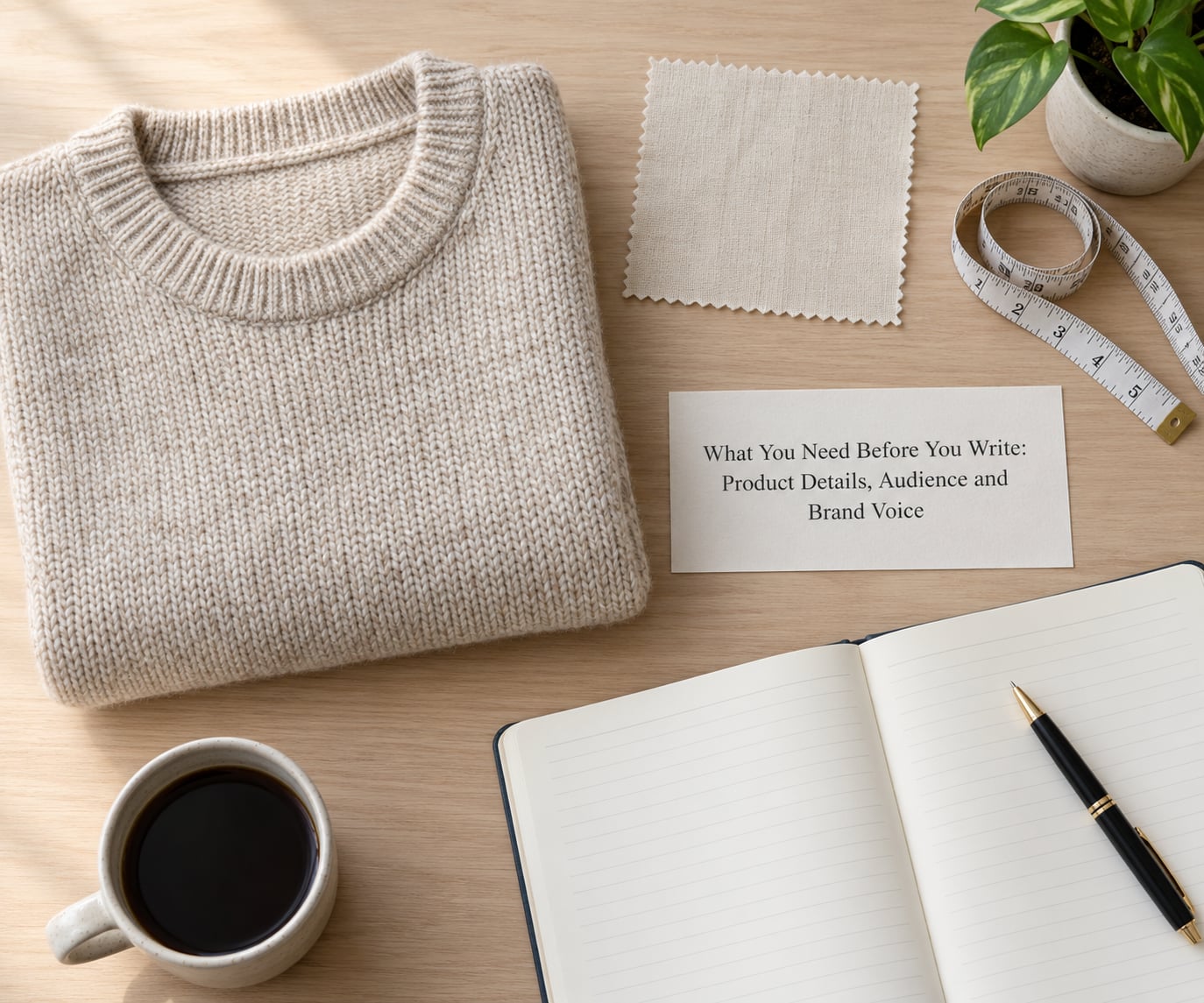
The kit breaks into four piles:
- Product details. Fiber content and percentage, fabric weight, garment measurements (chest flat, length, sleeve, inseam), lining and construction notes, care instructions, color names as you actually sell them, and the country of manufacture if you have it. Anything you cannot verify, you leave out.
- Fit data. Your size chart, the fit type for each garment (relaxed, fitted, tailored, oversized, athletic), how the model wore it, and any guidance you already give customers about sizing between sizes.
- Audience notes. Two or three sentences about who buys from you, what they already own, and what worry brings them to your store. Not a demographic chart, a real picture of a person.
- Brand voice rules. A short list of words you use, words you never use, and whether you write in first person, second person or plain third person. Store owners auditing their catalogs tend to find beautiful prose and no consistent voice at all.
- Search groundwork. A short keyword list per garment type rather than per item, so you are not rewriting the same intent 300 times.
- Trust material. Review count and average rating, return window, any guarantee, warranty or repair promise, and certifications such as GOTS, OEKO-TEX or Fair Trade if you hold them.
- Channel context. Where the description lives, because the length changes. A marketplace listing has about 200 characters of visible copy before truncation. A Shopify page can hold 150 words and a spec table. An Instagram caption is not a product page.
Keep all of it in one place per garment, a spreadsheet row or a card in your content tool. Every factual claim you write later traces back to a cell in that record, which is how you avoid the two worst clothing-copy errors: wrong fiber content and guessed measurements.
Step-by-Step: How to Write Product Descriptions for Clothing
1. Start with the shopper and the garment
Before writing a word, finish one sentence: “This is for the person who ____.” The blank usually reveals more than you expect. “This is for the person who wears the same jeans four days a week and wants a softer pair for the office” gives you a tone, a length, and a set of words to use. It also tells you what to leave out.
Then pick the garment’s single strongest reason to exist. Most pieces have one. A heavyweight cotton tee exists because it holds its shape after the tenth wash. A wrap dress exists because it flatters without a zipper. If you cannot name one, the description will not have one either, and shoppers will bounce.
2. Gather accurate product details
Pull the fiber content, fabric weight, measurements, care symbols and construction notes from the tech pack or supplier listing, not from the last listing you wrote. Suppliers change fabrics between production runs, so a description copied from an old product page is quietly lying to your customers.
Then test each claim against reality. Does it wrinkle? Does it hold a press? Does the color run when it gets wet? Hand-wash the sample if you have to. One washed sample tells you more than an hour of guessing, and the things you learn there are usually the three details shoppers ask about most.
3. Choose the main benefit and its supporting details
Features tell, benefits sell. “100% combed cotton, 240 gsm” is a feature; “opaque enough to wear without a cami, and it softens after a wash instead of going scratchy” is the benefit. You do not throw the spec away, you put it after the benefit so the reader can verify it.
Keep the list short. Pick three to five details that change how someone wears the piece, and let the rest live in the specifications table or the accordion panel. Clothing buyers read with their thumb on the screen; a 400-word essay loses them at paragraph two.
4. Write a specific opening sentence
The first sentence does the heavy lifting because most product pages get truncated in the first 60 to 100 characters on mobile. Make it concrete and make it about the garment. “A heavyweight cotton tee with a boxy, slightly dropped shoulder” tells a shopper more than “our best-selling tee” ever will.
Put the primary keyword in the product title and the first sentence where it reads naturally, then answer why this one before repeating it. Search intent first, human readability second, but never at the cost of the second. The shops that rank for long-tail clothing terms are not the ones with the prettiest prose, they are the ones that answer the question in the opening lines.
5. Describe fabric, fit and construction in concrete language
Fabric description is where clothing copy either wins or dies. Name the fiber, then say what it does: weight and drape, whether it breathes, whether it pills, how it feels after a wash. Use the correct word. “Breathable” on a tight polyester jersey is a claim you cannot defend, and returns follow.
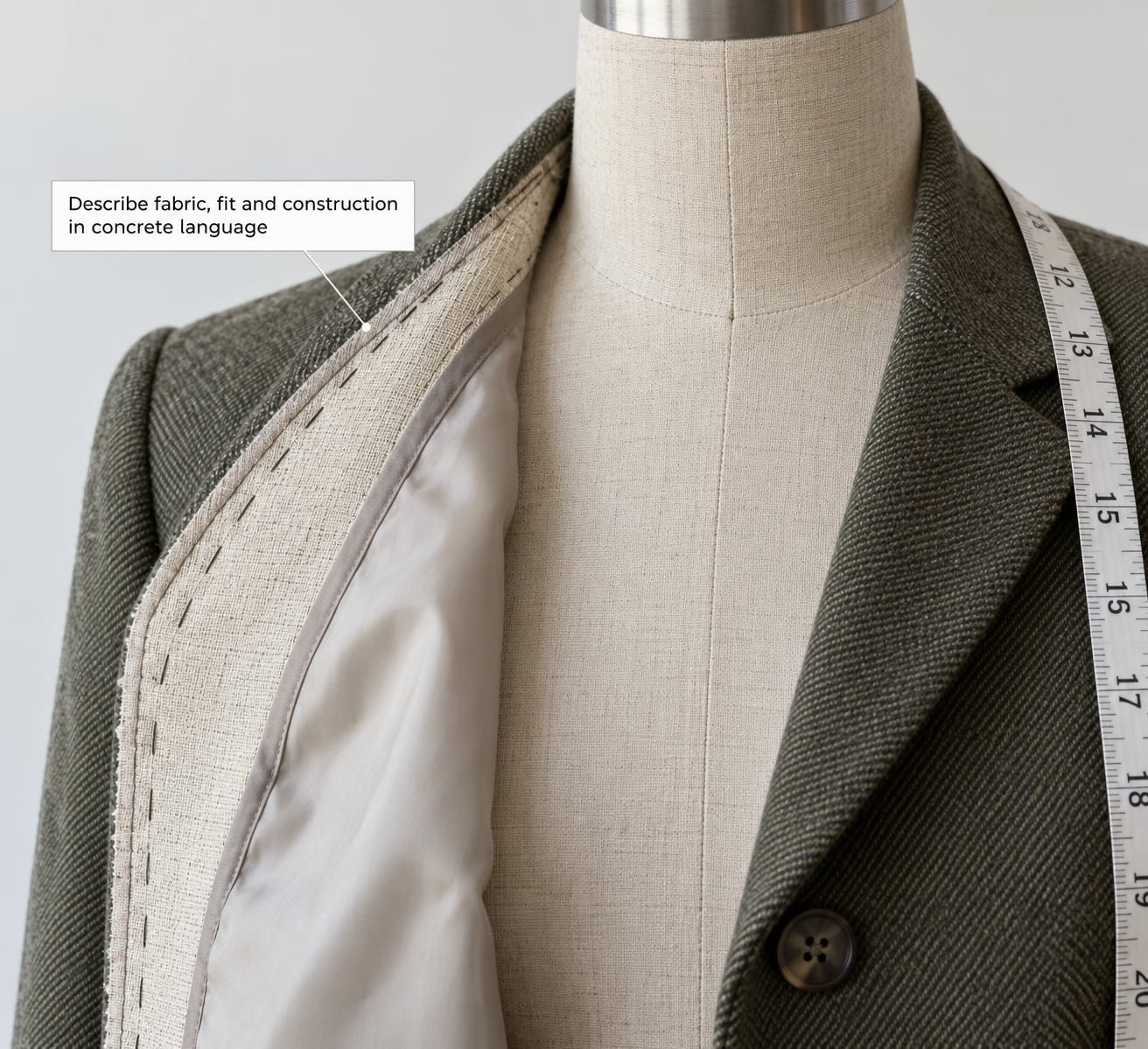
Fit needs the same precision. Say what the cut does on a body: relaxed through the body, cinched at the waist, cropped at the hip, sleeves hit just below the elbow. Then give the model’s measurements and the size worn, which converts a vague idea into something a shopper can picture.
Construction details signal quality when they are specific. French seams, a bound interior, a two-button closure, a lined bodice, a bar-tacked pocket. One or two of these do more work than three adjectives about craftsmanship.
6. Add styling and use-case context
Tell the reader where the piece goes. “Works over a tank in July, under a blazer in October” is more useful than any mood language. Describe three outfits or three occasions and the garment becomes a decision rather than a scroll item.
Match the vocabulary to how your customers actually talk. Oversized, relaxed fit, tailored, fitted, athleisure, capsule wardrobe, wardrobe staple, statement piece. Use these when they describe the garment truthfully and skip them when they are just trend decoration. A customer who finds “deadstock” on a page will wonder what you meant by it.
7. Add care, fit and purchase details
Care instructions belong in the copy, not only in a tiny label graphic. Write them as a sentence people understand: “Machine wash cold with like colors, line dry, a warm iron if you need it.” Vague care advice is a top reason customers return clothing.
Fit guidance is the single highest-leverage paragraph on the page, and almost nobody writes it properly. Say whether the garment runs small or large, what to size up or down for, how a size compares to a familiar brand, and link the measurement chart from the first mention. Apparel return rates commonly sit in the 20 to 30 percent range, and fit confusion drives most of that.
Add the risk reversal last and keep it short: the return window, who pays shipping, and whether exchanges are free. Do not manufacture urgency you do not have. “Limited run” on a garment you reorder every month costs you trust with the customers who notice.
8. Edit for clarity, voice and search intent
Read the draft out loud. Anything you would not say to a friend in a shop, cut. Then run a claim check line by line: every fiber percentage, measurement, certification and performance statement has to match the product record. Unsupported specificity is the fastest way to lose a chargeback.
Trim to fit the channel, confirm the keyword appears naturally rather than six times, add descriptive alt text to the product images in plain words, and read the spec table against the paragraph above it. If you want a second set of eyes, a language model is fine for spotting repetition or vague verbs, but every factual claim should be rechecked by a human who has held the garment.
A quick template you can reuse
Title, then benefit sentence, then two or three sentences of fabric and fit detail, then styling sentence, then care and sizing sentence, then trust sentence. Many Shopify stores use exactly this order and change only the content. The structure is what lets you write forty pieces in an afternoon without them all sounding identical.
Testing after you publish
Change one variable at a time: the opening sentence, the bullet order, or the guarantee line. Shops that do this report conversion shifts of several percentage points over a test cycle. Track the return rate and the questions in your customer service inbox too, because a description that sells the wrong size is not a win.
Common Mistakes That Flatten Clothing Descriptions, and How to Fix Each
Most underperforming clothing copy fails in one of a handful of predictable ways. Each has a quick correction.
- Descriptions any competitor could publish. If you swap the brand name and the copy still works, it is generic. Fix: add one measurement, one fabric weight, one construction detail that only your garment has.
- Feature dumping. A spec sheet in paragraph form. Fix: lead with the benefit, then let the numbers support it, and move the full specification list into a table or accordion.
- Fabric claims you cannot prove. “Breathable,” “buttery soft” and “eco-friendly” on garments that support none of those claims. Fix: name the fiber, the weight and the finish, and describe what the shopper will actually feel.
- Keyword stuffing. The same phrase six times, which reads badly and changes nothing. Fix: title, one H2 or section opening, and two natural uses in the body.
- Ignoring fit and care. Two paragraphs about lifestyle and nothing about measurements or washing. Fix: write the fit paragraph before you write the styling paragraph, every time.
- Voice that shifts page to page. One product sounds clinical, the next sounds like a magazine. Fix: write three voice rules and run every description against them before publishing.
- Writing for the algorithm, not the shopper. Long-tail phrasing repeated so often that the page stops making sense. Fix: keep the search intent, lose the repetition.
- Fake urgency. Countdown timers and “selling fast” on evergreen stock. Fix: use real signals like review counts, restock dates you control, or a genuine limited run.
Frequently Asked Questions
What is the 3-3-3 rule for clothing?
The 3-3-3 rule is a working shorthand used by some apparel writers, not an industry standard. The common version: three benefits in the main copy, three supporting details or specifications, and three styling or use-case notes. Brands adapt it, and some use three sentences per paragraph instead. Use it as a drafting constraint that forces you to choose what matters, then break it when a garment genuinely needs more.
How long should a clothing product description be?
Around 100 to 160 words for a standard product page, with specifications and care in separate blocks. Marketplace listings need far less, often under 200 visible characters before the page truncates. Social captions need a different length again. Write to the channel you are publishing in rather than to a single ideal number, and keep the first 60 to 100 characters self-contained because that is what most mobile shoppers actually read.
What should be in a product description?
Six things: the product title with the primary keyword, the main benefit in plain language, fabric and construction specifics, fit with real measurements and the model’s size, care instructions, and trust signals such as reviews, a return policy and any certification. Everything else, including the styling paragraph, should support those six rather than compete with them.
How do I write a good description for a clothing brand?
Write the brand description the way a founder would explain the line to a customer in a shop. Say who the clothes are for, what problem the brand was built to solve, and what makes the construction different in terms a shopper can verify. Name specific fabrics, specific fits and specific people, and cut every adjective that has no measurable detail behind it.
Do product descriptions help SEO?
Yes, though the mechanism is narrower than most advice suggests. The title, the opening sentence and the specification text are what search engines can reliably read and match, and they decide whether your page answers the query at all. Structured data such as Product, Offer and Review markup lets search engines display your ratings and price in results, which typically matters more for apparel than keyword density does.
Can AI write clothing product descriptions?
Yes, as a drafting assistant. Give it the verified product record and ask for three openings, then rewrite them in your own voice and check every claim against the garment. The failure mode is confident invention: invented fiber content, invented measurements, invented certifications. A human who has handled the garment signs off, and the AI never publishes.
Conclusion: Start With One Garment and Do It Properly
Start with a single garment today. Pull its verified details into a record, write one sentence about the person who buys it, name its main benefit, and draft an opening sentence that a competitor could not copy. Then finish the copy in the order that works: benefit, fabric and fit, styling, care and sizing, trust. Write the fit paragraph before the styling paragraph every single time, and your return rate will tell you it was worth the habit.