Knowing how to write a client questionnaire for styling services comes down to one rule: ask only for what changes a decision you will make in the room. A good form is a short questionnaire a stylist sends before a session to learn a client’s lifestyle, fit needs, wardrobe gaps, taste, budget and goals, so the session starts from real information instead of guesswork. Getting one right takes about two hours the first time and twenty minutes once you have a template. The finished version runs 15 questions, fits in one sitting, and arrives 48 to 72 hours before you meet.
Most stylists I know lose the first twenty minutes of a session on questions the client could have answered at home. They ask what the client does for work, what the dress code is, what they already own, and what they keep returning to the shop. None of that is hard to write down, and all of it changes what you pull that morning.
The flip side is that a bad questionnaire is worse than none. Forty vague questions, sent a week early with no explanation of why, comes back as a wall of two-word answers. You end up guessing anyway, just with more reading.
Table of Contents
- What You Need
- Step-by-Step: How to Write a Client Questionnaire for Styling Services
- 1. Define the service and the client outcome
- 2. Start with easy background and scheduling questions
- 3. Ask about goals, occasions, and definition of success
- 4. Capture style preferences and lifestyle needs
- 5. Establish wardrobe, budget, and shopping parameters
- 6. Add accessibility, privacy, and consent questions
- 7. Review, test, and refine the client questionnaire
- The copy-paste template
- Common Mistakes and Quick Fixes
- How to use the questionnaire for different services
- Frequently Asked Questions
- How many questions should a styling client questionnaire include?
- What sensitive questions should a stylist avoid asking?
- Should I require every styling questionnaire field to be completed?
- How do I adapt a client questionnaire for personal styling versus event styling?
- What information is most useful before a wardrobe consultation?
- How should I handle a client who leaves questions unanswered?
- Conclusion
What You Need
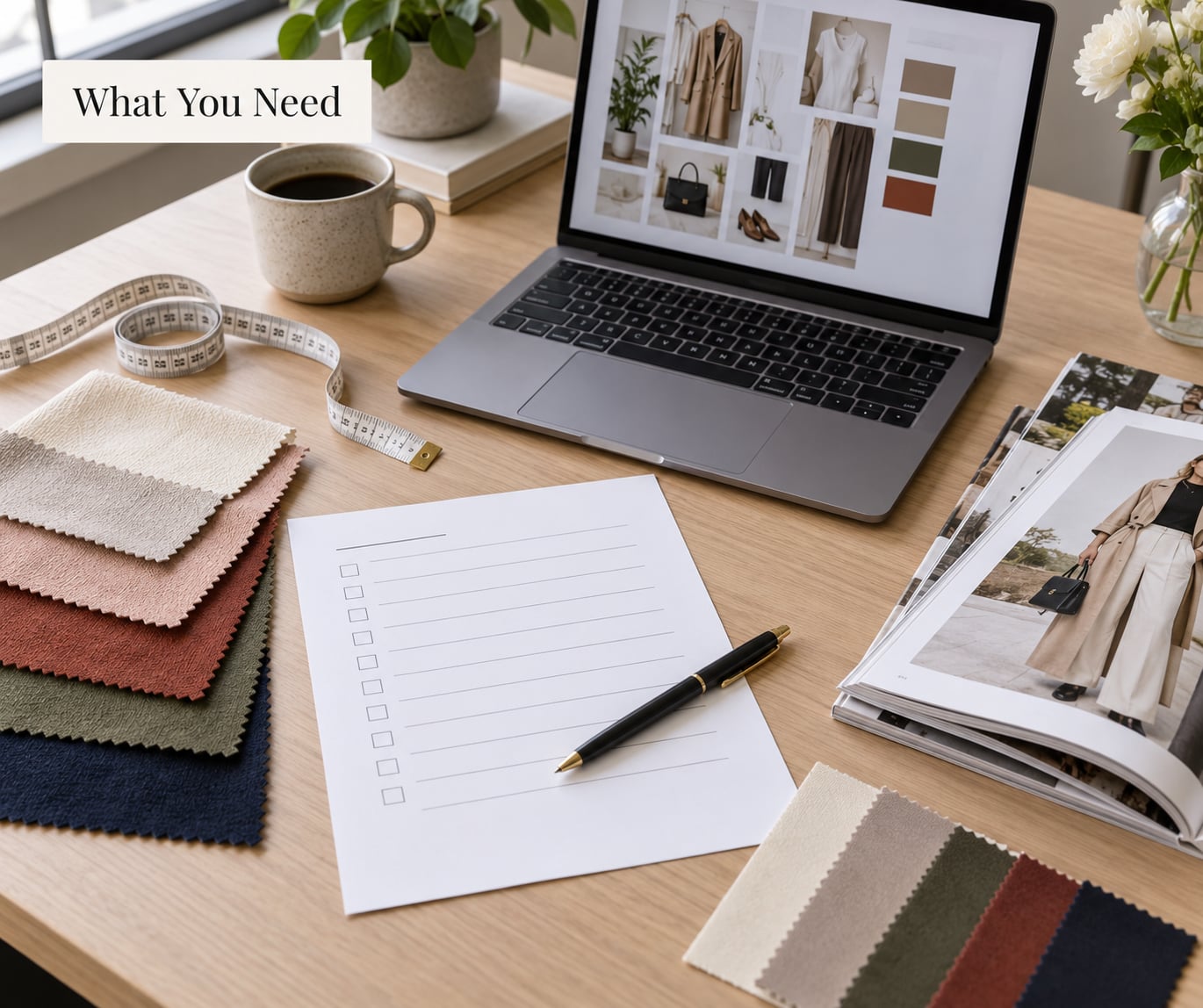
You need less than most people expect. A document to draft in, a place to host the form, and a decision about what the session has to resolve.
- Your service defined in one line. Personal styling, a virtual consultation, a closet edit, personal shopping, event styling and retainer clients all need different questions. Write the sentence you would say on a discovery call, because that sentence tells you what to ask.
- Your last three session notes. Reread them and circle anything you asked twice. Those repeated questions are your form’s spine.
- A drafting document. Draft questions messily first, then tidy. Writing the finished version straight away makes everything sound like a survey instead of a conversation.
- A form host. Google Forms, Typeform, Tally or a client platform’s built-in intake. Paper works for in-person sessions, and you will still want a typed copy for records.
- A privacy line. One sentence saying answers are private, used only for their styling, and deleted on request. It goes at the top of the form.
- A send time in your calendar. Block out twenty minutes to read the returned answers properly, before the session, not during it.
Skip the branding. A neutral header, a clear title and your name is plenty.
Step-by-Step: How to Write a Client Questionnaire for Styling Services
1. Define the service and the client outcome
Start with what has to be true when the session ends. Not what you will do, but what changes for the client. “You leave with a capsule of 30 pieces that covers work, weekends and one trip” is a real outcome. “We review your wardrobe” is not, and it will not tell you what to ask.
Then pick the questions your service cannot work without. An event stylist needs the date, the dress code, the venue and who else is coming. A closet edit needs the number of pieces, what they hate, and how ruthless you are allowed to be. Write your five must-haves in a list and build everything else around them.
2. Start with easy background and scheduling questions
Open with questions that take ten seconds, because early momentum is what carries someone to the harder questions further down. Name, pronouns, city or timezone, how they heard about you, and how many sessions you have had.
Then the logistics. When do they want to look put together by, what is fixed and what is flexible, and what time zone do they actually live in if they travel. Virtual clients give you all of this in three lines. Getting it in writing stops the email thread that would otherwise eat a week of scheduling.
3. Ask about goals, occasions, and definition of success
This is the section clients skip if you write it as a wish list. “What would you like to change about your style?” invites a polite answer. “When do you feel most like yourself, and when do you feel least like yourself?” gets something real.
Ask for occasions rather than categories. A wedding in June, a board meeting every second Tuesday, a three-week trip with one checked bag. Then ask what a good result looks like in six months, in their words. You will quote that sentence back to them at the end of the project, which is one of the easiest ways to prove the work landed.
4. Capture style preferences and lifestyle needs
Preferences come from references, adjectives and dislikes. Ask which three people or brands they admire and why, what they stopped wearing, and which item in their wardrobe they reach for when they want to feel sharp.
Lifestyle questions decide whether your recommendations survive contact with a real Tuesday. Ask what a normal week looks like, what the commute involves, how much they sit, how much they travel, who else shops with them, and how they do laundry. Someone who irons for twenty minutes and someone who lives out of a suitcase need completely different recommendations from the same budget.
Keep body and fit questions phrased around clothes rather than bodies. “Which areas are easy to dress, and which do you avoid?” tells you what to pull. “Do you like your shape?” tells you nothing you can use, and it usually gets a rehearsed answer. If you need fit data, ask for the sizes they buy successfully in trousers, dresses and shoes, and invite photographs of a favourite-fitting garment, front and back.
5. Establish wardrobe, budget, and shopping parameters
Budget is the question stylists avoid because it feels blunt. Ask it as a range with a purpose: what range should I plan each piece within, and is there a separate ceiling for outerwear or shoes. Ranges get honest answers, single figures get negotiated ones.
Then the wardrobe itself. Roughly how many pieces, what proportion still gets worn, which categories are thin, and what they have already tried buying and returned. Add shopping context: which shops they use, whether they prefer shopping with you or alone, whether they want you to order online, and whether anything needs a partner’s approval before it is bought.
If sustainability matters to them, ask how, specifically. Thrifting only, natural fibres, no new logos, a repair-first approach. Otherwise you will make a recommendation they quietly decline.
6. Add accessibility, privacy, and consent questions
Include an optional block for mobility, sensory and comfort considerations: standing time, seated work, heat sensitivity, fabric sensitivities, or anything that rules out a category. Leave it optional and label it optional. Clients tell you far more when they are not forced to tick or untick a box about their body.
State plainly what happens to the answers. Who can see them, how they are stored, how long you keep them, and that you will delete them on request. If you are taking photographs of garments or measurements, say so here too.
Finish with consent. Permission to photograph, permission to use anonymised outfits in your portfolio, and confirmation that the client’s contact details may be used for scheduling and follow-up.
7. Review, test, and refine the client questionnaire
Read it back line by line against one rule: does this answer change a decision you make in the session. If it does not, cut it. Then pilot it on one real client, watch where they hesitate, and shorten wherever the hesitation was.
Send it 48 to 72 hours ahead. Any earlier and it gets forgotten, any later and it does not exist. Ask them to answer from home rather than in the session, because a clipboard in front of you produces polite answers, and an evening at the kitchen table produces honest ones.
Read the returned answers the same day, highlighting recurring words. Three “hate” or “can’t” answers in one section is a signal, and a single one is usually noise.
The copy-paste template
This is the fifteen-question version grouped into the sections above. Duplicate it, delete what does not apply to your service, and change the wording into your own voice.
- Welcome. These answers are private, used only to plan your styling, and deleted on request. How long do you expect this to take?
- What should I call you, and what are your pronouns?
- Where are you based, and what time zone do you work in?
- How did you hear about me, and is this your first session?
- What is the date you want to feel ready by, and what is fixed versus flexible?
- What are you asking for help with this time?
- When do you feel most like yourself, and when do you feel least like yourself?
- Which three people, brands or accounts do you admire, and what specifically do you like about them?
- What have you stopped wearing, and why?
- What does a normal week look like, including commuting, standing time, travel and who shops with you?
- Which areas are easy to dress, and which do you usually avoid?
- What sizes do you buy successfully in trousers, dresses and shoes?
- How many pieces do you own that you wear, and which categories are thin?
- What range should I plan each piece within, and where do you shop most?
- If this goes well, what feels different six months from now?
Add the optional block on mobility, sensory and comfort needs, the photography and storage permission, and a closing line thanking them and naming what happens next.
Common Mistakes and Quick Fixes
Most questionnaires fail for the same handful of reasons, and all of them are quick to fix.
Too many questions. Anything past twenty-five and completion drops off a cliff. Cut anything you would ask conversationally in the first five minutes anyway.
Vague wording. “Describe your style” gets a paragraph of nothing. “Which three items do you own that make you feel best?” gets wardrobe specifics you can build on.
Skipping budget and logistics. These two sections decide whether your recommendations are buyable and repeatable, which is why half the returns come from leaving them out.
Leading questions. “What are your favourite parts of your wardrobe?” produces compliments. “Which pieces do you keep buying versions of?” produces insight, because the answer points at a gap.
No explanation. A short line saying why you need the fit information is what stops clients from guessing rather than answering. Motivation beats nagging every time.
No next step. Close with what happens after they submit, when you will be in touch, and what to have ready for the session.
| Weak question | Stronger rewrite | Why the rewrite works |
|---|---|---|
| What can I do to improve? | What has to happen for you to keep going with this? | The first invites requests you cannot promise; the second surfaces the client’s own success condition. |
| What is your favourite colour? | Which colours do you wear often, and which do you avoid even when they look good on you? | Turns one data point into a working range with a boundary. |
| Do you like your body shape? | Which areas are easy to dress, and which do you usually avoid? | Moves the focus from identity to clothing, which you can actually act on. |
| How much do you want to spend? | What range should I plan each piece within, and is there a separate ceiling for outerwear? | Gets a usable range instead of a number you have to negotiate. |
Two more things that cost you nothing to fix. Ask for one more thing than feels natural, because half of the value is in what nobody would have volunteered. And keep the questionnaire as a working document: bring the answers to the session, point at one of them, and show the client you read it.
How to use the questionnaire for different services
The fifteen questions are a floor, not a ceiling. What changes is the weight you put on each section, and it changes a lot between service types.
| Service | What the questionnaire must resolve | Length |
|---|---|---|
| Virtual consultation | Measurements, photographs, shipping addresses, budget, and what they want to see on screen | 20 questions |
| In-person closet session | What to wear that day, closet access, what can be removed, what the partner or family thinks | 15 questions |
| Wardrobe edit | How ruthless to be, what has sentimental value, what gets donated, who else uses the clothes | 18 questions |
| Event styling | Date, venue, dress code, guests, travel, weather, and the outfit’s role in the photos | 15 questions |
| Seasonal retainer | What changed since last season, new sizes, new budget, what they want more of | 10 questions |
Virtual clients need more measurement and logistics detail than in-person clients, who need more about what to wear and how the session runs. Retainer clients need very little, because you already have the history.
One habit worth building in: after the session, send the questionnaire back with the answers you used highlighted and one line on what you built from them. It is the cheapest follow-up you will ever send, and it is the point where clients realise the form was not paperwork.
Frequently Asked Questions
How many questions should a styling client questionnaire include?
Fifteen to twenty questions is the working range, and most of them should be answerable in one sitting of ten to fifteen minutes. Below ten and you will miss the fit, budget or lifestyle detail that shapes your recommendations. Above twenty-five and completion falls away, because a long form invites two-word answers. If your service is narrow, such as event styling, cut to fifteen. If you run virtual sessions where you never meet in person, go closer to twenty.
What sensitive questions should a stylist avoid asking?
Avoid anything that asks a client to rate or evaluate their own body, including body shape, weight, age or attractiveness. These rarely change what you do, and they usually produce a rehearsed answer or an abandoned form. Keep the focus on clothing instead: which areas are easy to dress, which sizes work, what has not fitted before. Put every sensitive question in an optional block, and say plainly that the answers are private and used only for styling.
Should I require every styling questionnaire field to be completed?
Only make the handful of questions that genuinely block your work required: contact details, the date they want to feel ready by, and budget range. Making all twenty required is the fastest way to teach clients that your form can be ignored. Everything else should be optional, with a short line explaining why you would like an answer. Clients fill in more when a question has a visible purpose, not when it is compulsory.
How do I adapt a client questionnaire for personal styling versus event styling?
Personal styling is about the next six months, so weight the lifestyle, wardrobe audit and budget sections heavily and keep goals broad. Event styling is about one date, so lead with the date, venue, dress code, guests and weather, then move to budget and what they already own that could work. Cut the wider life questions entirely from an event form. The same fifteen-question template works for both; the section order and the emphasis are what change.
What information is most useful before a wardrobe consultation?
A rough count of what they own and what they actually wear, the occasions they dress for in the next few months, their budget range per piece, and the sizes that fit. Those four answers decide nearly everything you do in the room, because they tell you what to pull, what to fix and what you can recommend without a second trip. Style references are helpful but not essential. A client with no reference photos but an honest budget and wardrobe audit will get more value from your hour.
How should I handle a client who leaves questions unanswered?
Send one short follow-up rather than a second copy of the form, naming the two or three sections you actually need and asking directly. Most blanks are time pressure or uncertainty, not refusal. If the required answers still do not arrive, work around the gaps: ask the outstanding questions in the first five minutes of the session and treat the form as a starting point. Once, when it affects scope or price, a clear note that you proceed without shopping or sourcing recommendations is fairer than guessing.
Conclusion
A client questionnaire for styling services earns its keep when every question points at a decision you will make in the room. Fifteen questions, six short sections, sent 48 to 72 hours ahead, with a note about why you are asking and what happens to the answers.
Start with the first draft today: one paragraph on the client’s goals, one on service constraints, one on lifestyle and one on budget. Turn those into fifteen questions, test it on one real client, then refine it. The version you refine is the one that saves you twenty minutes a session and keeps clients coming back for the next season.