
Hourly vs day rate for creative freelancers is a question about who carries the risk. Hourly billing protects the client when scope is fuzzy; a day rate protects you when the work is defined and you want speed to pay you back. Bill by the hour when the brief is still moving. Quote a day rate when the deliverable and the schedule are agreed.
Most freelancers pick one and stick with it, and most regret it. The hourly-only designer gets slower every year without earning more, because being good at the job means finishing early. The day-rate-only creative cannot sell a two-hour task, and spends half the week pitching work that never lands.
This guide walks through both models, shows what your day rate really equals per hour once admin eats into it, gives you the break-even maths, and ends with a hybrid most freelancers should use. Rate benchmarks are typical US and UK freelance ranges and they move; check them against local market data before you quote. Last updated October 2026.
Table of Contents
- Hourly vs Day Rate for Creative Freelancers at a Glance
- What Is an Hourly Rate?
- What Is a Day Rate?
- How Your Pay Changes With Each Model
- How to Calculate Your Break-Even Point
- Which Model Protects You From Slow or Scattered Work?
- How to Set and Defend Your Rate
- How to Choose an Hourly Rate or Day Rate
- Which Should You Choose?
- Frequently Asked Questions
- Can creative freelancers charge both an hourly and day rate?
- How do taxes work when charging a day rate?
- Should a freelancer use a day rate for a retainer?
- What happens if a day-rate project takes longer than expected?
- How often should freelancers raise their rates?
- Conclusion
Hourly vs Day Rate for Creative Freelancers at a Glance
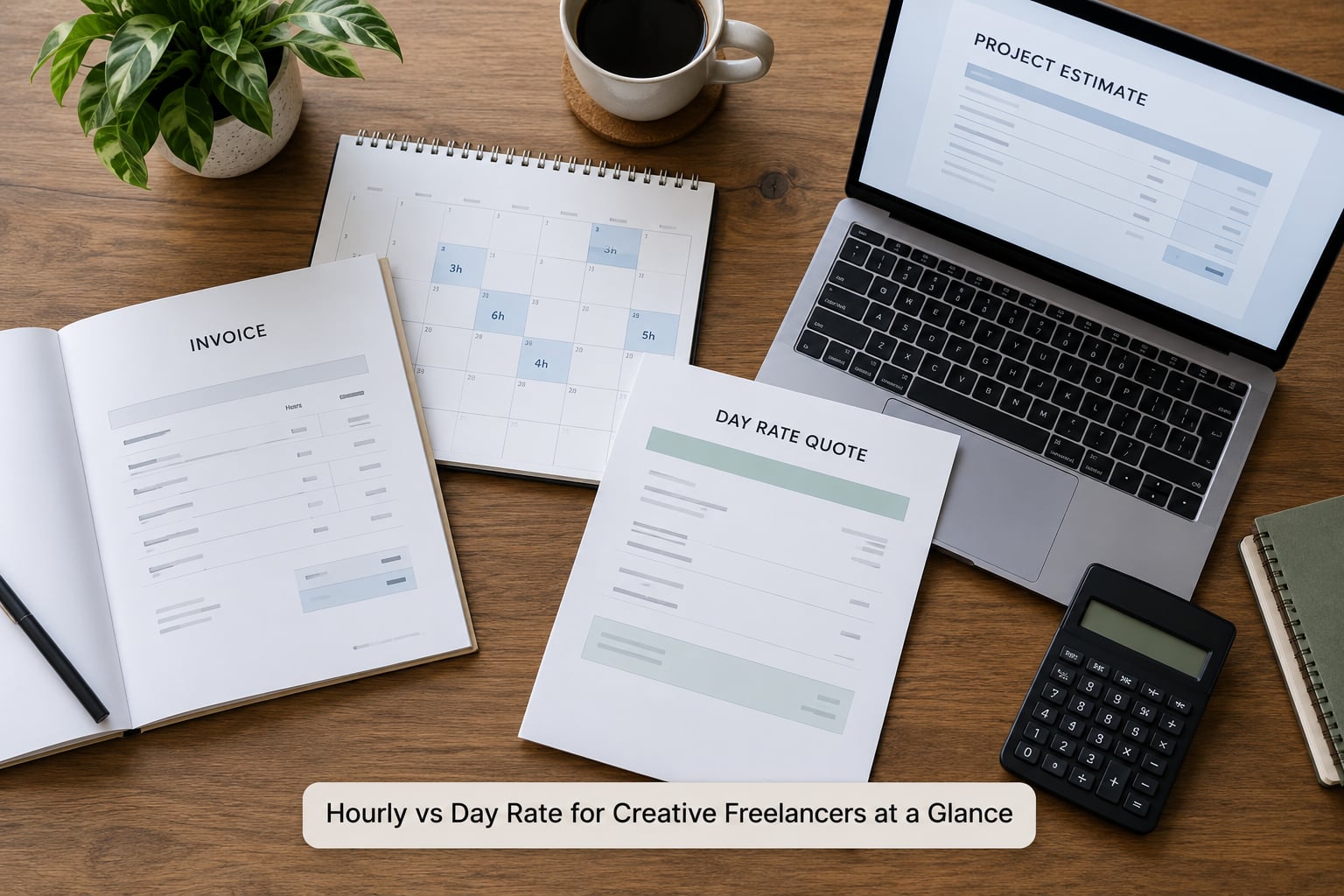
Hourly wins on flexibility and client protection. A day rate wins on predictability and earning power per day worked. Here is the honest split:
| Criterion | Hourly rate | Day rate |
|---|---|---|
| Cost certainty for the client | Low, the budget grows with the clock | High, the client buys a number of days |
| Earnings during active work | Fall as you get faster | Hold steady or rise |
| Protection from slow, scattered work | Strong | Weak unless hours are capped |
| Revision rounds and scope creep | Absorbed naturally | Only if you cap them in writing |
| Payment predictability | Depends on time tracking discipline | Strong, invoiced per day booked |
| Small tasks and quick turnarounds | Easy to sell | Awkward, needs a half-day rate |
| Best fit | Open-ended support, evolving scope, hand-holding | Production blocks, shoots, campaigns, defined deliverables |
One line from a r/freelance thread captures the core argument for day rates: an expert works faster, and under hourly billing that efficiency costs them money. The flip side comes from r/livesound, where a freelancer described a four-day gig where every day ran sixteen to eighteen hours and nobody had agreed which eight of those hours were actually being bought.
What Is an Hourly Rate?
An hourly rate prices your time in billable blocks, usually billed in quarter-hour or half-hour increments. You invoice the hours you worked on that project, and the client’s total depends on how long the work actually took. That simple mechanic is why hourly is the default for new freelancers and why it stays popular with clients who need flexibility.
Hourly billing makes sense when the scope of work is genuinely unknown. A brand identity that starts as three logo routes can turn into packaging, naming and a guidelines document. A writing engagement that begins with one article can become interviews, research and a voice guide. Billing the hour removes the argument about who absorbs the surprise.
A second use case is open-ended support. If a client buys ten hours a month for design tweaks, feedback and the occasional small build, hourly is the only honest way to price it. The same client gets visibility into where the hours went, which matters to almost every buyer.
The calculation is simple: hourly rate multiplied by hours billed equals the invoice. The hard part is the rate itself, and the fact that speed and seniority quietly reduce your earnings under this model unless you keep raising the number.
What Is a Day Rate?
A day rate is a fixed fee for one full working day, usually eight hours, quoted per day or per half-day and invoiced by the day booked rather than by hours spent. It turns your time into a unit the client can budget for, and it pays the same whether the day runs short or long.
One paid day should clearly include eight hours of focused professional time plus the small things that make a day usable: a short catch-up call at the start, a break in the middle, and a handover note at the end. What it should not include is unlimited revisions, an open invitation to hop on calls all afternoon, or production work specified on the spot.
Day rates suit concentrated work with a defined output. A photo shoot day, a two-day campaign concept sprint, three days of editing, a strategy intensive with a deck at the end, or a build block where you disappear into a component library. The client knows how many days they are buying and what comes out of each one.
Set the boundaries in writing and the model holds up. Specify a day as eight hours, name what is excluded, set the number of revision rounds, state the half-day rate, and agree an overage rate for days beyond the estimate. A kit fee for hired equipment and a separate line for expenses keep travel and gear from quietly eating the margin.
A note on UK engagements: the way a day rate is contracted affects tax treatment. Some clients will ask about your IR35 status before booking, and contractors are expected to cover their own tax and national insurance either way. Rules differ by country and change over time, so check the current position for your location.
How Your Pay Changes With Each Model
The same fee can produce very different outcomes depending on how the work actually unfolds. Take a project quoted at a fixed 3,000, which a day-rate freelancer would bill as three days. Under an hourly model at 120 an hour, the maths runs in three directions:
- Work takes 18 hours. Hourly billing returns 2,160. Day-rate billing returns 3,000, because the day was bought at the start.
- Work takes 25 hours. Hourly billing returns 3,000 and the client feels the overrun rather than you.
- Work takes 40 hours after four rounds of revisions and a stakeholder change. Hourly billing returns 4,800. Day-rate billing returns 3,000 unless revisions were capped, and you just worked three full days for less than a third of what you would have earned employed.
The pattern is simple. Hourly billing punishes the client when work spreads and rewards you when you are slow; day-rate billing does the opposite. Neither is fairer in the abstract. The question is which surprise you can afford to absorb.
Here is the other half of the calculation, often skipped by people comparing the two models. Your day rate is not your hourly rate multiplied by eight. The table shows what a 1,000 day rate actually pays per productive hour:
| Billable hours in the day | Day rate paid | Effective hourly rate |
|---|---|---|
| 4 | 1,000 | 250 per hour |
| 5 | 1,000 | 200 per hour |
| 6 | 1,000 | 167 per hour |
| 7 | 1,000 | 143 per hour |
Anyone dividing a day rate by eight to compare it to your hourly rate is comparing two different products. That error shows up constantly in r/consulting threads, where clients treat a day rate as an hourly rate with a bulk discount attached and then question the total.
How to Calculate Your Break-Even Point

Your break-even point is the day rate and billable hours you need to hit your target income after unpaid work. It takes four numbers: your target take-home pay, your annual costs, your realistic utilization rate, and the size of your billable day.
Work through a realistic US example. Say you want 85,000 a year after tax, which means roughly 121,500 gross once you allow for income tax, self-employment tax and health insurance. Add 18,000 of annual costs: software, equipment, insurance, an accountant, a website and marketing. You now need about 139,500 of gross income.
At a 1,000 day rate, that is 140 billable days. Take forty-six working weeks at five days, or 230 available days, and 140 billable days is a utilization rate of 61 percent. That is a good year for a freelancer who also pitches, sells and does admin. Anything above 70 percent means you are not looking for new work hard enough.
Now run the same target on an hourly model. Your billable hours at 61 percent utilization are 230 days times 8 hours times 0.61, or about 1,122 hours. Dividing 139,500 by 1,122 gives an hourly rate of about 124.
| Utilization rate | Billable days | Day rate needed for 139,500 | Hourly rate needed |
|---|---|---|---|
| 50% | 115 | 1,213 | 155 |
| 61% | 140 | 996 | 124 |
| 70% | 161 | 867 | 104 |
The most useful line in that table is the first. Freelancers who quote hourly without measuring their real utilization quietly assume 70 percent billable time, then discover they are billing for twenty billable hours a week and wondering why the bank balance does not move. Measure your utilization over three months of real invoices before you set either number.
One freelancer described the hidden-hourly approach in r/graphic_design: keep an hourly rate for your own calculations, estimate the time from similar past projects, and quote a fixed price to the client without ever revealing the rate underneath. Several others in that thread do the same with package pricing. It is the most common way freelancers reconcile the two models in their heads.
Which Model Protects You From Slow or Scattered Work?
Hourly protects you from interruptions, complicated client decisions and delayed feedback, because all of those things cost the client more rather than you. Day rates are only as safe as the boundaries around them, and most day-rate contracts that go wrong failed on the same three things: uncapped revisions, undefined daily hours and calls that were never scheduled.
Slow or scattered work comes from four places. Meetings that fragment the morning and afternoon into unusable pieces. Feedback that arrives late and triggers rework. Decisions that require five stakeholders instead of one. And small changes treated as quick favours rather than scope changes. Under hourly billing each of those shows up transparently on the invoice, which is exactly why clients find it safe.
Under a day rate you need substitutes. Book the days in a block so the client is not allowed to slot a call into your afternoon. Cap revisions at two rounds, with a defined change fee after that. Name the day as eight hours and set an overage rate, commonly the full day rate again. Agree a kill fee for work cancelled after you have held the dates.
None of this makes day rates risky. It makes them a contract instead of a favour. Freelancers who skip these clauses usually blame the model, when the model was working exactly as designed.
How to Set and Defend Your Rate
Set your rate from the income you need, not from a number you heard in a Facebook group. The formula is simple enough to do in a spreadsheet:
- Set your target take-home income for the year. Work backwards from what you want to live on, not from a salary comparison that assumes you get paid for twelve months of holiday.
- Gross it up for tax. In the US, self-employment tax plus federal and state income tax plus health insurance can consume a quarter of gross income for many freelancers. Get the actual numbers from an accountant rather than guessing.
- Add your annual costs. Software, hardware, insurance, hosting, an accountant, a website, and any marketing you pay for.
- Divide by your billable days. Available days are about 230 a year. Multiply by your real utilization rate, measured from your last twelve months of invoices.
- Add a buffer. Ten to fifteen percent covers slow months, unbillable gaps and the project that eats a month you did not price for.
Then sanity-check against market benchmarks. Typical ranges, which vary by city, seniority and contract length, look like this:
| Discipline | Typical day rate (USD) | Typical day rate (GBP) | Typical hourly (USD) |
|---|---|---|---|
| Creative director | 1,200 to 2,000 | 650 to 1,100 | 150 to 250 |
| Art director | 900 to 1,500 | 550 to 900 | 110 to 190 |
| Senior graphic designer | 650 to 1,100 | 400 to 650 | 80 to 140 |
| Midweight graphic designer | 450 to 750 | 300 to 450 | 60 to 95 |
| Copywriter | 600 to 1,100 | 350 to 650 | 75 to 140 |
| Content strategist | 600 to 1,000 | 400 to 700 | 70 to 130 |
| UX and product designer | 700 to 1,200 | 450 to 750 | 85 to 150 |
| Motion designer | 700 to 1,200 | 400 to 700 | 85 to 150 |
| Producer | 650 to 1,100 | 400 to 650 | 75 to 135 |
| Full stack developer | 800 to 1,400 | 450 to 800 | 95 to 165 |
These are typical US and UK freelance ranges, not a promise, and they shift with region and over time. A senior brand designer quoted in a US city will sit above a national average figure, while a freelancer working remotely for a regional client will sit below it.
When you defend the number, frame it around the day or the outcome rather than around your years of experience. Clients rarely argue with a day rate for a shoot, a strategy intensive or a defined production block. They argue with an hourly number attached to an open brief, because that reads as a risk being passed to them. Present a named scope, a named number of days and a clear boundary around revisions, and the conversation becomes about the work instead of about you.
One Glassdoor poster, a senior visual brand designer, charges 100 to 150 an hour in the US while quoting clients package pricing, with most clients not realising the package nets out to that hourly rate. That is not deception, it is pricing. When the client asks how a two-hour task costs a full day, you have a choice: sell the half-day rate, sell the value, or walk. Know which one you are making.
How to Choose an Hourly Rate or Day Rate
Match the model to how much of the risk you can see. If the number of days is knowable, day rate wins because the client gets certainty and you keep efficiency. If the number of hours is knowable but the days are not, hourly wins. Where neither is knowable, use a hybrid rather than guessing.
- Open-ended assignments. Embedded support, ongoing tweaks, an undefined brief that will grow. Hourly, with a monthly hour cap so the arrangement has a ceiling.
- Fixed-scope projects. A logo family, a photo shoot, a landing page, a defined video edit. Day rate, with days estimated up front and an overage rate attached.
- Urgent work. A rush turnaround. Day rate with a premium multiplier, plus a kill fee. Hourly rate with a rush clause works too, but you have less control over the deadline.
- Retainers. A fixed monthly fee for a set number of days or hours per month, delivered in advance. This is the cleanest version of a retainer because the volume is defined without defining every task.
- Workshops and intensives. One or two days of facilitation with a fixed output. Day rate, plus travel and expenses billed separately.
- Concept pitch work. Speculative or unpaid pitching is a business cost, not a deliverable. Bill it as a project fee or a separate day, or set it against a day rate in the proposal. Never fold it into hourly.
For a side-gig or part-time freelancer, a full day rate can be unsellable when your client only needs four hours a week. In that case set a half-day rate at roughly half your day rate and a short-block rate below that. It is better to have a real rate card than to stretch a day rate across a week and resent the client.
Which Should You Choose?
Choose hourly when the scope is uncertain, the work is interruptible, or you are supporting a team rather than delivering to it. Choose a day rate when the deliverable and the schedule are agreed, when you are being paid for a block of focused production, or when the work rewards you for being fast.
For projects with mixed risk, use a hybrid: day rate for defined production blocks, a project fee for pitch or concept work, and an hourly rate for anything that is genuinely open. That structure is more common in practice than either pure model, and it is the one that survived the rate conversations in the threads I read while researching this.
And if you currently bill hourly because it felt safer, that is worth revisiting. Speed is the whole reason clients hire a senior creative over a junior one, and hourly billing quietly taxes that seniority. Measure your utilization first, then run the break-even numbers above, then decide.
Frequently Asked Questions
Can creative freelancers charge both an hourly and day rate?
Yes, and many do. Keep an hourly rate as your internal measuring stick for estimating effort, then quote clients a day rate or project fee based on that estimate. The rate card can offer all three, as long as the client sees one clear number per engagement rather than a menu that invites haggling.
How do taxes work when charging a day rate?
The tax treatment usually follows the payment, not the label you put on it. In the US, day rate income is generally self-employment income reported on a 1099, with quarterly payments often required. In the UK, how a day rate is contracted can determine whether the client deducts tax under IR35. Rules vary by location and change, so confirm your own position before invoicing.
Should a freelancer use a day rate for a retainer?
Only when the retainer covers defined days or blocks of production. A monthly day rate works well for scheduled production, planning or advisory blocks that are booked in advance. If the client expects ad hoc requests any time, use an hourly retainer with a monthly hour cap, so interruptions stay visible instead of quietly consuming your month.
What happens if a day-rate project takes longer than expected?
You absorb it, unless you wrote the terms in advance. That is why an eight-hour day definition, a revision cap, an overage rate and a kill fee matter so much. Projects overrun for ordinary reasons: unclear briefs, late feedback, extra stakeholders. A written overage clause turns a potential loss into an invoice line.
How often should freelancers raise their rates?
Every twelve to eighteen months is a reasonable rhythm for most freelancers, and immediately when your scope, seniority or cost base changes materially. Review the same time every year rather than mid-project, and give existing clients notice. Raising rates with clients who have known your old number is uncomfortable, and it is still the correct move.
Conclusion
Here is the first thing to do: list the hours you honestly expect the project to take, add your realistic admin and revision time, and divide by a real billable day rather than eight. That gives your effective hourly rate. Then calculate the day rate you need to hit your annual target after tax and costs, and pick the model that puts the risk where it can actually be managed.
If the days are knowable, quote the day. If they are not, quote the hour and cap the hours. If neither is knowable, split the engagement and price both halves.