
You get featured in a gift guide by researching which publications run the kind of guide your product fits, then pitching the named commerce editor with a specific angle, complete assets and a live affiliate program well before that guide locks. It takes two to four months of lead time and costs nothing but research time.
Most small brands get this wrong by treating it like a mass email blast. The work is reverse-engineering, not spraying. Here is the whole roadmap in seven steps.
- Choose one product that passes a giftability test
- Build a list of 20 to 30 publications and the commerce editors who write for them
- Read each publication’s most recent gift guide and note the gaps
- Write a short pitch that opens with why that guide specifically
- Send it to the named editor, one at a time, with every asset attached
- Follow up once after seven to ten days, adding something useful
- Log every send and response so next season starts from data instead of guesswork
The rest of this guide breaks each step down, including the exact pitch templates and the pitching calendar. If you only have time for one thing, build the media list first. Everything else depends on who is actually on it.
Table of Contents
- What You Need Before You Pitch
- Step-by-Step: How to Get Featured in a Gift Guide
- 1. Choose a Product Editors Will Want to Use
- 2. Build a Relevant Editor List
- 3. Research the Recent Gift Guide
- 4. Write a Specific Pitch
- 5. Send the Pitch to the Right Person
- 6. Follow Up Once Without Being Pushy
- 7. Track Results and Learn From the Process
- The Gift Guide Pitching Calendar
- What Every Gift Guide Pitch Must Include
- Common Mistakes
- Frequently Asked Questions
- Can a small brand get featured in a gift guide without a publicist?
- Do gift-guide editors accept free products?
- How do I find the right editor for my product?
- Is it normal to follow up after a gift-guide pitch?
- How long does it take to get featured in a gift guide?
- Conclusion
What You Need Before You Pitch
You need a small kit of assets and one list of names. Without them, the pitch cannot be sent, and an editor who replies asking for a missing piece usually never replies again.
- A product detail sheet: name, SKU, materials, dimensions, price range, where it ships from, and two or three sentences a writer could adapt into copy.
- Photography: at least three usable high-resolution images, on a clean background, plus one lifestyle shot. Send the files through a shared drive link rather than as attachments.
- A working retailer link to the exact page where the product can be bought, tested and photographed by a shoot editor.
- An affiliate program with a stated commission, because most commerce desks will not link to a product they cannot be paid on.
- A giftability note: why this belongs on a gift list rather than a personal shopping list. Sets, bundles and anything with a ready-made presentation win here.
- A media list spreadsheet with columns for publication, guide title, editor name, email, deadline if known, date sent, response and result.
- A tracker for placements, referral traffic and any affiliate revenue that follows.
If your product photography is weak, fix that before you start pitching. A writer needs to shoot it, and a flat image on a white background loses to a considered one every time.
Step-by-Step: How to Get Featured in a Gift Guide
1. Choose a Product Editors Will Want to Use
Choose the product that solves a gift-gifting problem for a specific person, not the product you most want to sell. Editors are filling a reader’s shortlist, so they pick items that are easy to describe, easy to buy and easy to give.
Run a quick giftability check on yourself. Who is the recipient, what occasion are you solving, does the product arrive ready to present, and can you describe the benefit in one sentence? If a product only makes sense with a paragraph of explanation, it is a review candidate rather than a gift guide candidate.
Then verify the boring details editors will check anyway: current availability, shipping times, whether the product page is live, and whether the photos match what ships. Availability is the quiet killer of pitches. A product that sells out mid-research is a wasted pitch and a lost relationship.
2. Build a Relevant Editor List
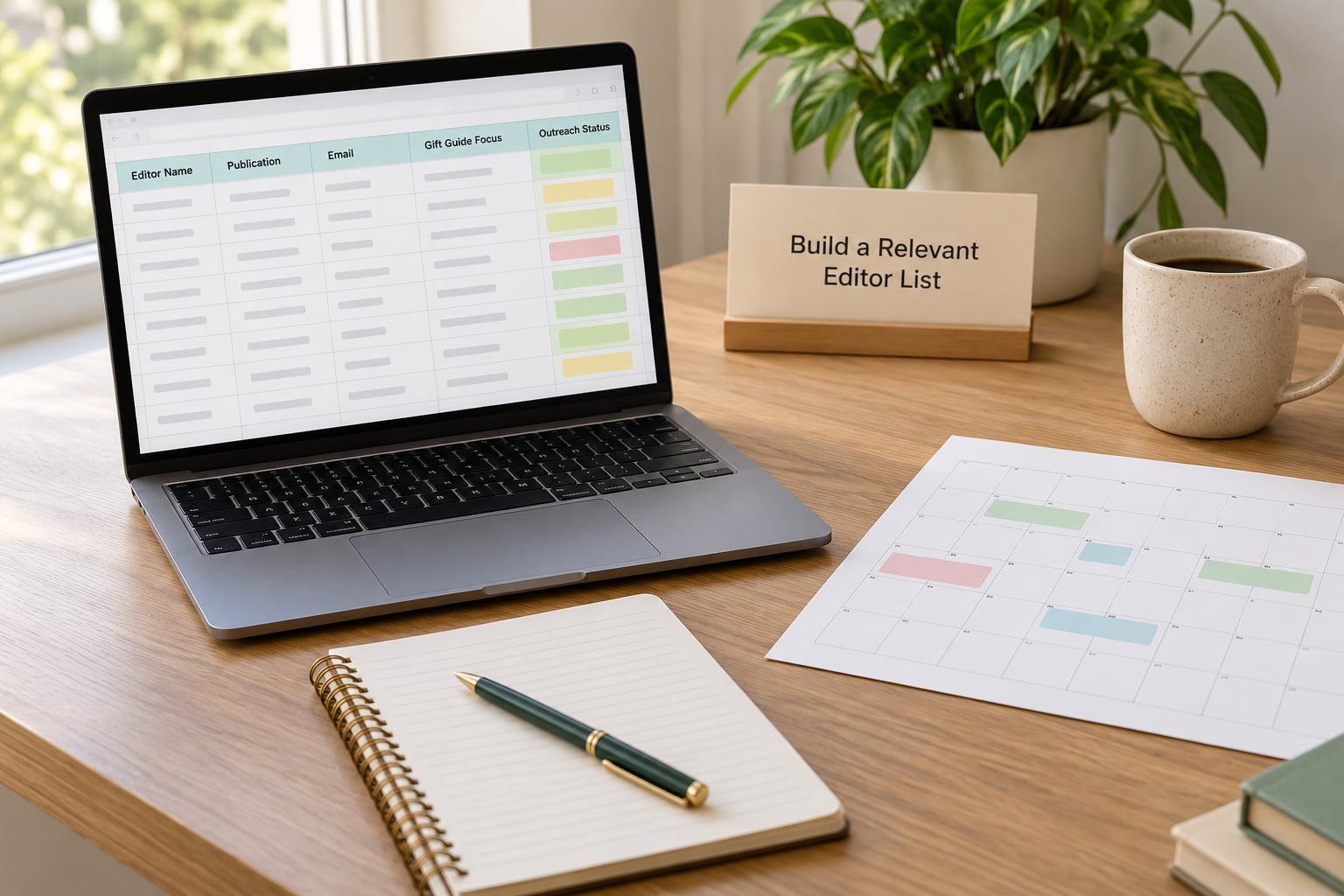
Build your list by publication and by guide title, not by industry. Search for the phrase plus the season and the theme, work through the results, and write down every publication that already runs a guide your product could sit inside.
Then find the person. Most commerce desks publish bylines, so read the byline on the most recent guide and use that name in your search for a contact. The general assignment desk is usually the wrong target. Gift guides are assigned to the commerce or shopping editor who owns that section, and advice from working publicists is consistent on this point.
A useful list of 25 rows looks like this:
- Publication and the exact guide title, so you can reference it later
- The editor’s name and role
- A verified email address
- Whether the publication runs an affiliate program and what the commission is
- Anything published that suggests a gap you could fill
- The date you sent and the date you followed up
Twenty to thirty well-researched targets beat two hundred scraped addresses. Quality is the whole game here.
3. Research the Recent Gift Guide
Read the publication’s latest gift guide end to end before you write a word of your pitch. You are looking for what the editor chose, not what they left out, though the gaps are where your angle comes from.
Note the categories and how many items sit in each one. Look at the price bands they use and the order they run in. Check whether selections are one product per brand or whether several products from one company ever appear. Some of the biggest gift guides explicitly limit how many picks any single brand can hold, and pitching without knowing that wastes your one chance.
Also read the intro and any contributor notes. If the publication states submission guidelines, follow them to the letter. One of the two instant-rejection triggers named by working commerce writers is ignoring stated instructions, and it is a much easier mistake to avoid than it is to recover from.
4. Write a Specific Pitch
A good gift guide pitch is short, specific and gives the editor something to work with. Six things belong in it, in this order.
- Why this guide: name the publication, the guide and the gap you noticed.
- What the product is: one line, plain language, no brand adjectives.
- Who it is for: the recipient and the occasion.
- Useful detail: price range, materials, dimensions, availability, shipping.
- What you are supplying: high-resolution images with credit, a retailer link, sample availability and the affiliate rate.
- A clear next step: ask whether it fits the guide, and say you can send a sample.
Customise the first line for every editor. It is the only part that proves you read their work, and it is the part that gets you past the delete key. Fill-in-the-blank version:
Subject: Gift guide idea for [Guide name] — [specific product]
Hi [First name],
I read your [Guide name] from [month/year] and noticed [specific observation, such as the small number of options for X].
[Product name] is [one-line description]. It suits [recipient] for [occasion], and [one useful differentiator].
Details: [price range], [materials or dimensions], [where it ships and when]. [Retailer link].
I have high-resolution images with photo credit ready, an affiliate programme paying [rate], and can send a sample this week if that helps.
Would it fit the guide? Happy to send anything else you need.
Best,
[Your name]
[Brand]
[Contact details]
5. Send the Pitch to the Right Person
Verify the address before you send. A bounce costs you a contact, and a contact who receives an error from a stranger is unlikely to reply later.
Keep the subject line plain and specific. A weak subject line looks like “Great gift idea for your holiday guide.” A stronger one names the guide and the product, and reads like a colleague rather than a promoter. Skip the puns; working publicists advise against them consistently.
Send individual emails, one recipient at a time. Bulk tools that send thousands of identical messages in a single send are how a pitch ends up in a spam folder, and they strip the personalisation that made the pitch worth sending in the first place.
Send on a Tuesday or Wednesday morning. Nothing lands well on a Friday afternoon when an editor is closing out the week, and holiday-season inboxes are worse than usual. If a publication has a stated deadline, work backwards from it rather than guessing.
6. Follow Up Once Without Being Pushy
One follow-up is acceptable. Two is the limit, and the second one only makes sense if it carries something new. The lightest touch that still works is a single note seven to ten days after the first email.
Subject: Re: [original subject line]
Hi [First name],
Following up on my note below. One thing that might be useful for this guide: [new detail, such as the new colourway, the restock date or the gift set packaging].
Still happy to send a sample or resend images if it helps.
Best,
[Your name]
After the second touch, stop. Silence in gift guide pitching is usually a decision rather than an oversight. One guide can receive thousands of pitches, and a no is a no. Write the result in your tracker and move to the next name.
What matters is the long game. The same commerce editor who ignores a holiday pitch in August may use your product in a Mother’s Day roundup the following spring, or mention you when a topic comes up unprompted. Publicists who keep working lists report that most placements come from second and third contact over multiple seasons.
7. Track Results and Learn From the Process

Track every pitch, because the pattern is the lesson. If twenty targeted pitches produce two placements, your list is working and your copy needs work. If twenty produce none, the problem is usually the product fit or the timing, not the email.
Log the columns that matter: publication, editor, date sent, date followed up, response type, product pitched, result, and any commission earned. Then add two numbers per placement: referral sessions and revenue, if your analytics and affiliate platform can attribute them.
When a placement lands, ask the editor whether the page can include structured data for the products, and keep the link live. If a guide is retired, ask politely whether it can redirect rather than disappearing.
Then do the part most people skip. Share the placement on your own channels with the editor credited by name, add it to your press page, and reference it in your next pitch to that outlet. A guide inclusion you never mention is a backlink no one visits and proof no future editor sees.
Finally, pitch the next season. The editor already knows your product, your photography is already approved, and your host and packaging are already solved. That is why the second season is easier than the first.
The Gift Guide Pitching Calendar
Timing is the one variable that can override a good pitch. Print titles commission holiday gift guides months before publication, while digital publications keep refreshing guides well into the season.
| Period | What is happening on the editorial side | Your move |
|---|---|---|
| May to June | Digital and regional guides are commissioned; annual print planning begins | Build the media list, finalise photography, set up the affiliate programme |
| July | Print national magazines lock holiday gift guide assignments | Send first-round pitches with assets complete |
| August | Major annual list deadlines fall, such as Oprah’s Favorite Things on August 7 | Follow up once; send samples to warm contacts |
| September | Digital guides are assembled; product photography is scheduled | Pitch remaining targets, warm up contacts for spring moments |
| October and November | Digital and last-minute or quick-ship guides are still published and updated | Late pitches are still viable; emphasise availability and shipping speed |
| January to April | Valentine’s, Mother’s Day and spring roundups are commissioned | Follow up on silence, publish results, reset the list |
Normal lead time is three to four months, and it stretches beyond six months for print national titles. A useful rule of thumb from agency practice: two to four weeks for standard product roundups, four to six weeks for seasonal gift guides.
What Every Gift Guide Pitch Must Include
Commerce desks work through hundreds of pitches against a fixed deadline. They need the same handful of items in the same format every time, and a pitch missing one of these gets cut.
| Item | Why the editor needs it | Required format |
|---|---|---|
| Product name and SKU | Links the pitch to a shootable, buyable item | Plain text |
| What it does and what makes it different | Becomes the first line of the listing copy | Two plain sentences, no adjectives |
| Price range | Fits the guide’s budget category and its readers | A stated range or exact figure |
| Retailer link | The affiliate or referral link goes straight into the page | One live URL, tested |
| High-resolution images with credit | Shoot editors need clean files and a credit line | Shared drive link, 3 plus images, descriptive filenames |
| Affiliate programme and commission | Most desks will not link without a way to be paid | Network name and percentage |
| Availability and shipping | Keeps a published pick from going dead after publication | Restock date and ship window |
| Sample offer | A physical sample changes the odds more than any copy change | One line, no strings attached |
Never send an email with twenty URLs. Never attach a 400-image gallery. Never name a file img0001.jpg. These are the small behaviours that tell an editor you have never done this before.
Common Mistakes
Most rejected pitches fail on process rather than product. These are the ones I see repeated, with the fix for each.
- Mass sending the same message. One personalised email beats fifty near-identical ones. Fix: personalise the first line for every recipient and send individually.
- Offering money or paying for placement. It is not buying coverage, and the offer itself ends the conversation. Fix: offer an affiliate commission instead, which is standard practice and legitimate.
- Missing the deadline. Print titles lock assignments months ahead. Fix: work backwards from the publication’s stated deadline and land your pitch two weeks before it.
- Sending incomplete details. A pitch with no retailer link, no price and no availability is the rejection trigger working as designed. Fix: run the checklist above before every send.
- Broken or unverified links. The editor tries to buy the product, fails, and moves on. Fix: open every link in a private window the day you send.
- Following up too often. Three emails turns a no into a block. Fix: one follow-up after seven to ten days, then stop and log it.
Two extra tips. Send no-strings samples of products that are currently available, months before the holiday ask, so the editor meets the brand before the pitch arrives. And if you are starting late, shift your angle to evergreen, last-minute and quick-ship gift guides, which are still being written and updated in October and November.
Frequently Asked Questions
Can a small brand get featured in a gift guide without a publicist?
Yes. The work is research, writing and follow-up, and a founder can do all three. Publicists are useful for volume and for relationships at large outlets, but most small brands win by building a tighter list of 20 to 30 well-researched targets rather than a large untargeted one. The main prerequisite is time: plan two to four months ahead so photography, retailer links and the affiliate programme are ready before you send anything.
Do gift-guide editors accept free products?
Most do, and most treat samples as a normal part of the process rather than a favour. The etiquette is to offer a sample in the pitch and send it without any strings attached. Never make coverage a condition of the gift, and never frame it as a trade. Sending a product that is genuinely useful, with a short note and no ask attached, is often the fastest way to build a working relationship with a commerce editor.
How do I find the right editor for my product?
Search for gift guides matching your product’s category, theme and season, then work through the publications that publish them. Read the byline on the most recent guide to identify the commerce or shopping editor who owns that section, and look for a contact address on the publication’s site or in their professional profile. Record for each target why your product is a genuine fit, because that note becomes the opening line of the pitch.
Is it normal to follow up after a gift-guide pitch?
One follow-up is normal and expected. Send it seven to ten days later, keep the same subject line thread, and add something useful such as a new colourway, a restock date or gift-set packaging. Do not resend the original message and do not ask whether they received it. If the second touch gets no reply, the answer is no, so log it, stop, and keep the relationship warm for a future roundup.
How long does it take to get featured in a gift guide?
Plan on two to four months from first research to publication for most digital guides, and six months or more for print national titles. A single roundup can receive thousands of pitches, so a reply within a few weeks is a good outcome rather than a promise. Pitching late is not fatal: digital and quick-ship guides are still commissioned and updated in October and November, though earlier work makes your asset list look more professional.
Conclusion
How to get featured in a gift guide comes down to three things: pick a product that is genuinely giftable, research a short list of publications and the named commerce editors who write for them, then send a specific pitch with every asset ready before the deadline.
Start today with this sequence. Choose one product and run it through the giftability check. Find five gift guides your product could sit inside and note the editor by name on each. Write one personalised pitch using the template above, verify the retailer link, and send it Tuesday morning.
One well-researched pitch teaches you more than a hundred sent in bulk. Keep the tracker, follow up once, and by next season you will have a list, a set of approved photography and real numbers to plan against.