Knowing how to read a runway look book comes down to one habit: walk the looks in the order they were shown and describe what repeats — silhouette, proportion, drape, construction and color. The opening look sets the proposition, the middle proves the range, and the closing look restates the argument. Anything that appears once is an accent. Anything that appears across the show is the collection’s actual idea, and only those repeated signals are candidates for the trend cycle.
That distinction is the whole skill. A show can contain one unforgettable dress that gets screenshotted all week while the real message sits quietly in looks four, five and six. Learning to see past the single famous exit is what separates a reaction from a read.
Table of Contents
- What You Need
- Step-by-Step: How to Read a Runway Look Book
- 1. Start With the Collection Context
- 2. Identify the Dominant Silhouette
- 3. Separate Garments From Styling
- 4. Read Color as a System
- 5. Look for Repeated Details
- 6. Compare Looks, Not Just Outfits
- 7. Track the Model or the Body
- 8. Write a Collection-Level Summary
- Common Mistakes
- Frequently Asked Questions
- What is a runway look book?
- Can I read a runway look book without fashion experience?
- What should I look at first in a runway look book?
- How do I tell the difference between a trend and a collection theme?
- How do I analyze a runway look if I cannot see the live show?
- What vocabulary should I use when describing a runway look?
- Conclusion
What You Need
You need four things, and none of them cost money.
- The look book itself. Ideally the full show video, or the photographed set of every look in walking order. A look book is only a document if it is in sequence.
- Show credits and context. Season, venue, casting, show notes, and who the designer said they were thinking about. Most designers publish show notes or interviews alongside the collection, and those notes are often more honest about intent than the clothes are.
- A notebook or annotation tool. Paper works fine. A simple table with one row per look and columns for silhouette, color, fabric and styling will turn an hour of scrolling into something you can actually use later.
- Working garment vocabulary. You do not need a fashion degree. You need about fifteen words: silhouette, proportion, drape, volume, construction, line, palette, hardware, trim, tailoring, hand, seam, hem, neckline, closure.
You also need the full show, not the clips. Runway coverage is edited, and the edit decides what you see. Short-form clips tend to feature the moments with a strong silhouette or a surprising reveal, which is precisely the sample most likely to mislead you. As one commenter put it on a fashion discussion board, runway is “an analytical challenge because it is not really a literal preview.”
Free sources will carry you a long way. Vogue Runway gives the closest detail shots and the most careful credits, though it sits behind a subscription, which is a recurring complaint. WWD is free and faster. BoF is written for buyers, so its coverage leans commercial. Designers’ own YouTube and Instagram accounts post the collection immediately, and by 2026 that is usually the fastest route to a clean, uncut look book.
Step-by-Step: How to Read a Runway Look Book
1. Start With the Collection Context
Context comes first because it changes what the clothes mean. Note the season, the city, the time slot in the fashion week calendar, the venue, and the season type: ready-to-wear, haute couture, resort or pre-fall.
These are different documents with different jobs. A resort collection is designed for holiday wardrobes and sold to boutiques rather than to department store buyers. Haute couture is made to order for a small number of clients and is not a forecasting tool at all. A ready-to-wear show is the one that feeds the retail cycle.
Before you judge a single look, spend two minutes on the credits. Who cast it, what music, what lighting, what the designer said in the show notes. The music and venue are styling decisions, and they will colour your read of the clothes if you let them.
2. Identify the Dominant Silhouette
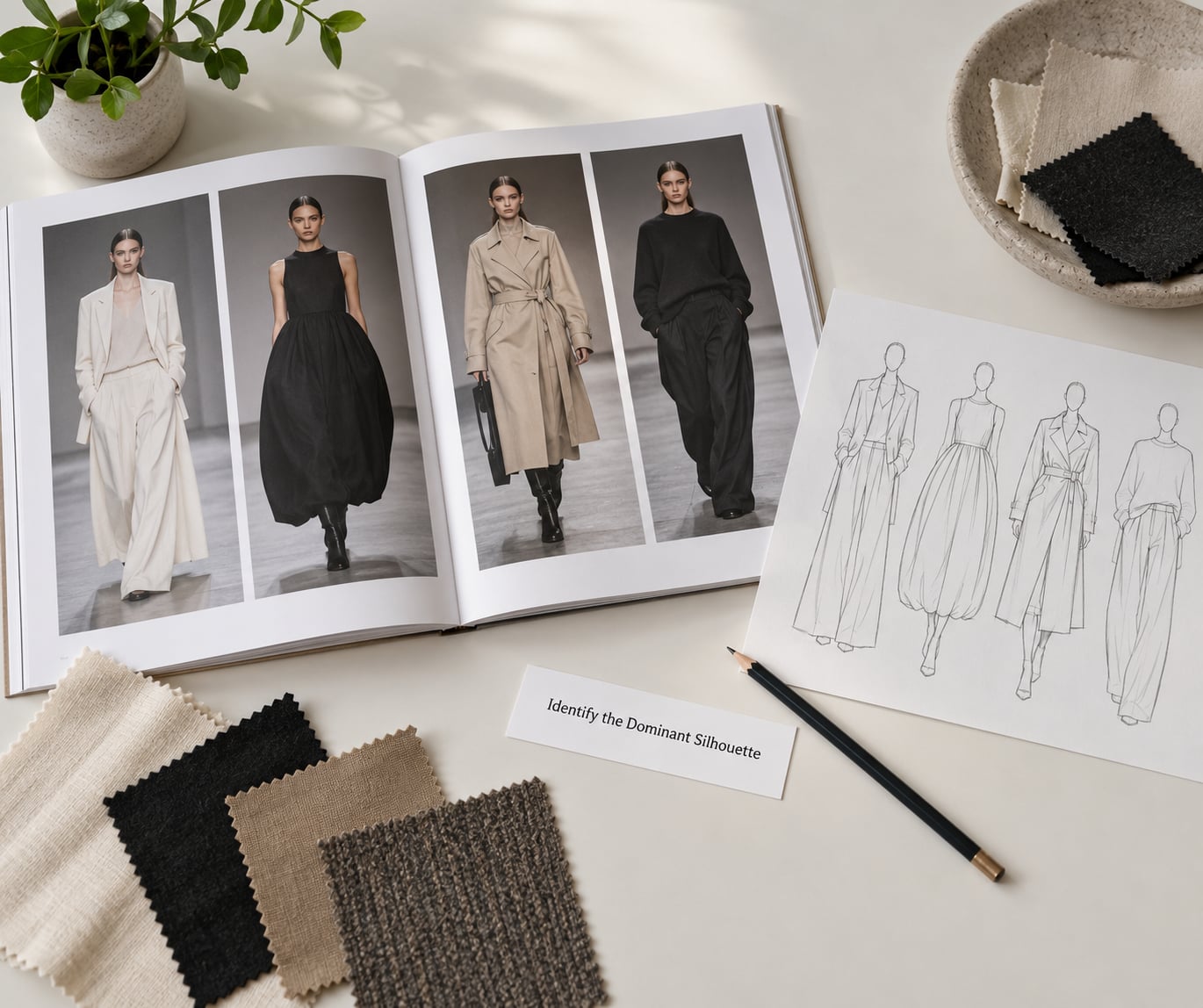
Silhouette is the overall shape the body makes, and it is the fastest way to describe a collection. Name the proportion rather than listing the garments. A look made of a wide shoulder and a narrow hem is a wedge; a single unbroken line from shoulder to floor is a column.
The useful vocabulary for proportion is small and specific:
- Oversized — volume deliberately added on top of the body.
- Columnar — one continuous vertical line, usually narrow, no waist definition.
- Cropped — the hem sits above the natural waist or the trouser break, so the eye stops short.
- Hourglass — defined waist with volume above and below.
- Layered — pieces stacked so the body reads as depth rather than outline.
- Draped — fabric falling from a single point or edge rather than being cut to shape.
- A-line, sheath, cocoon, cocoon-like blouson — named shapes worth learning one at a time.
Go through the whole show once and write down only the silhouettes. If you write the same word six or seven times, you have found the dominant shape. If you write eight different words, you have a collection built on variety, and that is a legitimate and interesting choice too.
3. Separate Garments From Styling
This is where beginners misread most often, and it is the single biggest source of bad trend forecasts. A runway image contains the garment plus footwear, bag, hat, jewellery, hosiery, gloves, outerwear, makeup, hair, and the model’s posture and pace.
Make two lists for every look. The first column is clothing the designer actually made. The second is styling, which may have been pulled from the props department, the archive, a sponsor, or a stylist who was told to make everything look like one idea.
Then ask which styling pieces repeat. If every look has a wide black belt, that belt is part of the proposition even if it is not a garment. If one look has chrome sunglasses and no other does, the sunglasses are a styling accident.
Be honest about the limits here. A heavily art-directed photograph, a dramatic pose and low lighting can make an ordinary garment look extraordinary. If you are evaluating whether a shape will sell, look at a second photograph of the same look from a different angle before you commit to a note.
4. Read Color as a System
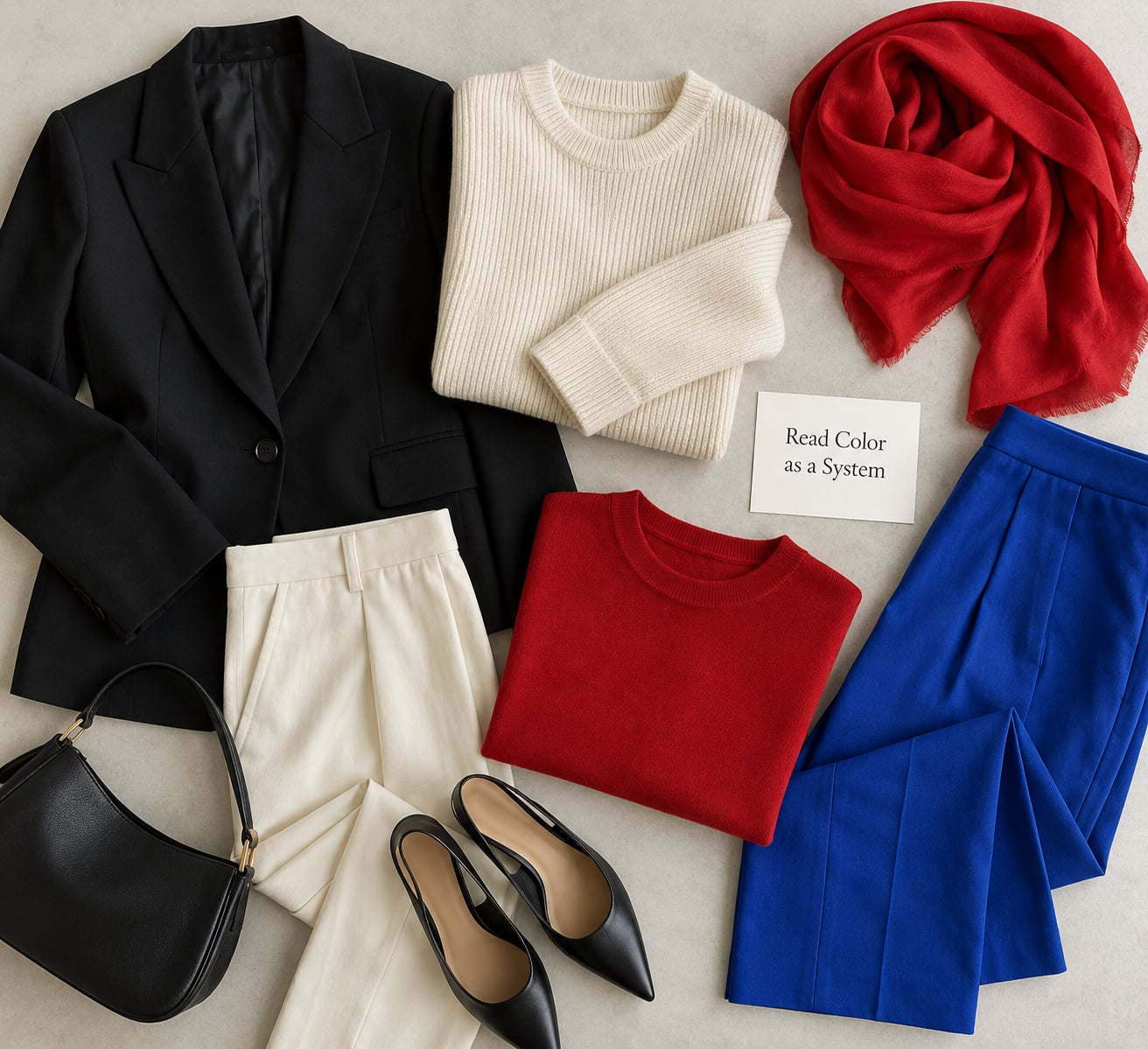
Treat color as a system with three layers, not as a list of individual outfits. The dominant tone covers the largest share of looks. Secondary tones support or answer it. Accent colors appear rarely and deliberately, and they are the ones that get remembered and photographed out of context.
Note the neutrals too. Black, cream, grey and navy are a palette choice, and a collection built on them is making a different argument from one built on saturated color. A designer who sends 30 of 40 looks in a narrow range is telling you the accent look at look 12 is intentional.
Write down the ratios rather than the shades: roughly how much is neutral, how much is color, how many accent looks are there. When a trend forecaster later reports a color as the season’s story, this is the raw material they used.
5. Look for Repeated Details
Details are where a designer’s hand shows up, and they are the strongest evidence you have for intent. Scan every look for the same construction decisions appearing again: a particular seam, hemline, cuff treatment, collar shape, button, buckle, print scale, or textile.
Some recurring things worth counting separately:
- Construction. Padding, quilting, exposed seams, bonded panels, hand-finished hems.
- Trims and hardware. Ribbing, piping, toggles, buckles, zips, drawcords.
- Print and motif. A pattern repeated across several looks means it is a signature, not an accident.
- Texture and fabric hand. Nylon, brushed wool, crisp poplin, heavy denim, sheer layers.
- Hemlines and sleeves. A sleeve length that never changes across the show is a deliberate line.
My rule is simple: three appearances makes it a motif, one appearance makes it an experiment. Write the number in your table so you are not relying on memory when you look back at the show a week later.
6. Compare Looks, Not Just Outfits
Reading one outfit at a time gives you a list. Comparing looks gives you an argument. Put the first and last look side by side, then the two looks that seem to contradict each other.
Ask what changed and what held. The shoulder line stayed but the hem went from full to cropped. The palette held steady while the fabric changed completely from matte to reflective. Every change you can name is a decision the designer made, and every thing that held is a decision too.
Some shows deliberately place a counterpoint in the middle. A couture show may run dozens of related looks and then break them with one piece from a different reference, to keep the eye awake. If you spot a look that belongs to nothing else, check the show order again.
7. Track the Model or the Body
The body is part of the image, and it distorts what you see. A longer stride makes a garment look more fluid. A strong pose hides a construction detail. A model walking slowly in a heavy coat reads very differently from the same coat on a fast walk.
Casting is a styling decision too. A show cast entirely with one model, or with a single visible body type across the lineup, is pushing a message about the brand as much as about the clothes. Reading that is part of reading the collection, as long as you keep your attention on how the garment sits.
Practical rule: if a look only makes sense because of how it is being presented, you have found a halo look. Those looks get imitated in costume and never reach a shop. Note them separately so you do not build a wardrobe plan on them.
8. Write a Collection-Level Summary
Finish with a short paragraph, not a list. Six sentences covers most collections well: the dominant silhouette, the palette, the main fabrics, the recurring details, the styling logic, and the effect the show had on you.
The test of a good summary is that it would still make sense if the pictures were removed. If your notes only work while you are looking at the images, you described the photography, not the clothes.
Some designers in the r/fashiondesigner community build this habit into tooling rather than notebooks, pulling downloaded show photography into colour extraction to see the palette before they commit to a read. Whether you use a spreadsheet or a pen, the discipline is the same: count repeats, not impressions.
Common Mistakes
Judging looks in isolation. The fix is to read the show twice: once for the individual outfits, once for the sequence. The first pass gives you texture, the second gives you argument.
Describing only color. A palette tells you about mood, not about clothes. Anyone can name black. Name the silhouette, then the fabric, then the color.
Treating accessories as separate. Shoes, bags and jewellery are part of the styling and sometimes part of the proposition, but they are not the collection. Keep them in their own column.
Confusing trend language with analysis. Writing that a show was “bold” or “edgy” tells a reader nothing. Writing that the collection held one shoulder line across 30 of 40 looks while the hem shortened by half tells them everything.
Overreading one dramatic look. A single extreme piece is often theatre, reference, or a gift to a stylist and photographer. Weight it by its neighbours.
Ignoring source bias. Clips get filmed first for the strong silhouettes, the show is edited before you see it, and the best-covered shows are the ones with budget and access. Know the pipeline before you trust the sample.
A few habits make this stick. Compare two collections side by side rather than one in isolation, because your read of a single show is always influenced by whatever you saw last. Keep a shared vocabulary list, even a small one, so your notes stay consistent across shows. And revisit the collection a month later to see which signals actually appeared in shops, because that check is where the real learning happens.
Frequently Asked Questions
What is a runway look book?
A runway look book is the visual document of a designer’s collection: usually the full show video, or a photographed set showing every look in the order it walked, often paired with credits and a written review. It is a document rather than a highlight reel, which is why sequence matters. Reading one means walking the looks in order and describing what repeats across them.
Can I read a runway look book without fashion experience?
Yes, and the method is easier than it looks. You only need a small vocabulary, roughly fifteen words covering silhouette, proportion, drape, construction and palette, plus the discipline of counting repeats instead of reacting. The skill is observational rather than technical. Most people who get good at it simply watch more shows and keep notes in the same format each time.
What should I look at first in a runway look book?
Start with the opening look and the credits, then the closing look. Those three things set the collection’s boundaries: the first look usually proposes an idea and the last restates it. Everything in between is either developing that idea or deliberately contradicting it. Reading the ends first gives you a frame, and the middle becomes much easier to interpret once you know what the show is arguing.
How do I tell the difference between a trend and a collection theme?
A collection theme is what one designer did in one show, and it may be entirely personal to that season. A trend is a signal that appears across several designers, several shows, and then shows up in retail and on the street. Runway alone is a weak predictor. Confirm a trend by checking street style photographs and what buyers actually ordered before you treat anything as a trend rather than a theme.
How do I analyze a runway look if I cannot see the live show?
Work from the full recorded show or a complete photographed set, not clips. A sequence of stills in walking order works well because the order carries meaning, and the credits will tell you the season type and venue. If only highlights are available, treat your read as provisional and note that limitation, because the edit already decided which looks you are seeing.
What vocabulary should I use when describing a runway look?
Lead with proportion, then construction, then fabric, then color. Words like oversized, columnar, cropped, layered, draped, cocoon and A-line describe shape; structured, bonded, quilted, pleated and draped describe construction. Naming the garment itself should come last, because a good description tells the reader what shape the body made before it lists what the person was wearing.
Conclusion
A runway look book is a sequence, not a mood board, and reading it well comes down to one habit: count what repeats before you react to what is striking. The opening look, the dominant silhouette, the palette ratios, the recurring construction details and the styling kept in its own column will tell you more than any single famous exit ever could.
Start with one collection this week. Pick the look that stopped you, name its silhouette in one word, list the styling separately from the clothing, and then walk the other thirty-odd looks counting how often that same silhouette appears. Write one sentence at the end that would still make sense without a single picture in front of you. If you can do that for three shows in a row, you are reading look books rather than reacting to them, and you will be a much better judge of what is actually heading for stores.