What measurements modeling agencies look for comes down to four numbers: your height, bust, waist and hips. On top of those, agents record your shoe size, clothing size, inseam and age, then add the non-body specs like hair, eyes and tattoos. None of it is about beauty. It is about whether you can wear a client’s sample garment and show the clothing properly on camera. Updated October 2026.
Below, the numbers are market references rather than agency rules. Every major agency sets its own submission requirements, and those shift with the client and the season, so always check the submission page of the agency you are actually approaching.
Table of Contents
- What Measurements Modeling Agencies Look For at a Glance
- Which Body Measurements Do Modeling Agencies Request?
- What Measurements Modeling Agencies Look For by Modeling Market
- Women’s markets
- Men’s markets
- How to Read the Measurements Modeling Agencies Look For
- Does Your Body Have to Match an Agency’s Ideal Measurements?
- How to Measure Yourself Accurately at Home
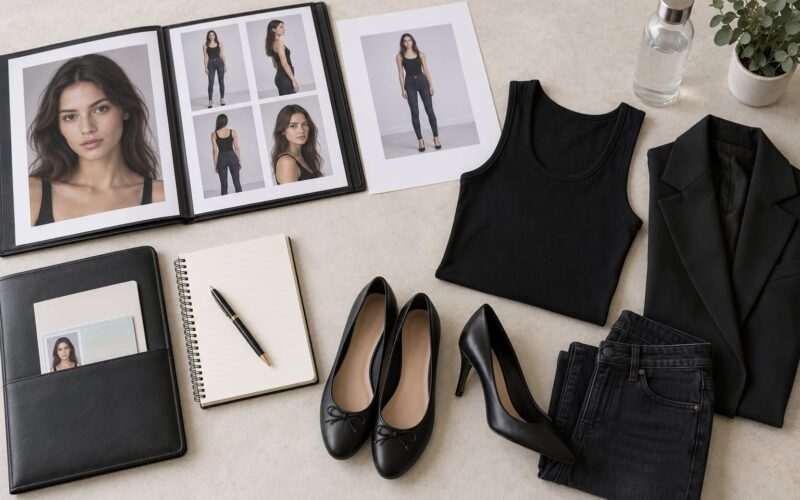
- What Should You Put on Your Model Comp Card?
- How Agencies Verify and Update Your Measurements
- Common Measurement Myths and Mistakes
- Frequently Asked Questions
- Can I become a model if I do not fit an agency’s published measurements?
- Do modeling agencies measure you in person before signing you?
- Should a model comp card include measurements in inches or centimeters?
- What clothing size should I write on a comp card?
- How often should I update my modeling measurements and comp card?
- Conclusion
What Measurements Modeling Agencies Look For at a Glance
| Figure | What it tells the agency | Common reference range (women) | Common reference range (men) |
|---|---|---|---|
| Height | The first field agents read and the hardest one to change | 5 ft 9 in to 6 ft 0 in (175-183 cm) for runway, lower for commercial | 6 ft 0 in to 6 ft 3 in (183-191 cm) for runway |
| Bust or chest | Sample size and garment drape | 32-34 in (81-86 cm) commercial, 32-34 in (81-86 cm) runway | 39-42 in (99-107 cm) |
| Natural waist | How a silhouette hangs and how tailoring is altered | 24-25 in (61-64 cm) | 32-34 in (81-86 cm) |
| Hips | Trouser and skirt fit, plus the proportion clients brief on | 34-36 in (86-91 cm) | 39-41 in (99-104 cm) |
| Shoe size | Footwear and whether you can walk in a given heel | US 6 to 10 (EU 38-42) | US 9 to 13 (EU 42-47) |
| Clothing size | The label a stylist will order samples in | US 0 to 4 | US 30 to 34 |
| Inseam | Denim, tailored trousers and legwear | 31-34 in (79-86 cm) | 32-35 in (81-89 cm) |
Why height leads the list is not mysterious. Industry guides on client booking data report that around 80 percent of briefs specify height first, roughly 70 percent include a clothing size, and about 65 percent ask for appearance details. The agency filters its roster against those briefs before anyone looks at your portfolio.
The reason is sample size. Collections are cut to one standard size, made up in a handful of samples, and shown on those samples. If you cannot wear the sample, the garment cannot be shown properly, and the client says no. That is why there is a floor and a ceiling rather than one ideal height.
Which Body Measurements Do Modeling Agencies Request?
Bust or chest is the first circumference, taken across the fullest part with the tape level around the back. For women it is measured while wearing a well-fitting bra; for men it sits under the pecs and across the shoulder blades, so a shirt does not add width.
Underbust, the circumference directly beneath the bust line, tells the agent how garments will sit on you. It is not always requested, but runway and lingerie bookings ask for it because sample garments are drafted from it.
Natural waist is the narrowest point of the torso, usually just above the navel. It is the figure clients care about most when briefing a fitted look, and the one people most often measure wrong by pulling the tape tight.
Hips are measured at the widest point, usually 8-10 in (20-25 cm) below the natural waist, across the fullest part of the seat. If you are unsure, keep the tape level all the way around and mirror what you did at the bust.
Inseam runs from the crotch seam to the hem of the trouser leg, which is not the same as your full leg length. It matters for denim and tailored trousers, where a stylist orders a specific rise and inseam.
Height and shoe size are usually supplied by you, but an agency will verify both. Weight is recorded on many cards too, although most agencies treat it as a description of the body rather than a target to hit.
Two figures get argued about more than the rest. Clothing size is a conversion of your body measurements into a retail label, and the same body can read as US 2 in one system and EU 34 in another. Units are the other issue: many agencies keep records in inches, others in centimeters, and international markets usually work in centimeters. Write both units on your card and the confusion disappears.
What Measurements Modeling Agencies Look For by Modeling Market
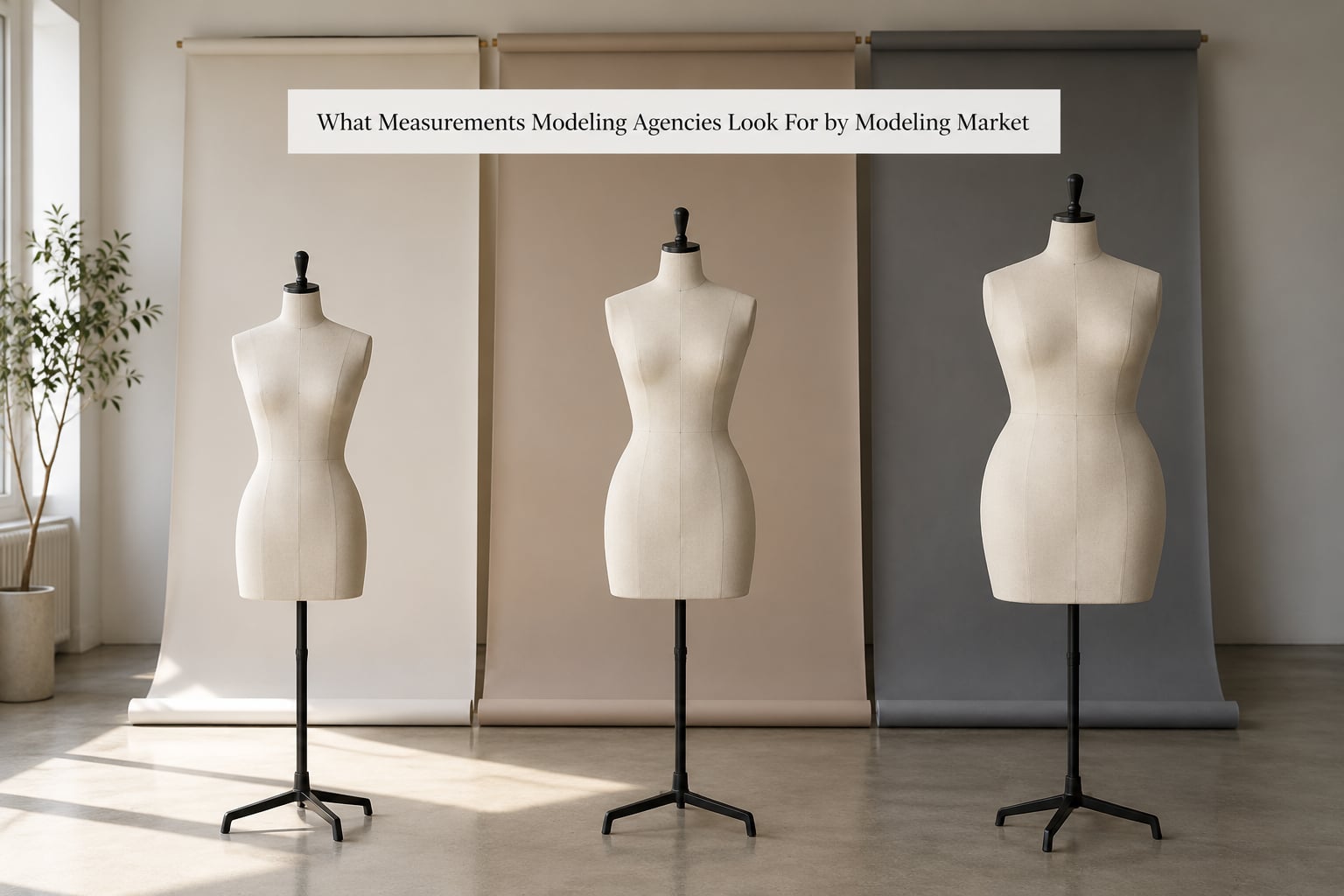
The same body can be rejected by a runway board and booked twice in a week by a commercial agency. Treat the ranges below as how each market tends to brief, not as a gate you have to pass.
Women’s markets
| Market | Height | Bust / Waist / Hips (in) | Bust / Waist / Hips (cm) | Clothing size |
|---|---|---|---|---|
| Runway and high fashion | 5 ft 9 in-6 ft 0 in (175-183 cm) | 32-34 / 23-25 / 34-35 | 81-86 / 58-64 / 86-89 | US 0-2 |
| Editorial and print fashion | 5 ft 8 in-5 ft 11 in (173-180 cm) | 33-35 / 24-26 / 34-36 | 84-89 / 61-66 / 86-91 | US 2-4 |
| Commercial and catalog | 5 ft 5 in-5 ft 10 in (165-178 cm) | 32-36 / 24-28 / 34-37 | 81-91 / 61-71 / 86-94 | US 0-6 |
| Plus size and curvy | 5 ft 5 in and up (165 cm+) | 38-44 / 30-36 / 40-46 | 97-112 / 76-91 / 102-117 | US 14-24 |
| Petite | Under 5 ft 5 in (under 165 cm) | 30-33 / 23-25 / 33-35 | 76-84 / 58-64 / 84-89 | US 0-2 |
| Mature (50+) | No fixed floor | Market-wide, sample to sample | Market-wide | US 4-14 |
Men’s markets
| Market | Height | Chest / Waist / Hips (in) | Chest / Waist / Hips (cm) | Shoe size (US) |
|---|---|---|---|---|
| Runway and high fashion | 6 ft 0 in-6 ft 3 in (183-191 cm) | 39-41 / 31-33 / 38-40 | 99-104 / 79-84 / 97-102 | 9-12 |
| Editorial | 5 ft 11 in-6 ft 2 in (180-188 cm) | 40-42 / 32-34 / 39-41 | 102-107 / 81-86 / 99-104 | 10-13 |
| Commercial and catalog | 5 ft 9 in-6 ft 0 in (175-183 cm) | 40-44 / 33-37 / 40-43 | 102-112 / 84-94 / 102-109 | 9-13 |
| Fitness | 5 ft 10 in-6 ft 1 in (178-185 cm) | 44-48 / 32-35 / 40-42 | 112-122 / 81-89 / 102-107 | 11-13 |
Height has a ceiling as well as a floor. Agency guides note that women above roughly 5 ft 11 in (181 cm) start getting booked as fit models instead, because sample garments and shoe platforms stop working the same way. For men the upper runway limit sits around 6 ft 3 in (191 cm).
Below and above those bands, work still exists. Short models move into petite, e-commerce, catalog and commercial bookings, where samples run smaller. Taller models lean into fit, hand and character work, and editorial.
How to Read the Measurements Modeling Agencies Look For
The string of numbers everyone quotes online, 34-24-36, is written bust-waist-hips in that order, and it is in inches unless the source says otherwise. It is a shorthand for proportion, not a grade. 34-24-36 and 32-24-33 both appear constantly in modelling communities as reference points rather than requirements.
Agents read the middle number first when they are assessing proportion, because the gap between bust and waist is what shows how a fitted garment will hang. A 34-26-36 and a 34-24-36 are both commercially bookable and they get offered different jobs.
Watch for the ordering trap. Some European boards list hips-waist-bust, so a number that looks larger than the one before it may simply be listed differently. If a card shows a waist bigger than the bust, the order is reversed, not the body.
Proportion beats raw size in most markets. A 34-25-35 model and a 32-23-32 model are the same proportion, and the client only cares about whether the sample fits and drapes the way the design intended.
Does Your Body Have to Match an Agency’s Ideal Measurements?
No, and the marketing card is usually the loosest document the agency owns. Those range cards describe the look the agency wants to promote. The actual decision happens against a live booking brief from one client on one day.
That gap is the reason most working models are outside somebody’s published range. An agency that markets a 34-24-34 card still books a 32-25-35 for a lifestyle campaign, because the client asked for a real person and the sample fit.
A listed range matters most in runway, where samples are unforgiving and designers have strong ideas about silhouette. It matters far less in commercial, e-commerce, catalog, mature and plus work, where the priority is relatability and showing a product clearly.
Distinctive features are a business asset rather than a defect. Models with visible braces, tattoos, freckles, vitiligo, scars or a very short stature get booked for briefs that specifically ask for them, and those campaigns often struggle to cast. Disclose honestly on your card and let the agent match you.
How to Measure Yourself Accurately at Home
You need a soft tailor’s tape that does not stretch, a fitted but comfortable outfit, a flat wall or a door frame, and someone to help. Do the bust, waist and hips measurements over a thin layer rather than a bulky sweater.
- Bust. Stand with arms relaxed at your sides. Run the tape around the fullest part, keep it level across the back, and pull it snug without compressing. Exhale normally, do not suck in.
- Underbust. Take the tape directly under the bust line where the band sits. Keep it snug and level, and do not let it ride up into the ribcage.
- Natural waist. Bend sideways and find the crease above your navel. Stand straight, let the tape settle at that narrowest point, and keep it parallel to the floor.
- Hips. Stand with feet together and weight even. Take the tape across the widest point of the seat, one hand’s width below the natural waist, and read it in front of a mirror.
- Inseam. Wear a pair of trousers that fit you well, button them, and measure from the crotch seam straight down the inside of the leg to the hem. Have your helper hold the tape straight along the leg.
- Height. Stand against the wall, heels together, looking forward, mark the top of your head and measure from the floor. Do it in the morning, since most people are slightly taller then.
- Shoe size. Measure both feet in the evening, when feet are at their largest, and take the longer one. Wear the socks you would actually model in.
Check each circumference twice and write it down immediately. People consistently pull the waist tape tight and then wonder why the number is two inches smaller than the agency’s.
What Should You Put on Your Model Comp Card?
A comp card, sometimes called a model card or composite, is a single sheet an agent keeps on file. The required data is short and the photography is optional depending on what you are applying for.
Required profile data, in the order agents tend to read it:
- Name and contact details, including an email and phone number you actually answer
- Height in feet and inches, with centimeters as a second line for international submissions
- Bust, natural waist and hips, in inches or centimeters, labelled so there is no guesswork
- Clothing size in your home market, plus the US size if you know it
- Shoe size and inseam
- Date of birth or age
- Agency name, if you have one
- Measurements divided by division, for example runway and commercial, when they differ
Optional but useful: full-body front and back shots in a plain outfit, a profile headshot, a smiling and a neutral expression, barefoot shots, and a note of any special skills such as horseback riding, dancing or a second language.
Disclose hair colour and length, eye colour, skin tone, tattoos, piercings, scars and birthmarks. Clients ask for appearance details in the majority of briefs, so an agent who does not know cannot match you to that work.
How Agencies Verify and Update Your Measurements
Somewhat unusually for creative work, this is a measured profession. Scouts often measure at an open call with a tape, agencies keep a measurements sheet per model, and clients may ask for figures again at the booking stage.
Digital measurement is becoming common at larger agencies, where a scanning or photo-based system produces a size grid in minutes. It exists to replace guesswork when a stylist orders samples, not to judge you.
Updates happen on a cycle. Because bodies and sample sizes both change, agencies typically re-measure every three to six months and reprint the card, and any significant change should reach your agent before a shoot rather than on the day.
Clients narrow things further at booking. A brief may specify not just a clothing size but a silhouette, a fabric weight or a shoe, which is why keeping your card current saves fittings.
Common Measurement Myths and Mistakes
The myth that there is a required height. There is a market reference and a client brief, and they differ. People consistently point out in modelling forums that a rejection in New York says very little about commercial or e-commerce work.
The myth of a universal agency size. There is no single number that unlocks the industry, which is exactly why different sources quote different ranges. Each one is describing a different division.
The myth that an hourglass figure is required. Proportion matters for silhouette, but sample sizes are drafted to a standard grid, and plenty of booked models fall well outside the shape most advice articles describe.
The myth that a comp card is permanent. Cards expire as bodies change, and an outdated card is worse than no card because the agency books you into something that does not fit.
Common mistakes include guessing your clothing size instead of measuring, measuring over a puffy jacket, taking the waist reading while sucking in, listing inches without saying so, and photographing yourself from an angle that stretches your proportions out. Frame yourself straight, arms slightly away from your sides, and let the tape do the flattering later.
Frequently Asked Questions
Can I become a model if I do not fit an agency’s published measurements?
Yes, more often than not. An agency’s range card describes the look it markets, not a hiring rule. Real decisions come from a client brief, and a brief specifies a clothing size, a height range and an appearance description rather than one ideal body. Plenty of working models fall outside the card they signed with, because commercial, e-commerce, mature, plus and petite bookings are brief by brief. Target the division your proportions suit instead of trying to fit a range you cannot change.
Do modeling agencies measure you in person before signing you?
Usually yes, at an open call or the first meeting after they contact you. Scouts measure height, bust, waist, hips, shoe size and sometimes inseam with a tape, then record the figures on the agency’s measurements sheet. Some agencies use a digital or scanning system that produces a size grid in a few minutes. Bring accurate self-measured numbers with you anyway, because the in-person reading confirms them and starts the conversation about what you actually fit.
Should a model comp card include measurements in inches or centimeters?
Match the market you are submitting to. US agencies work in inches, most European and Asian markets work in centimeters, and international submissions are easiest when you list both on separate lines. Label the unit clearly either way, because an unlabelled 36 is the single most common source of confusion on comp cards. Many European boards also list hips before bust, so writing bust-waist-hips in that order, with labels, removes any doubt about how you should be read.
What clothing size should I write on a comp card?
Write the size of the garments that already fit you, not the size you wish fit you. Take it from a trouser and a top you own rather than guessing, and note the market so the conversion is possible, for example US 4 or UK 8. If your bust, waist and hips land in different size categories, list the size that matches your hips for bottoms and your bust for tops, and mention the split. Stylists order samples from your figures, so an optimistic number shows up as a bad fitting.
How often should I update my modeling measurements and comp card?
Every three to six months is the usual rhythm, and immediately after any significant change in your body, hair or height. Agencies re-measure to keep their measurements sheet and size grid accurate for sample ordering, then reprint the card. Tell your agent before a shoot rather than letting them work from old figures, since an outdated card is what causes fittings that do not work on the day. If you are freelance, keep your own dated card so you always submit current numbers.
Conclusion
Measure yourself properly first, then compare those numbers against the markets you actually want to work in rather than against a generic chart. Write your comp card with labelled units, bust-waist-hips order, and a size taken from clothes that fit today, then update it every few months.
Most people who get rejected have aimed at the wrong division, not the wrong body. Target commercial, e-commerce, plus, petite, mature or fit work and the measurements you already have start doing useful work for you.