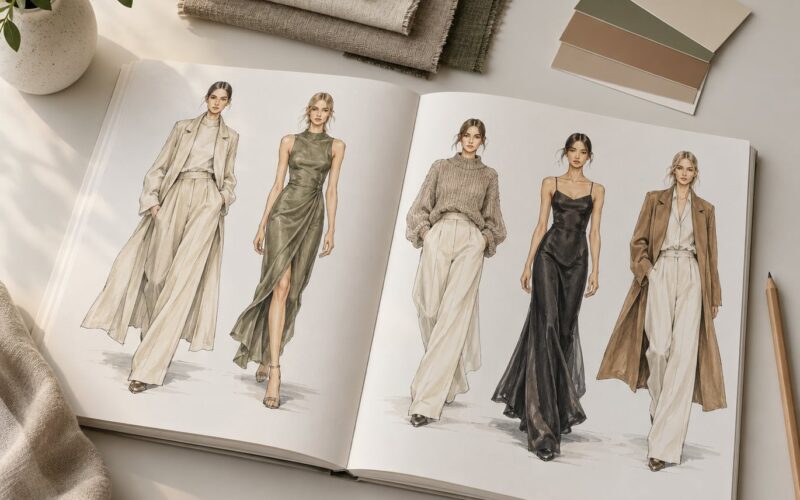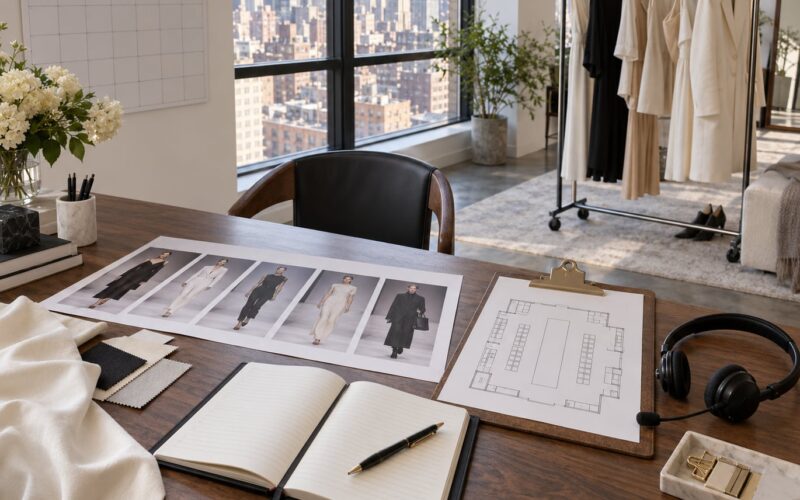
So how designers choose models for a runway show comes down to this: they match a model’s size, proportions, movement and presence to the collection’s concept and sample garments, then confirm every choice at a fitting where the looks are pinned, walked and allocated. Casting is not a beauty contest. It is a set of production decisions about who can carry a specific silhouette for six minutes in front of an audience.
The whole thing usually starts about three months before the show, and it rarely ends when the lineup is announced. Models get re-cast, looks change, and a garment that looked perfect in the studio can behave differently under stage lights. If you are a designer planning a first show, or a model trying to work out why you were passed over, the process is worth understanding from the inside.
Table of Contents
- What Does a Runway Casting Brief Tell Designers?
- Where Do Runway Models Come From?
- What Do Designers Look At When Choosing Runway Models?
- How Well Does Each Model Fit the Collection?
- How Designers Choose Models for a Runway Show by Watching Them Move
- Which Model Skills and Experience Matter?
- Why Do Measurements, Availability, and Practicalities Matter?
- How Do Designers Handle Special Casting Requirements?
- How Does a Designer Build the Final Runway Lineup?
- What Happens After a Model Is Selected?
- How Can an Aspiring Model Prepare for Runway Casting?
- Frequently Asked Questions
- Do runway models have to be professional?
- Can a designer hire a model without an agency?
- How much runway experience does an aspiring model need?
- Do models audition in a specific type of clothing?
- Why might a model be cut after a successful casting interview?
- Conclusion
What Does a Runway Casting Brief Tell Designers?
A casting brief is a written document that tells everyone involved what the show actually needs before anyone walks into a room. Without one, casting turns into a popularity contest, and that is usually how it goes wrong.
A useful brief usually covers the collection concept in a sentence or two, the number of looks and models, the show format and location, and the dates that are fixed. It lists the sample sizes being shown, how many fittings are planned, whether there is a rehearsal, and where the money is coming from. It also names the experience level wanted: a group of professional runway models walks differently from a group of student models, and that has to be built into the plan.
Two details matter more than people expect. The first is the venue, because a low-ceilinged room with a narrow runway changes how much room a model has to walk. The second is the transformation count. A show with thirty looks that change four times an hour is a different casting problem from a static presentation where each model walks once.
Where Do Runway Models Come From?
Most designers combine two or three sourcing routes instead of relying on one. Mixing routes gives them more control and more variety.
- Agency submissions. The designer sends a request to a casting director or directly to agency booking agents, who send books with measurements, experience and rates.
- Open casting calls. Applications posted online for a fixed window. Good for volume and for reaching people no agency represents.
- Direct portfolio submissions. Models email a portfolio with current polaroids. Since the mid-2010s this has become a normal route, not a workaround.
- Casting databases and model boards. Casting directors maintain scouted lists with photos, measurements and walk videos that designers can search by size.
- Street scouting and referrals. Someone on the team spots a walk and asks. Industry referrals also fill the lineup with people who already know the room.
Agency submissions cost more and take more coordination. Open calls cost time and produce a large pool that has to be culled carefully. A label showing a size range that no single agency covers well often ends up combining an open call with agency bookings.
What Do Designers Look At When Choosing Runway Models?
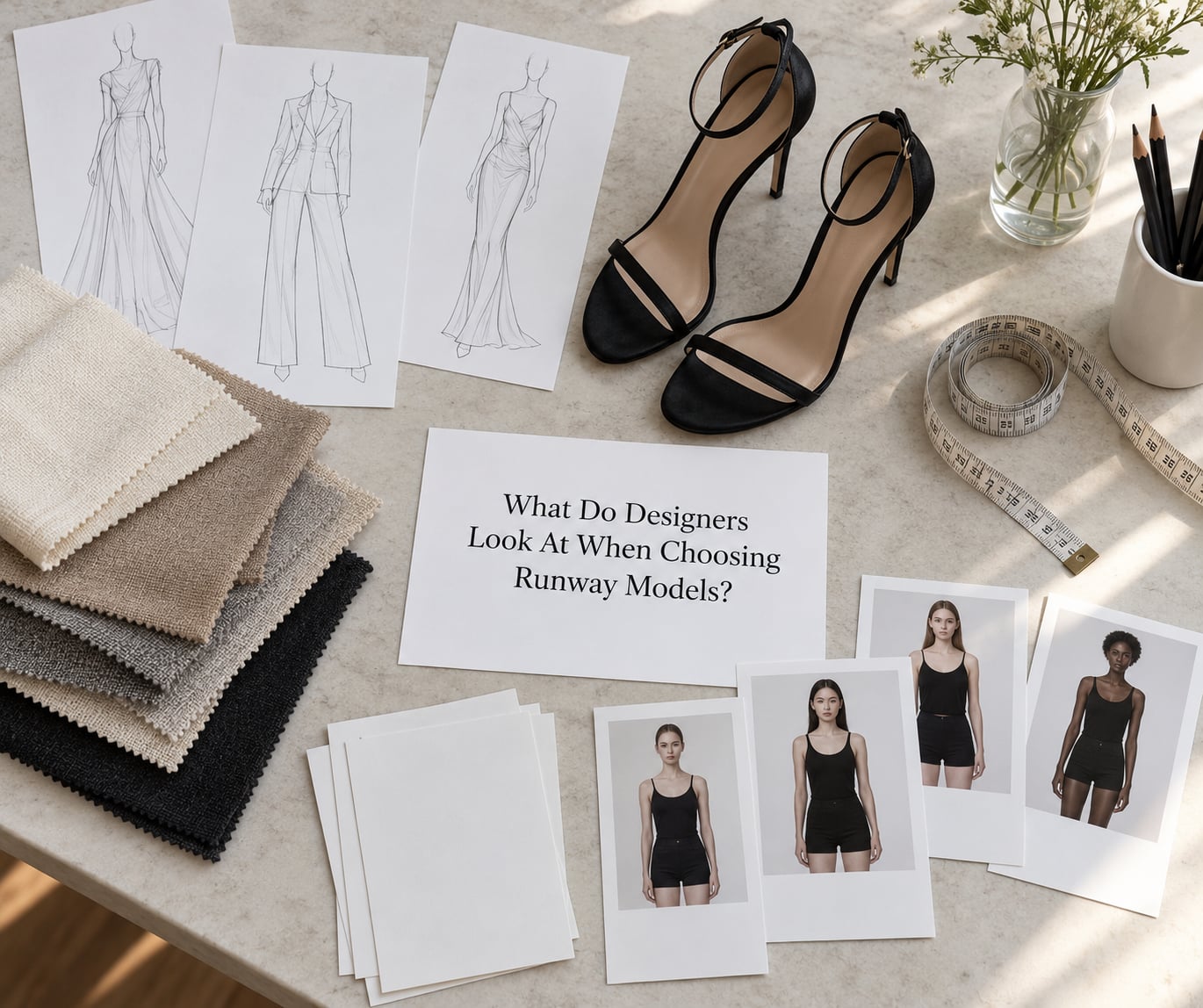
Designers are casting a complete show rather than picking a single face. The criteria below are weighed against each other, and the weight shifts with every collection. A fluid draping collection may lean hard on how a model carries movement, while a structured tailoring collection leans on posture and stillness.
How Well Does Each Model Fit the Collection?
Garment proportions decide more pairings than faces do. A sharply padded shoulder needs a frame that does not fight it, and a bias-cut dress behaves completely differently on someone with a longer stride than on someone with a shorter one. Designers watch how fabric sits, where a hem lands, whether a collar rolls.
Take structured tailoring as an example. The jacket has to close at the shoulder and hold its line through the arm, so the model who wears it needs consistent posture and a walk that does not collapse the sleeve. Now take fluid draping. The same fabric looks best on someone who moves slowly and deliberately, because fast steps make the cloth swing past the intended line. The right model makes the designer’s decision disappear.
How Designers Choose Models for a Runway Show by Watching Them Move
Walk tests are short. A model walks across the room, turns, pauses, and the designer’s eye catches whatever is missing: a shoulder that drops, a step that lands heavy, hands that break the line of the coat. Personality and presentation get judged in the same thirty seconds. A model who speaks clearly and takes direction is often easier to work with than a stronger walker who argues about styling.
Which Model Skills and Experience Matter?
The useful runway skills are learnable and mostly boring. Turning on the correct foot, holding a pose without shifting weight, walking in heels on an unfamiliar surface, and stopping when you are told to stop are what get a model repeated bookings.
Fitting feedback is the least obvious one. During a fitting, designers alter garments live, sometimes on the body, and a model who stays calm, keeps still and reacts usefully to a note is worth a lot. Rehearsal discipline matters too. Show days run on tight call times, and someone who has been to three rehearsals is cheaper than someone who needs explaining twice.
Experience with different formats helps as well. A presentation show, a seated runway, a filmed lookbook and a New York Fashion Week slot each run differently, and experienced models already know the pace. Name recognition usually comes last, if at all. A recognizable face can open press coverage, but plenty of designers would rather have a dependable walker for a look that needs precision.
Why Do Measurements, Availability, and Practicalities Matter?
Size is the hard constraint, and it is a production constraint rather than a beauty standard. A collection cut to a sample size needs bodies that fit it, or the sample room needs to work harder than it should.
Common industry reference points for women’s runway casting sit around 5 ft 4 in to 5 ft 9 in with measurements near 34-26-37. Menswear casting often works around 6 ft 1 in to 6 ft 2 in with measurements near 39-34-39. These are references, not entry tickets. Petite, curve and tall ranges get cast separately when a collection is designed for them, and the brief should say so before anyone applies.
Availability causes more dropped casts than anyone admits. A model already booked with another show cannot walk two slots at the same hour. Designers check dates, travel feasibility, and whether the model can commit to every fitting as well as show day. Some markets also carry union or agency contract conditions that affect who can be booked and how, so production checks those before offers go out rather than after.
How Do Designers Handle Special Casting Requirements?
Creative priority usually decides the edge cases. A show in a regional market may cast almost entirely locally, because the cost of flying twenty people in and putting them up is real money for an independent label. Opening and closing slots often go to whoever communicates the theme most clearly, which is a creative decision rather than a physical one.
Representation is now written into many briefs as a range rather than a gesture. A designer planning a show that includes curve, petite, tall or different age ranges casts them deliberately, with looks designed for those bodies, instead of squeezing them into existing looks. Emerging talent gets cast for the same reason established names get cast: a fresh face can become the story a collection is built around.
Some productions now plan for rental or resale rather than one-off garments, and that changes casting decisions, since a rented piece has to survive multiple bodies across multiple shows. Whatever the constraint, a good casting director writes it into the brief so models can self-select honestly.
How Does a Designer Build the Final Runway Lineup?
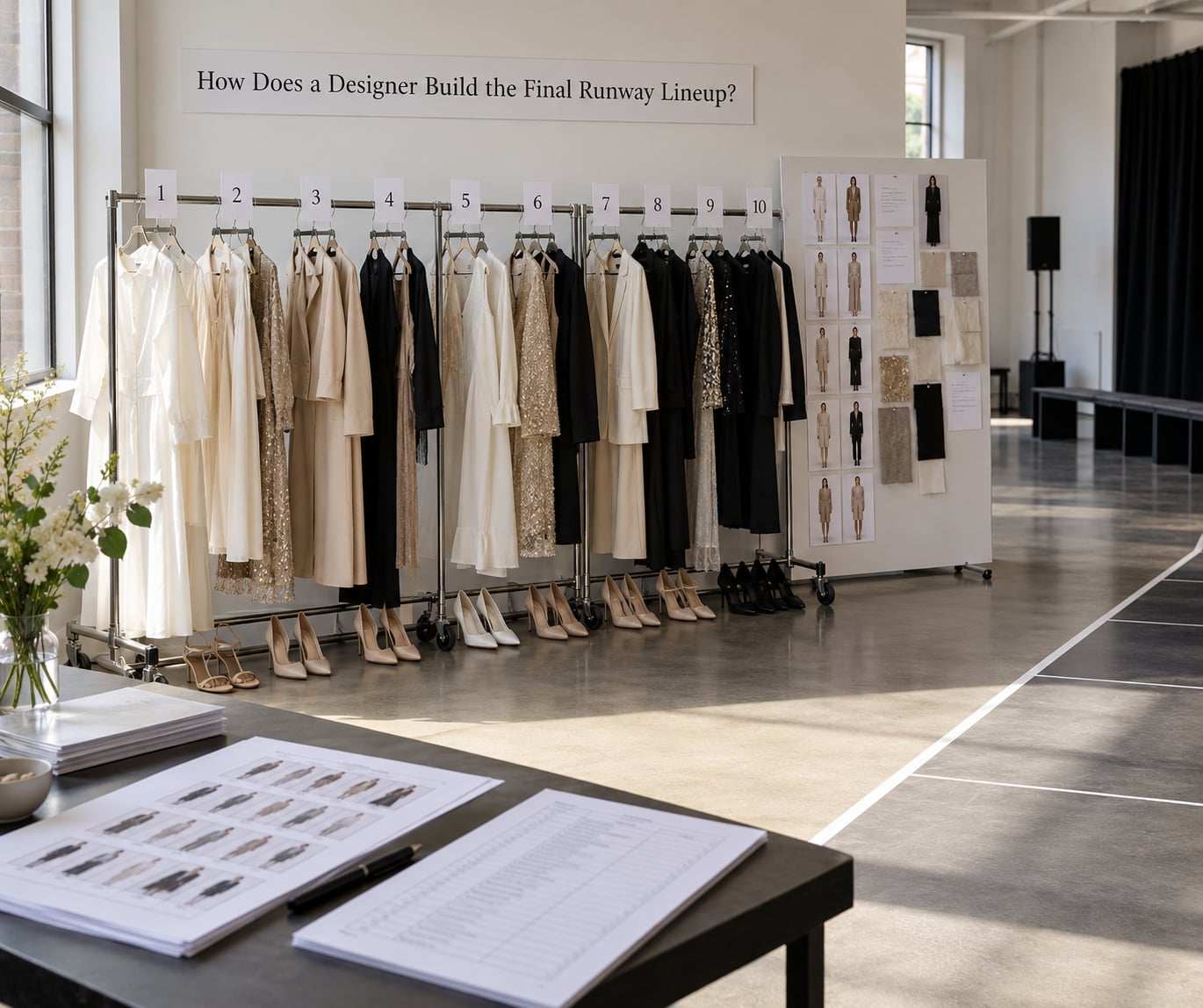
The lineup gets built as a sequence, and it usually happens as a team decision with the designer, the casting director and the show producer in the room. The steps run in order: check the confirmed pool against the brief, verify dates and sizes, hold fittings with the actual garments, allocate looks, then lock the running order with transitions considered.
Look allocation is the part people underestimate. A heavy look needs a strong opener, a delicate one needs a controlled walker, and the model who closes often walks more looks than anyone. Producers also check adjacent pairings, because two models with the same proportions in neighbouring looks flatten the silhouette of the collection.
A simple criteria table keeps that conversation honest, especially when more people applied than there are slots.
| Casting criterion | What the designer is checking | Where it gets decided |
|---|---|---|
| Sample size fit | Garment closes at shoulder, hip and hem without alteration | Fitting |
| Proportion and movement | Silhouette reads correctly while walking and turning | Fitting and walk test |
| Walk control | Even stride, clean turn, holds a pose under lights | Preview and rehearsal |
| Availability | Free for every fitting, rehearsal and show call | Offer stage |
| Fit with the collection | Supports the concept without fighting it | Lineup meeting |
| Reliability | Takes direction, arrives on time, finishes changes quickly | Rehearsal and show day |
What Happens After a Model Is Selected?
Selection is the start of a schedule, not the end of the process. Offers go out in writing with the dates, the rate structure and any usage terms, and models confirm quickly because shows rarely have room for a late replacement. Measurements and a current polaroid are collected so the sample room can work from accurate numbers rather than memory.
Then come fittings, typically a final one close to show day, plus hair and makeup tests. Rehearsals set the running order, cue music and mark transitions. Backstage, each model gets a board showing the looks in order with the changes flagged, and a call sheet gives the times for arrival, fitting, rehearsal and curtain. What the team needs at that point is simple: someone who knows the order, can execute a quick change, and can hit a cue on time.
How Can an Aspiring Model Prepare for Runway Casting?
Research the designer first. Look at the previous three collections and write down what the clothes are about, because that is what the designer is casting for and it is usually visible in how the room treats you.
Then sort your materials. Current polaroids taken in natural light, front, side and back, plus a short portfolio with walk video if you have one. Old photographs from two years ago get applications skipped. Keep your measurements current and accurate, a problem that comes up constantly at fittings.
Practise walking without performing it. Long confident strides look wrong in a small room, and a runway walk should feel like you are covering ground rather than posing. Stay open to feedback, arrive on time with clean hair and minimal makeup, and wear plain clothes that let a designer judge fit. Turning up in the outfit you hope to be cast in is a mistake.
Tell the truth about experience. If you have never done a runway show, say so, then mention anything you have done that is close: editorial work, lookbook shoots, dance, stage work. On modeling boards the same confusion comes up over and over, whether a casting call is legitimate and who is actually making the decision. A clear brief from the designer answers most of it.
Frequently Asked Questions
Do runway models have to be professional?
No. Plenty of independent labels and student showcases cast from open calls and direct submissions, so a commercial booking history is not required. What helps is a reliable walk, correct measurements, comfort in front of a camera or a room, and the ability to take direction. Professional models simply arrive with more runway formats already behind them.
Can a designer hire a model without an agency?
Yes, and many do. Direct submissions and open casting calls are routine now, and a designer only needs a clear brief covering dates, sizes, fittings and compensation. Working through an agency or casting director still helps when you need specific sizes or volume, because they arrive with a scouted pool.
How much runway experience does an aspiring model need?
Almost none. A first show is a fine starting point, because designers are casting the collection rather than the resume. Learn the basics first: turning on the correct foot, holding a pose without shifting weight, and walking in heels steadily. Show up early, follow the creative team’s notes, and stay calm while a garment is adjusted on you.
Do models audition in a specific type of clothing?
They are usually asked to come in fitted, plain clothing such as leggings and a tank top or a simple dress and heels. You will be asked to walk, turn and sometimes sit, and there may be a quick fitting in actual garments if you are still in the running. Wearing your own styled outfit makes it harder for anyone to judge fit.
Why might a model be cut after a successful casting interview?
The most common reason is a scheduling conflict. Dates can also clash with an existing agency booking, or the designer may need a different size for a particular look. Cutting someone is not a judgement of your ability. When it happens, ask whether you can be considered for future shows and keep your materials updated.
Conclusion
Designers choose runway models the way they choose every other part of a production: against a written brief, then against the garments themselves. The physical criteria get a model into the room, and the fitting decides whether they stay.
So the first step, whether you are designing or auditioning, is the same. Study the collection the designer actually makes, arrive with current and accurate materials, and be someone who can be directed without friction. In 2026, that combination still matters more than recognition.