How brand collaborations are priced for creators comes down to four line items a brand should be quoting separately: the deliverables you produce, the rights they get to reuse that content, how long those rights last, and whether you are locked out of competing brands while the campaign runs. In the US, a single sponsored Instagram Reel typically lands somewhere between 100 USD and 50,000 USD depending almost entirely on audience size, engagement and scope.
That range sounds useless until you break it into parts you can actually price. This guide gives you the benchmarks, the four-step calculation behind them, and the negotiation moves that keep you from anchoring yourself at the bottom of a brand’s budget sheet.
One note before the numbers: every figure here is a typical US range. They vary by region, by niche, by audience quality and by how much of the production the brand wants from you, and they move over time. Treat them as benchmarks for a conversation, not as entitlements.
Table of Contents
- Typical US Creator Collaboration Costs
- What Determines What a Brand Will Pay?
- How brand collaborations are priced by deliverables and usage rights
- How to Set Your Rate
- Step 1: Price your time
- Step 2: Take the higher of time or benchmark
- Step 3: Add rights and exclusivity
- Step 4: Add 20 to 30 percent of negotiation room
- Ways to Save on Brand Collaboration Costs
- Frequently Asked Questions
- How much should I charge for a brand collaboration?
- Do follower count or engagement rate matter more?
- Should I accept free product instead of a fee?
- Is a flat fee or commission better for a brand deal?
- How much should I charge for usage rights and whitelisting?
- How do I negotiate when a brand lowballs the offer?
- Conclusion
Typical US Creator Collaboration Costs
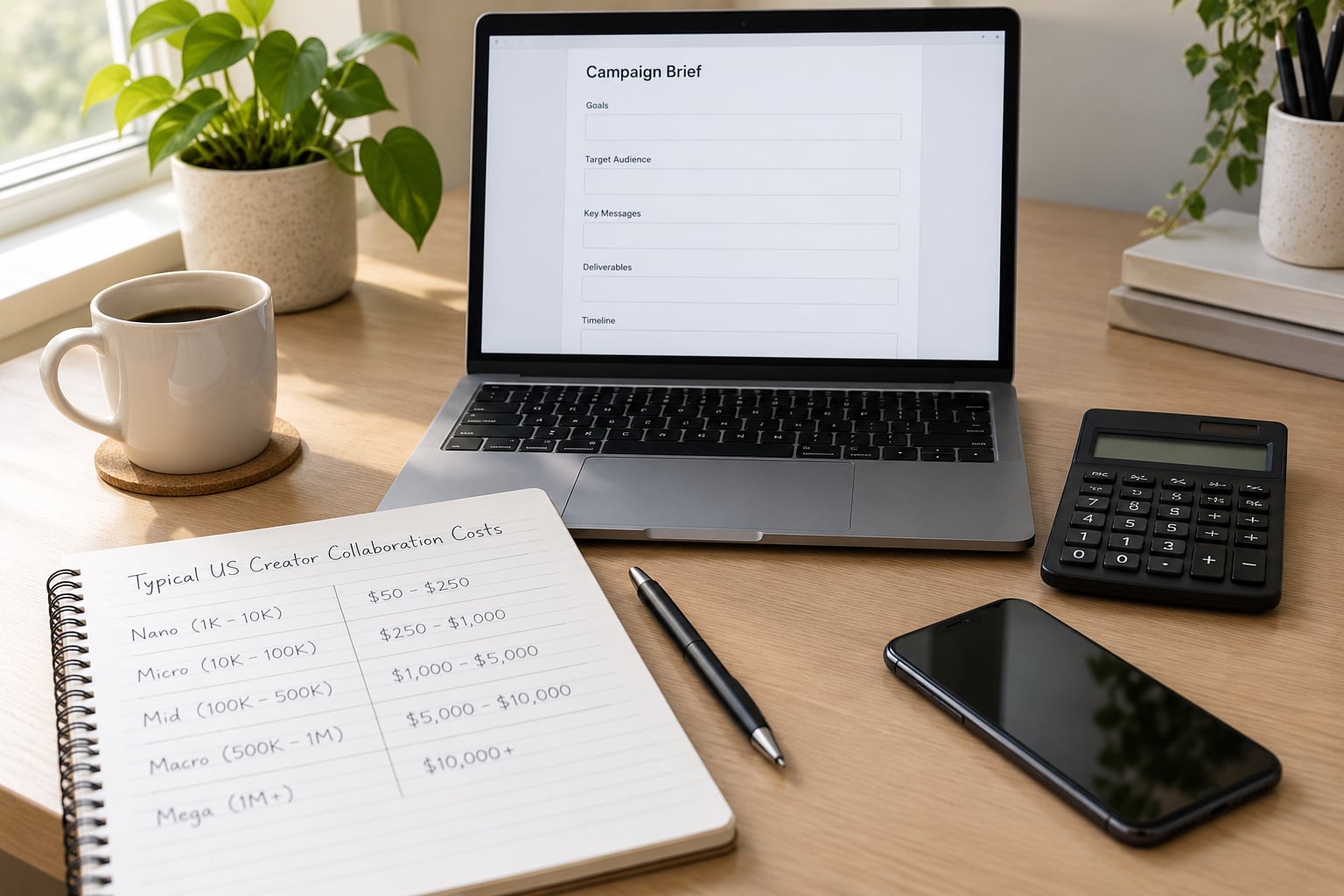
A single sponsored post from a nano creator with 1,000 to 10,000 followers usually falls between 100 and 300 USD. A micro creator with 10,000 to 50,000 followers charges 300 to 1,500 USD for the same Reel, and a macro creator with 250,000 to 1 million followers sits between 3,500 and 10,000 USD. The same pattern holds across platforms, with video and dedicated YouTube work pulling the highest numbers at every tier.
These are typical US ranges that vary by region and change over time. Niche, audience quality, average views and campaign scope move any single deal up or down inside the band.
| Creator tier | IG Reel | IG static post | IG Story set | TikTok video | YouTube integration | YouTube dedicated | UGC-only licence |
|---|---|---|---|---|---|---|---|
| Nano (1K to 10K) | 100 to 300 | 75 to 200 | 50 to 150 | 100 to 300 | 200 to 500 | 400 to 1,000 | 150 to 400 |
| Micro (10K to 50K) | 300 to 1,000 | 200 to 700 | 150 to 500 | 300 to 1,000 | 500 to 1,500 | 1,000 to 3,000 | 400 to 1,200 |
| Mid-tier (50K to 250K) | 1,000 to 3,500 | 700 to 2,000 | 500 to 1,500 | 1,000 to 3,500 | 1,500 to 5,000 | 3,000 to 10,000 | 1,200 to 3,000 |
| Macro (250K to 1M) | 3,500 to 10,000 | 2,000 to 6,000 | 1,500 to 4,000 | 3,500 to 10,000 | 5,000 to 15,000 | 10,000 to 30,000 | 3,000 to 8,000 |
| Mega (1M and up) | 10,000 to 50,000 | 6,000 to 25,000 | 4,000 to 15,000 | 10,000 to 40,000 | 15,000 to 50,000 | 30,000 to 100,000 | 8,000 to 25,000 |
Everything in that table is a flat fee for the content on your own handle with organic posting only. Add usage rights, and the number moves again.
Formats have a predictable order of value inside each tier. A static Instagram post typically lands at 50 to 60 percent of a Reel. A Story set usually prices 30 to 50 percent below a feed post. A dedicated YouTube video runs 2 to 3 times an integration because your audience came for your channel, not for a mention. LinkedIn work often carries a 30 to 50 percent premium over the same deliverable on other platforms.
A second way to sanity-check your number is cost per thousand views. One approach creators repeat across Reddit threads applies roughly 15 USD CPM to your average views, which puts a post averaging 33,000 views near 500 USD before rights or exclusivity. If your fee and your average views point in opposite directions, one of them is wrong.
Deal structure changes the number too. A flat fee pays a set amount regardless of results. An affiliate or commission deal pays a percentage of tracked sales, usually somewhere between 10 and 30 percent, and pays nothing when nothing sells. A retainer or ambassador agreement pays a monthly fee for an ongoing commitment. Product gifting pays you in merchandise, which is a cost to the brand, not income to you, and creators in r/UGCcreators describe gifted-only collaborations as a loss rather than a deal.
What Determines What a Brand Will Pay?
Brands price creators on audience quality first, then engagement, then scope. A 40,000-follower account with 6 percent engagement and a tight geographic match to the brand’s customers is worth more than a 400,000-follower account where nobody clicks, and experienced buyers know it.
The inputs they actually evaluate, in rough order of weight:
- Audience quality and fit. Age, geography, income bracket and category interest. Matching the brand’s actual customer matters more than raw reach.
- Engagement rate. Comments and saves relative to follower count. This is where nano and micro creators win, and where they should charge like it.
- Reach and average views. Story views, video views and impressions from the last ten posts, not your best month.
- Content production. Whether you supply a raw vertical clip or a finished, edited, on-brand piece. Finished work is not the same job.
- Number of deliverables. One Reel and one Reel plus three Stories plus a raw cut are very different asks.
- Exclusivity. Whether you are barred from working with competitors, and for how long.
- Turnaround and revisions. Rush deadlines and open-ended revision rounds both carry a price.
- Reputation and reliability. Brands pay more for a creator who delivers on the brief and posts on schedule. This is the factor you control most directly.
How brand collaborations are priced by deliverables and usage rights
Usage rights are where most creator quotes go wrong. Organic posting on your own feed is normally included in the base fee. Everything beyond that, running the brand’s ads from your post, using your image on their site, or locking your likeness forever, is a separate line that brands should pay for separately.
Common practice puts paid social rights for a short window at 30 to 50 percent on top of the base rate. Longer windows and wider uses climb from there. Whitelisting and Spark Ads, where the brand runs ads from your own handle, typically add another 30 to 50 percent per campaign.
| Rights requested | Typical adder on the base rate |
|---|---|
| Organic posting on your own handle | Included in the base fee |
| Paid social, 30 days | 30 to 50 percent |
| Paid social, 90 days | 50 to 75 percent |
| Paid social, 12 months | 75 to 100 percent |
| Whitelisting or Spark Ads | 30 to 50 percent per campaign |
| Brand website and email use | 30 to 50 percent |
| Perpetual buyout of the asset | 100 to 200 percent |
| Out-of-home or large-format use | 150 to 300 percent |
Exclusivity sits alongside rights rather than inside them. A 30-day category exclusivity commonly adds 20 percent. Sixty to ninety days runs closer to 50 percent, and a full-year category lock often doubles the base rate. A limited licence period is sometimes priced higher still, at two to five times the standard rate, which tells you how much of a bargain perpetual or long-term rights represent.
The failure mode is timing. Creators on r/influencermarketing describe brands requesting usage rights retroactively, after the content is already live, when the creator has no leverage left. Price rights in the original quote, every time.
How to Set Your Rate
Set your rate in four steps: price your time, take the higher of that or your tier benchmark, add rights and exclusivity, then add negotiation room. Creators who quote their true minimum on the first message end up living at that number, because brands treat the first offer as the ceiling and negotiate down from it.
Step 1: Price your time
Count every hour the job takes: concept and brief review, research, shooting, editing, caption and cover, revisions, and the admin of approving and posting. Multiply by an hourly rate that matches your skill and your other work. For a creator charging 65 USD per hour and spending seven hours on a Reel with Stories, that is 455 USD.
Step 2: Take the higher of time or benchmark
Compare that against the tier table. If the benchmark floor for your tier is higher than your time cost, quote the benchmark, because that is what comparable creators are getting. If your time cost is higher, quote that instead. You are setting a floor here, not a final number.
Step 3: Add rights and exclusivity
Apply the multipliers to whatever base you landed on in step 2. In the example, a micro creator quoting 800 USD for 90 days of paid social plus a 30-day category exclusivity lands at roughly 1,360 USD.
Step 4: Add 20 to 30 percent of negotiation room
First offers are almost always meant to move. Quoting 1,360 USD and settling around 1,700 USD is a normal outcome. Quote 1,700 USD, and know that anything under 850 USD is below half your standard rate and worth walking away from.
Here is the same example end to end. A 42,000-follower beauty creator with 5.2 percent engagement gets a TikTok collab request. Seven hours of work at 65 USD an hour is 455 USD. The micro benchmark band runs 300 to 1,000 USD, and strong engagement puts her near the top, so her base is 800 USD. Ninety-day paid social adds 50 percent, 400 USD. Thirty-day exclusivity adds 20 percent, 160 USD. Base total is 1,360 USD. She adds 25 percent negotiation room and quotes 1,700 USD, with a walk-away floor of 850 USD.
Put that structure on a rate card and send it with every inquiry. A rate card lists your deliverables and prices, what each package includes, your rights structure and add-on prices, exclusivity windows, revision limits, turnaround times, payment terms, and how long the rates stay valid. Six to twelve months is the common validity window, and reviewing rates twice a year keeps you from drifting below your own market.
A media kit is a different document. The media kit sells you: who you are, audience demographics, past campaign results, testimonials and reach. The rate card sells the work. Brands ask for both, and conflating them tends to get you paid media-kit rates for the media kit and nothing for the content.
One more number to have ready: what your manager or the brand’s agency takes. Commission quoted in creator communities ranges anywhere from 10 to 40 percent, commonly landing around 15 to 30 percent. Decide before you sign whether that comes out of your rate or is invoiced to the brand on top, and get the answer in writing.
Payment terms deserve the same clarity. Net 30 from invoice is normal; Net 60 or longer means you are financing the brand’s marketing. Ask for a kill fee if the campaign is cancelled after you have delivered but before it goes live, and put a late-payment term in the agreement. If a brand insists on a contract you have not read, or asks you to absorb commission without saying so, that is the point to slow down. Money and tax questions are worth a quick check with an accountant or a lawyer, not a guess in a DM thread.
Ways to Save on Brand Collaboration Costs
When a budget is short, cut scope rather than rate. A creator who drops the fee to fit a smaller budget teaches the brand that the number was inflated, and the same brand will use it again. Changing what is included keeps the price defensible and keeps the relationship intact.
- Bundle the deliverables. Three deliverables priced together usually cost less than three separately priced ones, and the brand gets more content for the same money.
- Run a smaller pilot first. One deliverable at one tier, with performance data, sets up a larger second contract with actual numbers behind it.
- Share production. When two brands are in the same category-neutral space, a co-produced video splits the cost of shoot time and editing.
- Use tiered packages. Offer a basic, standard and premium version of the same campaign so the brand picks its budget instead of dictating yours.
- Reuse your own footage. Offering the brand extra cuts from a shoot you already ran costs you an hour, not a day.
- Cap revisions at two rounds. Each extra round is a paid add-on, stated up front.
- Charge rush turnaround separately. Turnarounds under a week commonly carry a 25 to 50 percent premium.
- Price long rights up front. A higher fee today beats a retroactive usage request after the post has performed.
For the brand side, the same logic applies: pay for the deliverables that move the metric, and keep the rest as options rather than commitments. Creators notice the difference, and so do their rates.
Frequently Asked Questions
How much should I charge for a brand collaboration?
Work out your time cost first, then check the tier benchmark and quote the higher of the two. Add 30 to 100 percent for usage rights and 20 to 50 percent for exclusivity, then add 20 to 30 percent negotiation room on top. Quote the number, not a range, and put the terms behind it in writing.
Do follower count or engagement rate matter more?
Engagement rate and audience fit usually decide more than raw follower count. A creator with 40,000 followers and 6 percent engagement in the brand’s target market can justify more than one with 400,000 followers and one percent. Brands increasingly price per deliverable and per result rather than per audience size.
Should I accept free product instead of a fee?
Treat gifting as a bonus, not payment. Gifted product is a cost to the brand and does not cover your time, and in most cases the value of goods received is still taxable income you are responsible for reporting. If you accept gifting, say openly that it is not a substitute for a fee and price the next collaboration normally.
Is a flat fee or commission better for a brand deal?
Flat fees pay predictably and reward your time; commission pays more when the content sells and nothing when it does not. Commission structures commonly run 10 to 30 percent of tracked sales. If you take commission, ask for a flat fee floor so you are covered when the content performs well but the conversion does not.
How much should I charge for usage rights and whitelisting?
Thirty days of paid social typically adds 30 to 50 percent to your base rate, 90 days adds 50 to 75 percent, and a 12-month licence adds 75 to 100 percent. Whitelisting and Spark Ads add roughly 30 to 50 percent per campaign. Perpetual buyouts commonly run 100 to 200 percent, and out-of-home use far higher.
How do I negotiate when a brand lowballs the offer?
Ask what the budget covers before you respond, then reduce scope rather than rate. A usable line: based on my standard rate, that budget covers one deliverable with organic posting only. If you want the full package with 90-day paid usage, the fee is higher. Below half your standard rate, decline politely and stay available.
Conclusion
Pricing a brand collaboration well means refusing to quote one number for four different things. Define the deliverable, confirm the usage rights and duration in writing, price your time, and value the audience and expected results before you say a fee out loud. Then quote 20 to 30 percent above your minimum, because the first number is a starting position rather than a settlement.
Start with one line in your rate card this week: deliverables and prices, rights add-ons, exclusivity windows, revision limits, payment terms, and a validity date. Everything after that gets easier.