Most About pages are skipped, and the reason is boring: they talk about the business instead of the person reading. If you want to know how to write an about page people actually read, the fix is a short, specific page that orients a named reader, proves you can do the work, and hands them one obvious next step. About an hour of drafting and one honest edit is enough for most one-person businesses.
That matters more than most site owners think. The About page is one of the few places a visitor chooses to read about you, so it carries far more weight than a footer link suggests. A weak one quietly cancels out the claims on your homepage, your service page, and every ad you have ever run. People notice filler instantly, and they read about three seconds of it before deciding.
Table of Contents
- What You Need
- How to Write an About Page People Actually Read, Step by Step
- 1. Identify Who the Page Should Help
- 2. Write a Clear, Specific Opening
- 3. Add Proof Without Turning Into a Résumé
- 4. Bring Your Personality Into the Story
- 5. End With One Clear Next Step
- 6. Edit for Scanability and Trust
- 7. Publish and Test the Page
- Common Mistakes
- Frequently Asked Questions
- How long should an About page be?
- Should an About page be written in the first person?
- What should I put on an About page for a personal brand?
- How do I make an About page sound more personal?
- Where should I link my About page?
- Conclusion
What You Need
You need five things before you open a blank document, and none of them take long to gather.
- One clear reader. A specific person with a specific problem, not “people who care about style.”
- A focused promise. What you do for that reader, in a sentence you could say out loud.
- Specific proof. Two or three real details: a number, a named client, a visible outcome, a recognizable place.
- A recognizable voice. Your actual way of speaking, in writing, without the warmth stripped out of it.
- One desired next step. The single action you want a reader to take after they finish.
Here is what is not required, and skipping these is how most pages end up overlong. You do not need a professional headshot, a full life history, a polished mission statement, or a large vocabulary. You do not need a team photo if you are a team of one, and you do not need a founding myth.
Set aside about an hour. The work is deciding, not composing.
How to Write an About Page People Actually Read, Step by Step
The order below is deliberate. Positioning comes before sentences, because prose written before you know who it serves will read like filler no matter how well it flows.
1. Identify Who the Page Should Help
Choose one primary reader and describe their situation in enough detail that you could recognize them. What are they trying to fix, what have they already tried, and what do they want to feel after they contact you?
Then name who the page is not for. Freelancers report that the fastest-performing About pages are the ones that explicitly exclude somebody, because an exclusion is proof of focus. “I work with independent designers in New York and Los Angeles, not with large retail brands” tells a visitor in one line whether they are in the right place.
Compare two openings for the same stylist. The broad version: “At [Name] Studio we believe everyone deserves to feel beautiful, and our team brings years of expertise and passion to every client.” The specific version: “I’m Mara Ellison, a stylist working mostly with women in their thirties who are interviewing for jobs in six weeks and have nothing to wear that fits.” Same studio, different reception. The first one could describe any page on the internet.
Quick check: if your reader could not tell whether the paragraph was written for them, it is not specific enough yet.
2. Write a Clear, Specific Opening
Your first three sentences should answer three questions: who you help, what you do, and where you do it. That is the whole job. Put the answer within the first few sentences, because a reader deciding whether to keep scrolling is reading your first line and a half.
Weak opening: “Our journey began in 2019 with a vision to revolutionize the way people experience fashion. We are passionate about delivering exceptional service to every client who walks through our doors.”
Stronger opening: “I am Kelly Cutrone, a stylist and founder based in New York. For sixteen years I have dressed people for red carpets, shoots, and the week they start a new job, and I help everyday clients build a wardrobe that works on a normal Tuesday.”
Nothing was invented there, and nothing was promised that could not be delivered. Swap adjectives for facts and the paragraph starts working on its own.
3. Add Proof Without Turning Into a Résumé
Pick two or three proof points, not twelve. A full career history is unreadable, and it makes the reader do the work of deciding whether you are qualified.
Connect each proof point to the reader’s problem rather than to your ego. “Eleven years styling” is a fact. “Eleven years styling, which means I can build a work wardrobe from nine pieces and a two-week notice” is a reason to keep reading.
| Proof type | What to show |
|---|---|
| Client results | One before and after, described in the reader’s terms |
| Recognizable experience | A named publication, show, or room you have worked in |
| Numbers | Clients served, years in business, turnaround time, repeat rate |
| Process transparency | How a session actually runs, hour by hour |
| Community | A group, class, or regular roster that keeps showing up |
What if you have nothing yet? New sites get this brief constantly, and the fix is to use credible substitutes instead of invented achievements. Describe your process in detail, name the training you have actually completed, state plainly what stage you are at, and show the work in progress. Honesty about stage reads as more trustworthy than a vague claim, because there is nothing to disprove.
Check: could a stranger verify each of these? If not, soften the claim until they could.
4. Bring Your Personality Into the Story
The memorable pages have one moment in them, usually a specific scene rather than a moral. A story is only worth 60 words if something happened in it.
Consider a stylist who describes the first time she styled someone for a job interview and the person got it, then came back a year later to ask for her help with a promotion. That scene carries a point of view about her work without stating a value. A public-relations colleague might use the moment they lost a client pitch in a waiting room and rewrote the pitch in a car park, and the lesson they drew from the version that landed.
Write the moment you would tell a friend at a party, at the length of a voice note. Then stop.
5. End With One Clear Next Step
One call to action, matched to what the page is for. If the goal is bookings, the button says book a consultation. If the goal is a newsletter, it says join, and it tells them what lands in their inbox. If the goal is a shop, it points at the collection.
A vague ending wastes the attention the rest of the page earned. “We love to connect with our community and would love to hear from you any time” tells a reader nothing about what happens next. “Book a 20-minute styling call, and I will tell you honestly whether I am the right fit” does three things: it names the time cost, it names the format, and it lowers the stakes of contacting you.
Two competing buttons on an About page split attention and lower both click rates. Pick one.
6. Edit for Scanability and Trust
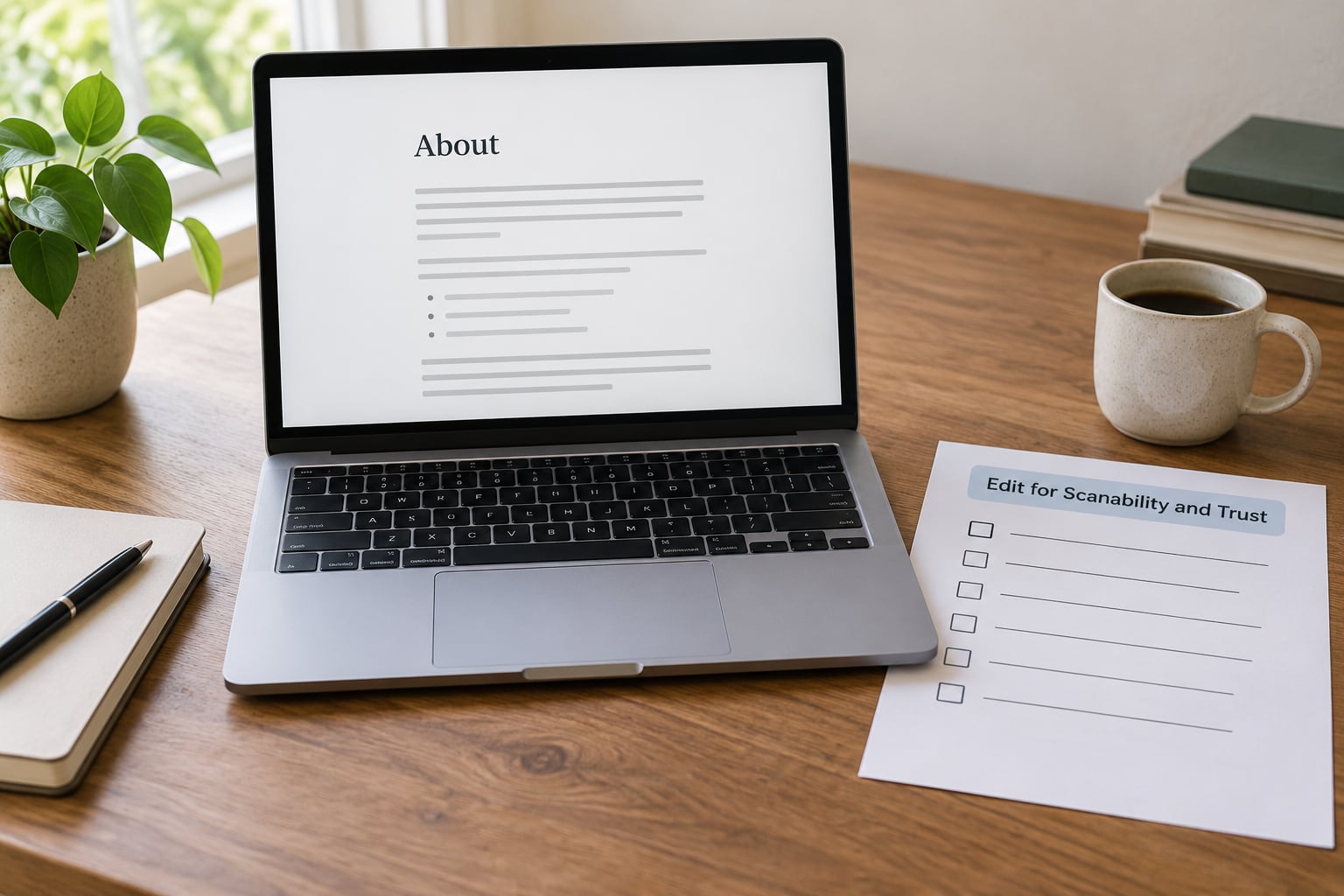
Read the draft line by line and apply these checks.
- Cut anything under 20 words that no reader would miss.
- Break every paragraph after three sentences. Two is better on a phone.
- Replace passive constructions with a verb and a subject.
- Delete every claim you cannot support in a conversation.
- Remove jargon a customer would not use out loud, including internal team jargon.
- Check that the About page agrees with your homepage and services pages on names, numbers, and offers.
- Confirm it still works at arm’s length on a phone screen.
On length: aim for 300 to 600 words of body copy for a one-person business and up to about 800 with a short team section. Longer than that and visitors stop scrolling somewhere in the middle. The only figure you will find floating around, 500 to 600 words, is a reasonable default, not a rule from somewhere.
On images: real photographs of the actual workspace and the actual people outperform stock photography every time. A studio shot of a stock model in an empty loft tells a reader nothing true. Give every image alt text that describes the picture, and never leave the alt attribute empty.
7. Publish and Test the Page
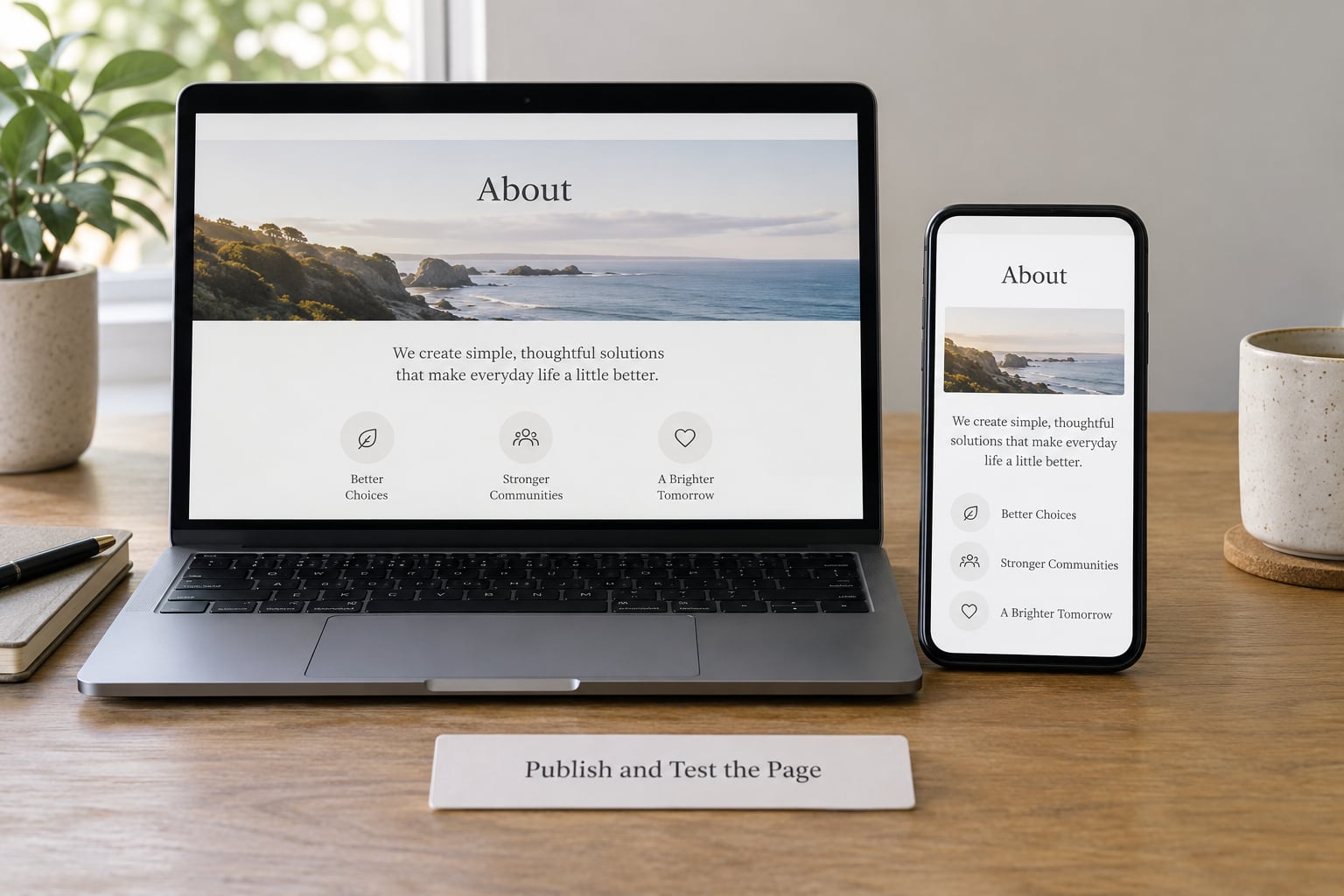
Put the page in your main navigation or footer so it is one click from the homepage. A page nobody can find is a page nobody reads.
Then load it on a phone. Check that no line runs long, that the call to action is reachable without pinching to zoom, and that the first paragraph appears without waiting on a heavy image to load.
The most useful test costs nothing: hand the page to one person who matches your target reader and ask them three questions afterward. What do you offer, who is it for, and what is the next step? If they cannot answer all three, the page is not finished, no matter how it reads to you.
For a real signal, check scroll depth in your analytics so you can see where readers stop, and run a simple A/B test on the opening line for two weeks. Heatmaps tell you the same thing visually. Practitioners rarely talk about this part, and it is the difference between guessing and knowing.
Common Mistakes
Opening with a life story. A reader arrived to find out whether you can help. The childhood and the unrelated career change belong further down, if anywhere. Fix: open with the promise, move the origin story to the fourth paragraph.
Writing in the third person. “Kelly is passionate about…” reads like a press release written by a stranger about your friend. Fix: use I, and use it often.
Listing every credential. Twelve qualifications become a wall. Fix: keep two or three that matter to this reader, and move the rest to a resume page or your author bio.
Sounding generic. “Innovative, passionate, dedicated” applies to every business ever started. Fix: delete each adjective and ask what it looks like in practice, then write that.
Making claims nobody can verify. Vague superlatives invite suspicion. Fix: trade the claim for a fact, or cut it.
Overloading navigation. Nine menu items and a pop-up chat widget bury the page you wanted read. Fix: keep the menu short and let the About page do one job.
Ending without a next step. Warm copy that goes nowhere loses the reader who was convinced. Fix: one button, written in the reader’s words.
A couple of habits help more than any single tip. Read the finished page out loud, because you will hear the sentences that are padding. And test it on a real person before you test it on a tool.
Frequently Asked Questions
How long should an About page be?
For a solo business, aim for 300 to 600 words of body copy. Add roughly 100 words per teammate you introduce, and cap the total near 800. Length matters less than whether every paragraph gives the reader something specific. If you are over 800 words, look for credentials and history you can move to a separate page, because the About page’s job is to build trust and hand over a next step.
Should an About page be written in the first person?
Yes, for a personal brand or a small studio. First person sounds like a person rather than a committee, and it is easier to keep honest. Company About Us pages for larger teams often mix voices, but each section should still have a named human behind it. Whichever form you use, avoid third person descriptions of yourself, because they read as borrowed.
What should I put on an About page for a personal brand?
Four things, in this order: the reader you serve, the specific problem you solve, two or three pieces of proof, and one next step. Add a short personal moment later on, once the reader already knows what you do. If you are starting with no track record, describe your process, your training, and where you are in building the business rather than inventing achievements.
How do I make an About page sound more personal?
Cut the adjectives and keep the details. Write one specific scene of about 60 words: a client moment, a mistake you learned from, or a day that went differently than planned. Use first person and plain verbs. Then read it out loud and remove anything you would not say to a stranger over coffee. Specificity reads as personal far more reliably than warmth does.
Where should I link my About page?
Link it from your main navigation or footer, your homepage, and anywhere you mention yourself, including a newsletter welcome email and your social bio. Freelancers should also link it from proposals, invoices, and booking confirmations, since those are moments when trust matters most. Use plain, descriptive anchor text that says what the reader will find there.
Conclusion
Start with one sentence: who you help, what you do for them, and one piece of proof. Write it plainly, then run it back through the steps above until each paragraph gives a reader a reason to keep scrolling. Published in 2026, a page like that works harder than three pages of polished filler.