Describing your style in words comes down to two or three honest adjectives, backed by evidence from your own wardrobe rather than borrowed trend language. You audit what you actually reach for, collect the qualities you notice, then narrow them down. The result becomes a filter you can use for every future shop. Learning how to describe your style in words is less about finding the right vocabulary than about gathering the evidence first.
If you have ever typed “I have no style” into a search box, this is for you. Most people who say that are not style-less. They are just unused to the vocabulary, or they assume the vocabulary belongs to thinner, younger, more photogenic wardrobes than theirs.
Give it about thirty minutes. Below is a seven-step process that takes you from a pile of unworn clothes to a sentence you could put in an Instagram bio, hand to a stylist, or say out loud in an interview without wincing.
Table of Contents
- What You Need
- Step-by-Step: How to Describe Your Style in Words in 7 Steps
- Step 1: Define Your Style Starting Point
- Step 2: Find Your Defining Style Words
- Step 3: Combine the Words Into a Style Formula
- Step 4: Add Specific Clothes and Context
- Step 5: Describe Your Style in Words Without Locking Yourself Into a Label
- Step 6: Test Your Description in Real Situations
- Step 7: Write Your Personal Style Statement
- Variations Worth Writing in Advance
- Common Mistakes
- Frequently Asked Questions
- How can I describe my style without using brand names?
- What are the best style words for a personal bio?
- How do I describe my style for a fashion portfolio?
- What if my style changes frequently?
- How do I make a style description sound unique?
- Conclusion
What You Need
None of this needs a special tool. It needs access to the things you already own and a bit of honesty about them.
- Your everyday wardrobe. The rail or drawer you actually dress from, not the aspirational one.
- Five outfits you have worn most often in the last six months. Photo five of them on your phone if you have to.
- Your saved looks and order history. Screenshots, wishlists, past receipts. Shopping apps keep years of this.
- A note, on any device. A phone note is fine. A paper receipt and a pen works just as well.
Two things help more than they should. The first is your laundry pile, because unworn clothes are the loudest clue in any wardrobe. The second is a list of things you avoid, and why. “I do not buy jackets” and “I refuse to wear anything that needs ironing” are style information, even though they feel like complaints.
Step-by-Step: How to Describe Your Style in Words in 7 Steps
Step 1: Define Your Style Starting Point
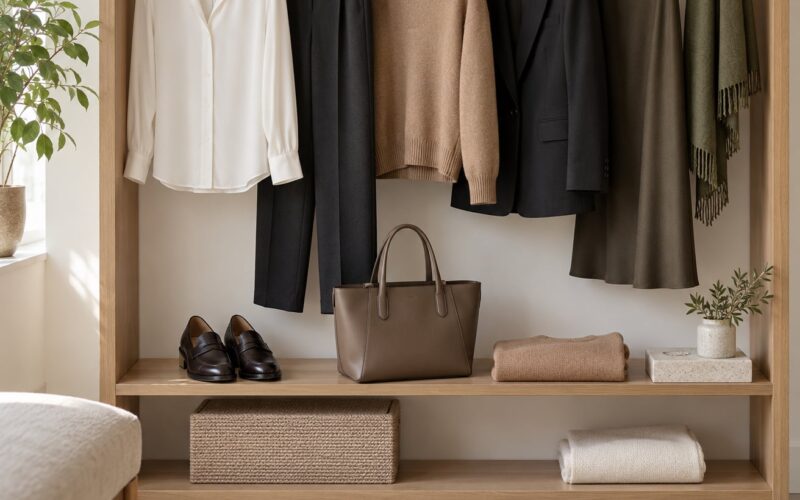
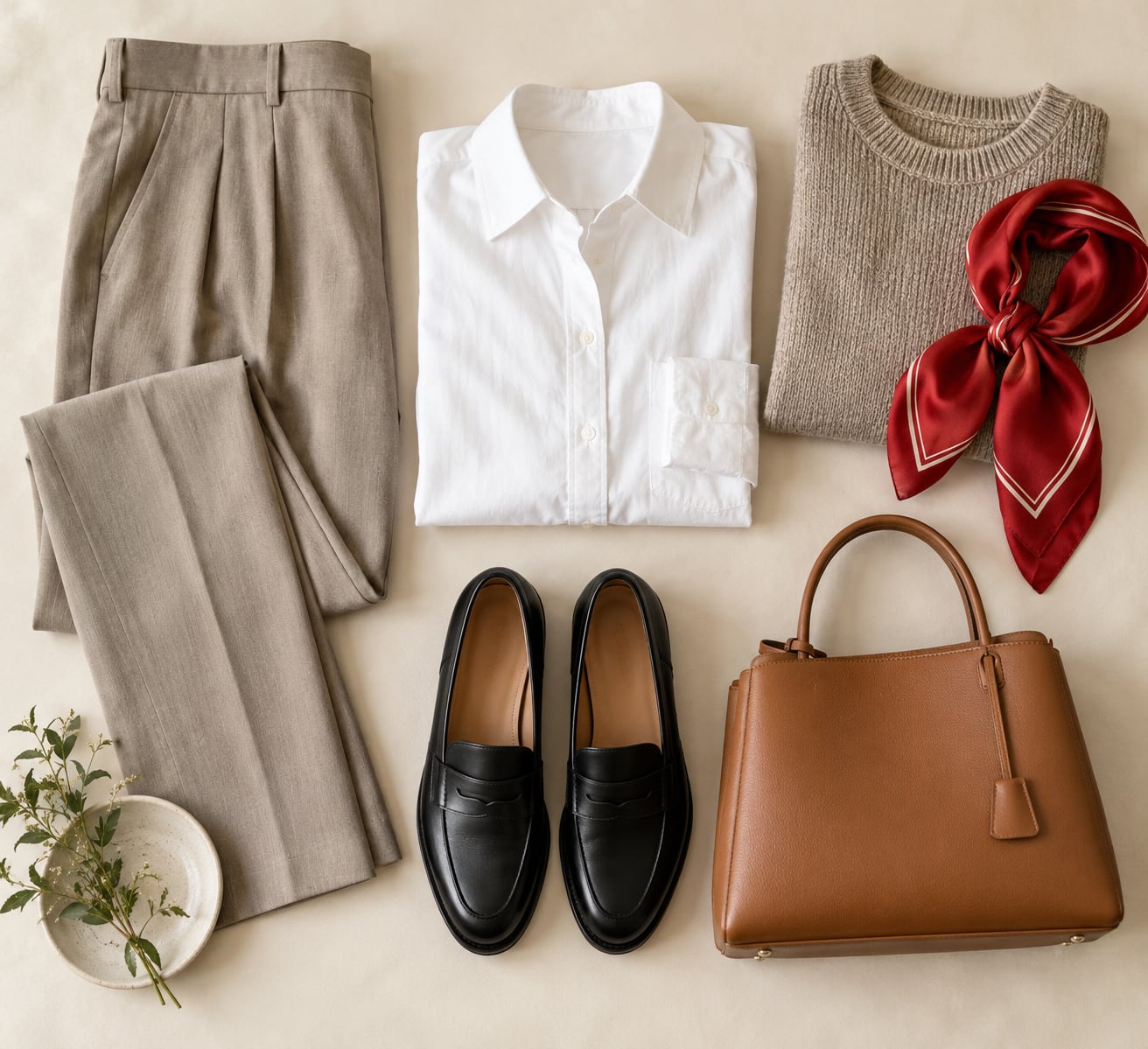
Start with evidence, not adjectives. Lay your five most-worn outfits side by side and write down what they have in common, in plain language. Garments first: the trench, the straight-leg jeans, the fine-gauge knit, the loafers. Then colors: black always, cream, olive, one red thing. Then silhouette: relaxed but not baggy, close to the body at the shoulder.
Mood comes last. “Navy, cream and olive, close-fitting on top and easy everywhere else, mostly leather” is an observation. “Effortless” is an interpretation of one. Write both, then keep the observation, because observations survive moods and interpretations do not.
In a Mumsnet thread on style in three words, the replies that landed with people were the blunt ones: “black always black”, “understated, clean, sharp”, “less is more”. Nobody voted for “eclectic”. Specificity is the whole trick, and it starts here.
Step 2: Find Your Defining Style Words
Now translate your inventory into candidates. A word earns its place if it is evocative, wearable, accurate and open to everyone. Accurately describing a body of any size, at any age, counts as accurate. Words that quietly exclude people, or that only work on a 22-year-old with a particular kind of bone structure, are not useful.
| Useful word | What it actually signals |
|---|---|
| Minimalist | Few pieces, chosen carefully, nothing shouting |
| Understated | Quality and cut over logos and print |
| Eclectic | Mixed sources, periods and textures on purpose |
| Romantic | Softness, movement, florals, volume in the right places |
| Directional | Clear point of view, clothes that start a conversation |
| Relaxed | Easy fits and washable fabric over structure |
Now compare with what people usually offer instead. “Nice” tells a shop assistant nothing. “Trendy” describes a season you will be over by spring. “Glamorous” is fine for one evening and wrong for every other. Vague words cost you, because they give a stylist, a tailor or an algorithm nothing to work with.
Collect about twenty candidate words before you narrow anything. Twenty feels excessive and that is the point: your first instinct picks the safe option, and you need volume to get past it.
Step 3: Combine the Words Into a Style Formula
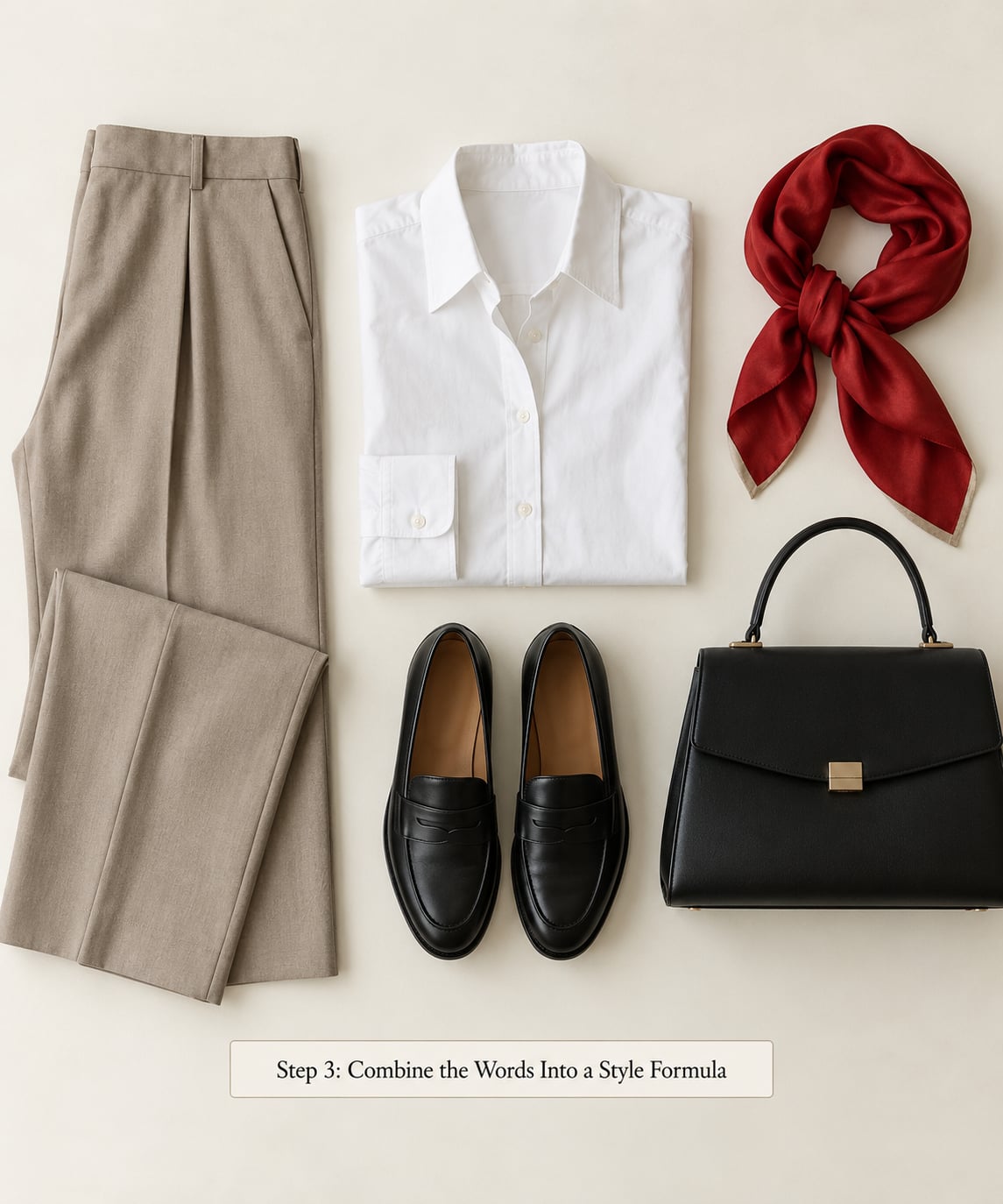
Four parts make a formula that holds together: a core aesthetic, one defining characteristic, the mood it gives off, and a single deliberate contrast. The contrast is what stops a description reading like a catalogue.
- Template: My style is a [core aesthetic] look built on [defining characteristic]. It usually feels [mood], with [one contrast] keeping it from being predictable.
Filled in, that reads: “My style is a relaxed, menswear-influenced look built on strong shoulders and good knitwear. It usually feels calm and a bit serious, with bright colour in a scarf stopping it from going flat.” Another: “My style is an eclectic mix built on vintage pieces in good condition. It usually feels warm and unhurried, with one sharp tailored piece doing all the structure work.”
A third, from a reader who described herself online as “WFH tramp chic, classy lady who lunches, date night”: “My style is a practical base built on washable layers. It usually feels easy, with the good shoes only coming out when I know the lighting is good.” Three moods in one person. Formulas accommodate that better than labels do.
Step 4: Add Specific Clothes and Context
General words only go so far. To make a description usable, hang it on real garments, materials, colours and situations. Add one item per part of the formula: the piece that proves the aesthetic, the fabric you keep reaching for, the colour that always appears, and where the look actually gets worn.
“Relaxed, practical, neutral” is fine. “Relaxed and practical in cream, olive and navy: linen trousers, a chunky knit, waxed cotton, leather sandals, and it is clothes I can walk a dog in and still walk into a meeting” is a description someone else can shop from.
Context matters as much as the garment. Most style words only make sense against a life: a commute, school runs, a client dinner, a wedding in August, five days a week in a home office. Say where the clothes go and the description stops sounding like a mood board.
Step 5: Describe Your Style in Words Without Locking Yourself Into a Label
Style changes with jobs, weather, budgets, bodies and boredom. Describing it as a fixed identity creates a rule you will break and then feel bad about. Describe it as a current instead, and use verbs that allow movement.
Phrases that stay honest over time: “currently drawn to”, “usually builds around”, “tends to lean”, “at the moment my style is”. These are not hedges. They mark your words as a dated snapshot, which is more credible, not less.
The same rule applies to mixing. If two of your words sit in different rooms, do not force them apart by picking a compromise word. A Mumsnet respondent called herself “a bit of a mish-mash” and got replies agreeing that a mix is a legitimate answer. Keep both words and name the tension between them. “Eclectic, and warmer and heavier than it looks in photos” is honest in a way “polished” never was.
Step 6: Test Your Description in Real Situations
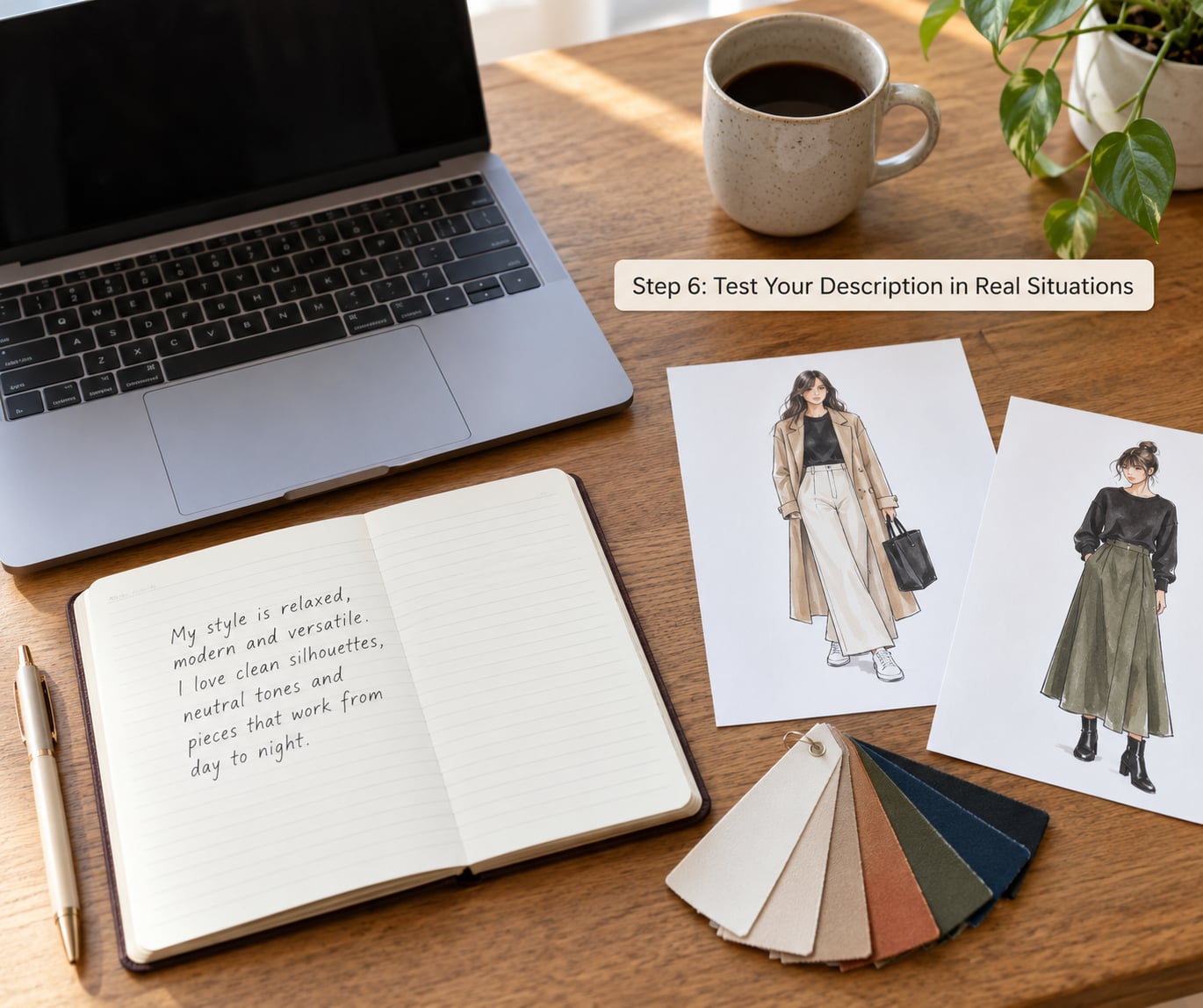
A description that only sounds good in your head is not finished. Put it somewhere other people will read it, then watch which words get ignored.
- Social bio. Thirty characters before the link is generous. Three words fit. If you need all four parts of your formula here, it is too long for a bio and belongs on your about page.
- Stylist consultation. Bring the formula plus your five outfits. A good stylist will use the words to suggest pieces you would not have picked yourself, which is the point.
- Portfolio or shop page. Three words in the header, one short paragraph underneath, and captions that name garments rather than moods: “washed linen trouser, waxed cotton jacket”, not “summer vibes”.
- Job application. Say which words describe how you already work. “Minimalist and detail-obsessed” tells a creative director more than any adjective about personality.
Read each word back and ask one question: did I actually buy anything with this word? If a word has never changed a decision, it is decoration. Cut it.
Step 7: Write Your Personal Style Statement
Your statement is one or two sentences. Core aesthetic, defining characteristic, mood, one contrast, and a hint of what you are actually wearing.
“I wear relaxed, neutral clothes with a sharp shoulder and one good coat. It is usually quiet, and the colour comes from a scarf or a bag.” That is a complete style statement. It would survive a bio, a shop conversation and a decade of small changes.
Adjust the length to the use case. A casual version: “Practical, slightly scruffy by choice, mostly in the same four colours.” A professional version: “Understated tailoring with soft structure, built to survive a full day and still look considered at the end of it.” A creative version: “Mostly neutral, always one strange detail, comfortable enough to move in.” A capsule wardrobe version: “Twenty pieces, three colours, one good coat, shoes I can walk in for hours.”
Variations Worth Writing in Advance
Keep a short version, a long version and a one-word version written down somewhere. The one-word version is surprisingly useful, and it is often the hardest, because one word has to hold the whole thing. “Deliberate” does more work than any adjective from the twenty you generated in step two.
Common Mistakes
Most bad style descriptions fail for a handful of repeatable reasons. Here they are, with the fix.
Copying trend jargon. “Quiet coastal grandmother” or “mob wife” are fun and specific, but they describe a costume, not a person. Borrow the individual word, drop the costume.
Using too many unrelated labels. Listing six aesthetics says you have no aesthetic. Three words is the ceiling for a description anyone else will remember.
Naming brands instead of aesthetics. “I wear Celine and Toteme” dates your sentence and says nothing about you. “Understated tailoring, Scandinavian, cream and charcoal” ages better and describes a person.
Describing one outfit instead of a pattern. The party outfit is not your style. Your five most-worn outfits are. Use the pattern, mention the outlier separately.
Sounding negative. This is the one that stops people most often, and it deserves a table of its own.
| What people say about themselves | What to say instead |
|---|---|
| Frumpy | Relaxed, unfussy, deliberately loose |
| Mumsy | Easygoing, wash-and-go, comfortable |
| Old | Conservative, timeless, classic |
| Scruffy | Casual, low-maintenance, unpolished on purpose |
| Sludgy | Fluid, draped, soft tailoring |
| Boring | Understated, quiet, low-contrast |
A host in that same Mumsnet thread ran exactly this exercise, turning “frumpy” into casual, “old” into conservative, “mumsy” into effortless. The clothes never changed. Only the sentence did, and that is the whole point of step two.
Describing what you want rather than what you own. Keep two sentences, one for now and one for where you are heading. Mixing them makes both less useful, and shoppers lose money chasing an aesthetic that does not exist yet.
Three habits keep a description alive. Date it, so “as of this spring” is part of the sentence. Test every new word against a real purchase within a month. And read the description aloud, because words that sound awkward spoken are usually the ones doing the least work.
Frequently Asked Questions
How can I describe my style without using brand names?
Describe the effect instead of the label. Ask what a brand does well for you: sharp shoulders, undyed linen, wide proportions, a colour you keep buying. Turn that into a general word such as tailored, relaxed, monochrome or handmade. Someone can then shop your description at any shop, not just one you already shop at.
What are the best style words for a personal bio?
Short, concrete and readable at a glance. Words like understated, relaxed, eclectic, romantic, directional and sharp travel well because most people already half-know them. Skip anything that needs a paragraph to explain. Three words is usually the maximum a bio can hold before a click, so pick the three you would still be happy to say out loud.
How do I describe my style for a fashion portfolio?
Lead with the method rather than the mood. Name the palette, the silhouettes and the fabrics you return to, then show five looks that prove it. Captions should identify garments plainly: washed linen trouser, waxed cotton jacket, leather loafer. Then add one short paragraph on where the work is heading, so the portfolio reads as a direction rather than a mood board.
What if my style changes frequently?
Treat style words as a dated snapshot, not an identity. Write currently, usually and tends to in front of your description, and date it. When tastes shift, replace one word at a time rather than rewriting the whole sentence, and keep your old wording in a note so you can see what changed. Clothing changes faster than people assume.
How do I make a style description sound unique?
Uniqueness comes from specificity, not odd words. Black always black is more memorable than eclectic because it is true and testable. Add one honest detail that nobody else would claim: the coat you have had for nine years, the sneakers you wear with the tailored trousers, the fact that every colour you own is a shade of blue. Anyone can copy a mood. Nobody can copy your wardrobe.
Conclusion
Start tonight, not on Sunday. List the five outfits you wear most, find the one quality they share, and write a single sentence combining that quality with two style words. That is the whole of how to describe your style in words: evidence first, a fixed formula second, and a willingness to rewrite the sentence whenever your wardrobe moves.
Then say it out loud. If it feels slightly wrong, the fix is usually one word, not the whole sentence. Nobody has their style finished, and the people who describe theirs best are usually just being more specific than the rest of us.