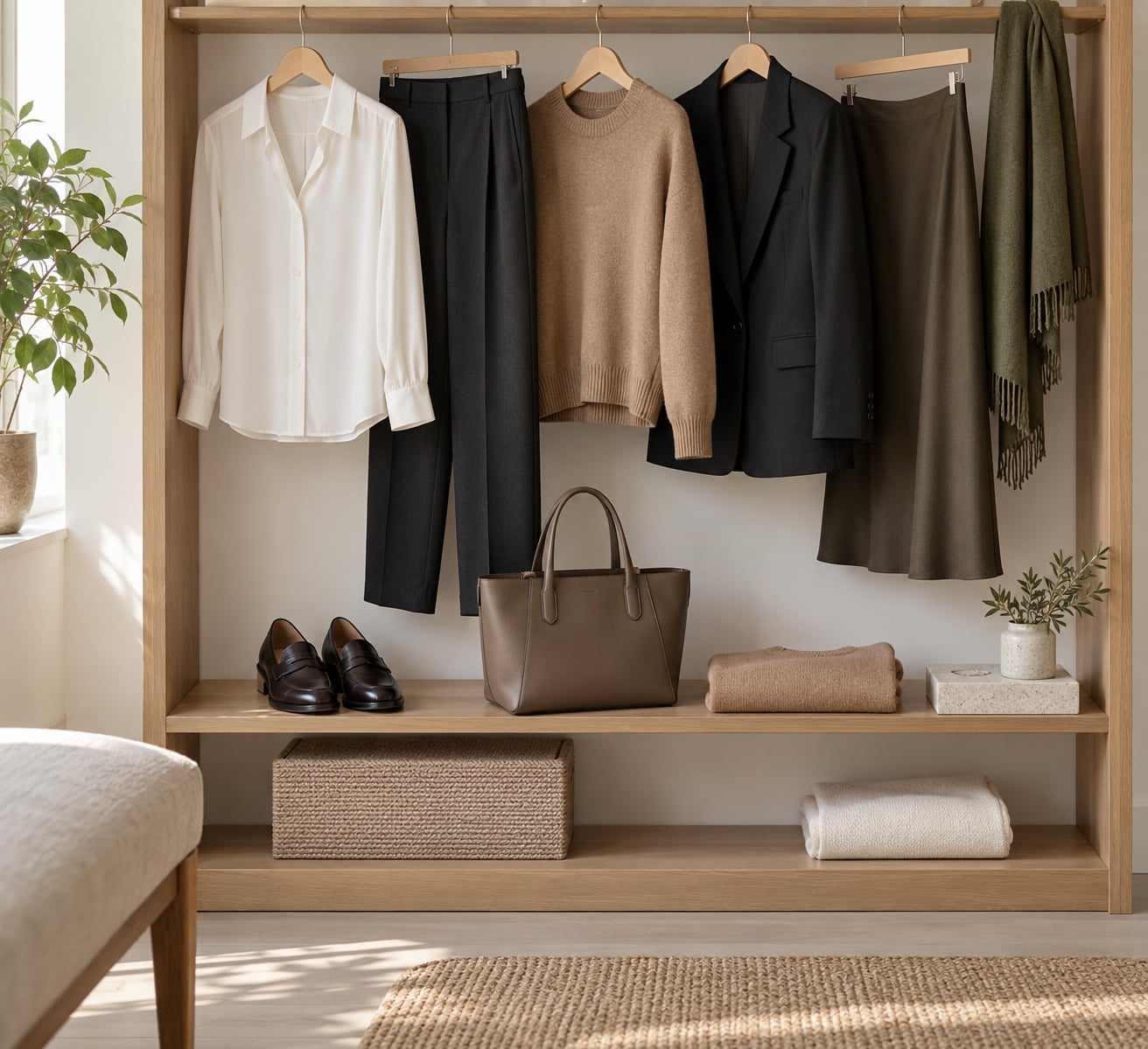
A work capsule wardrobe is a small set of pieces, usually 15 to 25, built so every top pairs with every bottom and the outfit is finished before your coffee cools. You get there by auditing your actual dress code first, locking a neutral color palette, then adding one piece per gap instead of buying a list top-down. Most people can do the whole build in a weekend plus a few evenings of auditing.
The reason it works is multiplication. Six tops, three bottoms and two layers already give you more combinations than most closets produce with thirty pieces, because none of them clash. What follows takes that apart piece by piece, including the awkward parts people skip, like what to do when your office sits somewhere between business casual and creative.
Table of Contents
- What You Need
- Step-by-Step: How to Build a Capsule Wardrobe for Work
- 1. Define Your Real Workweek
- 2. Audit What You Already Own
- 3. Choose a Controlled Color Palette
- 4. Select the Core Work Categories
- 5. Check the Mix-and-Match Potential
- 6. Shop for Gaps Instead of Filling a Number
- 7. Test and Maintain the Capsule
- Common Mistakes
- Frequently Asked Questions
- How many pieces should a work capsule wardrobe contain?
- Is a capsule wardrobe appropriate for a business-professional office?
- Should a work capsule wardrobe change with the seasons?
- How can I build a work capsule wardrobe on a limited budget?
- What are the best first pieces to buy for a work capsule?
- Conclusion
What You Need
Before you open a single shop page, gather five things. Skipping this stage is how people end up with a beautiful capsule that cannot survive a Tuesday.
- Access to your whole current wardrobe, including the tote bags and laundry baskets. Items you have not seen in a year are part of the audit.
- A week from your calendar, marked with the activities you actually repeat: stand-ups, client calls, presentations, site visits, conferences, after-work drinks.
- Your office dress code in writing if it exists, plus a note on climate. Overheating rooms in July and freezing ones in January change which fabrics you buy.
- A realistic budget and your laundry rhythm. Most people wash twice a week, so you need enough looks to cover two days without a repeat.
- A simple combination tracker. A note on your phone works. You record the piece, the category and what it already pairs with.
Add one optional item if your schedule is hybrid: your gym kit and the change of clothes you use for it. That context matters later, because several people in work wardrobe discussions are trying to make one outfit handle both a meeting and a workout.
Step-by-Step: How to Build a Capsule Wardrobe for Work
1. Define Your Real Workweek
Write down one honest week, then look at it. Most office jobs are far less formal than the clothes people buy for them. If you sit at a desk three days, take a train once, and see clients twice, you need comfortable pieces that photograph well on video and one outfit that holds up in a room across from someone.
Mark each activity with the dress level it requires: relaxed, business casual, or client-facing polish. Video calls matter more than people expect, because a top that gapes at the neckline or a shirt with a visible logo reads clearly on a laptop screen.
You will know this step worked when you can name the three or four situations your capsule has to cover, and nothing else is on the list.
2. Audit What You Already Own
Pull everything out and sort it into four piles: keep, tailor, donate, replace. This is the step that takes the longest and saves the most, and people consistently underestimate how much usable clothing they already have.
Judge each piece on fit first, then fabric, then condition. A blouse in good shape with a gaping neckline is a tailor, not a donation. Check how often you wore it in the last year; something worn zero times but sitting in the closet unwashed is usually a donation.
One thread on building a professional work capsule noted the advice that keeps coming up in these discussions: find the one or two pieces you genuinely love, a dress or a great blazer, and build the rest of the wardrobe outward from them instead of following a list top-down. Advice on starting lean is just as consistent: two pairs of trousers, one dark neutral and one lighter, plus sturdy basics in your chosen colors.
3. Choose a Controlled Color Palette
Pick two neutrals, one dark neutral and one light, then add one or two accent colors. A working palette looks like navy, white, gray and black, with olive or burgundy as accents. Anything more than three neutrals and two accents and you will hit pieces that cannot cross categories.
Color discipline is what makes mix-and-match effortless. When every skirt is in the same family, you stop thinking about it in the morning, and that is the entire point of a capsule.
Keep the accent colors to the pieces closest to your face, like a blouse, a knit or a scarf, and let the neutrals carry the rest. Your bag and shoes should be neutral so they work with everything.
4. Select the Core Work Categories
Fill these categories with quantity ranges rather than exact numbers, and adjust for how often you actually dress for work. Someone in the office five days a week needs more tops than someone in the office two.
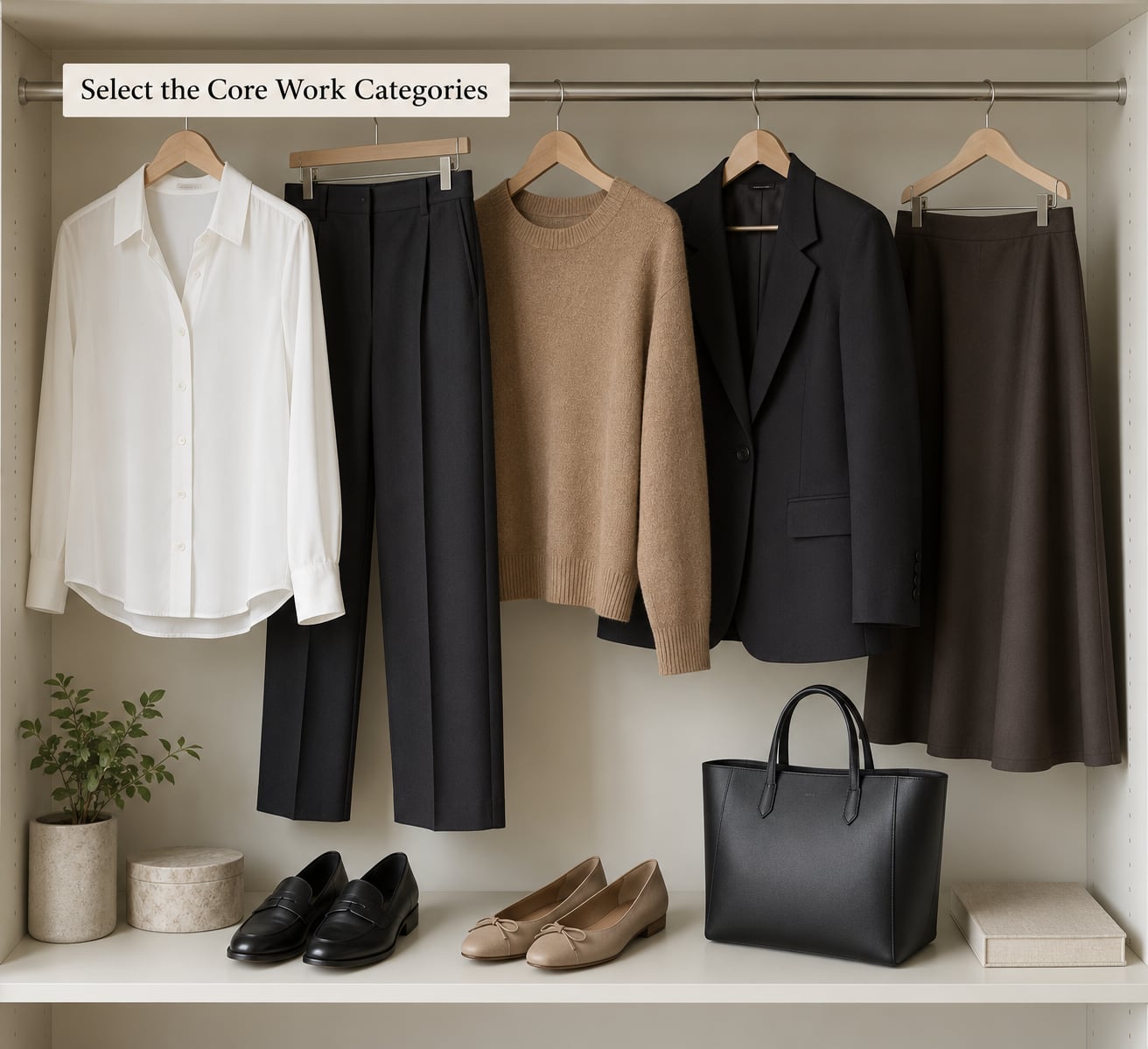
- Tops and knitwear: 4 to 6 pieces. Two crisp shirts, two or three polished tops, one lightweight knit. This is the category you will buy most of.
- Bottoms: 3 to 4 pieces. Two trousers in different weights, one skirt or alternative silhouette, and one piece that is slightly more casual for hybrid days.
- Layers: 2 to 3 pieces. A structured blazer and a cardigan or second knit. These carry an outfit from “fine” to “presentation-ready” without changing anything underneath.
- Dresses: 1 to 2 pieces. A non-seasonal wrap or midi dress covers days when you cannot be bothered to match two halves.
- Outerwear: 1 to 2 pieces. A mid-weight layer that works over everything in your palette, plus weather coverage if you commute outdoors.
- Footwear: 2 pairs. One polished pair for meetings and one comfortable pair for commuting and long office days. Closed toe for most professional environments.
- Bag: 1 structured tote that holds a laptop, a water bottle and a folder without looking like a gym bag.
Nobody needs all of these at full quantity. If you wear knitwear daily and almost never wear skirts, drop the skirt and take a second knit instead.
5. Check the Mix-and-Match Potential
This is the step people skip and the one that decides whether the capsule works. Take each piece and count what it already pairs with. A new trouser must work with at least three or four tops in your palette, and a new top must work with every bottom you own.
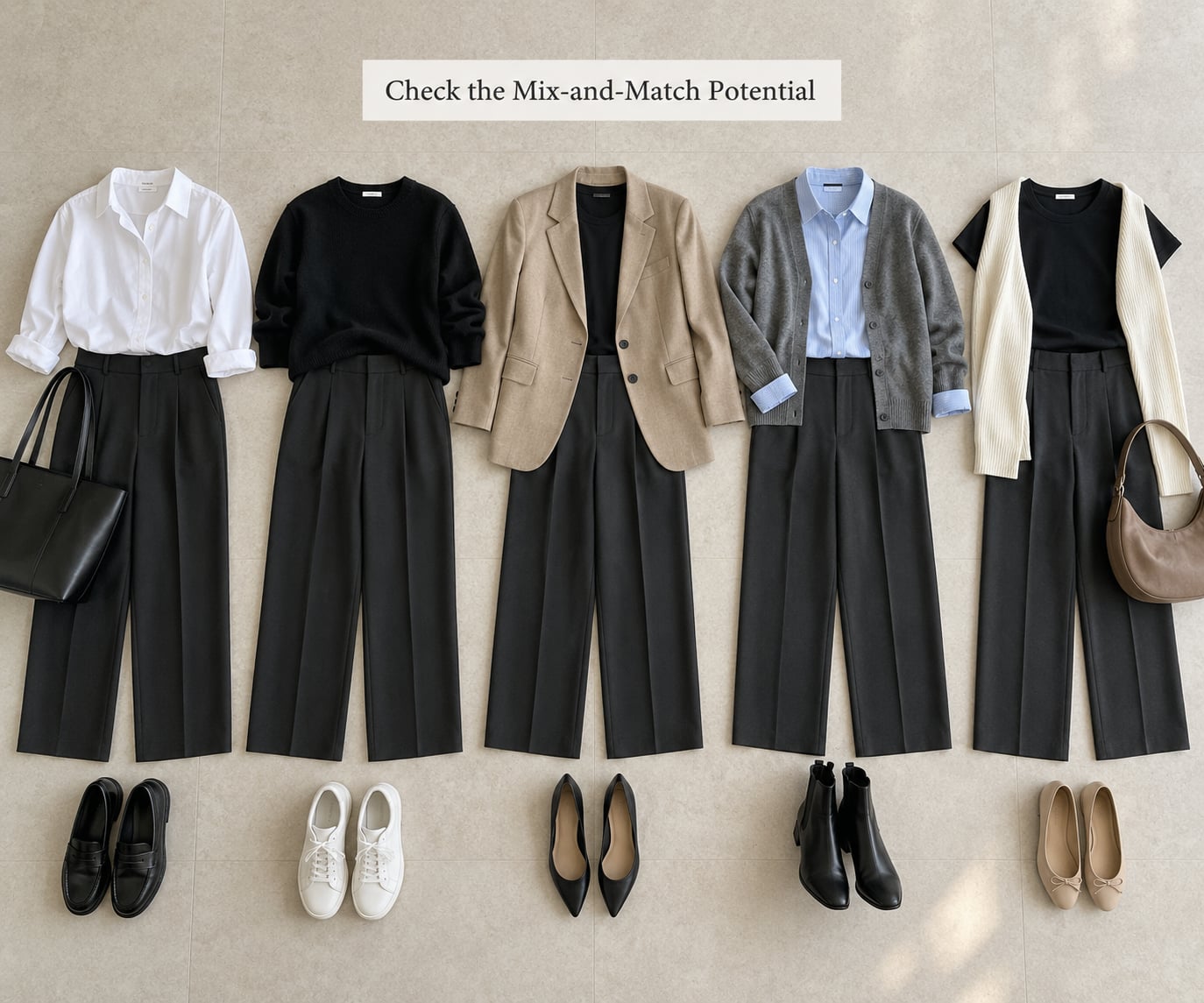
Run the outfit maths. Four tops, three bottoms and two layers gives you twenty-four combinations before you count layering changes, which is more than a five-day week needs with no repeat on the same week. Ten pieces can work if you wash mid-week; fifteen feels varied; twenty is comfortable for daily office wear; twenty-five starts to include seasonal and specialist pieces.
You will know it worked when you can name fifteen distinct outfits for a normal week without straining.
6. Shop for Gaps Instead of Filling a Number
Look at your audit and buy the missing roles, not the missing count. Right now you might have no meeting-ready layer, no footwear that survives a wet commute, no coverage for a hot office, and nothing that works for an interview next month.
Buy those, one role at a time, and let the count land where it lands. Shopping a role at a time is what stops duplicate purchases, because you are never buying a second blouse when what you actually needed was a blazer.
On budget, invest in fit and fabric for the pieces you wear most, the blazer, trousers and shoes, and save on the categories that take abuse, like basic tops. One garment worn 100 times at a moderate price beats three worn ten times each. If you are rebuilding from very little, start with the two pairs of trousers and one perfect top, then build outward.
7. Test and Maintain the Capsule
Wear every new piece for two weeks before you consider the capsule finished. Track what you reach for, what you avoid, and what you wore twice in one week because nothing else fitted the dress code.
Pieces that never combine with anything usually failed the mix-and-match test and can go. Pieces that are uncomfortable get replaced, no matter how good they look on the hanger. Fabric that creases badly or holds odor fails by Wednesday afternoon in a warm office, so test before you commit more pieces to that style.
Set a six-month calendar reminder to repeat the audit. Jobs change, dress codes shift, and the piece you avoided all year is usually the one you should replace first.
Common Mistakes
Buying to a number instead of a need. A target of twenty pieces becomes twenty purchases whether or not the gap exists. Fix: buy roles, and let the count arrive on its own.
Going all-neutral with nothing to look at. A capsule of gray, navy and black works, but it gets boring by week three. Fix: two accent pieces, worn close to the face.
Ignoring the commute and the room temperature. Beautiful wool trousers are miserable on a platform in January and a boiling office in July. Fix: check the climate before choosing fabric weight, and keep one wrinkle-resistant travel layer.
Compromising on fit and fabric. Ill-fitting trousers and scratchy synthetics get left at home, which defeats the purpose. Fix: try on, move around, and sit down before you buy. A tailor is cheaper than a replacement piece you never wear.
Treating trends as core pieces. A trend top is fine once, not as a load-bearing layer. Fix: keep trends in the accent slot and rotate them out after a season.
Not wear-testing before expanding. New pieces get judged by memory rather than by three weeks of real mornings. Fix: the two-week test before buying anything else.
One last habit ties it together. Keep the capsule count visible in your tracker and review it twice a year, because the most common failure is not a bad first purchase, it is the quiet creep back to forty pieces over six months.
Frequently Asked Questions
How many pieces should a work capsule wardrobe contain?
Most office capsules sit between 15 and 25 pieces covering tops, bottoms, layers, footwear and a bag. If you dress for work five days a week, lean toward the higher end. If you are hybrid or dress up less often, 15 is plenty. Judge the number by outfits produced rather than pieces owned: you should be able to name fifteen distinct work outfits without repeating within the week.
Is a capsule wardrobe appropriate for a business-professional office?
Yes, and a business-professional office is one of the easier cases because the dress code narrows your choices for you. The shift is toward weight and formality: structured suiting fabrics, closed-toe shoes in leather, knee-length or longer skirts, and layers that read tailored rather than slouchy. Keep the same neutral-first palette and just raise the dress level of every category by one step.
Should a work capsule wardrobe change with the seasons?
Keep the core non-seasonal and rotate only the climate layers. Tops, trousers, skirts, dresses, shoes and your bag stay year-round; what changes is outerwear, knit weight and fabric thickness. That way you are not rebuilding the whole capsule twice a year. In practice most people hold a core of 15 to 20 pieces and add three or four seasonal pieces on top for summer and winter.
How can I build a work capsule wardrobe on a limited budget?
Start with the audit and shop gaps, not categories. Spend on the pieces you wear most, which means fit on trousers, a good blazer and shoes that survive commuting, and economise on basic tops and layering knitwear. Buy secondhand where you can inspect seams and fabric first, and remember the cost-per-wear maths: one piece worn 100 times beats three worn ten times each.
What are the best first pieces to buy for a work capsule?
Two pairs of trousers, one dark neutral and one lighter, plus one excellent top you genuinely love and a structured tote. Advice that repeats across work wardrobe discussions is to start lean and build outward from a piece you love rather than buying a full list top-down. Add a blazer next, since it lifts everything underneath it, then fill in tops until your laundry rhythm is covered.
Conclusion
Building a capsule wardrobe for work comes down to four actions in order: document one real week of your worklife, sort what you own into keep, tailor, donate and replace, fix a palette of two neutrals, one light, one dark and one or two accents, then buy only the gaps that audit exposed.
Do the fifteen-outfit check before you buy anything else, and wear-test every new piece for two weeks. The right capsule is not the one with the nicest pieces in it, it is the one that makes Monday morning a non-decision. Since 2026, most people find that one good blazer and two pairs of properly fitting trousers do more for their work wardrobe than any shopping spree.