Shopping your own closet first means styling outfits from clothes you already own before you spend anything new: purge what does not work, write down what is actually left, and build repeat combinations you can wear this week. The full reset takes roughly two to three hours spread over a week, plus fifteen minutes a day for the first fortnight. It is not difficult, but it does ask you to make real decisions about things you feel attached to.
Here is the whole process in five lines:
- Write down a boundary for what you are allowed to shop for, before you look at anything.
- Take everything out and sort it into categories, with seasonal and work-only pieces kept apart.
- Split the lot into wear-now, rework, and release piles.
- Photograph and write down 10 to 15 outfits built from what survived.
- Live from that list for two weeks, then buy only the gaps that showed up repeatedly.
The last step is the part most people skip, and it is the whole reason the method works. If you shop your own closet first without recording outfits, you just shuffle hangers and change nothing.
Table of Contents
- What You Need
- Step-by-Step: How to Shop Your Own Closet First
- Set a Shopping Boundary Before You Begin
- Take Everything Out and Sort by Category
- Create Wear-Now, Rework, and Release Piles
- Build 10 to 15 Outfits From What You Already Own
- Shop Your Own Closet for the Next Two Weeks
- Make a Small, Evidence-Based Shopping List
- Maintain the Reset With a Ten-Minute Weekly Check
- Common Mistakes
- Frequently Asked Questions
- How long does a closet reset usually take?
- What do I do with sentimental clothes I never wear?
- Does this work if I have a small closet or a rental?
- What if nothing I own feels wearable anymore?
- How do I stop impulse buying clothes after the reset?
- What is the 3-3-3 rule for wardrobe?
- Start With One Worn-Out Favorite
What You Need

You need about six things, and none of them are expensive.
- An hour or two of uninterrupted time. Split it into two sessions if you have to. A rushed purge turns into a re-shuffle.
- Somewhere to spread out. A bed, a floor, or the dining table works. A laundry room with no space does not.
- A full-length mirror, so you can check fit without carrying things back and forth.
- Hangers or baskets for the three piles. Labels matter more than matching ones.
- A notebook or a notes app for the inventory and the outfit list. Paper and pen felt faster to me, but either is fine.
- A number for later, not now. Decide what you would actually spend on replacements once you can see what is missing. Deciding before the inventory almost always sets the wrong target.
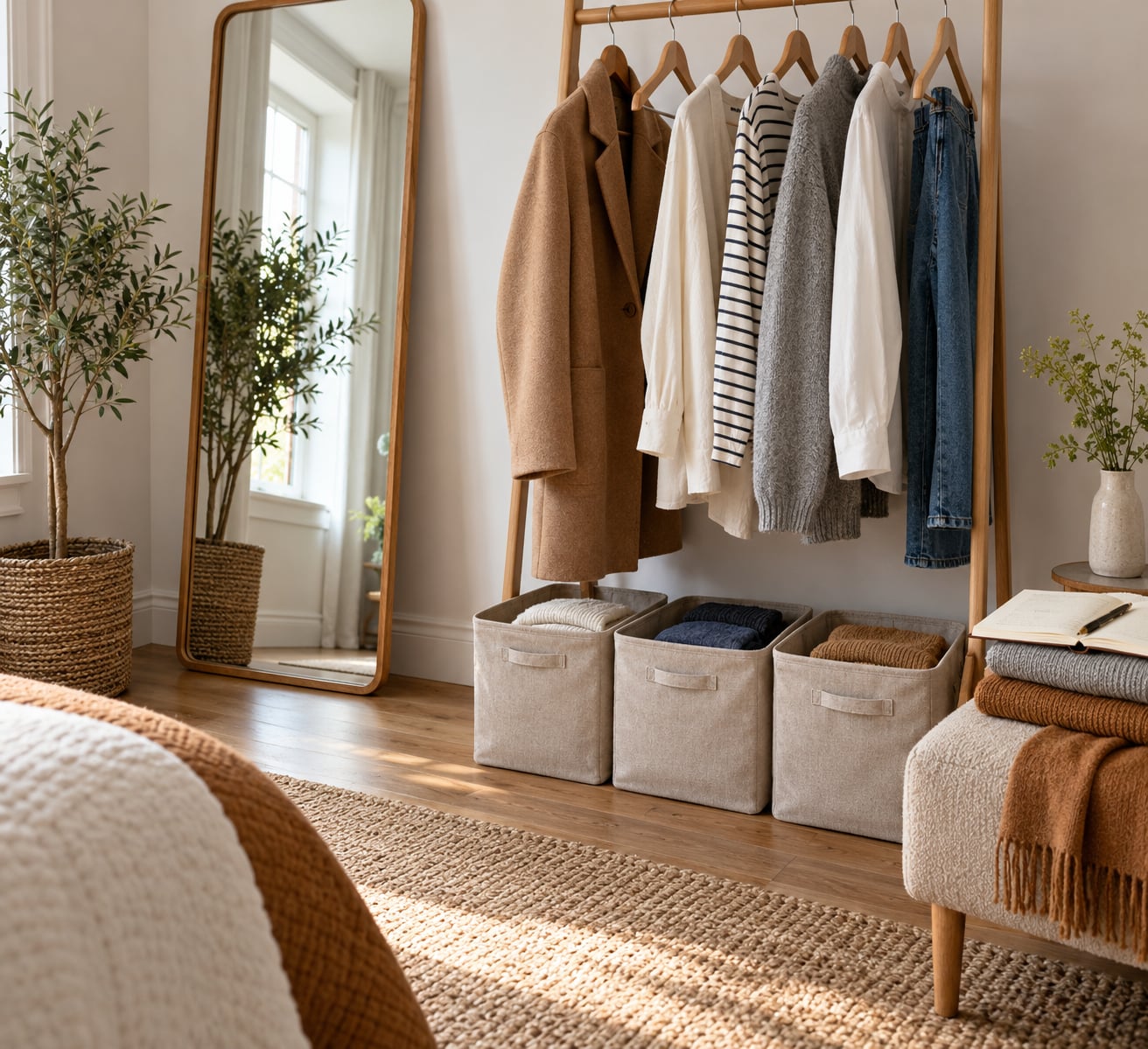
One optional addition: a garment rack or a door you can hang things on temporarily. When I did this, the laundry door held about forty pieces at a time, and that turned a two-hour job into three short ones.
Step-by-Step: How to Shop Your Own Closet First
Set a Shopping Boundary Before You Begin
The most common way this goes wrong is starting with a vague goal like needing more clothes or needing new work clothes. Vague goals have no stopping point, so the purge becomes an audition for what to buy instead.
Write one rule instead. Mine was: before I buy anything, I build three complete outfits from pieces I already own. Not one piece added to something I own, but three whole outfits that I can put on tomorrow.
You worked if the rule is specific enough to fail. A reader on a decluttering forum described the same idea as pretending to go shopping in her own clothes and only picking absolute favourites, with anything that does not get picked having to go. That framing works because it turns a judgement about attachment into a shopping decision.
Take Everything Out and Sort by Category
Pull it all out and group by type: tops, bottoms, dresses, outerwear, shoes, and accessories. Keep seasonal pieces and work-specific pieces in their own separate groups rather than mixed in.
Do not make any decisions yet. This stage exists so you can see the full inventory at once, which is nearly impossible when everything is on hangers. Expect the volume to surprise you. My tee count in the first ten minutes was 41, and I owned roughly 12 I actually wore.
Create Wear-Now, Rework, and Release Piles
Now divide the sorted piles three ways.
Wear-now goes straight back on hangers. It fits, it works with other pieces, and you like it. This pile should be big enough to cover two weeks of mornings without repeating.
Rework holds pieces that could work with a small change. A dress that reads dated with the shoes you reach for, trousers that need a hem, a blazer that is fine but has nothing to go with. Most people underestimate this pile. It is where most of your new combinations come from.
Release is everything you do not wear: damaged, stained, an objectively wrong fit now, or simply disliked. For undecided items, use a maybe bag. Put them in a bag, tuck it at the bottom of a closet or the back of a shelf, and give it a date. One reader told me she bagged thrift-bound items for months and never once reached into the bag, which is how she knew the decision was already made.
Build 10 to 15 Outfits From What You Already Own
This is where the actual shopping happens. Take your wear-now and rework piles and combine them into complete outfits: work, weekend, errands, evenings. Four per category is a good target, so you arrive at 10 to 15.
Use a simple outfit formula rather than free-styling from scratch every morning. One reliable shape is a base layer, a bottom, a top, a layer, and shoes, where changing just the top or the layer changes the whole outfit. Add a second formula that starts with a dress instead of a base layer.
Write each one down, word for word. Black trousers, cream knit, camel coat, ankle boots. Photograph them if you prefer, but photographs fail you in dim closets, so the written list is the one to trust.
Then mark the gaps you hit three or more times while writing. If you wrote four outfits and kept needing a belt, that is a real gap. If it came up once, it is not.
Shop Your Own Closet for the Next Two Weeks
Now do the part that makes this a habit rather than an exercise. For fourteen days, get dressed only from your written list.
Track lightly. I used a note with two columns: outfit and the date I wore it. That gave me three useful answers without any app. Which pieces came up again and again, which outfits I quietly substituted when I did not feel like the plan, and which combinations I had written but never actually put on.
That third one matters. You will find outfits on the list that you photographed but never wear, and they are usually the ones with an awkward gap in the middle or a colour that clashes with something else you own. Move them to rework or strike them out. The list should shrink to what genuinely works.
Make a Small, Evidence-Based Shopping List
Now, and only now, look at what you did not buy in the last two weeks. Your list should be short. If it has more than five items, you are still reacting to inspiration rather than to evidence.
For each item, write down how many of your existing outfits it would complete. An item that finishes four outfits is a buy. An item that finishes one is a want, and a want can wait a season.
Buy for repeatability, not for novelty. One versatile boot that works with every outfit you already own beats three trend-driven pairs that each need their own clothes around them. Before you buy anything, check the colour against your dominant palette, which you can work out by pulling out every garment you actually wear and looking at what appears most often.
The wear test keeps you honest later. Divide the price you paid by the number of times you expect to wear it in a year. An item you will wear thirty times a year is worth far more per dollar than a statement piece you will wear twice, even when the statement piece costs less. A high number of wears per season is the only real test of a good purchase.
When you are ready to buy, buy one thing, then let a full season pass before you decide whether it earned its place. That waiting rule is the most-endorsed anti-shopping tactic in the decluttering communities I read, and it works on any budget.
Maintain the Reset With a Ten-Minute Weekly Check
Closets refill themselves unless something stops them. Ten minutes a week is usually enough.
- Hang or fold the laundry the same day. A basket of unfolded laundry becomes tomorrow’s nothing-to-wear morning.
- Rotate the closet seasonally. In-season pieces go to the front, off-season goes into lidded bins or under-bed storage, shoes get boxed.
- Check the worn items and anything you are repairing instead of rebuying.
- Read the outfit list before you shop. If you have already built the outfit, you are not shopping, you are browsing.
- Apply one-in-one-out. Every new item triggers one going. It is blunt, but it works.
Also worth knowing: tailoring often beats replacing. A trouser that is perfect except for the hem is an alteration job, not a wardrobe gap. And when your body changes, the fix is frequently re-proportioning what you have rather than buying a new category of clothing.
Common Mistakes
Starting with a shopping day. Going straight to the shops and hoping the feeling passes is the single most expensive version of this. The reset comes first, every time.
Sorting instead of deciding. Sorting feels productive and changes nothing. Set a timer for each category and make a call on every item, or accept that the pile will still be there tomorrow.
Purging too hard and ending up with too little. This is the top objection people raise about strict declutter rules, and it is fair. If after two weeks you are genuinely short on wearable clothes, the fix is not more decluttering. It is a short shopping list built from the gaps you recorded.
Not recording the outfits. You will mentally remember your wardrobe as a flattering blur of all the pieces you like, which is exactly why the nothing-to-wear feeling exists.
Treating the maybe bag as a decision. An open-ended bag becomes a permanent storage unit. Give it a date and check it.
Fearing you will be seen in the same outfit twice. It happens, and it is far less noticeable than it feels from the inside. Photographs of your list will remind you that the same top with different trousers is a different outfit, and wearing something twelve times a year is normal, not embarrassing.
Buying too many replacement items at once. The temptation after a purge is to rebuild the whole wardrobe in an afternoon. Space those purchases across a season.
For momentum, keep the process small and visible. Do one category per session, put the maybe bag at the back where you will not see it, and tell someone what you are doing. If you want the reasoning behind the habit rather than the steps, the environmental side is worth a look: WRAP, a UK resources nonprofit, has found that keeping clothing in use longer cuts its footprint by roughly a fifth to a third, which makes the re-wearing half of this method a win twice over.
Frequently Asked Questions
How long does a closet reset usually take?
Two to three hours of actual sorting, spread over a week if you like, plus about ten minutes a day for a fortnight afterwards. Most people spend the first hour pulling everything out and sorting by category, the second hour making the wear-now, rework, and release decisions, and the third building and writing out their outfits. Trying to do it in one evening is the most common reason the process stalls.
What do I do with sentimental clothes I never wear?
Keep them, but take them out of the daily closet. Put the piece in a separate memory box, a garment bag at the back of a top shelf, or a digital photo if the sentiment is about the memory rather than the item. People rarely regret keeping a sentimental piece; they regret having it in the rotation, where it quietly occupies hanger space and reminds them to feel guilty. Memory is not storage.
Does this work if I have a small closet or a rental?
Yes, and small spaces actually make it easier to notice gaps. You cannot hide unworn pieces behind a closed door when everything is in one visible row. If you rent or move often, keep your inventory as a written list and your outfit list as photos on your phone rather than as a physical system, so nothing depends on where the storage is.
What if nothing I own feels wearable anymore?
That is a real outcome, not a failure, and it usually means your taste or your body changed rather than that you need a whole new wardrobe. Start small: pick the five pieces that still feel like you and build outfits from those, then build a short shopping list only for what those combinations prove is missing. Buy a little, wear it for a season, then repeat.
How do I stop impulse buying clothes after the reset?
Three habits do most of the work. Wait a full week between wanting something and buying it, because most urges fade. Read your outfit list before you shop anything, so you can check whether you already own a version of it. And apply one-in-one-out, so a purchase has to displace another piece and your total count stays level.
What is the 3-3-3 rule for wardrobe?
It is a popular capsule-wardrobe guideline usually read as thirty pieces worn at least three times a month, in three different combinations, for three months. The exact wording varies between sources, so treat it as a prompt to check what you actually wear rather than a law. Several similar systems exist, including the 5-4-3-2-1 method and the 80/20 rule, all designed to shrink a wardrobe toward what you really reach for.
Start With One Worn-Out Favorite
Do not start with the whole closet. Start with one item you already love and have worn more than any other piece you own, and build three outfits around it this week. Two changes of shoes, one swap of layer, one swap of bottom.
That is the whole habit in miniature, and it is enough to begin. Once you have written three outfits down, you have proof that you own something worth wearing again, and proof is what the nothing-to-wear feeling does not give you. Then repeat the process with the next favorite, and keep going until the written list is longer than the shopping list.