A minimum order quantity is the smallest number of garments a factory will agree to make for you, usually counted per style, per color, or per size. In apparel it typically lands somewhere between 50 and 500 units for each of those buckets, which is why minimum order quantity explained for new clothing brands comes down to one question: what exactly is the factory counting?
That single question decides how much cash you commit before a single customer sees your label, how many units end up in each size, and what your unit cost will be. Get it wrong and a friendly quote of 200 units turns into 1,800 garments you have to sell before you make anything back.
Founders posting in apparel communities keep hitting the same wall, so the rest of this guide walks through how the numbers actually work, what moves them up or down, and how to plan a first run that does not tie up your runway.
Table of Contents
- What Is Minimum Order Quantity in Clothing?
- Minimum Order Quantity Explained for New Clothing Brands at a Glance
- Why Do Clothing Factories Have Minimum Orders?
- What Determines a Clothing Brand’s MOQ?
- Fabric route
- Color count
- Size run
- Construction complexity
- Decoration method
- Trims and packaging
- Supplier size and location
- How Is MOQ Different from Minimum Run Length and MOQ per Color or Style?
- What a 200-unit MOQ actually means
- How Much Does a Small Clothing Run Cost?
- Fixed versus variable costs
- What landed cost adds
- How Can a New Clothing Brand Negotiate a Lower MOQ?
- What Alternatives Can New Brands Use When MOQs Are Too High?
- How to Plan a First Production Run Without Overordering
- Start with one or two styles
- Test demand before you cut fabric
- Choose a size ratio deliberately
- Set a reorder trigger before launch
- Protect cash, not just margin
- Frequently Asked Questions
- Is 12 pieces a realistic first order for a clothing brand?
- Does every size have to meet the minimum order quantity?
- Do overseas factories ever accept less than their published MOQ?
- When does a second production run make sense?
- What does 200 MOQ mean in clothing production?
- Should a new clothing brand manufacture domestically or offshore?
- Conclusion
What Is Minimum Order Quantity in Clothing?
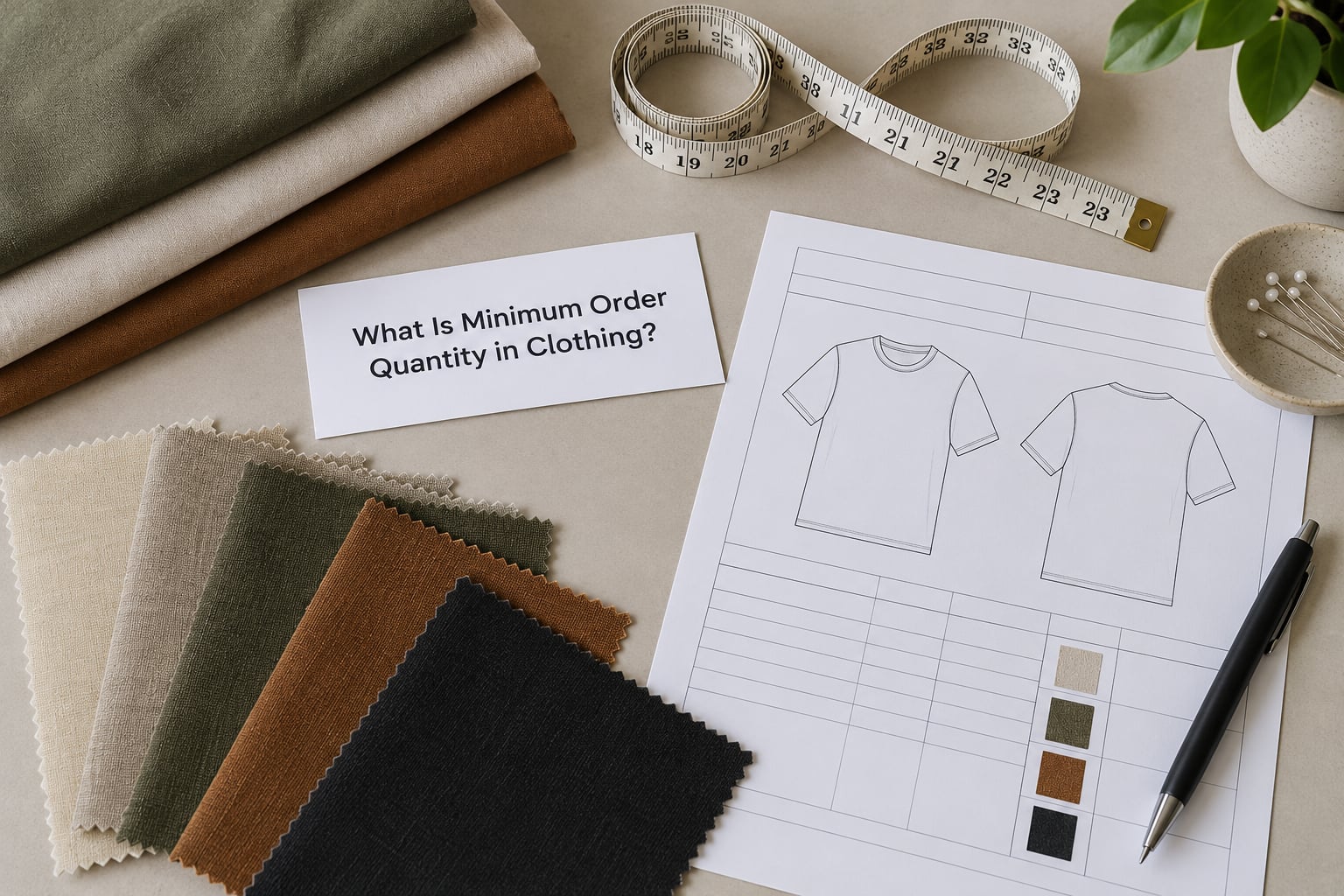
Minimum order quantity, or MOQ, is the smallest production run a manufacturer will commit to. It exists because a garment cannot be made in ones. Fabric is woven or knitted by the roll, dye lots have fixed sizes, cutting tables are planned against a marker, and a sewing line has to be set up, loaded, and monitored.
In clothing, the number almost never refers to your whole order. It is usually calculated per style, per colorway, or even per size. A quote of 200 might mean 200 units of one design in one color across all sizes, or it might mean 200 units of that design in every color you asked for.
Ask one clarifying question before anything else: is this minimum per style, per color, per size, or for the full order? The answer changes the real unit count by an order of magnitude.
Minimum Order Quantity Explained for New Clothing Brands at a Glance
Different minimums apply at different stages of a run, and confusing them is the most common sourcing mistake. This table separates the terms you will see in a quote.
| MOQ type | What it means | Why the factory sets it | Trade-off for a new brand |
|---|---|---|---|
| MOQ per style | Minimum units of one design, summed across its colors | Covers pattern cutting and sewing line setup | Adding styles multiplies your commitment quickly |
| MOQ per colorway | Minimum units of one design in one color | Each color needs its own dye lot or fabric allocation | Two colors can double your order before you sell one unit |
| MOQ per size | Minimum units per size within a style and color | Marker planning only cuts efficiently above a minimum per size | You may need to accept a narrow size run at first |
| Mill minimum | Minimum yardage or kilograms from the fabric mill | Dyeing and finishing runs have fixed minimum weights | Often the real blocker for custom fabric |
| Decoration minimum | Minimum pieces per screen, embroidery run or print placement | Setup and digitizing cost money regardless of volume | Cheap to add decoration, expensive at tiny quantities |
| Reorder minimum | Smallest repeat run the factory accepts later | Same setup logic applies to every new order | A first MOQ does not guarantee easy reorders |
Why Do Clothing Factories Have Minimum Orders?
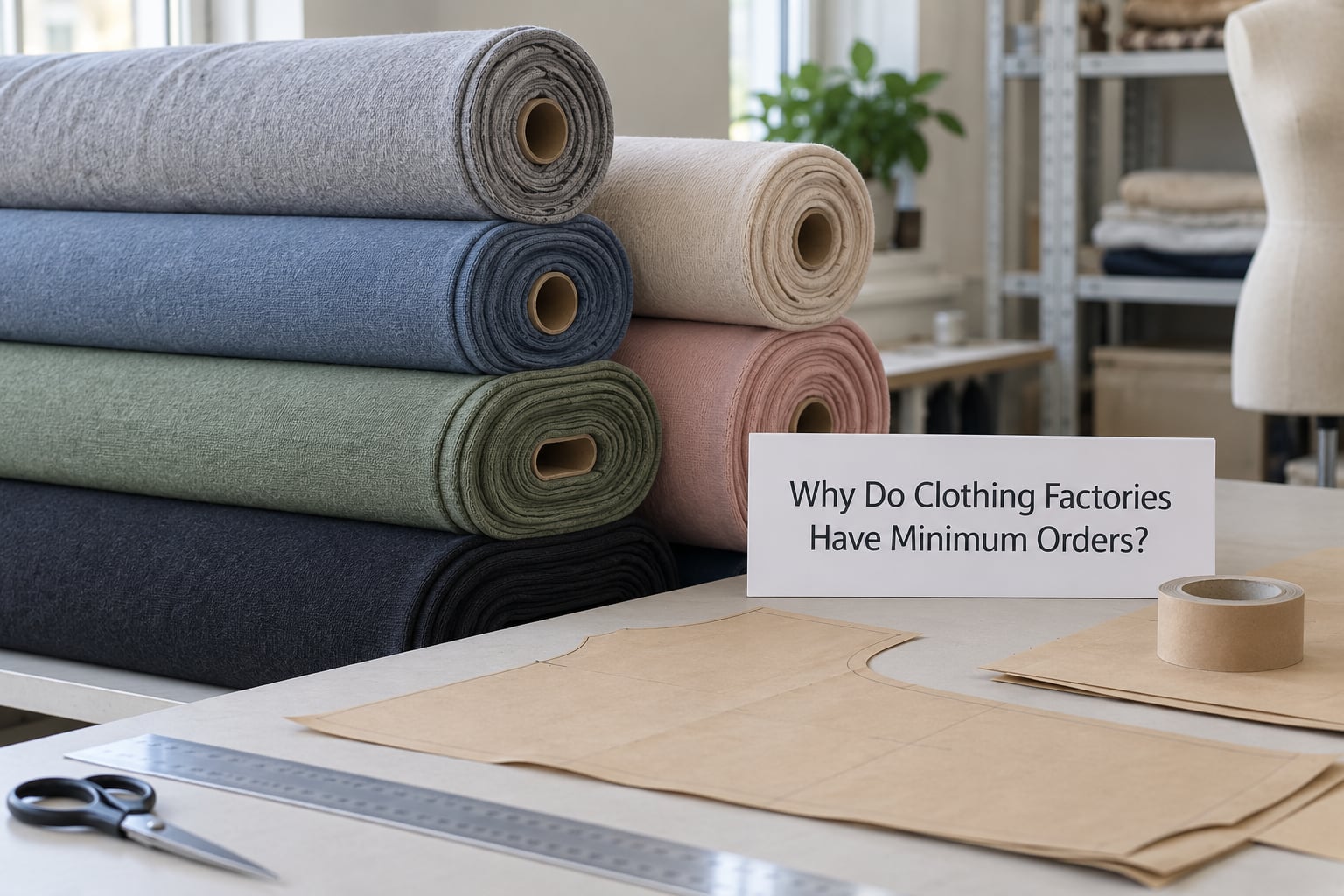
Factories set minimums to cover fixed costs that do not shrink when the run gets smaller. Some of those costs are physical, some are commercial, and a few are simply about risk.
- Fabric sourcing. Mills sell by the roll or by weight. A mill will not dye 30 meters of a custom knit, so a custom color often forces a minimum of hundreds of yards.
- Marker planning. Cutters lay patterns across the fabric width to reduce waste. Below a certain quantity the leftover is so large that cutting becomes unprofitable.
- Line setup. Threading, tension, timing and machine settings take time. Switching between garments mid-run costs more than running one style through.
- Decoration setup. A screen has to be burned. Embroidery files have to be digitized. Those setup charges are paid once, so the factory spreads them across the run.
- Trims and labels. Woven labels, hangtags and packaging are often ordered by the thousand or by the reel.
- Quality control. Inspecting 30 garments line by line is nearly the same effort as inspecting 300, so the per-unit inspection cost spikes.
- Freight. A carton that is half full costs nearly the same to ship as a full one. Consolidating shipping is part of the factory’s own economics.
Read those reasons carefully, because they tell you which levers actually work. You cannot negotiate your way past a mill minimum, but you can often move around it.
What Determines a Clothing Brand’s MOQ?
The same factory quotes two founders completely different minimums, based on what each order asks for. These are the factors that move the number.
Fabric route
Stock fabric sitting on a shelf is the cheapest route in and often the lowest minimum, because the mill cost is already sunk. Custom-milled or custom-dyed fabric carries the mill minimum with it, and that usually sets your MOQ no matter what the sewing floor says.
Color count
Every extra color is another fabric allocation, another dye or knit lot, and another small run of units. Founders who plan one hero color and add a second later cut their risk dramatically.
Size run
Seven or eight sizes spread across a small run leaves a few units per size, and a slow-selling odd size becomes deadstock you paid full price for. Factories respond well to a deliberate, smaller size run.
Construction complexity
A basic crew neck tee with straight seams is fast and simple. Kangaroo pockets, quilted linings, lined bodies and unusual hardware slow the line and raise the minimum, because each extra operation adds handling time.
Decoration method
Embroidery, screen printing and applied patches all carry setup costs. Digital printing and heat transfer are cheaper at small volume because there is no physical setup, which matters when you are ordering in the low hundreds.
Trims and packaging
Custom woven labels, branded hangtags, tissue paper and gift boxes look polished and quietly inflate your minimum. Printed neck labels and simple polybags cost less and buy you flexibility.
Supplier size and location
A large factory running full containers has less room for a 100-unit run than a small-batch shop in Los Angeles or London that was built around exactly that size. Large orders from a huge factory can also earn a lower MOQ, since the number is a smaller share of their capacity.
How Is MOQ Different from Minimum Run Length and MOQ per Color or Style?
These terms sound interchangeable and are not. Total order quantity is everything you are buying. Minimum run length is the smallest batch a factory will execute, which may sit below the MOQ for repeat business. MOQ per style, per color and per size are the three nested rules that decide how many total units your combination of choices actually creates.
What a 200-unit MOQ actually means
Here is the arithmetic that catches new brands. A factory quotes an MOQ of 200 per colorway. You want three colors in one style.
| Interpretation | Units you receive | What happened |
|---|---|---|
| 200 per color, three colors | 600 | The straightforward reading of a per-colorway minimum |
| 200 total across three colors | 200 | Only possible if the factory will mix quantities inside one colorway minimum |
| 200 per color, and 20 per size | 600 with a fixed ratio per color | Size-level minimums dictate your ratio, not your preference |
| 200 per style, colors split freely | 200 | The most founder-friendly structure, and the one you must ask for explicitly |
Same quoted number, four different orders. That is why the first email to a factory should state your style count, color count and size run, then ask them to confirm the minimum against that exact configuration in writing.
A related term worth knowing: a SKU is one stock keeping unit, which in clothing usually means one style in one color in one size. Three styles, three colors and eight sizes is 72 SKUs, and the quantity per SKU is where small budgets quietly fail.
How Much Does a Small Clothing Run Cost?
Total cost is not just the unit price times units. It is fixed setup work plus variable sewing and material cost, plus everything that happens after the garment is finished.
Fixed versus variable costs
Fixed costs hit once per order: pattern making, tech pack, sampling, screen or digitizing setup, trims and packaging design. Variable costs scale with units: fabric, cutting, sewing, trims, packing.
Divide the fixed portion across your units and the unit cost becomes obvious. A setup cost of a few hundred dollars spread over 50 units adds several dollars per garment; the same cost spread over 500 adds a small fraction. Unit cost typically drops steeply between 50, 100 and 500 units, then flattens once you are buying by the container.
What landed cost adds
The garment leaving the factory is not the cost of the garment. Add freight or air cargo, insurance, duties and taxes, customs brokerage, and your own fulfillment and returns. Owners sometimes quote a per-unit cost that looks attractive until duties and freight push the landed figure well above it, and the MOQ was small enough that the per-unit overhead was heavy to begin with.
Add your samples to that figure too. Founders routinely spend more on three rounds of sampling than they budgeted, because each revision looks cheaper than a production run and gets approved without hard deadlines.
How Can a New Clothing Brand Negotiate a Lower MOQ?
Most factories would rather have your repeat business than hold a hard line on 300 units. These levers work because each one reduces the fixed work behind your order.
- Use stock fabric. Ask what greys, blacks and whites are already in the factory’s stock. This single change can halve a minimum.
- Cut colors to one or two. Offer to launch in one colorway and add the second after the reorder. One color is easier for a factory to say yes to than three.
- Simplify construction. Remove a pocket, a lining or an unusual hardware detail and ask for a requote. Fewer operations mean fewer changeovers.
- Combine drops. Ask whether two capsule releases twelve weeks apart can count toward one minimum, with everything cutting in a single run.
- Commit to a reorder plan. Many factories will accept a lower minimum from a buyer who states a realistic reorder schedule and volume in writing. Ask for the minimum in writing and agree to the terms.
- Pay the setup openly. If the block is decoration setup or a custom pattern, ask whether charging that fee as a one-time item lets them drop the unit minimum. Clear costs get negotiated; vague ones do not.
What does not work is asking a factory to break even on your order. If the numbers do not cover their setup, the answer is no, and pressing produces a supplier who quietly cuts corners.
What Alternatives Can New Brands Use When MOQs Are Too High?
There are lower-commitment routes, and each one trades something other than minimum order size.
| Route | MOQ | Unit cost | What you give up |
|---|---|---|---|
| Print on demand | None | Highest per unit | No inventory, but thin margins and limited product control |
| Blanks plus your own decoration | Often low | Moderate | Generic base garment, your print and trims on top |
| Domestic small-batch factory | Low, sometimes 24 to 50 | High | Domestic labor cost, shorter lead times and easier visits |
| Nearshore or nearmake partner | Medium | Mid to high | Some cost advantage of offshore with much shorter lead time |
| Preorder or crowd-funded run | Set by demand | Standard bulk pricing | You must hit the preorder threshold or cancel publicly |
| Made-to-order | None | Low per unit at volume | Customer waits, and you hold no stock once a run closes |
| CMT cut make trim | Medium to high | Lower than full package | You buy fabric, manage trims and handle packing yourself |
Watch the small-batch claims. Plenty of suppliers advertise no minimum and actually mean blanks with a printed logo or a print-on-demand service. Ask directly whether you own the pattern and design, and whether the goods are exclusive to you.
How to Plan a First Production Run Without Overordering
MOQ sets your floor. Planning sets your ceiling, and the gap between the two is where most first-time brands go wrong.
Start with one or two styles
Community consensus among founders is consistent: a narrow launch of one to three styles produces readable feedback, while a broad first collection gives you thin quantities everywhere and tells you nothing about what works.
Test demand before you cut fabric
Post designs, build a waitlist, run a small paid campaign, or open preorders with a stated close date. Money and sign-ups are the only demand signals that survive contact with reality.
Choose a size ratio deliberately
Do not let the factory assign it. Decide your ratio from your own audience data, then check it against the size-level minimum. A ratio the factory can actually cut is worth more than an ideal ratio that leaves you with unusable quantities.
Set a reorder trigger before launch
Pick the sell-through rate that tells you to reorder, and the number of units remaining that tells you the reorder is now too late. Reorder minimums are often close to the original MOQ, so a fast seller is not the same as a re-orderable seller.
Protect cash, not just margin
A landed cost model that includes MOQ unit cost, freight, duties and packaging is the right planning tool. Founders who value control over cash flow and low inventory risk report that a slower first run bought them the cash to respond to what actually sold.
Frequently Asked Questions
Is 12 pieces a realistic first order for a clothing brand?
Twelve units is possible through print on demand or made-to-order, but rarely through a custom factory run. Small-batch manufacturers often quote minimums in the 24 to 50 unit range per style and color. At that volume expect a much higher unit cost and a narrow size run, because anything outside your core sizes usually gets left out.
Does every size have to meet the minimum order quantity?
It depends on how the factory calculates it. Some apply the minimum across the whole size run of a style and color, others require a minimum in each individual size. The second structure controls your size ratio, so ask which one applies before you approve a size run. Factories with narrow-per-size minimums will usually suggest a fixed ratio for you.
Do overseas factories ever accept less than their published MOQ?
Yes, more often than founders expect. Stock fabric, fewer colors, simplified construction and a stated reorder plan are the usual levers. Large buyers can also get a lower minimum because small orders barely register on their capacity sheet. What rarely moves is a custom mill minimum, since that cost sits with the fabric mill rather than the sewing floor.
When does a second production run make sense?
Run two when your first run sold through at a predictable rate, your cash position can cover the reorder minimum, and you have data showing which size and color performed best. Many factories quote reorder minimums close to the original MOQ, so a quick sell-through on a tiny run does not always mean you can reorder quickly. Check the reorder minimum before you launch.
What does 200 MOQ mean in clothing production?
It usually means 200 units of one style in one colorway, not 200 garments in total. Add colors and the order grows quickly, so three colorways at a 200 minimum becomes 600 units before you count size-level constraints. Always ask the factory to confirm whether the quoted number applies per style, per color, per size, or to the whole order.
Should a new clothing brand manufacture domestically or offshore?
Domestic and nearshore factories usually quote lower minimums, shorter lead times and easier communication, at a higher unit cost. Offshore factories win on unit cost and container pricing once your volume grows. For a first run where the design is still unproven, a short lead time often matters more than unit cost, because it lets you correct the second run.
Conclusion
Start with one question to every factory: is the minimum per style, per color, per size, or for the whole order, and can you confirm it against my exact configuration in writing. Once you have that number, multiply it by your color count and check it against a full landed cost, not the quoted unit price.
If the total frightens you, change the order rather than forcing it. Stock fabric, one color, three styles and a preorder test will get you a real first run inside your budget, and real data is worth more than a big order you cannot reorder quickly.