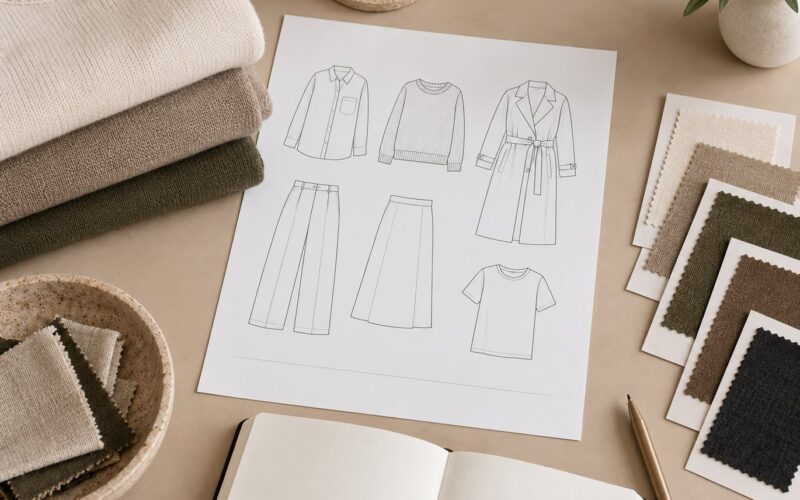
If you have ever tried to work out whether a garment is actually worth making, you have probably built something like a cost sheet already, just on the back of an envelope. Knowing what a cost sheet looks like for apparel matters more than most founders expect: it is a single page that itemises every input for one style, fabric, trims, cut-make-trim labour, finishing, packaging, factory overhead, then freight and duty on top, rolled up into a cost per garment you can turn into a wholesale or retail price.
The examples below use a fictional style, a 180 GSM cotton jersey tee at a quantity of 5,000 pieces, priced in USD. Nothing on this page is a supplier quote. The point is to show the structure and the maths so you can drop your own numbers into the same rows.
Table of Contents
- What Is an Apparel Cost Sheet?
- What a Cost Sheet Looks Like for Apparel
- The header block: what the sheet is about
- The columns: what each one is for
- The line items: a worked cost sheet
- From FOB to landed cost
- Which Costs Should an Apparel Cost Sheet Include?
- Manufacturing cost is not landed cost
- Which items are excluded from a cost sheet
- How Do You Calculate the Cost per Garment?
- How Do You Set a Wholesale or Retail Price?
- What Is the Difference Between Cost Sheet, Budget, and Invoice?
- What Makes an Apparel Cost Sheet Useful?
- The four types of cost sheet
- Frequently Asked Questions
- What is a cost sheet with an example?
- What does a job cost sheet look like?
- Which items are excluded from a cost sheet?
- What are the types of cost sheets?
- How do I calculate garment costing?
- Do I need a cost sheet before talking to a factory?
- Conclusion
What Is an Apparel Cost Sheet?
An apparel cost sheet is a per-style document that lists every cost input needed to produce one garment and totals them into a per-unit factory cost (FOB) and, once freight and duty are added, a landed cost. It exists so you know what a style costs to make before you commit to a production run.
Three documents get confused with it constantly. A price list shows what you charge customers. A development budget shows what a whole collection is expected to cost you across sampling, production and marketing. A cost sheet is narrower than both: it is one style, costed line by line, and it is the only one of the three that tells you what a single garment earns you.
The other thing worth knowing is that a cost sheet is a working document, not a contract. You revise it when the fabric supplier changes, when the factory sends a corrected quote, when a lab dip comes back a shade off and the fabric has to be reordered.
What a Cost Sheet Looks Like for Apparel
Every decent sheet has the same three layers: a header that says which style and which quote the numbers belong to, a body of itemised line items grouped into sections, and a summary block that turns the body into FOB, landed cost and price. Here is a real one, section by section.
The header block: what the sheet is about
Before you read a single number, check the header. A cost sheet without this block is just a list, because you cannot tell whether the figures are a 1,000-piece quote or a 50,000-piece quote, or whether they are current.
| Field | Entry in this example |
|---|---|
| Style number | KT-1041 |
| Style description | Short sleeve crew neck tee, 180 GSM cotton jersey |
| Season | Autumn/Winter 2026 |
| Factory | Unit 4, Tiruppur (named supplier) |
| Quote date and revision | Quote valid 30 days, revision 3 |
| Quantity tier | 5,000 pieces |
| Currency | USD, converted at the rate on the quote date |
| Incoterm | FOB |
| Price break | 1,000 pieces at higher rate, 5,000 and 10,000 at the rate shown |
The columns: what each one is for
The column layout matters more than most people expect. If a column is labelled “cost” without saying per what, two people will read it two ways and you will lose an afternoon arguing about a total.
| Column | What it tells you |
|---|---|
| Cost element | The section the line belongs to: fabric, trims, CMT, finishing, packaging, overhead. |
| Detail | Specification: composition, GSM, width, colour, supplier reference. |
| Unit | What the supplier sells it in: yard, metre, piece, kilogram, hour. |
| Consumption or rate | How much of that unit one garment uses, or the hourly rate. |
| Cost per unit | The result: consumption multiplied by rate, in USD. |
| % of total | That line as a share of the FOB total. This is the column that tells you where to argue with the factory. |
The line items: a worked cost sheet
Here is the body of the sheet. Every figure is in USD per garment. The fabric consumption of 1.85 yards already includes a wastage allowance built into the marker, which is the single most common thing costing sheets leave out.
| Cost element | Detail | Unit | Consumption or rate | Cost per unit | % of FOB | |
|---|---|---|---|---|---|---|
| Fabric | Body fabric, 100% cotton jersey, 180 GSM, 70 inch width | Yard | 1.85 at USD 3.60 | 6.66 | 48.8% | |
| Fabric | Rib knit for collar and cuff, cotton/elastane | Yard | 0.16 at USD 2.20 | 0.35 | 2.6% | |
| Trims | Fusible interfacing, chest and collar | Yard | 0.10 at USD 0.35 | 0.04 | 0.3% | |
| Trims | Sewing thread, 40/2, matched colour | Piece | 1 per garment | 0.04 | 0.3% | |
| Labels | Printed neck label, satin | Piece | 1 per garment | 0.06 | 0.4% | |
| Labels | Woven main label, branded | Piece | 1 per garment | 0.09 | 0.7% | |
| Labels | Size tab | Piece | 1 per garment | 0.03 | 0.2% | |
| Packaging | Hangtag on string | Piece | 1 per garment | 0.08 | 0.6% | |
| Packaging | Polybag with tint and seal | Piece | 1 per garment | 0.07 | 0.5% | |
| Packaging | Export carton, 24 pieces per carton, allocated | Carton | 1/24 of USD 2.40 | 0.10 | 0.7% | |
| Materials subtotal | Fabric, trims, labels and packaging | 7.52 | 55.1% | |||
| CMT | Marker making and cutting | Piece | Allocated per garment | 0.55 | 4.0% | |
| CMT | Sewing operations, 12 operations at an average of USD 0.28 | Minute | 12 minutes SAM | 3.36 | 24.6% | |
| CMT | Fusing and interlining attachment | Piece | Allocated per garment | 0.12 | 0.9% | |
| CMT subtotal | Cut, make and trim labour | 4.03 | 29.5% | |||
| Finishing | Wash and finish | Piece | Allocated per garment | 0.20 | 1.5% | |
| Finishing | Press, final inspection | Piece | Allocated per garment | 0.15 | 1.1% | |
| Finishing | Barcoding and polybag packing | Piece | Allocated per garment | 0.06 | 0.4% | |
| Finishing subtotal | Wash, press, inspect, pack | 0.41 | 3.0% | |||
| Overhead | Factory overhead allocated at 12% of direct cost | Piece | 12% of 11.96 | 1.44 | 10.6% | |
| Contingency | Waste and rework allowance, 2% of direct cost | Piece | 2% of 11.96 | 0.24 | 1.8% | |
| Total FOB | Factory gate, before freight and duty | 13.64 | 100% | |||
From FOB to landed cost
The FOB total stops at the factory gate. Everything after that depends on where the garment lands, so it belongs in its own block, clearly labelled, with the basis stated. Duty rates vary by country of origin and destination, so check your own classification rather than copying a percentage.
| Step | Basis | Cost per unit |
|---|---|---|
| Total FOB | From the line items above | 13.64 |
| Ocean freight and marine insurance | 40 ft container, 5,000 pieces, share of 3,600 freight | 0.72 |
| Import duty | 11% of FOB on the declared fibre content | 1.50 |
| Customs handling and port charges | Allocated per garment | 0.09 |
| Landed cost | 13.64 + 0.72 + 1.50 + 0.09 | 15.95 |
The formula is short enough to memorise: landed cost equals FOB plus freight plus insurance plus duty plus any port or customs charges. Once you have that number, every pricing decision in the business is a decision about what happens next to it.
Which Costs Should an Apparel Cost Sheet Include?
A complete sheet has five cost groups. Most disputes about a costing sheet come down to somebody’s group being folded into someone else’s, usually overhead, where it cannot be challenged line by line.
- Direct product costs: body fabric, lining, rib, interfacing, thread, buttons, zips, labels, hangtags, elastic. Anything physically in the garment or on it.
- Production costs (CMT): marker making and cutting, sewing operations, fusing, and any special process like embroidery placement, screen printing or garment washing if it happens at the factory.
- Finishing costs: washing, pressing, final inspection, barcoding, folding and polybagging.
- Logistics costs: inland transport to the port, ocean freight, insurance, duty, customs and port handling.
- Overhead: factory overhead allocation, tooling or setup amortised across the run, and a waste and rework allowance.
Manufacturing cost is not landed cost
Manufacturing cost, usually quoted as FOB or CMT, is what the factory charges to put a finished garment in a box. Landed cost is what it costs you once it is in your warehouse. On this example the gap is USD 2.31 per garment, which is 17% on top of the factory price, and every one of those brands underestimates it.
CMT and FOB are not the same either. A CMT quote covers labour and trims only, because you supply the fabric. A FOB quote includes the fabric the factory bought on your behalf. Comparing the two without checking which one you are holding is the fastest way to compare two suppliers unfairly.
Which items are excluded from a cost sheet
Three things stay off a garment cost sheet, deliberately. Margin and markup are not costs, they are what you decide to add afterwards. Retail operating costs, meaning shop rent, staff, marketing and returns, belong in your P&L rather than in the factory sheet. Consumer sales tax or VAT is collected at the point of sale and is not part of your production cost.
Beyond those three, brand-side costs such as warehousing, fulfilment and payment processing are often omitted too, and that omission is a choice you should make on purpose. Decide early whether your cost sheet stops at landed cost or runs all the way to cost-to-serve, then keep the same definition across every style. Mixing the two conventions across a range makes the collection impossible to compare.
How Do You Calculate the Cost per Garment?
The calculation is one multiplication per line and one addition per section. For each line, multiply the rate the supplier charges by the consumption per garment, which gives the cost per unit. Then sum the sections.
In the example: fabric 3.60 per yard times 1.85 yards equals 6.66. Rib 2.20 times 0.16 equals 0.35. The ten material lines come to 7.52. CMT comes to 4.03 and finishing to 0.41, so direct cost is 11.96. Overhead at 12% adds 1.44, the waste allowance at 2% adds 0.24, and FOB is 13.64.
Five variables move that result more than anything else:
- Quantity. The 5,000-piece tier is cheaper per garment than the 1,000-piece tier because setup spreads wider. Cost at the tier you will actually order, not at the best tier the factory quotes.
- Marker efficiency. Consumption of 1.85 yards comes from a marker at about 85% efficiency. A wider usable fabric or a smarter lay can pull that down, and it is the single largest line on the sheet.
- Labour minutes. Twelve minutes of sewing at the quoted rate is 3.36. Ask for the standard minutes per operation rather than accepting one flat CMT figure, because a flat figure hides where the time goes.
- Freight and duty. Both are volume-sensitive. A full container spread over 5,000 pieces is cheaper per garment than the same fabric moved in 1,000-piece lots.
- Defects and rework. Without a waste and rework line, every rejected garment quietly eats your margin. Two percent is a starting point; your factory’s actual rejection rate is the honest number.
One more habit worth keeping: cost the sample, the pre-production sample and the bulk run in separate columns on the same sheet. Sample rates are high by design, and treating them as bulk rates is how brands convince themselves a style is viable.
How Do You Set a Wholesale or Retail Price?
Markup and margin are two ways of saying similar things and getting different answers. Markup divides by cost: a 100% markup doubles the cost. Margin divides by price: a 50% margin means half of what the customer pays is gross profit. Cost of 20.05 with a 100% markup sells for 40.10, and that price carries a 50% margin.
Most brands price backwards from a target margin rather than forwards from cost, because the target margin is the thing that survives a bad season. Take landed cost of 15.95, add brand-side costs of 4.10 for warehousing, fulfilment, payment processing and a returns provision, and you have a cost to serve of 20.05.
| Stack | Number | What it includes |
|---|---|---|
| Landed cost | 15.95 | Factory gate through to your warehouse |
| Cost to serve | 20.05 | Landed cost plus warehousing, fulfilment, payment fees, returns provision |
| Wholesale price | 44.50 | Cost to serve divided by 0.45, a 55% brand gross margin |
| Suggested retail price | 99.00 | Wholesale divided by 0.45, a 55% retailer margin |
Two sanity checks are worth running. First, does the retail price sit in a believable band for that garment in your market, or did the maths produce a number nobody will pay? Second, what happens to margin if the landed cost rises 10% because of freight or duty: on this example, wholesale has to move from 44.50 to 48.50 just to hold the same margin, and most buyers will not take that.
What Is the Difference Between Cost Sheet, Budget, and Invoice?
These three documents get filed together and then misused, because each answers a different question and each exists at a different moment. A cost sheet is the estimate you build before you commit. An invoice is the document that arrives after goods are made.
| Cost sheet | Budget | Invoice | |
|---|---|---|---|
| Scope | One style | A season, a collection, a department | One shipment or one order |
| When it exists | Before sampling or before the run | At the start of a season | After production, before payment |
| Status | Estimate, revised as quotes change | Plan, compared against actuals | Binding, must be paid |
| Key detail | Per-garment line items, consumption, rates, overhead | Category totals and a cash timeline | Amount due, payment terms, quantities received |
| Answers the question | What does one garment cost to make? | Where is the season’s money going? | What do I owe and by when? |
The useful habit is comparing the three after the season closes. Actual invoices against the original cost sheet tell you your true costing accuracy; actual against budget tells you whether the season plan held.
What Makes an Apparel Cost Sheet Useful?
A sheet is useful when someone else can pick it up in six months and get the same numbers you would. That comes down to a handful of disciplines rather than anything fancy.
- Keep assumptions in their own block. Currency, exchange rate date, freight basis, duty rate, wastage assumption and the quantity tier all sit at the top, not buried in a cell.
- Use one measurement system. Decide whether you buy fabric in yards or metres and convert once, in the header. Mixing the two on one page produces errors that take weeks to find.
- Give every input its own line. A practical rule is that anything above 1% of landed cost deserves a row. That usually produces 12 to 20 line items, which is the right density.
- Round only at the end. Carry full precision through the subtotals and round the totals, otherwise the column does not add up and nobody trusts it.
- Version it. Revision number, date and the reason for the change. When a lab dip is rejected you want to see which quote the buyer signed off on.
- Note quote validity. Quotes expire. Fabric mills move monthly, and a six-week-old quote is a starting point for negotiation, not a fact.
- Separate the factory-facing sheet from the brand-facing sheet. The factory version shows operations and minute rates. The brand version shows costs per style and margin. Confusing the two is how internal hourly rates end up in front of a buyer.
The four types of cost sheet
Quotation or estimated cost sheet: built before production from supplier quotes and standard minutes. This is the one you build first, and it is the only one you control.
Sample cost sheet: a separate version for the sample round, where labour is charged at sample rates and quantities are one or two pieces. Keeping it separate stops sample rates leaking into bulk planning.
Pre-production sheet: issued after the PP sample is approved and before bulk cutting, when quantities, trims and trims lead times are confirmed. This is the sheet you sign off before money moves.
Actual cost sheet: closed after the shipment lands, built from the invoice. Comparing it with the estimate tells you whether your costing was honest, and it is the only reliable base for costing the same style again.
Frequently Asked Questions
What is a cost sheet with an example?
A cost sheet is a per-style document listing every input needed to make one garment, then totalling them into a per-unit cost. For a cotton jersey tee, the rows run from body fabric at 6.66 per garment through rib, interfacing, labels, hangtag, polybag and carton, then sewing operations, finishing, overhead and a waste allowance, ending at an FOB total of 13.64 before freight and duty are added.
What does a job cost sheet look like?
A job cost sheet has three layers: a header naming the style, factory, quantity tier, currency and quote date; a body of itemised line items grouped into fabric, trims, CMT, finishing, packaging and overhead; and a summary that rolls the body into FOB, adds freight, duty and insurance for a landed cost, then layers on margin to reach a selling price. Each line carries a detail, a unit, a consumption or rate, and a cost per unit.
Which items are excluded from a cost sheet?
Margin and markup are excluded because they are what you add afterwards, not a cost. Retail operating costs such as shop rent, staff and marketing sit in your P and L rather than in the factory sheet. Consumer sales tax or VAT is also outside it, since it is collected at the point of sale. Brand-side costs like warehousing and fulfilment are a choice: either put them on every sheet or keep them off every sheet, but decide once.
What are the types of cost sheets?
There are four you will actually use. The quotation or estimated sheet is built from supplier quotes before you commit to a run. The sample sheet prices the sample round at sample rates. The pre-production sheet is confirmed after the PP sample and before bulk cutting. The actual sheet is closed from the invoice after the shipment lands, and comparing it with your estimate shows how accurate your costing really was.
How do I calculate garment costing?
Multiply the supplier rate by the consumption for each line to get a cost per unit, then sum the lines into section subtotals. Add factory overhead and a waste allowance to reach FOB, then add freight, insurance, duty and port charges to reach landed cost. The variables that move the answer most are order quantity, marker efficiency, standard sewing minutes, freight volume and the factory’s defect rate.
Do I need a cost sheet before talking to a factory?
Yes, and it changes the conversation. A factory quote is easier to negotiate against when you already know the expected consumption, the standard minutes and the wastage allowance. Without one, every number a factory gives you is a black box, and price becomes the only thing you can push on. Bring a draft sheet with the fields filled in and ask them to correct it: that produces a far better quote than an open-ended request for prices.
Conclusion
Start with one style. Pull the real fabric quote, the real trim prices and the factory’s standard minutes, fill in the twenty rows, and let the arithmetic produce an FOB number rather than a guess. Then add freight and duty to get landed cost before you decide on any wholesale or retail price, and keep the assumptions, currency and quote date printed on the page so the next person can repeat your number.