
A fake casting call is an unsolicited message, usually a DM, text, email or phone call, that impersonates a casting director, agent or producer to get money or personal information out of you. The tell is almost always the same: any request for a fee, or for your bank details, Social Security number or passport photos before you have met anyone in person. If you know the six checks below, you can usually settle the question in about ten minutes without sending anything.
Beginners get targeted far more often than established performers. You are easier to reach than a union member with a manager, you are actively applying online, and you often have no idea what a normal casting process looks like. That combination is attractive, and it is why the same handful of scams keep working in 2026.
Last updated: October 2026
Table of Contents
- What You Need
- Step-by-Step: How to Spot a Fake Casting Call Online
- 1. Check the Sender and Domain
- 2. Look for Pressure, Guarantees, and Upfront Fees
- 3. Verify the Company Through Independent Channels
- 4. Confirm the Recruiter or Agent Independently
- 5. Inspect Links, Attachments, and Requests for Information
- 6. Report and Block the Suspicious Contact
- Common Casting Scam Red Flags
- How the fake check scam actually works
- Side by side: fake and legitimate
- Common Mistakes
- Frequently Asked Questions
- Do legitimate modeling or acting casting calls ever ask for a fee?
- How can I verify whether a recruiter or casting agent is real?
- What information should I send after a legitimate casting call?
- Can a real company still send a scam message using its name?
- What should I do if I already clicked a link or sent personal information?
- Conclusion: What to Do First
What You Need
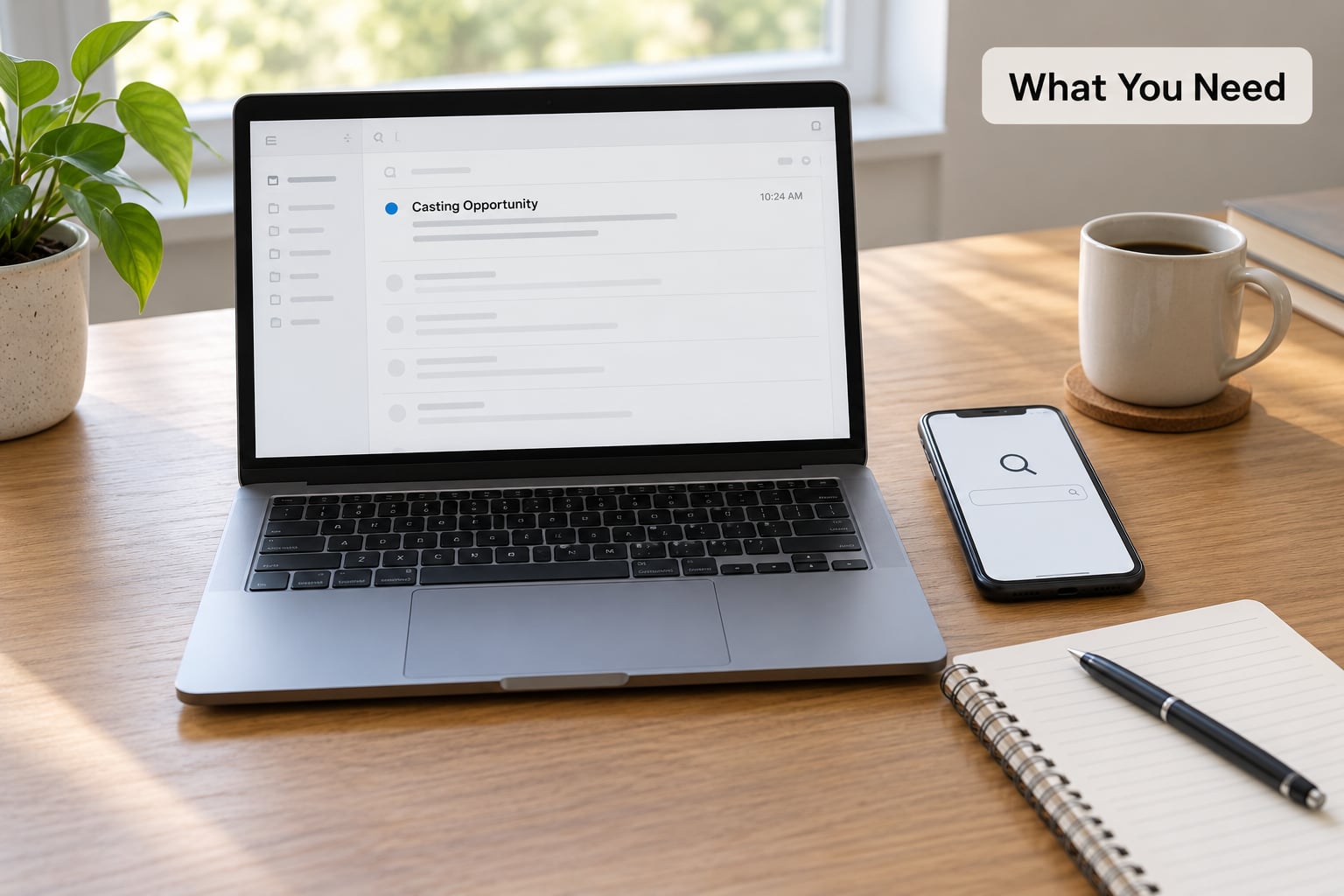
Before you reply to anything, put five things within reach. Ten quiet minutes with these beats an hour of panic-reading the same message again.
- The message itself, untouched. Do not delete it. Do not click anything inside it yet, and keep the full text including any signature block.
- Your own device, typed not tapped. A second phone or laptop matters because scammers sometimes send a link that quietly installs something or opens a fake sign-in page.
- The company’s real contact details, found by you. Type the company name into a search engine yourself and read their official site rather than following anything in the message.
- A way to see the raw details. In most email clients you can show the original message or the full header, and in most phones you can long-press a sender name to see the real address.
- A screenshot habit. Take screenshots as you go. If it turns out to be fraud, the evidence is what your bank, the platform and the police will need.
That is genuinely all of it. No special scanning tool exists yet, and anyone charging you for one is part of the problem.
Step-by-Step: How to Spot a Fake Casting Call Online
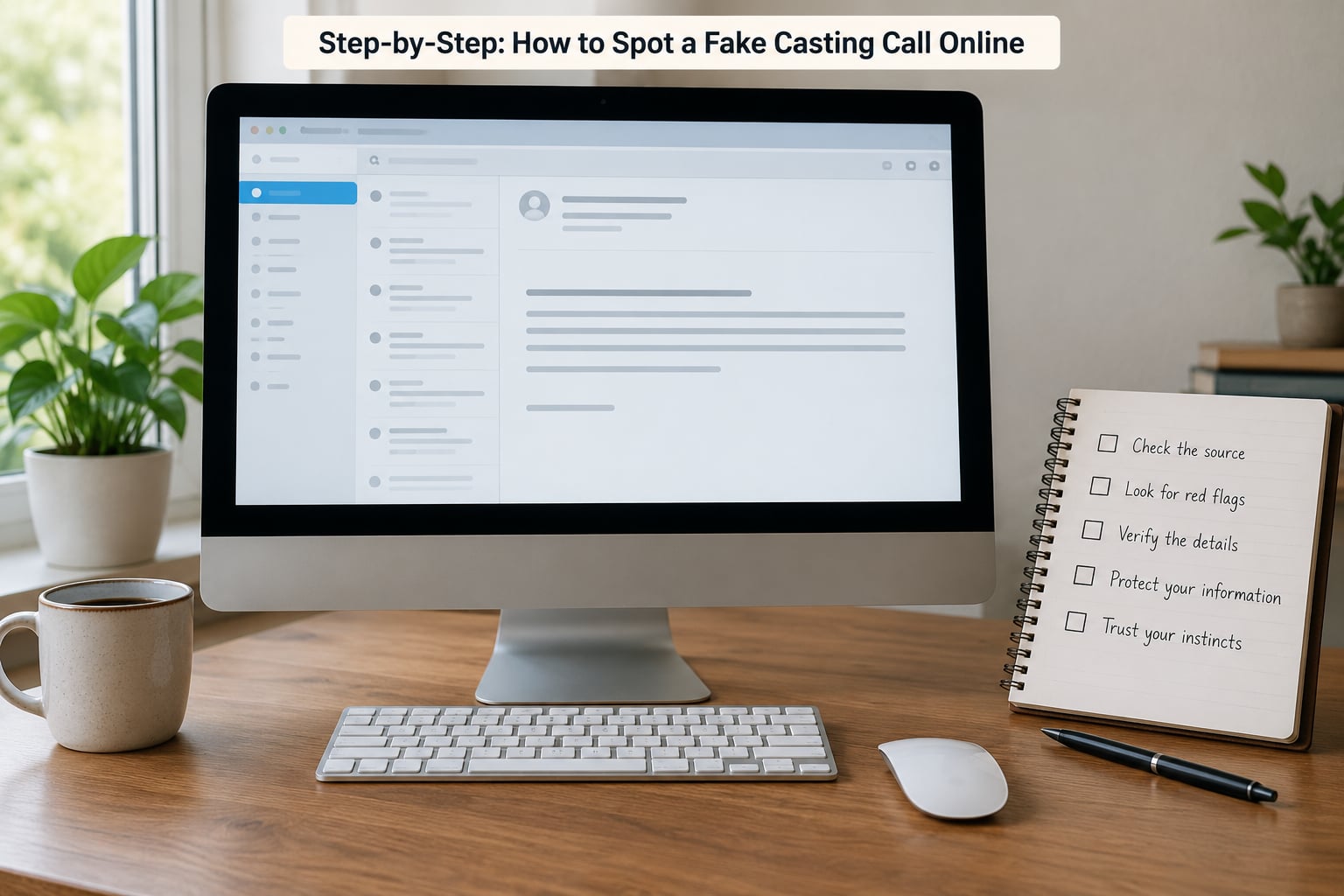
1. Check the Sender and Domain
The display name in a message is decoration, so check the actual address underneath it. A real casting office writes from the company’s own domain, and the domain matches the company website exactly, including the spelling.
Scammers buy lookalike domains and change one or two letters, or they use free mail services dressed up with a display name like “Casting Dept, Meridian Films.” Watch for lookalike spellings in the letters rather than the dots, plus reply-to addresses that differ from the sending address.
In Gmail, hover over the name next to Reply and the real return address appears in a small box. The same trick works in most other clients, and the equivalent on a phone is a long press on the sender’s name.
2. Look for Pressure, Guarantees, and Upfront Fees
If the message asks for money in any form, stop there. Legitimate casting directors never charge an audition fee, a registration fee, a processing fee, a background-check fee or a kit fee, and no real agency asks you to buy its training before it will represent you.
Common demands are gift cards, wire transfers, bank app payments, cryptocurrency, or payment to a personal PayPal account. Some arrive dressed as a refundable deposit for a portfolio shoot or a class required for the production.
Other tells sit right next to the money: a guaranteed booking, a role offered instantly with no audition, a deadline measured in hours, and a request to keep the conversation secret from family or anyone else. Push back once in a calm way and watch what happens. Legitimate people tolerate questions; scammers escalate pressure or go quiet.
Then there is the reverse move, where they want to pay you for appearing as a fake cashier, bank employee or package handler, or where they send a large payment by mistake and ask you to forward part of it. That is check or transfer fraud, and the money you send is almost never recoverable.
3. Verify the Company Through Independent Channels
Verify the company through channels you found yourself, never through details in the message. Search the production company name, then open its official website from the search results and look for a contact page with a real address, phone number and named staff.
Next, search the production title itself. If a project is supposedly shooting next month in Atlanta, you would expect a studio page, a crew announcement or at least a trade listing. A company with no web presence, no credits and no social accounts is describing something that does not exist.
Check where the production company is actually registered, and whether it has the website and reviews you would expect for a business of its size. If the only trace of the company is the link inside the message, treat that as the answer.
4. Confirm the Recruiter or Agent Independently
Finding a real person’s name is not the same as finding that person, because scammers copy real casting directors’ names and headshots. Search the name together with the words scam, review or complaint, and check the credits the person claims against an industry database and their own professional profile.
Then contact them through a channel you sourced yourself. Find the agency’s website from a search engine, or use the number listed on the company’s official contact page, and ask whether that person works there and whether they sent you anything. If you only have the number in the message, you are still testing the scammer, not the recruiter.
Be careful with search results that promise a verdict. Automated summaries can be confidently wrong, so open two or three real sources instead of trusting one generated answer.
5. Inspect Links, Attachments, and Requests for Information
Hover over every link and read where it actually points before you click. Watch for misspelled domains, shortened links that hide the destination, and forms asking you to sign in with email or social media credentials that are not the service’s real login page.
Requests for sensitive information are the other half of this step. No real casting process asks for a Social Security number, bank account and routing details, a passport photo, a driver’s licence scan or a tax form before a first conversation. Attachments in zip files or with names like Documents_Final_v2.zip deserve suspicion too, because that is a standard malware delivery trick.
Requests for nude or intimate photos deserve their own rule. Legitimate nudity in professional work happens, but only after a real casting process, through a known agency, with a contract, release and a rate. An unsolicited request for intimate images is not an audition, and you are not obligated to send one to anyone you have not independently verified.
6. Report and Block the Suspicious Contact
Once a message fails verification, stop replying. A scammer who gets no response moves on, and continued conversation only gives them better material to try again later.
Preserve the evidence before you clean up. Save screenshots, keep the full message with its headers, note the dates and any account names or numbers used, and keep the URL of any link they sent without opening it.
Report the message on the platform where it arrived, forward suspicious texts to 7726, and report fraud at ReportFraud.ftc.gov. In the US, the FBI’s IC3 complaint form handles internet fraud, and if money moved, contact your bank immediately to ask about a recall or chargeback, since speed decides whether it can be stopped.
If a real casting director’s name was used, tell that person and their agency. They will want to know, because their name is now attached to your complaint.
Common Casting Scam Red Flags
Here is the short list. If a message hits three or more of these, treat it as a scam without needing to feel certain.
- Any request for payment, in any form. Fees, deposits, gift cards, crypto and “processing” charges all end the conversation.
- Outreach you never applied for. An offer for a job you never sought, usually flattering, is the standard opening move.
- A booking with no audition. You are cast for a lead role without reading a line or meeting anyone.
- Vague or shifting project details. The title, budget, shoot dates and role keep changing depending on how you ask.
- Pressure and secrecy. Respond today, this offer will not last, do not tell your family or agent about it.
- Being moved off the platform. Within two messages you are on WhatsApp, Telegram or a personal email, outside any protection the platform offered.
- Requests for identity or financial documents. Passport, licence, Social Security number, bank details, tax forms or a selfie holding an ID.
- Requests for intimate photos. Especially when paired with a role offer that skips the normal process.
- Money sent to you, or to someone you were told to pay. The overpayment and fake-check mechanic.
- A recruiter who cannot be found anywhere else. No credits, no agency website, no verifiable professional history.
Being vague about a project is not proof on its own. Extra and background work is often advertised with almost no information, and that is normal in this industry. The difference is whether a vague listing still comes through a real company with a real process, or whether the vagueness comes with a fee, a deadline and a demand for your documents.
How the fake check scam actually works
The sequence matters, because each step looks harmless on its own. A “production coordinator” offers you a part, sends a payment for expenses or an advance that is larger than expected, apologises for the error, and asks you to send the difference to a supplier or to buy gift cards as part of the role.
What is really happening is that the original payment is stolen or fraudulent and will be reversed. By the time your bank takes the money back a week or two later, your own funds are gone, and the person who asked you to cover it has disappeared. If the first thing a stranger does is pay you, that is a reason to be suspicious rather than grateful.
Side by side: fake and legitimate
| Signal | Fake casting call | Legitimate casting call |
|---|---|---|
| Who contacted you | Unsolicited DM, text or cold email | You applied through a real platform, or an agency contacted you and is independently verifiable |
| Audition | Role offered immediately, no reading or camera test | Sides, a self-tape, or a scheduled callback before anything is decided |
| Money | You are asked to pay a fee, or to forward money you were sent | You are paid after the work, through a proper payroll process |
| Project details | Vague, shifting, or impossible to find anywhere else | Consistent details you can match to a real company and production |
| Channel | Moves you to private messaging within two replies | Stays on the platform or a company domain you found yourself |
| Timeline | Hours to decide, artificial scarcity | Days or weeks, with a stated callback window |
| Information requested | Passport, Social Security number, bank details, intimate photos | Headshots, résumé, availability, after a real callback |
| Paperwork | An unsigned NDA or “contract” sent as an attachment to read later | A contract and deal memo after terms are agreed, through an agent you have verified |
If you are under 18, add one more rule on top of all of this: tell a parent, guardian, teacher or manager before you reply to anything, and never meet anyone you contacted online without a trusted adult present. Legitimate casting for minors runs through schools, agencies and parent-approved processes.
Common Mistakes
Replying immediately because the offer feels rare. The pressure is the product. A real opportunity survives a day of silence, and so does a fake one that has moved on.
Trusting caller ID or the name on the profile. Both are easy to fake, and a well-made Instagram account with real-looking posts is a costume. Verify the person at the company instead of the company on the profile.
Paying a small fee because it seemed cheap. The small amounts people report losing, often only a modest one-off charge, are how these scams start. A real casting office does not run on small payments from strangers.
Using a sponsored search ad instead of the official site. Scammers buy ads that look like a real agency or studio listing. Click the organic result you typed yourself, or type the company’s web address directly into the browser.
Sending documents early to seem professional. A headshot and résumé are reasonable. A passport scan, a bank account and a tax form are not, no matter how warm the message is. Keep those until you are contractually in front of someone you have verified.
Staying polite and engaged to avoid offending anyone. You do not owe a stranger your time, your data or a reply. Ending a conversation is not rude; it is the entire defence.
Frequently Asked Questions
Do legitimate modeling or acting casting calls ever ask for a fee?
No. Legitimate casting calls are free to apply to and free to attend. Casting directors, agencies and production companies do not charge audition fees, registration fees, processing fees, background-check fees or portfolio kit fees, and they do not sell you a class or training you must buy before they will consider you. A few legitimate self-tape services are subscription products a performer may choose to buy, but no casting office requires it and no stranger may collect payment as part of a job offer. If a message asks for money, that is the end of the conversation.
How can I verify whether a recruiter or casting agent is real?
Search the person’s name with the words scam, review or complaint, then check the credits they claim against an industry credit database and a professional profile. Scammers copy real casting directors’ names and headshots, so finding the name proves nothing on its own. Find the agency or production company yourself through a search engine and contact it through the phone number or address on its official website. If that independent channel has never heard of the recruiter, treat the offer as fake.
What information should I send after a legitimate casting call?
Normally a headshot or photo, a résumé or CV, your availability, and a self-tape if sides are provided. Some productions ask for a wardrobe measurements sheet or a demo reel hosted on a public link. Never send a Social Security number, bank details, passport or driver’s licence scan, tax forms or intimate photos before you are in a verified, contracted conversation. A real process collects sensitive documents only after identity and terms have been confirmed, usually through a known agency.
Can a real company still send a scam message using its name?
Yes, and it is common. Scammers impersonate well-known casting directors and agencies with their real names, headshots and past credits, which is why checking the name alone gives you false confidence. This is why verification has to go through an independently sourced channel: the company’s own website contact details, its official phone number, or a reply from an address on its real domain. If a person claims to work somewhere, confirm it there before sending anything.
What should I do if I already clicked a link or sent personal information?
Stop interacting and act the same day. Screenshot the message and note the account details, then block and report the sender on the platform and forward suspicious texts to 7726. If you entered passwords, change them from the real service site immediately and enable two-factor authentication. If you sent money, contact your bank and ask about a recall or chargeback right away. If you shared a Social Security number, bank details or identity documents, file a report at ReportFraud.ftc.gov and an identity theft report, and place a freeze with the credit bureaus.
Conclusion: What to Do First
Pause before you reply, and treat any request for money or sensitive documents as a full stop. Verify the company and the recruiter through channels you found yourself, not through the links or numbers in the message, and send nothing personal until that check comes back clean.
If the message fails any of those checks, stop the conversation, keep your screenshots, block the account and report it to the platform, the FTC and your bank if money moved. Ten minutes of verification is cheap compared with losing your documents or your savings.