Registering a clothing brand name in the US takes three separate legal moves: form a business entity with your state, run a clearance search on the USPTO trademark database, then file a federal trademark application through the Trademark Center in Class 25 with a specimen showing your mark on a label, tag or listing. The state piece tells your state who you are. Only the federal filing gives you nationwide rights.
What nobody tells you at the start is that most rejections in apparel have nothing to do with whether your name is clever. They come down to which class you picked, whether you showed the right kind of proof of use, and whether an examiner thought shoppers would be confused by a mark that already exists. Get those three things right and the process is genuinely straightforward.
Two practical notes before we start. This is general information, not legal advice, and trademark law turns on details specific to your situation. And every fee and processing time below changes, so verify current figures on uspto.gov rather than trusting a number you read on a blog, including this one.
If you want the short version, here is the order of operations: pick several candidate names instead of one, search the federal database for each, secure the matching domain and handles, form the entity, choose your filing basis, file, answer the Office Action, then keep using the mark consistently and hit the maintenance deadlines. Most of the process happens before you ever pay a filing fee.
Table of Contents
- What You Need
- Step-by-Step: How to Register a Clothing Brand Name
- Step 1: Define the Brand and Choose the Name
- Step 2: Search the USPTO Database Before You Register Your Clothing Brand Name
- Step 3: Check Domains, Handles, and Business Names
- Step 4: Choose the Right Filing Basis and Class
- Step 5: Prepare and Submit the USPTO Application
- Step 6: Respond to Office Actions and Monitor the Application
- Step 7: Use and Maintain the Registered Brand
- Common Mistakes
- Frequently Asked Questions
- Do I need an LLC before I trademark my clothing brand?
- Can I trademark a clothing brand before I sell anything?
- What class do I file a clothing trademark in?
- How much does it cost to register a clothing brand name?
- What is a good specimen of use for a clothing brand?
- How long does a clothing brand trademark take to register?
- Start With Three Moves This Week
What You Need
None of this requires a lawyer to assemble, and it is much cheaper if you do it yourself. What it requires is decisions made in the right order.
A shortlist of three to five names. Founders fall in love with one name and search it once. Search five, because the first one probably has a conflict and you do not want to restart the whole process from scratch.
Your entity details. Decide the owner name that will appear on the application: an individual, a partnership, or a corporation or LLC. The USPTO requires a US address for a domestic applicant, so a foreign founder planning to sell into the US needs a US entity or a properly licensed attorney before filing.
A filing jurisdiction. Nearly everything here assumes the United States. If you manufacture overseas or sell mainly abroad, the route changes, because a US application assumes a US owner with a US address and foreign rights come from separate national or regional filings.
Handle and domain inventory. List every social platform you might use and check the exact name, not the one you hope for. Finding out your handle is taken is cheaper now than after your first production run.
A search method. You need a knockout search, a fast pass through the federal database to spot fatal conflicts. Decide now whether you also want a full clearance search, a deeper review that checks state registries, common law use and marketplace listings for legal risk.
A budget line you treat as fluid. The government fee is per class and each extra class adds another one, so the more classes you file in, the more the filing costs. That is the single biggest lever founders control, and it is why Step 4 matters more than it looks.
Step-by-Step: How to Register a Clothing Brand Name
Step 1: Define the Brand and Choose the Name
Before you search anything, write down who buys the clothes, what the brand stands for, and how wide the product range will be. A label that starts with graphic tees and adds handbags in year two has a different class plan than a workwear brand, and you would rather know that now.
Trademark strength runs on a ladder, and examiners think in those terms. Fanciful marks are invented words with no meaning, and they register most easily. Arbitrary marks are real words unrelated to the product, like a name for a t-shirt line that happens to be a place name. Suggestive marks hint at a quality without describing it. Descriptive marks name a quality or feature, and they are weak unless they have acquired secondary meaning. Generic names cannot be trademarked at all.
That last category is where a lot of first-time apparel founders get stuck. You cannot register a name for a clothing line that simply says cotton t-shirts. You also cannot register the garment design itself, a print pattern, or a colour on its own, because consumers do not buy a shirt for those. You are protecting the thing that tells a shopper where the garment came from, not the garment.
One decoration trap catches almost everyone. A large logo printed across the chest of a shirt is decoration, not source identification, and it is a weak specimen. The mark has to appear somewhere a shopper uses it to identify the brand, like a neck label, hang tag, care label or packaging.
Now generate a shortlist instead of picking one name. Two, three, maybe five. You are going to search all of them, and having options turns a dead end into a decision.
Step 2: Search the USPTO Database Before You Register Your Clothing Brand Name
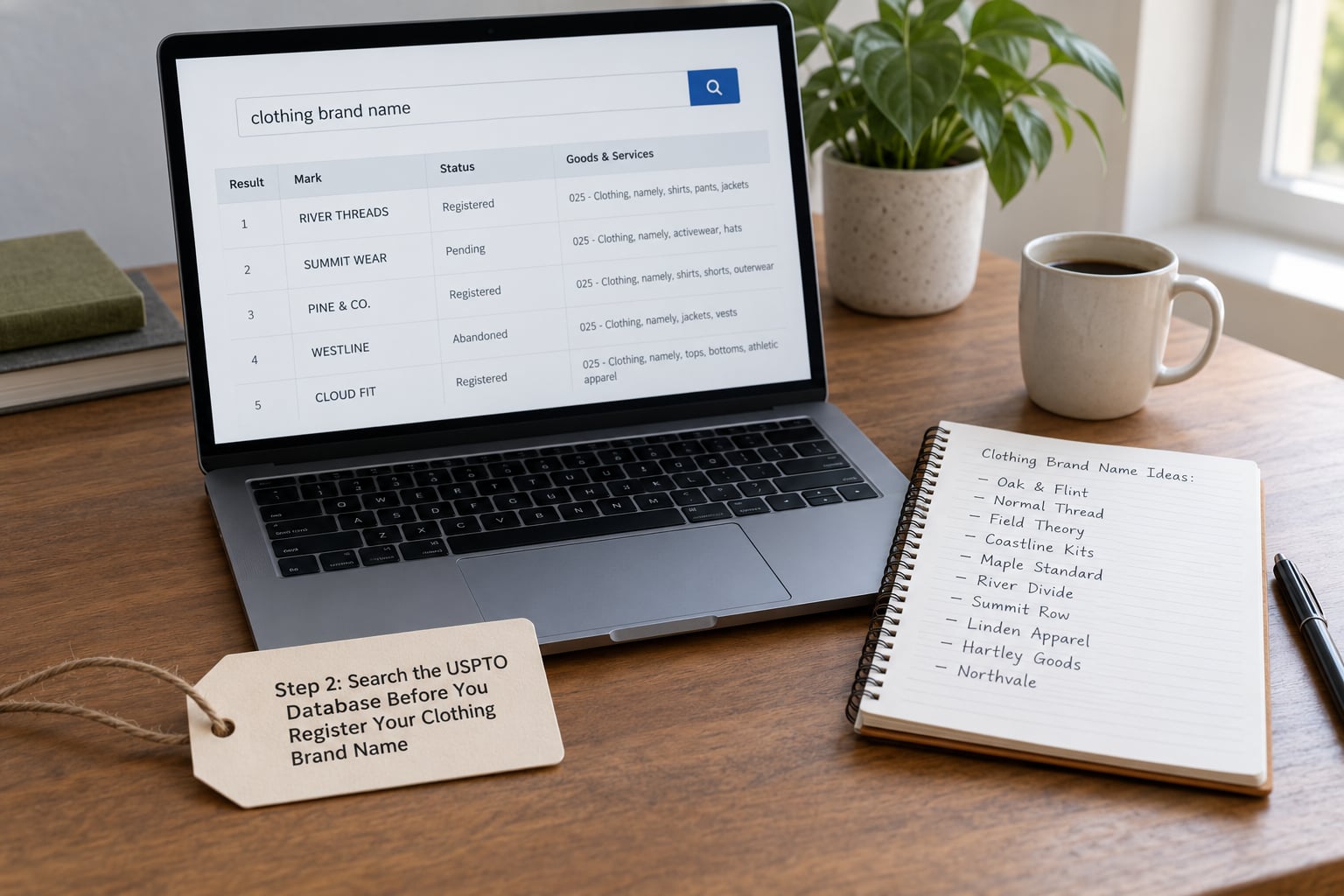
Use the USPTO Trademark Search system at tmsearch.uspto.gov, which replaced the old TESS database. Search each candidate name, then search it again with the goods field limited to Class 25 apparel so you are not distracted by unrelated hits.
Read the results properly, because raw result counts are misleading. One live registration for an unrelated software company in Class 9 does not necessarily block you. What matters is live marks in Class 25, dead marks, and the similarity of the goods.
Pay attention to three things. First, similar-sounding marks matter as much as identical ones, so try spelling variants and check phonetic similarity, not just exact words. Second, check the status of each hit: registered, pending, abandoned, or cancelled tells you very different things. Third, look at how close the goods descriptions are, because a mark registered for clothing in Class 25 is a far bigger problem than one registered for restaurant services.
Then widen the net. Check your state registry, search common law use by typing the name into major marketplaces and social platforms, and if the name matters commercially, run a professional clearance search that covers these sources properly. Write down what you found and what you decided, because that record is what you will point to if someone disputes your rights later.
A knockout search takes an afternoon and rules out obvious problems. A full clearance search takes longer, costs real money, and is what you want if the brand is the whole business or you have investors involved.
Step 3: Check Domains, Handles, and Business Names
Now handle the practical layer, and do it while the name is still cheap to change. Register the domain in every relevant extension rather than just the dot com, because shoppers will try the .co version when the .com is taken.
Claim the social handles on the platforms you actually plan to use, even if you post nothing yet. Do not skip this because the name is longer than fifteen characters. Pick something you can say out loud on a podcast and type from memory in a store, because a name people cannot spell will not spread for you.
Then form the business entity. In most states that means filing articles of organization for an LLC with the secretary of state, or registering an assumed business name, often called a DBA, with the county clerk where your studio or store actually sits. The DBA matters because it makes the brand name the name you invoice and sell under; the LLC gives you limited liability. You can do both and most founders should.
Get an Employer Identification Number from the IRS once the entity exists, and use the same owner name and address on the trademark application that match your state filings. Every new federal filing runs through the USPTO Trademark Center, and mismatched owner details are one of the most common reasons an application needs to be refiled.
If you are a foreign company with no US presence, this step is your blocker. The USPTO requires a US address for a domestic applicant, which in practice means forming a US entity or hiring a US-licensed trademark attorney.
Step 4: Choose the Right Filing Basis and Class
Class 25 is the apparel class and covers clothing in general as well as footwear, headwear and many accessories. For most clothing brands it is the only class you need on day one. Add classes only when you genuinely sell in those categories, because each one carries another government fee.
- Class 25 — clothing, footwear, headwear, belts, most fashion accessories. Your core filing.
- Class 18 — handbags, backpacks, wallets, luggage, leather goods. Add when bags are part of the line.
- Class 14 — jewellery, watches, chronometric instruments. Add for accessories or a jewellery capsule.
- Class 35 — retail and online retail services. Add if you run a store, a boutique or a marketplace presence under the brand name.
- Class 41 — clothing rental, fashion shows, workshops. Relevant if you rent garments or run events.
- Class 3 — scented products, cosmetics. Relevant for a fashion brand extending into beauty.
Next, the filing basis. A 1(a) application claims actual use in commerce, which means you must already be using the mark on goods and must submit a specimen. A 1(b) application, called intent to use, lets you apply before you sell anything, but the USPTO will require a statement of use later and that statement still needs a real specimen showing the mark in commerce. A foreign priority claim applies only if you filed the same mark abroad within six months.
So can you file before you have sales? Yes, on a 1(b) basis, and plenty of pre-revenue founders do. Just understand that you will not finish registration until you actually use the mark, and a specimen you cannot honestly produce will come back as a rejection.
Words or logo, or both? A word mark protects the name itself. A logo mark protects the design. If you want both, either file two applications and pay two sets of fees, or file a combined mark with a standard character claim, which covers the words broadly and the design as drawn. Plenty of clothing brands start with a word mark and add the logo design later once the word mark is secure.
Step 5: Prepare and Submit the USPTO Application
File through the Trademark Center at tmcenter.uspto.gov. It is the only route for new applications, and you will need a USPTO account before you start.
The form asks for several things you should have ready: the owner name and type, the owner address, the mark itself in words and in a drawing, the goods description, the filing basis, the class, and a specimen for a 1(a) filing. On the drawing, describe the logo plainly if you are filing a design element, since the wording in that field becomes part of the registration.
The goods description is where apparel applications most often go wrong. Use the wording in the USPTO ID Manual, which lists accepted terms by class. Do not write a marketing paragraph, and do not leave it vague with a pile of synonyms, because extra or incorrect terms can trigger an Office Action and cost you a round trip of months.
Then upload the specimen. For a clothing brand that means an image of the mark used as a source identifier: a neck label, an inside garment label, a hang tag, a care label with the brand, or a product listing page where the mark appears as the brand name on the item. Photograph it clearly enough to read, show the garment or tag context, and send only what the form asks for.
Print-on-demand sellers ask whether they can get a specimen at all. You can, but the listing has to show the mark identifying the product as its source, with your brand visible as the seller. A mockup where your name is invisible in the thumbnail is a weak specimen. If you have nothing yet, file on a 1(b) basis and submit a statement of use later.
Pay the government fee, which is charged per class, and save the confirmation and your serial number. You will need the serial number for every future status check and filing in this application.
Step 6: Respond to Office Actions and Monitor the Application
After filing, an examining attorney reviews the application. They may approve it, or they may send an Office Action, a written refusal or a requirement, usually within roughly four to eight months of filing. Check your USPTO account and your email regularly; missing a response deadline can abandon the application.
Most apparel refusals come down to likelihood of confusion under Section 2(d). In plain terms, the examiner found a live mark they think shoppers could mistake for yours. Relatedness of goods matters less to the test than most founders assume, and similar-sounding marks in the same or related classes get flagged often.
The second common refusal is a defective specimen, which is the decorative-versus-source-identifier problem from Step 1 arriving late. The fix is usually a fresh specimen, and occasionally a description of how the mark functions as a source identifier in commerce.
You generally get three months to respond, extendable to six in some cases, and you can pay to extend. Respond on the substance rather than on tone. If the examiner cited a registration you can show is related to unrelated goods, say so with the class numbers side by side. If the mark is honestly similar, consider a different mark now, because a final refusal ends the application.
Keep records as you go. Screenshots of your search, your specimen photos, your filing receipt and every response. Maintaining a record of intended and actual use is exactly what you will need later if anyone raises whether you still use the mark.
Here is the realistic sequence rather than the optimistic one, from filing to registration.
- Months 0 to 1 — application filed, serial number issued, search and records documented.
- Months 1 to 6 — assigned to an examining attorney. Most first actions land in the four to eight month window.
- Months 6 to 12 — Office Action issued and answered, or the application moves forward. Some applications get a second action.
- Months 12 to 18 — approval and publication for opposition in the Trademark Official Gazette.
- Months 18 to 24 — 30-day opposition window closes, registration issues, the registered symbol becomes usable.
- Years 5 to 6 — Section 8 declaration of use, due between the fifth and sixth anniversary of registration.
- Year 10 and every 10 after — renewal filing, plus Section 71 declaration in the same window.
End to end, budget somewhere in the twelve to twenty-four month range rather than the two months the marketing pages promise.
Step 7: Use and Maintain the Registered Brand
Once registered, use the mark consistently and specifically. Put it on hang tags and neck labels, on your packaging, on your site and on your invoices. Registration is not a reward for having filed, it is a record of a mark you actually use, and an examiner can look at the marketplace and see what your brand does.
On symbols: the TM symbol is a claim of common law rights that anyone may use without a federal registration, with no formal requirement that you have applied. The registered symbol is different. Use it only after the registration issues, because using it earlier is a false representation of federal registration and can get you in trouble with the USPTO and with other brands.
Then track the two maintenance windows. The Section 8 declaration of use falls between the fifth and sixth anniversary of your registration date and must show the mark in use, usually with another specimen. The Section 71 declaration of continued use covers the same period as a backup for cases of excusable nonuse. Both renewals in the tenth year need a filing too, and every ten years after that. Miss them and the registration cancels.
Registration is also the tool that makes enforcement practical. Federal registration carries a presumption of validity, which is a real advantage in a dispute, and it gives you a legal basis for platform takedowns on marketplaces and social sites that operate on registration records. Keep an eye out for copycats using a confusingly similar name or your logo on knockoffs, and keep a dated record each time.
Hire a trademark attorney when the refusal is final, when the name is central to the business and you are already selling, when someone sends you a letter, when you expand internationally, or when you are close to licensing, funding or acquisition. A knock-out search and a straightforward filing are genuinely manageable yourself. A likelihood of confusion refusal against a live registration is not.
Common Mistakes
Filing without searching. This is the expensive one, because a name you have printed on 500 shirts and shipped is not a filing you abandon easily. Search every candidate name in the federal database before you commit production money.
Treating an LLC or DBA as trademark protection. An LLC is a business registration. A DBA tells your county who you are. Neither creates nationwide rights against someone else trading on a similar name, and neither gets you a registered symbol.
Filing in too many classes. Every additional class is another government fee, and non-US commerce can face per-class foreign fees too. File Class 25 for clothes, and add Class 18, 14, 35 or 41 when the business is real in those categories, not because you might be someday.
Submitting a decorative specimen. A shirt photographed on a model with the logo across the chest is decoration. A neck label, hang tag, care label or a listing where your brand name identifies the seller is source identification. This is the most reported rejection among new apparel brands and it is entirely avoidable.
Changing the branding after filing. The application has to keep using the same mark, and a rebrand mid-process can leave you with a pending application for a name you no longer use. Finish the registration first, then decide whether the new identity needs its own filing.
Using the registered symbol early. TM is fine from day one. The registered symbol is not, and using it before registration is a false designation that the USPTO will ask you to explain and that opponents will use against you.
Ignoring the response deadline. An unanswered Office Action lets the application go abandoned, and refiling starts the clock and the fee over. Put the deadlines in a calendar the day you receive them, not after you remember.
Assuming registration covers garments made overseas. If manufacturing happens abroad, file in the countries where production occurs, not only where you sell. Counterfeit enforcement at the factory gate is far cheaper than pulling product after it lands.
The prevention list is short. Search five names, not one. File in the classes you actually sell in. Photograph your labels before production runs start. Track every deadline in one calendar. Watch for confusingly similar marks twice a year. That is most of it.
Frequently Asked Questions
Do I need an LLC before I trademark my clothing brand?
No, but forming one first is the common advice. The USPTO does not require a specific entity type, and individual applicants can file using their own name as owner. An LLC still makes sense because it matches the owner name on the application and separates personal liability from the brand. If you are a foreign company, a US entity is effectively required, since domestic applications need a US address.
Can I trademark a clothing brand before I sell anything?
Yes, using a 1(b) intent-to-use application, which states you plan to use the mark in commerce. The catch is that you still have to file a statement of use later with a real specimen once you are selling, so registration cannot be finished on paper alone. Many pre-revenue founders file this way to lock in a priority date and keep using the name consistently in the meantime.
What class do I file a clothing trademark in?
Class 25 for most clothing brands. It covers clothing, footwear, headwear, belts and many accessories in one class. Add Class 18 for handbags and luggage, Class 14 for jewellery and watches, and Class 35 if you run retail or online retail services under the brand. Each additional class carries its own government fee, so add them only when you genuinely sell in those categories.
How much does it cost to register a clothing brand name?
The government fee is charged per class, so a single-class Class 25 filing is the cheapest path and each extra class multiplies the total. Working with a trademark attorney adds a separate professional fee on top, and a full clearance search is a third cost if you want one. Check the current fee schedule on uspto.gov directly, because the figures change and most published guides are out of date.
What is a good specimen of use for a clothing brand?
An image showing the mark functioning as a source identifier: a neck label, hang tag, care label, branded packaging, or a product listing where your brand name identifies the seller. The mark should be legible and the context visible. A large logo printed across the chest of a shirt is decoration rather than source identification and is a frequent cause of refusal. Print-on-demand sellers can use a clear listing image showing their brand name.
How long does a clothing brand trademark take to register?
Plan on roughly twelve to twenty-four months end to end. The first Office Action usually arrives four to eight months after filing, publication for opposition adds another stretch, and the 30-day opposition window must close before registration issues. A clean application with no refusals moves faster than one that needs two rounds of responses. Maintenance filings come later, at years five to six and again at year ten.
Start With Three Moves This Week
Pick three more candidate names and search every one of them in the USPTO Trademark Search database with Class 25 selected. Register the matching domain. Then photograph a neck label or hang tag for your best candidate, because that shot is the specimen you will need either way.
That is real progress, costs little, and keeps you from printing money on a name you cannot protect. Everything after that is process, and process you can do. This is general information rather than legal advice, so confirm your own facts with a qualified trademark attorney before you file.