What to wear to a fashion job interview comes down to one rule: dress one level above the company’s actual dress code, then add exactly one piece of visible personal style. In fashion, clothing is read as a preview of your professional judgement, so the target is neither a full suit nor your usual Saturday outfit, but a look that says you understand this house’s aesthetic and can be trusted with it. The research takes about 20 minutes; the outfit build takes another 15 once you know what you’re building toward.
The tricky part is that fashion dress codes run from buttoned-up corporate buying rooms to all-black, ripped-denim studio floors, and advice written for banking makes people overdress for both. Candidates on Styleforum and r/mensfashionadvice keep circling the same tension: too formal and they worry they read as square, too casual and they worry they read as unprepared. The outfit formulas below are built to sidestep that.
Table of Contents
- What You Need
- Step-by-Step: Build an Interview Outfit That Fits the Role
- Research the dress code before you choose a single piece
- Choose a silhouette that matches the role
- Pick colour and fabric you can defend
- Style shoes for the room, not the photo
- Add accessories with a job to do
- Check fit, comfort and the seat
- Plan the fallback and the second round
- Adjust for video interviews
- Build for the budget you actually have
- Keep the context in mind
- How to Dress for Common Fashion Interview Roles
- Common Mistakes
- Wearing something that looks borrowed
- Dressing like a photocopy of their website
- Choosing a suit out of nerves
- Wearing comfortable clothes that read as careless
- Overdressing with logos and jewellery
- Picking shoes you can’t walk in
- Ignoring the practical demands of the day
- Showing up wrinkled, stained or untested
- Wearing nothing memorable, or too much
- Adding a colour for colour’s sake
- Frequently Asked Questions
- What should I wear to a fashion job interview when there is no dress code?
- Can you wear jeans to a fashion interview?
- Do you need to wear a suit to a fashion job interview?
- How do I show personal style without looking unprofessional?
- What should I wear if the company dress code is very casual or streetwear?
- What should I wear to a fashion job interview with no budget?
- Conclusion
What You Need
You cannot pick an outfit until you know what the room looks like, and you cannot know that without doing an hour of homework. Gather these before you open your wardrobe.
- The interview details. Time, duration, format (in person, phone, video), building and floor, and the name of the person you’re meeting. A 20-minute coffee with a stylist is not a two-hour presentation to a buying team, and the outfit should match the length.
- The job description, saved. Re-read it the night before and underline what they actually asked for. If the listing says “strong point of view,” they want to see taste. If it says “sharp attention to numbers,” the outfit should be quieter.
- Screenshots of how the team dresses. The company’s Instagram, LinkedIn and press images are your dress code. Look at the last ten posts and at any “behind the scenes” video where staff are standing, sitting or walking around.
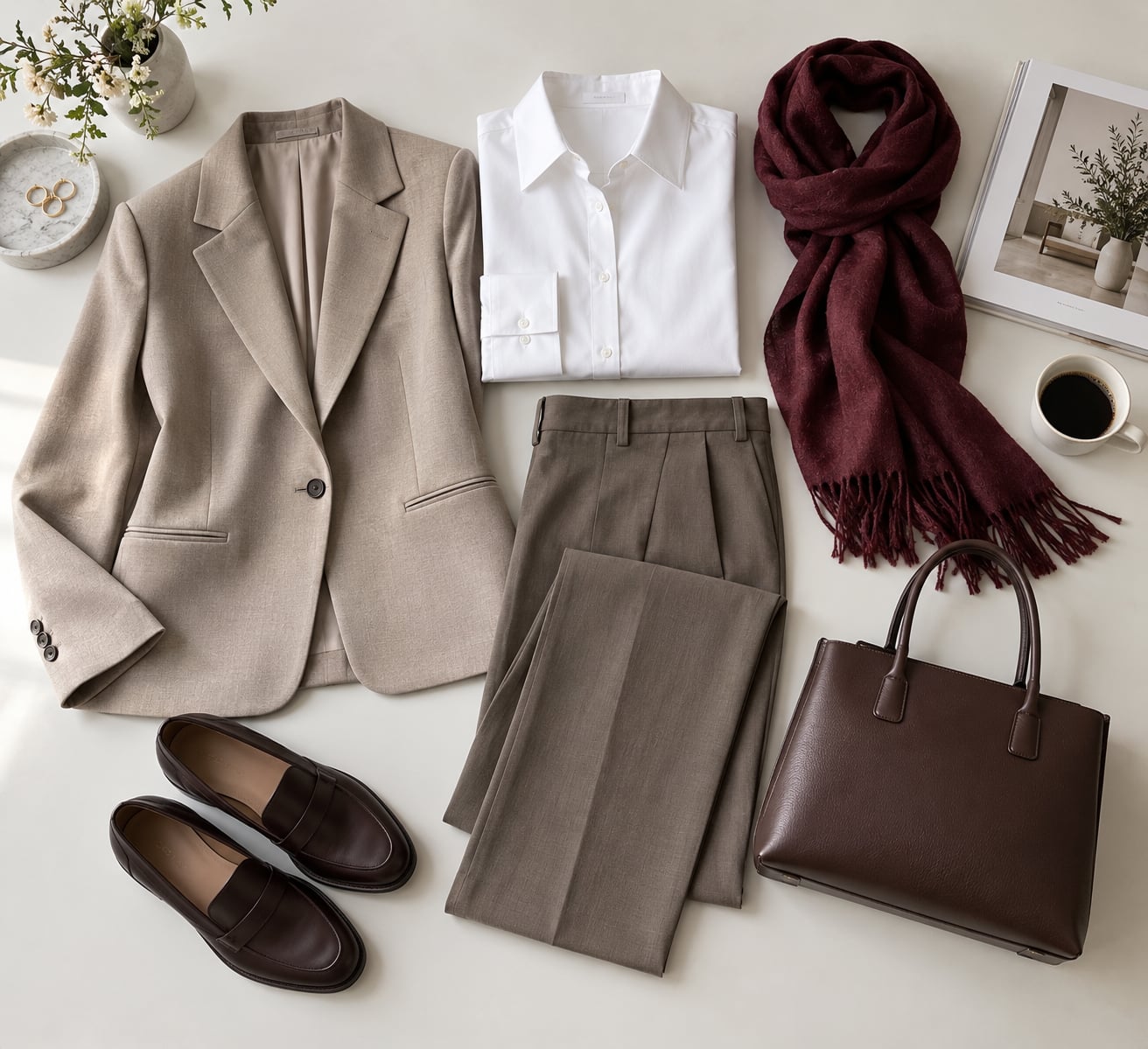
- One base layer. A crisp button-down shirt, a fine-gauge knit, a black turtleneck, a plain silk or cotton shell. Neutral, clean, nothing that needs steaming at 7am.
- One statement layer. A tailored blazer, a longline coat, a good knit, a printed skirt, a textured jacket. This is the single item that carries your taste.
- Bottom half and outerwear. Tailored trousers, a column skirt, wide-leg pants or a well-cut denim depending on the code. Coat and shoes chosen for the weather you’ll actually walk through.
- Shoes you can stand in. Closed-toe, broken in, quiet on a hard floor. Whatever you choose, test it on stairs.
- A bag that fits the portfolio. If you’re bringing work, the bag has to hold it flat without bulging. A medium leather tote is the workhorse; a hard portfolio case reads more senior.
- Grooming supplies and backup pieces. Steam, lint roller, stain remover, a small repair kit, spare tights or a second top, and safety pins. Pack these the night before, not the morning of.
One note on all of this: it’s built to work for any body and any gender. What reads as “professional” in fashion is fit and condition, not a specific silhouette, and the formulas below swap pieces rather than prescribing a male or female version of the same outfit.
Step-by-Step: Build an Interview Outfit That Fits the Role
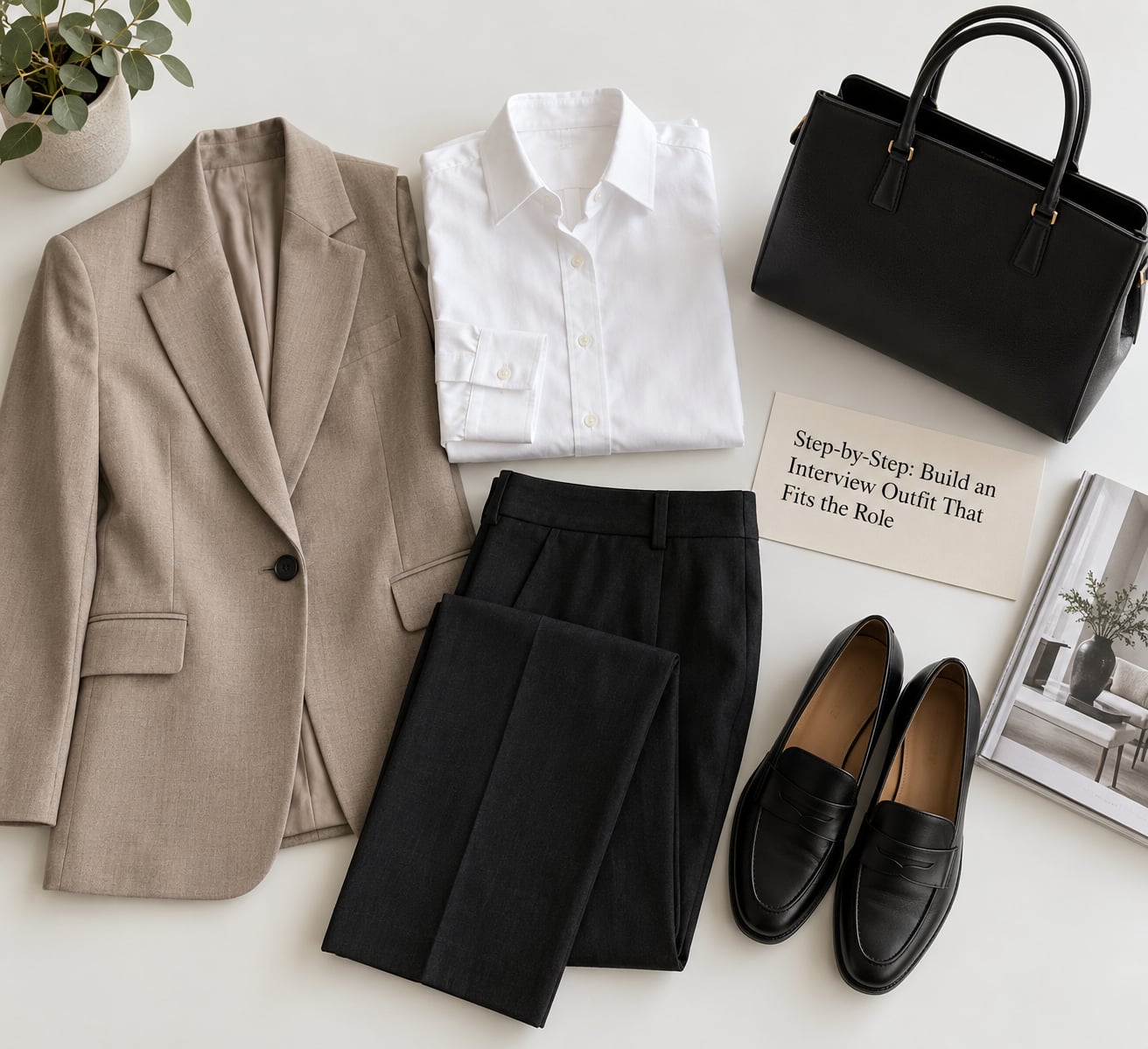
Work through this in order. Changing the order is how people end up in a beautiful blazer and the wrong shoes.
Research the dress code before you choose a single piece
Look at what people at the company wore in the last month, not what the careers page says. Instagram posts, showroom walk-throughs, LinkedIn headshots, red carpet appearances and conference panels all carry more signal than any written policy. Then do the thing people skip: email the recruiter and ask. “Could you tell me a little about how the team dresses day to day?” is a normal, professional question and it makes you look prepared.
Styleforum’s most-repeated heuristic, and the one I’d anchor everything else on, is to dress one level above where you would be working. The idea is that they see you as if you already worked there, only a little nicer.
Choose a silhouette that matches the role
Commercial and corporate fashion teams (buying, merchandising, finance-facing roles) read a clean vertical line as competent and controlled. Creative teams (styling, editorial, brand, design) read relaxed structure, interesting proportion and texture as evidence of taste. The silhouette is the first thing they decode, before colour, before fabric.
Pick colour and fabric you can defend
Fashion tolerates far more colour than finance, which is good news and also a trap. The rule that keeps it safe: let one thing in the outfit be the interesting one, and make it a deliberate choice rather than an accident. Rich jewel tones, saturated cobalt, an oxblood or a deep olive all work. Head-to-toe bright prints read as costume unless the company itself is loud.
Fabric is quieter than colour but reads better. Wool crepe, gabardine, good cotton poplin and washed silk hold their shape through a long interview. Jersey reads as comfortable, which is fine, unless the role is formal.
Style shoes for the room, not the photo
Yes, interviewers notice shoes. They’re the part of the outfit they’ve already finished thinking about, and in a showroom with a concrete floor they’re also the reason you shift your weight for an hour. Closed-toe, quiet soles, already broken in. A block heel or a flat loafer both work; the wrong choice is a pair of stilettos or new shoes on stairs.
Write it down from the forum wisdom that keeps surfacing: choose the shoe you’d be happy to walk fifteen minutes in. Interviewers form a first read in seconds, and someone wincing mid-step undoes a good blazer.
Add accessories with a job to do
One bag, one piece of jewellery, one small detail, and that’s it. Over-accessorising is the most common way creative candidates lose the room: the point of a statement piece is that it is a statement. If you’re unsure whether something is too much, wear it in your head for the whole interview and notice whether you keep touching it.
Check fit, comfort and the seat
Try the full outfit on, not the pieces. Button the jacket, sit down, cross your legs, walk to the end of the room and back. Most fit problems are shoulders and sleeve length, both cheap to alter and both visible from across a table. Then wear it for twenty minutes at home, including the bag, so you know where it sits and whether it presses.
Plan the fallback and the second round
Bring a second top in your bag. Showrooms are freezing, casting days run outdoors, and a button-down that felt right at noon can feel wrong in an air-conditioned room at four. For second rounds the standard shifts slightly: if the first interview was sharp and neutral, the second can carry a little more of your personality, because by then they’ve partly decided about you and are testing fit rather than polish.
Adjust for video interviews
A first-round video call changes the brief more than people expect. The top half of your outfit is the whole outfit, so make sure the neckline and fabric look right on camera and that nothing has a distracting pattern. Test the lighting and camera angle the day before, keep your background uncluttered, and skip anything that moves or catches light badly when you talk. A blazer reads as prepared on camera in a way it doesn’t always do in person.
Build for the budget you actually have
Interview clothes don’t require designer labels, and most candidates don’t have them. A six-piece capsule covers nearly every interview: one tailored blazer in a neutral, one button-down, one fine knit or turtleneck, one pair of tailored trousers, one skirt or second trouser, one pair of polished shoes. Second-hand and resale, everything else from a discount store with a proper fitting room, and you own a full interview wardrobe for less than most people spend on one coat.
Styleforum threads on this topic keep recommending the same practical fallback: a fast trip to a mid-range chain the day before, tailored and hemmed in a proper fitting room, beats an ill-fitting wardrobe piece every time. If you truly own nothing, borrow a blazer and return it the same day, and stand straighter.
Keep the context in mind
Career fairs, showroom walk-ins and pop-ups get a lighter version of the same outfit: the base layer plus a good coat, because you’ll be standing rather than sitting. Press appointments reward a little more polish than the office itself. Freelance and consulting pitches are the exception that proves the rule, where your own aesthetic is part of what you’re selling.
How to Dress for Common Fashion Interview Roles
Same base layer logic, different statement layer. Use this table as a starting point, then swap the pieces to match what you found in your research.
| Role | Base layer | Statement layer | Shoes | Bag |
|---|---|---|---|---|
| Stylist | Crisp shirt or fine knit | Tailored trousers or a bias-cut dress with texture | Loafers or a low block heel | Soft leather tote that carries a portfolio |
| Fashion buyer | Pressed button-down | Sharp blazer in navy or charcoal | Brogue or derby, well polished | Structured tote, nothing slouchy |
| Merchandiser | Tucked shirt | Textured knit or a clean midi skirt | Clean leather flat or derby | Medium tote with a flat portfolio slot |
| Creative director | Black turtleneck or fine knit | Longline coat, strong blazer or a bold colour | Polished boot, block heel or loafer | Structured bag, no handles worn down |
| PR and marketing | Soft tailoring | Print dress or wide-leg trousers | Block heel or a very clean sneaker | Sleek tote or a small crossbody |
| Editorial and magazine | Simple knit or shell | Interesting proportion, collar or sleeve detail | Clean ankle boot or loafer | Portfolio case or slim tote |
Stylist. They will be judging whether you notice things, so a texture or an unusual proportion earns its place. Keep the rest quiet so the outfit looks chosen rather than assembled.
Buyer. This is the most conventional room you’ll walk into, and the outfit should reflect that without becoming a suit. Pressed shirt, sharp blazer, polished shoes, structured bag. Colour, if you want it, goes in a single item.
Merchandiser. Somewhere between the two. You want neat and considered without looking like you’re interviewing for a bank, because the job involves visual judgement as much as numbers.
Creative director. This is the one role where a suit actively works against you, and where a bold coat or a strong silhouette is expected. Fashion Angel Warrior, writing from the hiring chair, warns against leggings for exactly this reason. A candidate who looks like they belong in the room they want is the whole pitch.
PR and marketing. Balance is the brief. You need to look like someone who could style a press image and also write a line about one. A printed dress or a soft suit with a good shoe does that quickly.
Editorial. Detail-forward and slightly idiosyncratic. Fabrics, collars and sleeve lengths get read here before logos do. Understated branding is the safest bet unless the publication itself is loud.
Common Mistakes
Wearing something that looks borrowed
A blazer that doesn’t close, a sleeve that’s a centimetre long, a skirt hem at an odd spot. Hiring managers do register this consciously, and one writer on Fashion Angel Warrior admits outright to judging candidates on wardrobe choice. Get it altered. Usually cheaper than replacing.
Dressing like a photocopy of their website
Showing up in head-to-toe of the brand you’re applying to is a misread, not flattery. It suggests you have one outfit. Wear one item that nods to their world at most.
Choosing a suit out of nerves
This is the single most-cited fear on Styleforum, where the worry is being seen as square or unlikely to fit in. It’s a real risk in a creative room and a large mistake in an all-black studio office. A suit says you borrowed someone else’s answer.
Wearing comfortable clothes that read as careless
Leggings come up constantly in the fashion-interview conversation and are repeatedly flagged as a leave-them-at-home item. More broadly, anything that reads gym-adjacent, beach-adjacent or club-adjacent is doing you no favours, however much you like it.
Overdressing with logos and jewellery
Logomania makes the outfit about the label instead of the person wearing it, and at some houses it’s simply tone-deaf. One ring or one earring reads as considered. Five read as a statement nobody asked for.
Picking shoes you can’t walk in
New heels, new boots, no broken-in pair in the bag. Office floors are hard and showrooms are cold. This is where the practical reasoning beats the aesthetic one, every time.
Ignoring the practical demands of the day
A heavy portfolio on a walk from the station, an outdoor casting in February, a showroom day that runs eight hours. Dress for what actually happens, not for the twenty minutes you’re in the room.
Showing up wrinkled, stained or untested
The night-before checklist: steam or press everything, walk in the full outfit for twenty minutes, pack the second top, check the portfolio is flat and complete, confirm the route and the building. The most avoidable interview disasters are logistical.
Wearing nothing memorable, or too much
The debate on the forums is real: one candidate was hired after wearing a double-breasted coat and an oxblood tie because the interviewer said he looked like his boss. Another thread argues for forgettable. Both are right, and the resolution is the one item. One deliberate piece, in a company whose palette is neutral, is memorable. Five is noise.
Adding a colour for colour’s sake
Fashion tolerates far more colour than most industries, which encourages people to overcorrect. Pick the colour, then go quiet everywhere else in the outfit so it reads as intent.
Frequently Asked Questions
What should I wear to a fashion job interview when there is no dress code?
Look at the team, not the job listing. Check the company’s Instagram, LinkedIn and press images for the last month, then match that level and add one layer above it: a blazer, a better coat or a sharper shoe. If nobody answers, business casual is the safe default, adjusted for the industry you’re in.
Can you wear jeans to a fashion interview?
Only if the company does, and even then pick a dark, clean, well-fitted pair and pair it with a pressed shirt and polished shoes. A dark straight-leg or bootcut denim reads as deliberate; a ripped, faded or loose pair reads as no effort. Most candidates are safer in tailored trousers.
Do you need to wear a suit to a fashion job interview?
Almost never, and in creative rooms it works against you. A suit signals you borrowed an answer from another industry. The exceptions are corporate buying roles, finance-facing merchandising positions, and any company whose senior staff visibly wear tailoring.
How do I show personal style without looking unprofessional?
Use one statement piece and keep everything else quiet. A textured coat, an interesting skirt or a bold colour, worn with a plain shirt, tailored trousers and clean shoes, reads as taste. The same outfit with three statement pieces reads as effort. Condition matters more than cost.
What should I wear if the company dress code is very casual or streetwear?
Go one level above, never one level below, and read it precisely. If the team wears ripped denim and graphic tees, wear clean dark denim with a good knit, a tailored coat and sharp shoes. Matching their level reads as belonging there; one step above reads as hired.
What should I wear to a fashion job interview with no budget?
Build a six-piece capsule: a neutral blazer, a white or pale button-down, a fine knit or black turtleneck, tailored trousers, a skirt or second trouser, and one polished pair of shoes. Second-hand and discount-store finds are fine if they fit and are altered. Fit matters more than label.
Conclusion
Start by confirming the format and researching how the team actually dresses. Build one outfit from a quiet base layer and a single statement piece, choose shoes you can stand and walk in, and get the fit checked. If you remember nothing else, dress one level above the dress code, add one deliberate detail, and let the rest of the conversation do the work.