Most people who say they have no style do not have an empty problem. They have a wardrobe, a phone full of saved outfit photos, and a habit of deciding at the till in under a minute. How to find your personal style when you have none is not about discovering something hidden. It is about making the pattern you already follow visible, then repeating it on purpose.
Done honestly, this takes three to six weeks and almost no money. You need about an hour a day for the first ten days, then twenty minutes most evenings. No quiz, no stylist, no shopping required to get started.
Table of Contents
- What You Need
- Step-by-Step: How to Find Your Personal Style in Six Moves
- 1. Notice What You Already Like
- 2. Separate Style From Trends
- 3. Define Your Style Priorities
- 4. Create Three Outfit Tests
- 5. Find Your Repeatable Formula
- 6. Shop and Edit With Intention
- Common Mistakes
- Frequently Asked Questions
- How can I find my personal style without buying new clothes?
- What if I do not know what colors look good on me?
- How long does it take to develop a personal style?
- Should I follow celebrity or influencer style inspiration?
- What is the best way to discover my style on a budget?
- How do I keep my personal style consistent as trends change?
- Conclusion
What You Need
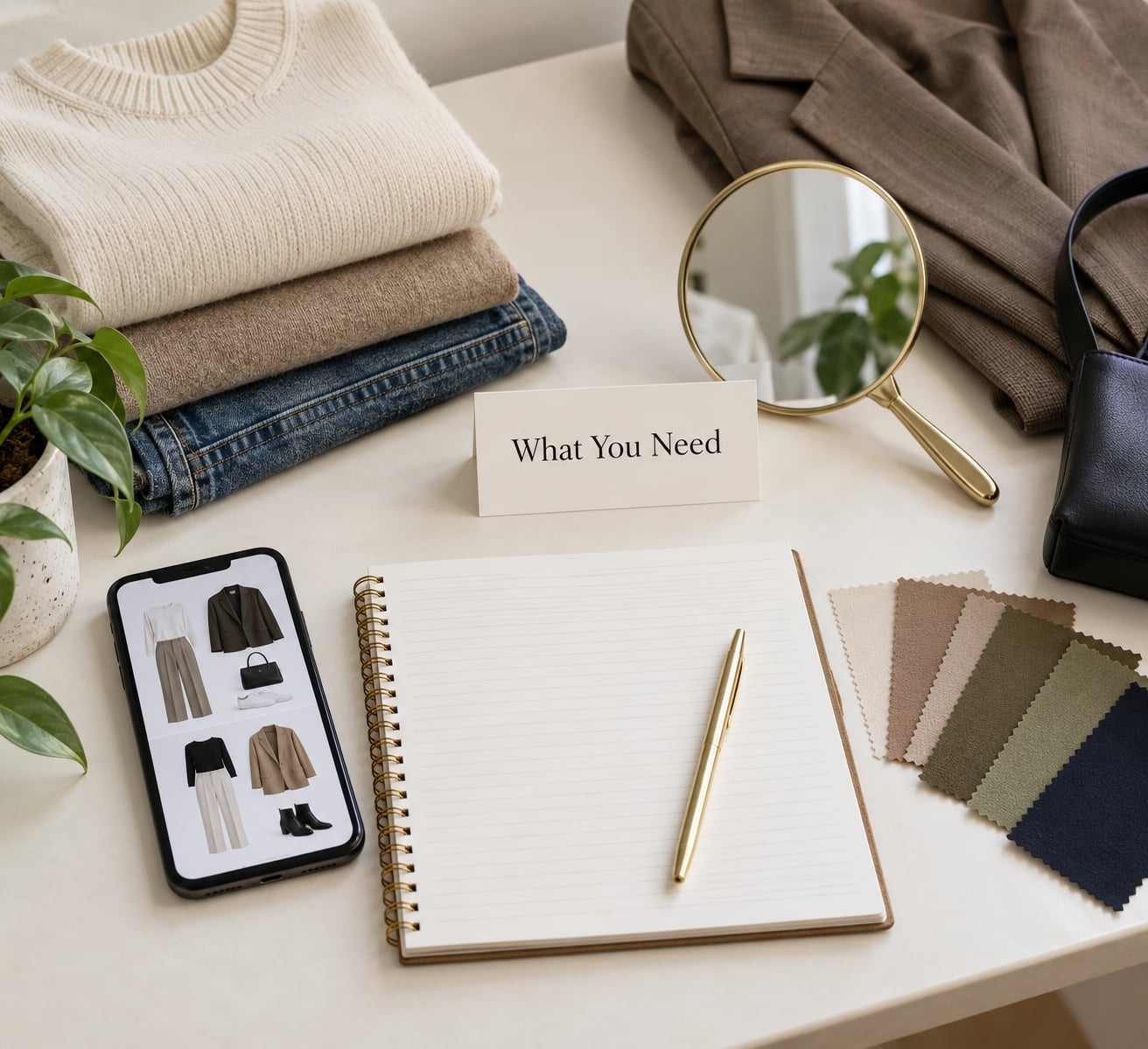
Everything here is free or already sitting in your flat, which is why this works even if you have decided you are not a shopping person.
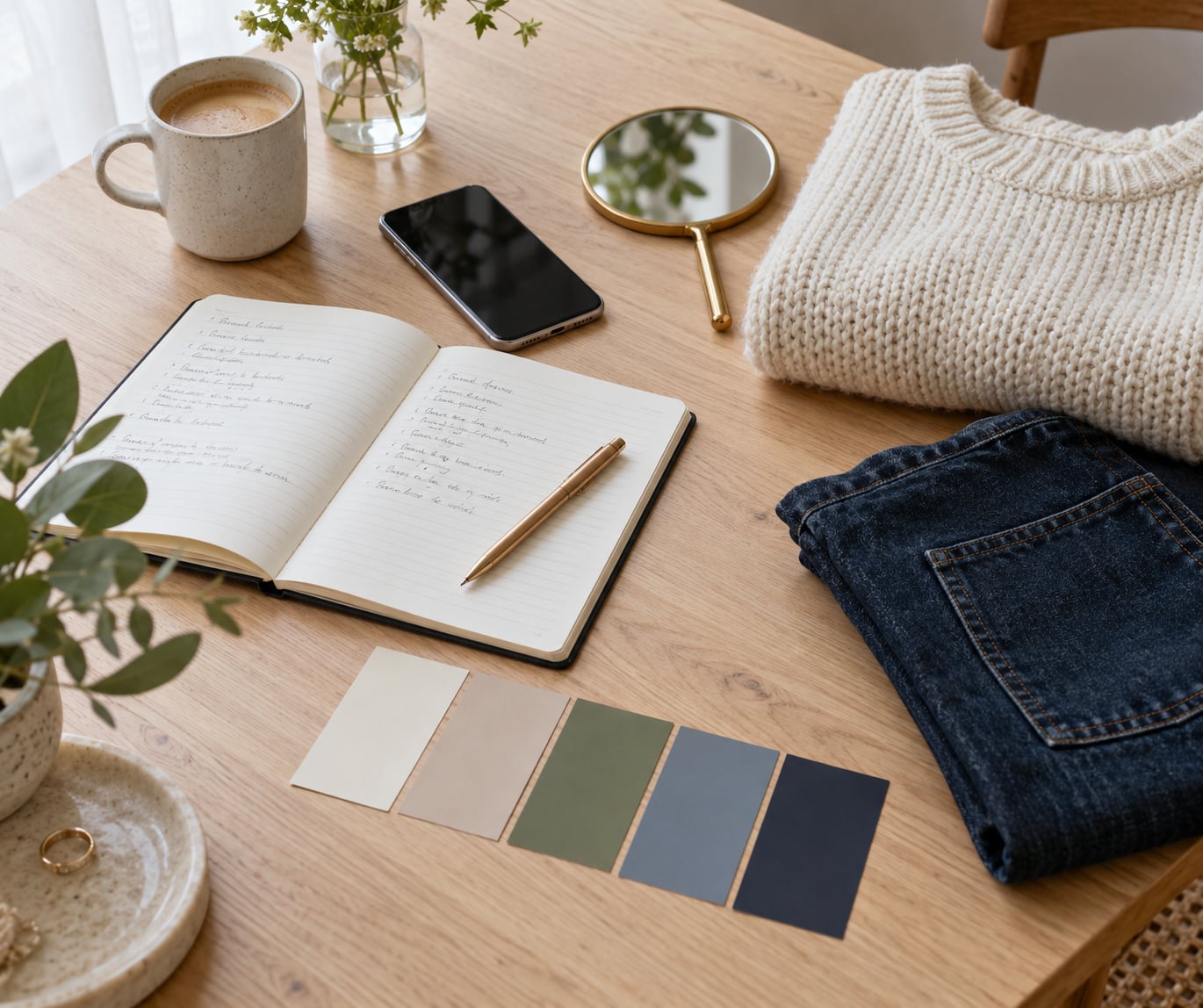
- A notebook or a notes app. Somewhere to write down what you notice. A pen is better for the first week because it slows you down.
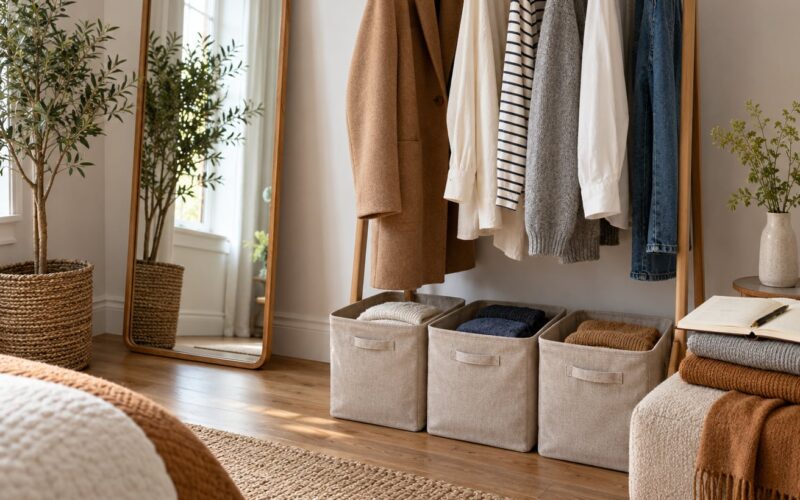
- Your current wardrobe, all of it. Including the drawer you forget about and the coat on the back of the door.
- A place to keep images. A phone folder, a camera roll album, or a mood board tool. Nothing needs a business account.
- A mirror you can stand away from. You need to see the whole outfit, not just the top of it.
- Basic access to shopping resources for later, when you know what you are looking for. Until then, buy nothing.
- Thirty days of honest outfit logging. This is the item everyone skips, and it is where the real progress happens.
Step-by-Step: How to Find Your Personal Style in Six Moves
Here is the whole system on one screen, and each move has its own section below.
- Notice what you already like, with evidence rather than aspiration.
- Separate your own preferences from whatever happens to be trending.
- Rank your style priorities so real decisions have an order.
- Build three outfit tests using clothes you already own.
- Write down the formula your strongest outfits have in common.
- Shop and edit against your own rules instead of the mood of the day.
1. Notice What You Already Like
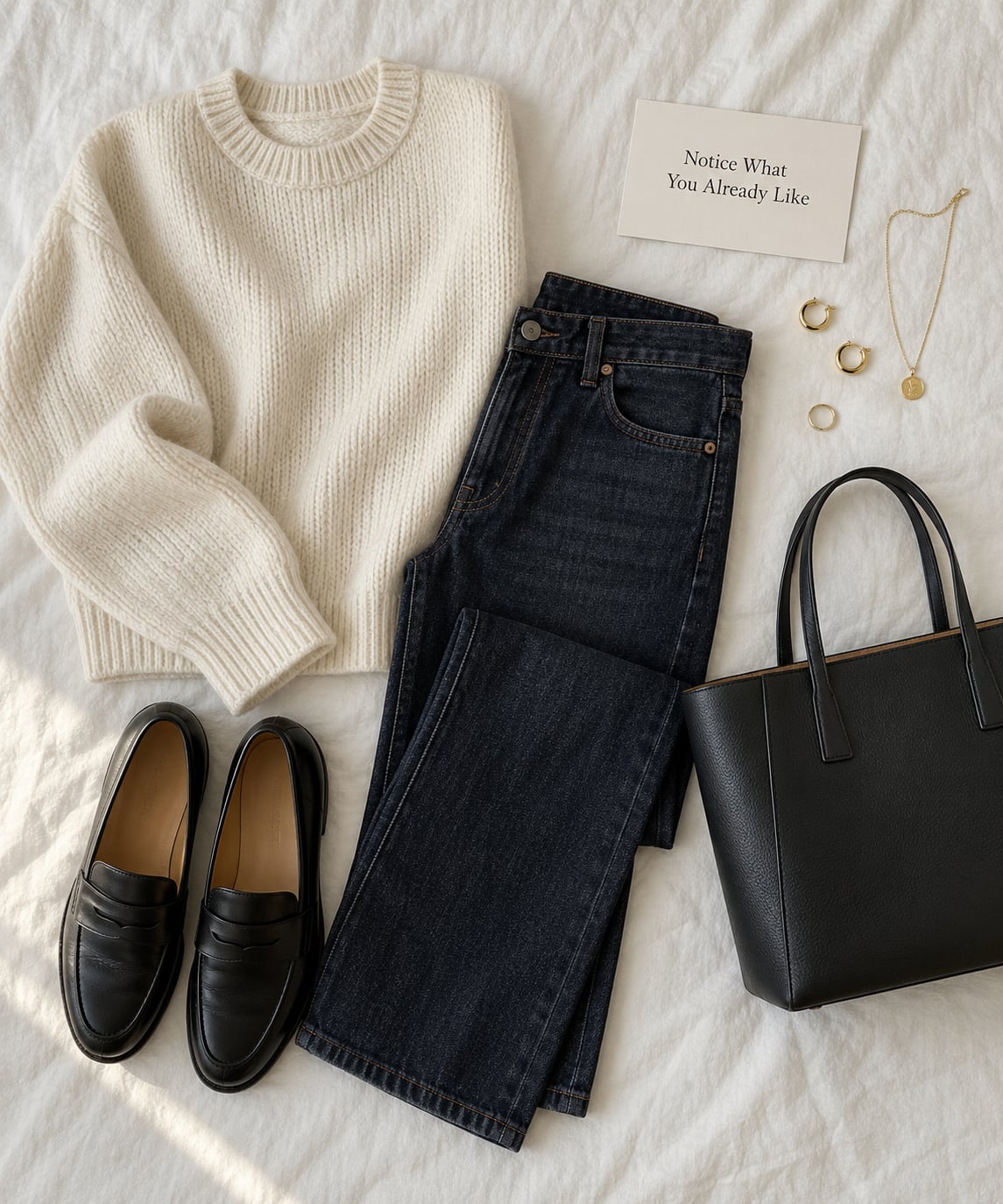
Start with evidence instead of daydreams. Pull out the five outfits that earned compliments, the things you reach for on a tired morning, and the pieces you felt a small pang about giving away. That is your raw material.
Then open your saved photos and count repeats, not outfits. Notice the colours that keep appearing, the silhouettes you keep saving, the decade you keep returning to, the fabrics you zoom in on. Three saves of wide-leg denim and a leather loafer is a pattern. One save of an outfit is a coincidence.
Ask why on three images only. The question is not whether you like it, you obviously do. The question is what specifically pulled you: the proportion, the contrast between a soft knit and a hard boot, the single colour that fires everything else up. Get the reason down in a sentence and the reason becomes something you can shop for.
The advice that keeps resurfacing on r/femalefashionadvice is exactly this: study the outfits you already wear and love rather than buying new ones to start from scratch. A user on the YouLookFab forum put the diagnosis well, saying no style is the absence of any intention. You probably have more intention than you think, just no record of it.
2. Separate Style From Trends
A trend is what is loud this season. Style is what stays after the noise moves on, and telling them apart takes three questions.
Would you wear this if nobody posted about it? Does it fit the week you actually live, or the one you scroll through? Can you wear it with at least three things you already own? Fail all three and it is a costume, not a wardrobe piece.
Concretely, a cropped jacket and a particular shade of butter yellow might be a trend this year. A plain striped tee and a good wool coat are building blocks that will outlast the jacket. Your style is made of building blocks, with maybe one or two trend pieces at a time, worn once or twice, then retired.
Keeping a trend piece is fine. It just does not get a vote on who you are.
3. Define Your Style Priorities
Pick five of these seven and rank them from one to five, in writing: comfort, polish, ease, creativity, boldness, formality, versatility. Then use that order as a decision rule. When two pieces or two plans disagree, the higher-ranked priority wins, and you stop relitigating the decision every morning.
It changes real answers. If polish sits at the top, you keep the scarf on a video call. If ease sits at the top, you take the cardigan off indoors and nobody minds. If boldness is number two, you pick the jacket with some character over the safest option in the shop.
Write the ranking where you can see it while you get dressed. Within two weeks it will stop feeling like a list of demands and start feeling like a personality.
4. Create Three Outfit Tests
Pick three directions that feel plausible for you and build each one completely from things you already own. A refined minimal, a relaxed uniform, and one expressive direction usually make a decent set. The point is to test, not to commit.
Wear each outfit at least three times across two weeks, on different days and in different settings. Log three things after each wear: how you felt out of ten, whether anyone remarked on it, and whether you would put it on again without needing a reason. That last question is the honest one.
Do not treat a bad day as a verdict. Clothes get rejected for reasons that have nothing to do with style, like a bad mood or a bad photograph. But if the same direction wins three times running, you have your answer in writing.
5. Find Your Repeatable Formula
Take your best-scoring test outfit apart and write the recipe in one sentence. Use five parts: silhouette, palette, texture, fit, and one personality detail.
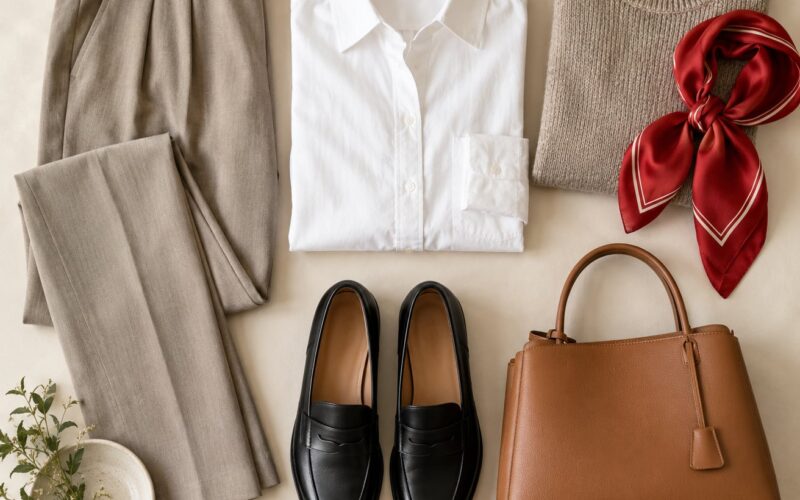
Something like this works: fitted on top, easy through the leg, cream and charcoal with one rust colour, mostly knit and cotton, boots rather than sneakers, always a watch. Read it back and you can picture a dozen outfits, not just one.
The personality detail is what stops it looking like a uniform. It could be a watch, a red scarf, a wide belt, a specific pair of glasses. One thing, worn most days, that you would notice missing if it vanished.
This formula is also how you cut the morning decision. Most style frustration is not really about taste. It is about deciding from scratch every day.
6. Shop and Edit With Intention
Now the shopping finally has rules. Before anything goes in the basket, ask four questions: does it fill a gap I have named, does it sit inside my palette, does it work with at least five things I already own, and would I wear it thirty times a year. Two yes answers is a purchase, one is a maybe, none is a no.
Edit the wardrobe at the same time. Anything unworn for a year leaves, and if a piece is only wearable with one other specific thing, it goes too, because it will die waiting for its partner.
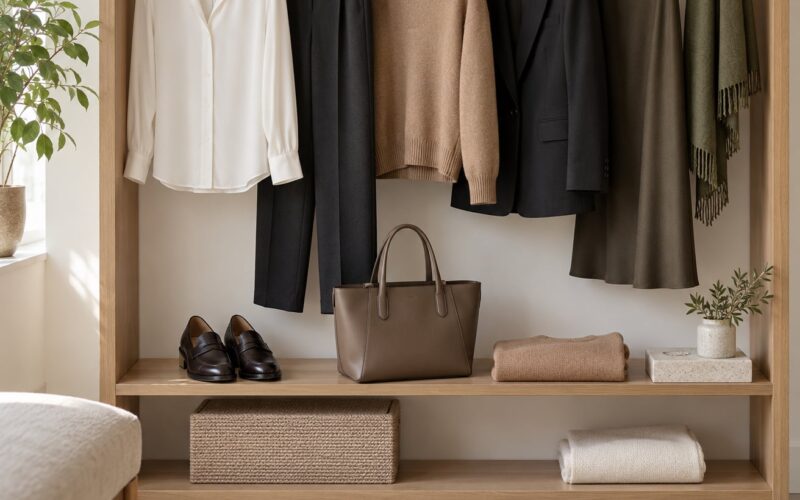
Then fill gaps in this order: a colour palette of five to seven shades, three anchors such as a coat, a good pair of trousers or jeans, and shoes you can walk in all day, and last of all one thing that slightly scares you. That last purchase is where style actually happens, and you only make it once the rest works without it.
Common Mistakes
Almost everyone stuck in this loop is making the same handful of errors. Each one has a straight correction.
- Copying one influencer wholesale. Take one element, not the whole look. Borrow a proportion or a colour, then build the rest from your own formula.
- Replacing your wardrobe before the audit. You cannot buy your way to a style you have not defined yet. You will just end up with a new pile of unworn clothes.
- Choosing a trend as an identity. Trends date your wardrobe and then leave. They are a guest in the house, not the family.
- Buying before you have a palette. Without five to seven colours in mind, you cannot tell whether two pieces belong together. Palette first, shopping second.
- Letting a photograph override comfort. If you cannot sit, walk and work in something, you will stop wearing it by month three, no matter how good it looked once.
- Asking clothes to fix a body concern. Fit changes week to week and it is not a character flaw. Get altered, and choose drape and proportion over fighting a size.
- Making every morning a fresh decision. A formula exists to end that loop. Use it on the easy days so you have energy for the days that matter.
Frequently Asked Questions
How can I find my personal style without buying new clothes?
Run the whole method on what you own. Audit the outfits you get compliments in, count the repeats in your saved photos, then build three test outfits from pieces already hanging up. Most people find two or three of their existing clothes are already on-message and were simply never combined. Nothing has to be bought to learn what you like; shopping only comes after the pattern is clear.
What if I do not know what colors look good on me?
Stand near a window in daylight and hold a fabric or a clothing tag against your bare face. If your skin looks brighter and more even, that colour is working with your undertone; if your face looks grey or sallow, it is not. You do not need a paid analysis. Start with neutrals that pass that test, then add one colour at a time and notice which ones get compliments.
How long does it take to develop a personal style?
Three to six weeks gets you a defined palette, a written formula and a tested direction, provided you do the steps consistently rather than once. Turning that into a wardrobe that reflects it takes months, because you have to wear things out and replace what does not survive. Anyone promising a finished personal style in a weekend is selling something.
Should I follow celebrity or influencer style inspiration?
Use them as data rather than instruction. Save what attracts you, then work out which single element you liked: the silhouette, the palette, the layering, the attitude. Wearing a whole look off someone with a different body, budget, climate and job is why so much borrowed style never survives a month.
What is the best way to discover my style on a budget?
Spend the first month buying nothing at all and just remixing what you own, including pieces you had written off. After that, shop secondhand and consignment for the specific gaps in your formula rather than browsing for inspiration. Borrowing from a friend whose style you admire is free and gives you a whole new set to test against.
How do I keep my personal style consistent as trends change?
Keep the formula and swap the inputs. Your silhouette, palette and personality detail stay fixed while the specific trend pieces rotate through a few times a year. If you rewrite the formula every season, you are not evolving, you are starting over, and that is why people feel they have no style twice a year.
Conclusion
Start tonight, with the clothes you already own. Pull out the one outfit you like most, name three things about it in plain words, such as colour, silhouette and the kind of shoe, then build one new combination from those three preferences alone.
That is how to find your personal style when you have none, in one evening rather than one shopping season. Keep the notes, keep the formula, and let thirty days of real outfits do the deciding for you.