Most people land somewhere between 25 and 40 pieces for a capsule wardrobe that covers a normal week, and somewhere between 15 and 20 if they want a stripped-back, daily-uniform approach. Those two numbers get quoted constantly, and they are only right for a narrow kind of life: one climate, laundry every few days, and a dress code that a jeans-and-a-knit can handle.
That is the short answer to how many pieces you need in a capsule wardrobe, but it is not the useful one. If you work in a client-facing office, split your weeks across two cities, or genuinely cannot wear the same silhouette five days running, your number will be different. So instead of another headline figure, this guide breaks the count down by lifestyle, shows you how to calculate your own target from your actual week, and settles what counts as a piece in the first place. That last part is where most of the confusion starts.
Table of Contents
- Capsule Wardrobe Size: What Actually Determines the Number
- How Many Pieces You Need in a Capsule Wardrobe
- Capsule Wardrobe Size by Lifestyle
- A Simple Formula for Choosing the Right Number
- What to Count, and What Usually Does Not Count
- How to Balance Tops, Bottoms, Dresses, and Layers
- How Climate and Work Dress Codes Change the Answer
- How to Test a Capsule Before You Buy More
- Frequently Asked Questions
- Is 30 pieces a good capsule wardrobe size?
- How many clothes are needed for a minimalist wardrobe?
- Do shoes and accessories count as capsule wardrobe pieces?
- Is a 20-piece wardrobe enough for work?
- How many outfits can a 30-piece capsule wardrobe make?
- Should a capsule wardrobe include activewear and sleepwear?
- Conclusion
Capsule Wardrobe Size: What Actually Determines the Number
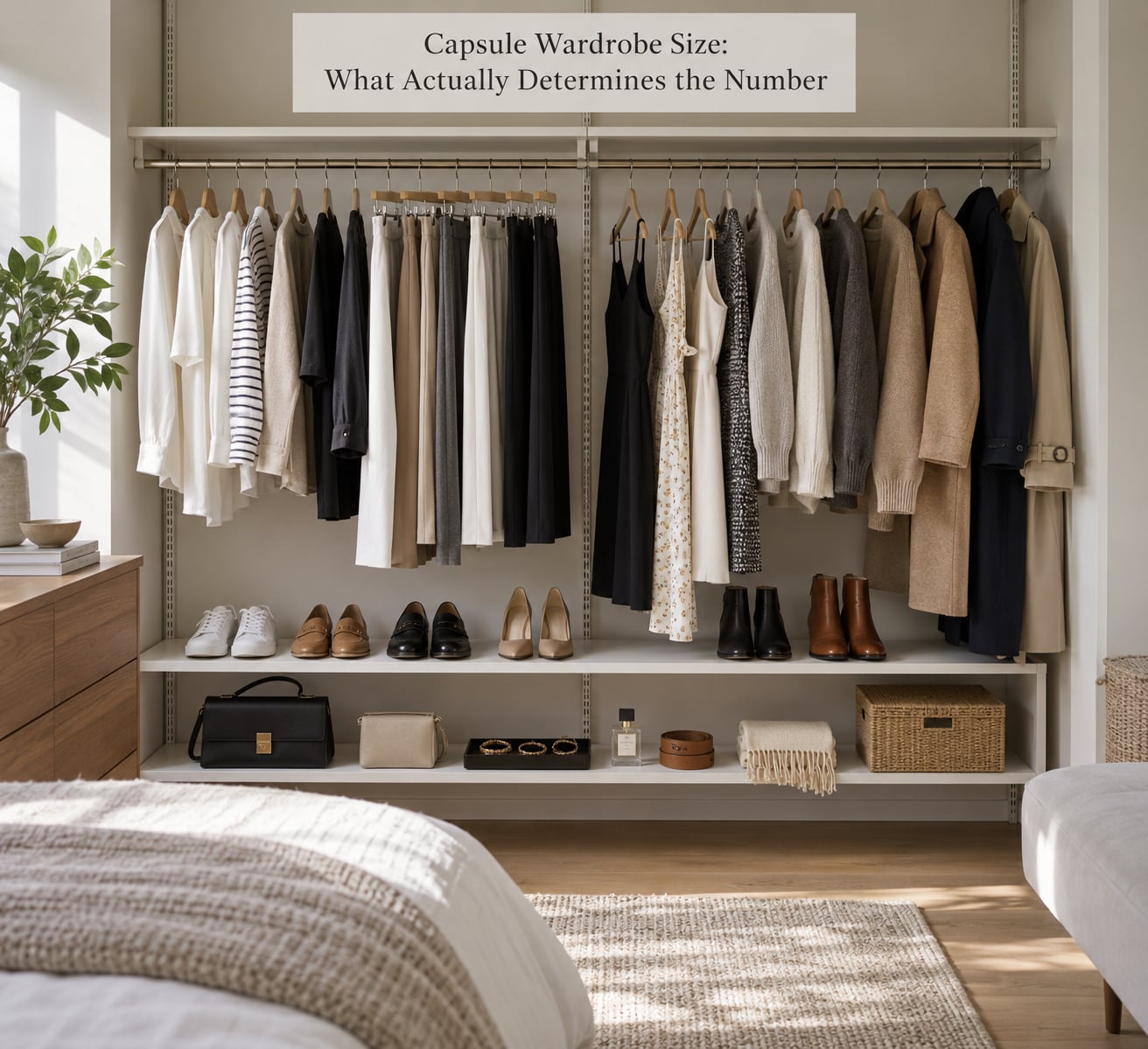
There is no universal capsule wardrobe size, and anyone who gives you one without asking about your week is guessing. Seven things actually move the number.
Lifestyle is the big one. A stay-at-home week and a week of client dinners do not need the same wardrobe, and neither does a parent who is dressed for a school run at 8am and a wedding at 4pm on the same Saturday.
Climate decides whether you need one wardrobe or four. A capsule in Southern California and a capsule in northern Minnesota are not the same project, because one is mostly t-shirts and linen and the other needs a serious coat.
Dress code is where minimal numbers break. If your office requires knee-length skirts, closed-toe shoes and nothing with a visible logo, several of your most versatile pieces become office-only, which means you need more pieces to cover the same week.
Laundry frequency sets your real floor. If you run one load a week, your wardrobe needs to cover seven days of underwear, socks and base layers no matter how few outfits it makes. People doing a ten-piece capsule in a studio apartment are usually assuming a wash every three days.
Your colour range matters more than people expect. Every outfit has to work with the same bottoms. Somebody in black, cream and denim gets enormous mileage from a small wardrobe; somebody drawn to olive, rust, butter yellow and burgundy will hit dead ends at about the twelfth piece.
Fit preferences decide whether you hold backups. If you are between sizes, or you have a body shape that needs specific cuts, a lean capsule leaves you no margin for a laundry-day emergency. Add three or four pieces as sizing insurance.
And occasions are the usual hidden variable. Formalwear, a wedding outfit, ski clothes, work gear — these are not usually in the capsule, but if they are not accounted for somewhere, the capsule gets raided every time you need them, and the pieces end up misplaced.
How Many Pieces You Need in a Capsule Wardrobe
Here is the rule of thumb: about 25 to 30 pieces for a flexible everyday capsule, 30 to 40 if your wardrobe has to work for an office as well as a weekend, and 15 to 20 for a deliberately limited-life capsule built around a daily uniform. Go higher than 40 when climate, dress codes or fit requirements genuinely demand it.
Count each top, bottom, dress, skirt, knit layer, outerwear piece and frequently worn pair of shoes as one piece. Count underwear, socks and sleepwear separately, because they are consumed daily rather than mixed and matched. That counting convention is the reason two people can both say “30 pieces” and mean completely different wardrobes, and it is worth fixing before you go further.
Capsule Wardrobe Size by Lifestyle
| Lifestyle | What defines it | Useful piece count | Categories that matter most | Main tradeoff |
|---|---|---|---|---|
| Daily uniform | Same silhouette most days, low tolerance for repeating an outfit | 15 to 20 | Tops, one or two bottoms, outerwear, shoes | Constrained variety, but nothing to think about in the morning |
| Casual everyday | Errands, casual work, weekends, no formal expectation | 18 to 25 | Tops, bottoms, layers, sneakers | Not enough range for a spontaneous dinner out |
| Athleisure-heavy | Gym, walking, movement clothes worn most of the day | 25 to 35 | Activewear, layers, casual bottoms | Activewear duplicates casual pieces and inflates the count |
| Office professional | A dress code with rules, meetings, a polished daily standard | 30 to 40 | Tops, tailored bottoms, dresses, blazers, office shoes | Works best split into two seasonal capsules |
| Creative professional | Client work with no strict rules, mixed casual and smart | 25 to 35 | Smart-casual tops, bottoms, one or two statement pieces | Hard to draw a line between work and going-out clothes |
| Business traveller | Multi-city weeks, carry-on only, climate changes mid-week | 20 to 30 per trip | Wrinkle-resistant layers, tops, bottoms, one dress, packable outerwear | Any piece that cannot survive a suitcase stays at home |
| Occasion-led | Events, hosting, weddings, dinners that dress up | 30 to 40 plus a small separate occasion group | Dresses, heels or elevated flats, jewellery, one suit or tailoring piece | Occasion pieces sit idle for long stretches and feel like waste |
The column worth reading twice is the last one. Every row above buys convenience with something, and the wardrobes that actually last tend to be the ones where the person decided in advance which tradeoff they could live with rather than discovering it in month three.
A Simple Formula for Choosing the Right Number
Forget the headline ranges and work it out. The calculation takes about ten minutes and it is the only method that accounts for your actual week.
Step one: count the outfits your real week needs. Write down what you genuinely wore last week, not what you planned. Most people land on 25 to 40 outfits. If you only wore 14 distinct outfits, your capsule does not need to make 40.
Step two: estimate combinations per piece group. Five tops with three bottoms makes 15 combinations before you add a layer. Three tops, three bottoms and three layers — the 3-3-3 rule — makes more than 20 outfits from nine pieces, because the layer is a multiplier rather than a separate outfit. Every extra piece multiplies the others, which is why tops and bottoms buy you more variety per dollar of closet space than dresses do.
Step three: check it against your laundry cycle. If you wash once a week, add enough pieces to cover seven days of base layers and underwear regardless of outfit combinations. A capsule that technically makes 60 outfits but runs out of socks on Thursday is not a working capsule.
Step four: add climate and dress code coverage. Reserve 15 to 20 percent of your total for the parts of the year that look nothing like the rest. A winter coat does not style with a summer dress, and pretending otherwise is where most people end up with a closet that works beautifully in April and not at all in January.
Step five: hold back for fit and backup. Add three or four pieces for size variation, laundry-day repeats and the shirt you spill something on. This sounds like padding. It is not, because a capsule without backups produces rebuying, and rebuying is how wardrobes grow back.
Here is the worked example. Take a 30-piece target for someone in a temperate climate with a smart-casual office and no kids. Nine tops, seven bottoms including two pairs of jeans and one skirt, four layers including a cardigan and a blazer, three dresses, one coat and two jackets, and four frequently worn pairs of shoes gets you to 30. Nine tops against seven bottoms is 63 combinations before layering. If they wash twice a week and need more base layers, six of those pieces get traded for underwear, socks and a couple of leggings, which takes the true count to 36 including consumables. That is the honest total, and it is why comparing counts across blogs rarely works.
A few named formulas float around and they are worth placing correctly. The 3-3-3 rule is a packing method, three tops, three bottoms, three layers, designed to make 20-plus outfits from nine pieces on a trip. The 5-4-3-2-1 method is a looser 15-item formula: five tops, four bottoms, three pairs of shoes, two jackets or layering pieces, one dress. Neither is a full capsule size — both are trip formulas that work because you already own everything else. The 70/30 rule is a maintenance guideline, 70 percent of a wardrobe should work together and 30 percent can be experimental. The 80/20 closet rule is the same idea as a health check: 80 percent of what you own should be pieces you actually reach for, and if it is not, the count is wrong rather than the taste.
What to Count, and What Usually Does Not Count
Two readers can each own “40 pieces” and be talking about different wardrobes. Fixing the convention removes most of that.
Count these: tops including t-shirts, shirts, blouses and sweaters worn as a top. All bottoms, including jeans, trousers, skirts and shorts. Dresses. Knitwear and shirts worn as layers. Outerwear including coats, jackets and blazers. Activewear worn in the same rotation as your everyday clothes. Sleepwear. Shoes you wear two or more times a week. These are the interchangeable units of the capsule.
Count separately: underwear, socks, tights and leggings, which are consumed daily and follow a laundry schedule rather than an outfit one. Specialist or safety gear, such as work boots, hiking kit or a hard hat, which has its own rotation entirely.
Usually keep outside the number: occasional statement pieces, costume jewellery, small accessories, and footwear you wear once or twice a year. These still have a place in your life, and taking them out of the capsule is not a reason to stop wearing them. The only rule is honesty about frequency, because a single pair of heels worn four times a year sitting inside the core count makes the capsule look thinner than it is.
Once you state the convention out loud, you can compare sizes properly. That is also why a breakdown built around 8 to 10 tops, 4 to 8 bottoms and 3 to 6 outerwear pieces adds up to roughly 25 to 30 wearing pieces while feeling like a much smaller number than a competitor citing 40.
How to Balance Tops, Bottoms, Dresses, and Layers
The category mix matters more than the total. Getting it wrong is what produces a wardrobe with nine dresses and no winter coat.
For a 20-piece capsule: six tops, four bottoms, one dress, three layers, two outerwear pieces, four shoes. This is a daily-uniform shape and it will feel repetitive by week three.
For a 30-piece capsule: nine tops, seven bottoms, three dresses, four layers, three outerwear pieces, four shoes. This is the sweet spot most people land on, and it holds up across a temperate year.
For a 40-piece capsule: eleven tops, nine bottoms, five dresses, five layers, four outerwear pieces, six shoes. The extra ten go where the gaps are — usually a second coat, more work-appropriate pieces and a wider shoe range for weather.
The logic underneath is consistent. Bottoms and layers take the most repeat wear, so they carry the wardrobe. Tops add variety cheaply because one new top works with every bottom you own. Dresses free up a top and a bottom for another day, which sounds efficient, but each dress only pairs with so many other pieces, so they multiply combinations at roughly half the rate of tops and bottoms.
Two or three dresses in a 30-piece capsule is a sweet spot: one day-to-evening shift dress, one for work or a warmer climate, one for a weekend when you want to stop thinking.
How Climate and Work Dress Codes Change the Answer
A bigger number is justified when reality forces it, and pretending otherwise just means you rebuild the same missing piece every six months.
Multiple climates are the clearest case. Living between two cities with opposite winters needs a heavier coat and proper boots that will never appear in a mild-climate capsule. Build one capsule per climate and store the other seasonally rather than merging them into one oversized closet.
Seasonal extremes work the same way. A single wardrobe trying to cover 95°F summers and freezing winters needs outerwear and base layers that sit unused for half the year. Two seasonal capsules of 20 to 25 pieces beat one wardrobe of 50.
Strict professional dress codes shrink the usable set. Rules about hem length, covered shoulders or no logos turn versatile pieces into wardrobe-specific ones, so you need a larger total to cover the same calendar.
Frequent travel inverts the priority. A capsule of 20 to 30 pieces for a week has to survive a suitcase, which means wrinkle-resistant fabric, packable layers and one shoe that works with most outfits. Buy the travel capsule separately rather than trying to pack from your everyday one.
Outdoor or physical work needs dedicated gear that is not part of the capsule at all. Count it, budget for it, but do not pretend it is a wardrobe staple.
Two editing strategies help when you want one small wardrobe despite these conditions. First, buy for the climate you live in nine months of the year and rent or borrow the extreme-weeks exception. Second, use a small allowance of five to seven percent of your budget each season for the pieces that genuinely cannot be shared across climates.
How to Test a Capsule Before You Buy More
The failure mode everyone describes in capsule forums is regrowth: the wardrobe works beautifully, then a few ordinary shopping trips later it is twice the size. A two-week test prevents most of that.
Run the test on what you already own before spending anything. For fourteen days, take a photo of each outfit you wear, or jot down the top, bottom, layer and shoes. At the end you have data rather than memory, and memory is usually kinder to clothes than they deserve.
Then sort the results into three groups. Pieces that generated multiple outfits across the fortnight are your core — keep them and count them. Pieces worn once, usually for an unusual event, belong in a separate occasion group outside the number. Pieces never worn are candidates for removal, and this group is usually bigger than people expect.
Now look for gaps rather than duplicates. If you have five pairs of jeans and no wool trousers, the answer is not another pair of jeans. Most wardrobes that stall out do it because new purchases fill categories that are already full.
Set a replacement rule before you shop: every new piece must retire a specific existing piece, and it must work with at least six things you already own. If it fails the second test, it stays out, however much you like it.
Finally, be slow about colour and trend. Adding a fourth neutral does nothing; adding a new silhouette in a colour that clashes with everything else does less. Most people report the best results from spending the first month changing nothing at all and only buying the gap they watched themselves reach for repeatedly.
Frequently Asked Questions
Is 30 pieces a good capsule wardrobe size?
Yes, for most people 30 is the practical middle. It is enough to make roughly 60-plus outfit combinations from tops, bottoms, layers and dresses, and it survives a fortnight of daily wear without repeating the same outfit twice. Treat it as wearing pieces only. Add underwear, socks, sleepwear and outerwear to that total, which usually takes a realistic wardrobe to 38 to 42 items.
How many clothes are needed for a minimalist wardrobe?
A minimalist wardrobe sits between 15 and 20 wearing pieces and works as a daily uniform. Nine tops, four bottoms, three layers, two outerwear pieces and a small shoe range cover a temperate year without much decision-making. It suits people who find variety tiring rather than people who want options, and it needs fit backups if you are between sizes.
Do shoes and accessories count as capsule wardrobe pieces?
Count shoes you wear twice a week or more, because each pair changes every outfit it works with. Leave occasional footwear outside the number and track it separately. Jewellery and accessories rarely count in the headline figure, though a bag and a belt that work with everything are worth including when you work out combinations.
Is a 20-piece wardrobe enough for work?
Only if your work dress code is genuinely relaxed or fully remote. Twenty pieces covers casual and smart-casual weeks well, but office rules that restrict hem length, shoulders or logos turn versatile pieces into work-only ones. For a client-facing role, 30 to 40 pieces is the realistic floor, usually split across two seasonal capsules.
How many outfits can a 30-piece capsule wardrobe make?
More than most people expect, because the count multiplies. Nine tops and seven bottoms alone give 63 combinations, and adding four layers roughly doubles that again since layers pair with almost anything. A realistic 30-piece capsule supports somewhere between 60 and 100 distinct outfits, which is far more variety than most people ever wear in a month.
Should a capsule wardrobe include activewear and sleepwear?
Activewear belongs in the count if you wear it several times a week, which most people do, and duplicating leggings and tops eats into the budget for everyday clothes. Sleepwear usually sits outside the headline number as consumable-type items like underwear. Keep a note of both so your total stays honest when you compare counts with other people.
Conclusion
So, how many pieces you need in a capsule wardrobe depends on the range that matches your real week rather than an internet average. Fifteen to 20 for a deliberate daily uniform, 25 to 30 for a flexible everyday capsule, 30 to 40 when an office is part of the picture, and more only when climate, dress codes or fit genuinely require it.
The first thing to do is not shop. Photograph what you wore for the last fourteen days, count the pieces that earned their place, and write down your own category gaps. Most people find they are closer to 30 than they thought, and they already own three quarters of what they need. Once you have that number written down, the harder job is choosing what a new piece has to replace before it enters the wardrobe at all.