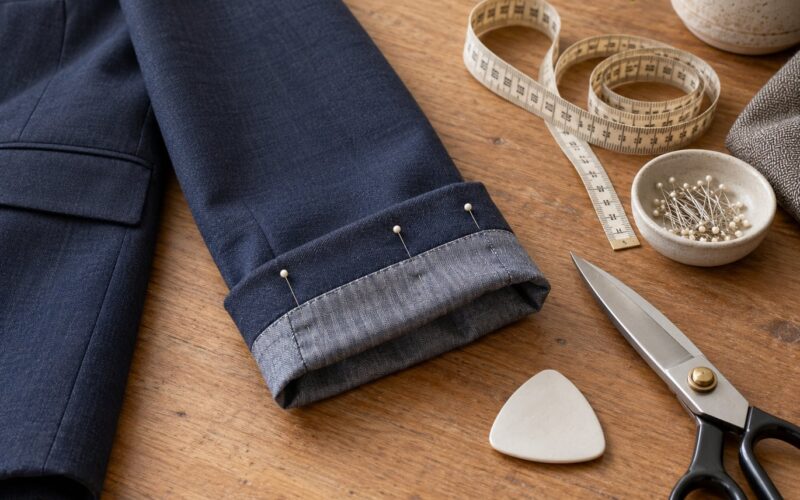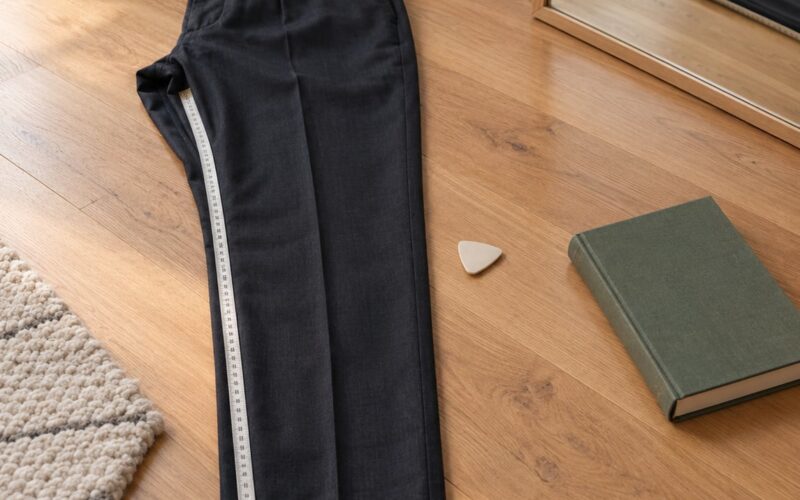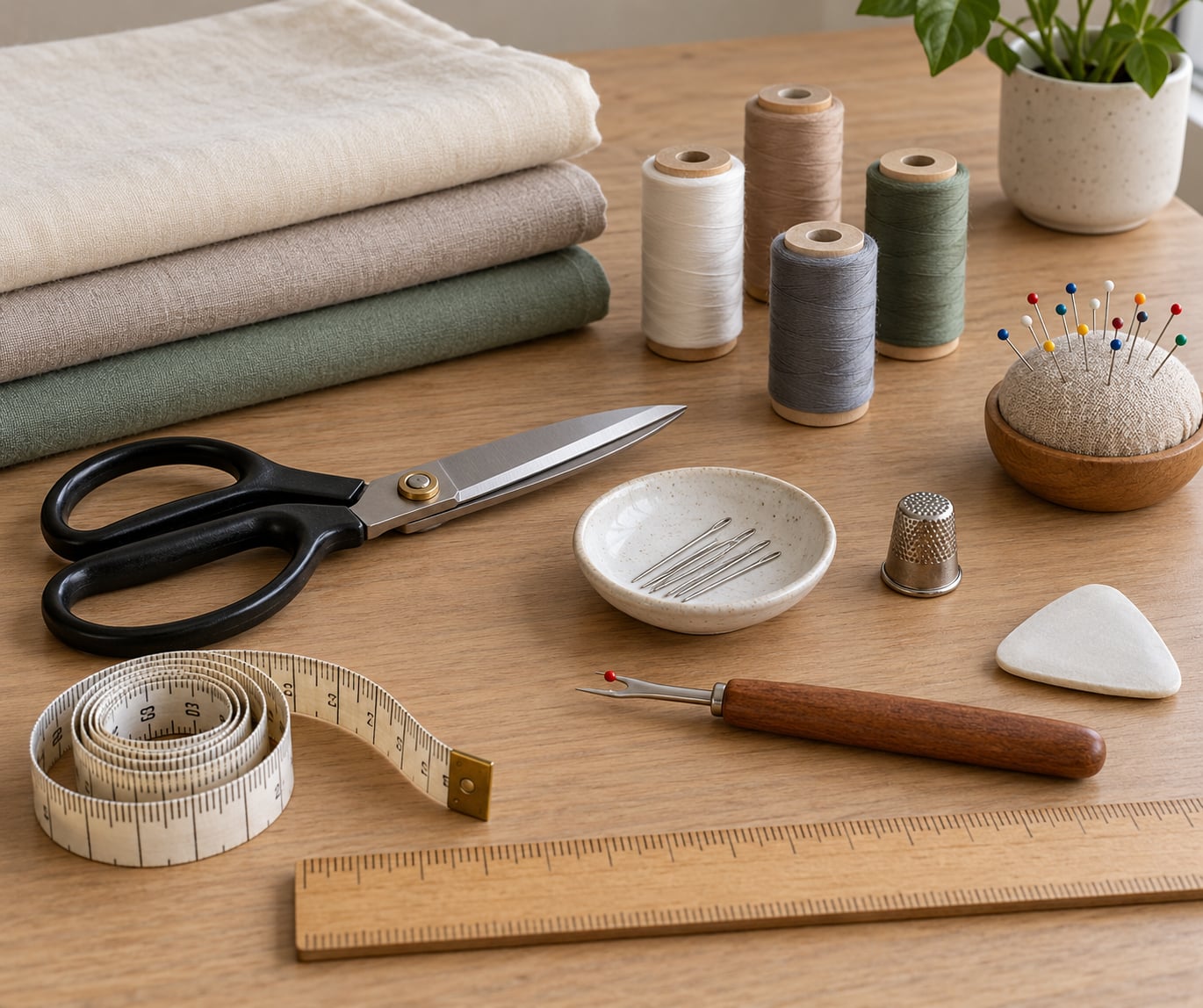
A beginner sewing kit only needs twelve things: fabric shears kept away from your paper scissors, hand-sewing needles and machine needles, pins, a seam ripper, a measuring tape, a ruler, a thimble, tailor’s chalk, a needle threader, all-purpose thread, and a yard of easy fabric to practise on. Everything else people pile into a 200-piece case is something you will use eventually, not something you need to start.
That matters because the first sewing kit is where most beginners get stuck. Retail pages show bundles with 167 named pieces and thin reviews, and it’s easy to walk out having spent real money on a tape measure, a pin cushion shaped like a tomato, and three kinds of scissors you’ll never touch.
Table of Contents
- Sewing Kit Essentials for Beginners: What to Buy
- The 12 Essential Sewing Supplies
- 1. Fabric Shears
- 2. Hand-Sewing Needles
- 3. Sewing-Machine Needles
- 4. Pins and Clips
- 5. Seam Ripper
- 6. Measuring Tape
- 7. Ruler
- 8. Thimble
- 9. Tailor’s Chalk
- 10. Needle Threader
- 11. All-Purpose Thread
- 12. Beginner Fabric
- How to Choose Sewing Machine Supplies for Beginners
- Which Tools Can You Skip as a Beginner?
- How to Organize a Beginner Sewing Kit
- How to Maintain and Use Your Sewing Kit
- Frequently Asked Questions
- How big should a beginner sewing kit be?
- Can I learn to sew without a sewing machine?
- What is the first thing a beginner should sew?
- How much does a beginner sewing kit cost?
- Which thread and needles should a beginner buy?
- What should I buy first if I have almost nothing?
- Start Sewing This Week
Sewing Kit Essentials for Beginners: What to Buy
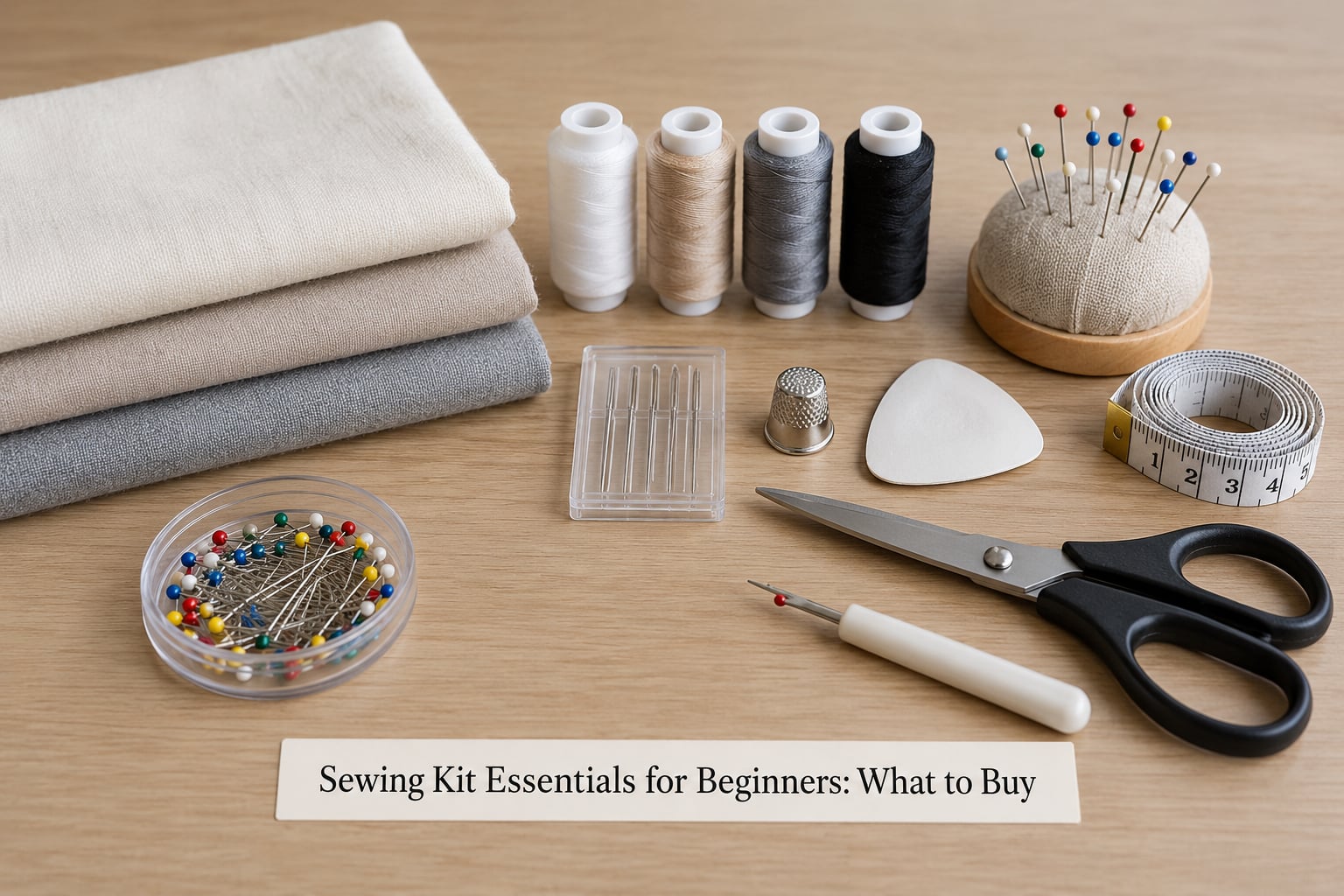
Here is the honest version of a starter kit: a cutting tool, something to hold layers together, something to measure with, something to mark with, something to take seams apart with, thread, needles, and fabric. Add an iron and a machine if you want one, and that’s the whole shopping list.
Quality matters in exactly three places. Buy good fabric shears, a decent measuring tape that doesn’t stretch or twist, and a thimble you will actually wear. Everything else is a starter-grade purchase that gets replaced the moment you outgrow it.
This cheat sheet is the whole kit at a glance, with the columns that decide the purchase order: what the tool does, whether you need it now or later, and how much of your attention it deserves on your budget.
| Tool | What it’s for | Buy now or later | Where to spend |
|---|---|---|---|
| Fabric shears | Cutting fabric cleanly without dragging the edge | Now | Worth spending on |
| Hand-sewing needles | Repairs, basting, hand-stitched seams | Now | Starter pack is fine |
| Machine needles | Stitching woven, knit and heavy fabrics | Now | Buy several sizes |
| Pins and clips | Holding layers in place while you stitch | Now | Glass head pins plus a few clips |
| Seam ripper | Undoing a seam without cutting the fabric | Now | Cheap and non-negotiable |
| Measuring tape | Body measurements, fabric length, seam allowances | Now | Worth spending on |
| Ruler | Straight hems, consistent seam allowances | Now | A small acrylic one is enough |
| Thimble | Protecting your finger when you push a needle through | Now | Comfort over looks |
| Tailor’s chalk | Marking notches and cutting lines | Now | Any type that shows on your fabric |
| Needle threader | Getting thin thread through a small eye | Now | Nearly free, buy two |
| All-purpose thread | Stitching woven cotton and blends | Now | White, black and one colour |
| Beginner fabric | Something to practise on before real projects | Now | Medium-weight woven cotton |
| Iron and ironing board | Setting seams so the project lies flat | Soon after | Any steam iron with a safe soleplate |
| Sewing machine | Faster seams than a needle and thread | Optional | Largest single expense by far |
Order matters more than people expect. Get the shears, the thread, the needles and the pins first, because those four are enough to finish a simple project by hand. Add the machine whenever you decide you want one, and only after you’ve made something you don’t enjoy making.
What about the mega-kits? The reviews on the big bundles usually cluster low, and for a reason. They mix good fabric shears with paper scissors, three needle sizes you don’t need, thread in shades nobody sews with, and a rotary cutter with nothing to cut on. It’s cheaper and cleaner to build a kit one purchase at a time.
The 12 Essential Sewing Supplies
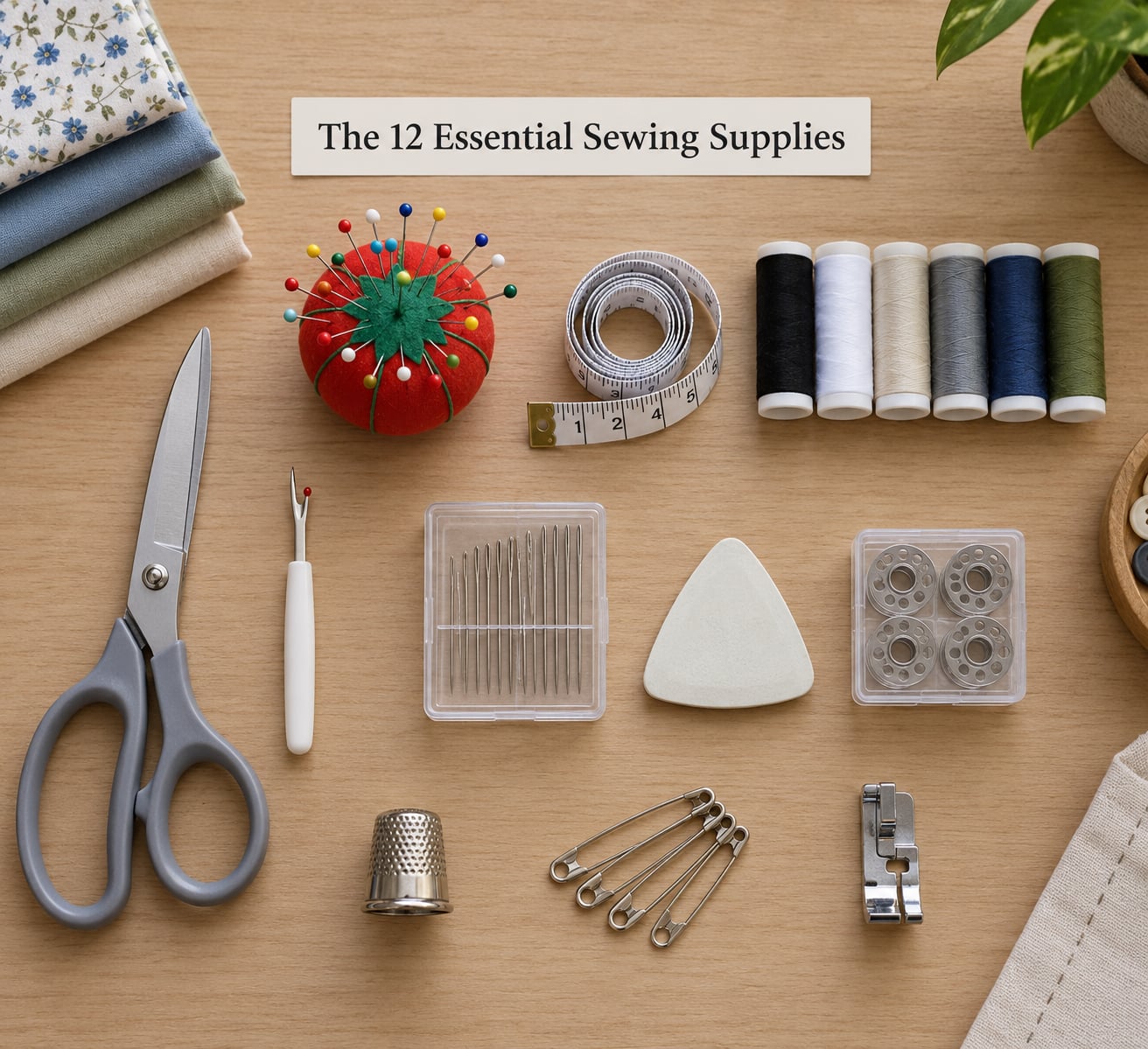
These twelve items are the full beginner sewing kit essentials list. Each one solves a specific problem you’ll hit within your first hour of sewing, and none of them is optional.
1. Fabric Shears
Fabric shears cut fabric; paper scissors cut paper. Mixing them dulls both, and a dull pair drags the edge and frays it instead of cutting cleanly. This is the one tool I’d buy from a proper sewing brand and keep somewhere nobody borrows from.
2. Hand-Sewing Needles
A small mixed pack of sharps, ball points and embroidery needles covers most hand work. Sharps for piercing woven fabric, ball points for knits so you don’t punch holes, and one or two larger embroidery needles for thick yarn or thick thread.
A beginner version is a 20-needle assortment. There’s no reason to buy a hundred needles in five sizes before you’ve sewn anything.
3. Sewing-Machine Needles
Machine needles are consumables, not tools. A universal 80/12 is the default that handles most woven cotton, and it is the safest first size. Buy a small pack and replace them often, because a dull or bent needle is the usual reason a machine starts skipping stitches or breaking threads.
4. Pins and Clips
Glass head pins are worth the extra few cents because the glass head doesn’t leave a hole or a mark in the fabric. Clips hold thicker layers than pins do, so they’re the better choice on knits, vinyl, and anywhere a pin would show.
Get a pincushion too. A tomato you fill with needles is tradition; a magnetic pin holder is what you’ll actually use if you sew at a machine.
5. Seam Ripper
A seam ripper undoes a stitched seam without cutting the fabric underneath. It’s the tool that saves beginners from the moment a seam goes in crooked, and it costs almost nothing. Keep it in your kit pouch rather than in a drawer.
6. Measuring Tape
A soft 60-inch tape measure takes body measurements and fabric lengths better than anything rigid. Cheap retractable tape measures stretch and their blades go blunt, which quietly skews every measurement you take with them. If you measure bodies at all, buy one you trust.
7. Ruler
A small acrylic ruler keeps hems straight and seam allowances consistent. A 6-inch by 2-inch one is plenty for garment work and it fits in a kit pouch. Bigger quilting rulers make sense once you’re cutting a quilt in strips.
8. Thimble
A thimble takes the sting out of pushing a needle through thick fabric. Ignore the decorative metal ones and choose a thimble that fits your middle finger snugly. If it slips, you’ll take it off, and then it won’t do its job.
9. Tailor’s Chalk
Tailor’s chalk transfers pattern notches, dart marks and cut lines onto fabric. White and blue chalk show on dark fabric, yellow and red on light. Whatever you use, mark every notch before you cut, because you cannot mark it once the fabric is in pieces.
10. Needle Threader
A needle threader is a tiny wire loop that pulls thread through the eye for you. It takes about two seconds to use and it removes the single most common frustration for people hand sewing. Buy a couple, since they bend.
11. All-Purpose Thread
All-purpose polyester thread handles woven cotton, cotton blends, and most beginner projects, and it stretches a little when you sew, which forgives small mistakes. Start with white, black, and one colour that matches something you want to make. That’s plenty.
12. Beginner Fabric
Start with medium-weight woven cotton such as calico or broadcloth. It doesn’t stretch, it doesn’t shed, it’s easy to press, and mistakes are visible before they become permanent. Hold off on jersey, corduroy, denim and anything slippery until you know how you handle a straight seam.
How to Choose Sewing Machine Supplies for Beginners
Choose machine supplies by fabric weight and fabric type, not by the machine’s brand. The needle is a consumable and the thread is a standard weight, so both are independent of whatever machine you own.
For woven cotton, an 80/12 universal needle with all-purpose polyester thread is the default combination. For knits and jersey, a ball point needle skips between the fibres instead of cutting them, which is the fix for the skipped-stitch frustration that pushes beginners back to glue. For denim, canvas and heavy upholstery fabric, a jeans needle is thicker and stiffer so it doesn’t snap.
The wrong needle is the most common cause of skipped stitches, broken needles and puckered fabric, and it costs nothing to fix.
| Fabric | Needle | Holding method | Edge-finishing tool |
|---|---|---|---|
| Lightweight woven cotton | Universal 80/12 | Pins | Nothing needed |
| Quilting cotton, layered | Universal 80/12 | Clips | Rotary cutter later, shears now |
| Knits and jersey | Ball point 75/11 | Clips, never pins | Nothing, leave the hem raw to test |
| Denim and canvas | Jeans needle 90/14 | Clips | Pinking shears or overlock |
| Shirting and woven rayon | Microtex 90/14 | Pins | Pinking shears to stop fray |
Pinking shears cut a zigzag edge that slows fraying, which is why they matter for shirting and denim and mean nothing on a cotton pillowcase. A rotary cutter and self-healing mat belong to the same upgrade, and only once you’re cutting repeated straight lines.
Which Tools Can You Skip as a Beginner?
Most beginner buying mistakes come from buying tools for the hobby you imagine rather than the one you’re doing. These can all wait, and several of them are things you should not buy at all until a specific project demands them.
A 200-piece mega-kit is the first skip. In forum threads, those bundles come up again and again as a regret, because the useful pieces are a small fraction of the case and the fabric shears inside are usually mediocre. Build the twelve instead.
A rotary cutter and self-healing mat are the classic later upgrade. They’re brilliant for quilting, for cutting strips, and for any repeated straight cut. A beginner uses shears for the first dozen projects, so a mat with a printed grid is shelf decoration until then.
A serger is next. It finishes a seam edge in one pass and it makes knits and stretchy fabric behave, but it does not replace a regular machine and it has its own learning curve. Borrow one from a class or a friend before you consider owning one.
An embroidery machine is a hobby machine, not a sewing machine. If you want to sew garments, it will disappoint you on almost every project you actually care about.
A dress form is worth buying on day one only if you fit and alter clothes for a living. For alteration work, a well-pinned garment on a hanger works fine at the start, and a cheap foam form gives you nothing useful to pin muslin to.
Quilting rulers, specialty presser feet and a garment steamer all solve problems you do not have yet. Specialty feet are also machine-specific, so buying them before you own a machine is buying accessories for a hypothetical machine.
Professional pressing equipment, like a garment steamer and a vacuum board, is worth it once you’re sewing lined garments or coats. A steam iron on a stable surface gets you through everything before that.
Here’s the honest answer to “what should I buy as a beginner sewing.” Shears, needles, thread, pins, a tape measure, a ruler, a thimble, chalk, a threader, a seam ripper, and fabric. Ten small purchases, no wasted shelf space, and you can start sewing the same afternoon.
How to Organize a Beginner Sewing Kit
A kit stays useful when you can see it. The goal is not a beautiful box; it’s that every tool has one home and you can find a marking tool at 9pm without turning the craft room upside down.
Use four small labelled containers for the small stuff: needles, pins, clips and markers; chalk and threaders; thread; and pressers and spare bobbins. Transparent boxes beat opaque ones because you’ll stop buying a third tape measure. Keep a dedicated tool pouch that moves between machines and travels to a class.
Store your fabric shears somewhere nobody will help themselves. This is not theoretical. One competitor’s sewing account described hiding them in a plastic box because family members kept borrowing them and blunting the blades, and that story circulates because so many sewists recognise it. A high shelf or a labelled case solves it in ten seconds.
Hang thread on a thread organiser rather than stacking cones in a basket. Sorted by colour, you find what you need in one pass instead of untangling the bottom layer every time.
Work in daylight if you can. The most common answer in sewing forums to “why shouldn’t you sew at night” is that you cannot see thread colour, pin shadows or a needle properly under a lamp, and mistakes made at 11pm are mistakes you find at 7am. A bright desk lamp fixes the evening; it doesn’t fix the second hand on the clock.
How to Maintain and Use Your Sewing Kit
Tools last longer when you treat them as consumables and replace them on a routine instead of waiting for something to break mid-project. Five habits cover almost everything.
Change your machine needle every eight to ten hours of stitching, or the moment it starts skipping. A fresh 80/12 costs less than a cup of coffee and it removes the single most common beginner frustration. Keep a spare pack taped inside your machine’s accessory tray.
Sharpen shears professionally once a year, and never use your fabric shears on paper, cardboard or a zip. Paper dulls the blades faster than anything else in the craft world.
Store needles and pins in a closed container or a pincushion, not loose on a table. A pin that travels is a pin somebody steps on. If you have kids in the house, this one is not optional.
Wash and press fabric before you cut it. Machine tension can shift as the fabric relaxes, and fabric you have never washed can carry sizing that marks or fades later. Air dry stored fabric away from damp, sunlight and pets.
Keep thread in its original packaging or on a rack, and discard anything brittle or dusty. Flossy thread jams tension dials, and it usually does it halfway through a panel you’ve already stitched.
Frequently Asked Questions
How big should a beginner sewing kit be?
Twelve core items is enough to finish your first project, and most beginners use about fifteen tools regularly. That means fabric shears, hand and machine needles, pins, clips, a seam ripper, a tape measure, a small ruler, a thimble, tailor’s chalk, a needle threader, all-purpose thread and a yard of practice fabric. Add an iron soon after, and treat the sewing machine as optional rather than essential.
Can I learn to sew without a sewing machine?
Yes, and for a lot of beginners hand sewing is the better starting point. A needle, all-purpose thread, a thimble and a needle threader will let you repair hems, mend seams, attach buttons and sew simple garments by hand. Hand sewing takes longer and gives you a feel for thread tension that machines hide from you. Many beginners buy a machine months later, once they know what they enjoy making.
What is the first thing a beginner should sew?
A pillowcase made from two squares of medium-weight cotton is the classic answer, and the reason is that it teaches straight seams, corners, pressing, and hemming without any tricky shaping. After that, move to a tote bag, then a zip pouch, and only then to a garment. Experienced sewists repeatedly warn beginners against starting with curtains or clothing, because both hide basic mistakes until the very end.
How much does a beginner sewing kit cost?
Prices shift constantly, so treat any figure you see as a snapshot rather than a quote. The general shape, though, holds steady: a hand-sewing kit of the twelve essentials is a modest one-off spend, adding an iron costs less than most people expect, and a sewing machine dominates the total by a wide margin. Check current listings before you buy, and build the kit in stages rather than all at once.
Which thread and needles should a beginner buy?
Buy all-purpose polyester thread in white, black and one colour you like, and a pack of universal 80/12 machine needles. That combination handles medium-weight woven cotton, which is what you should be sewing first. Add a ball point needle for knits and a jeans needle for denim or canvas once you reach those fabrics. Nothing else earns a place in the first month.
What should I buy first if I have almost nothing?
Four purchases get you sewing today: fabric shears, a pack of universal 80/12 needles, a spool of all-purpose thread, and a yard of medium-weight cotton. Pins, a tape measure and a seam ripper complete a kit that can finish a pillowcase. Everything after that is a comfort, not a requirement. Spending on those first four means you never own a tool you have not yet needed.
Start Sewing This Week
Buy the four things you need to finish a pillowcase, add pins and a seam ripper, and skip everything else until a project asks for it. Wash and press your cotton, mark the notches, pin, stitch a straight 5/8-inch seam, and press it flat before you go any further.
Sewing gets easy the same way every other skill does: a few hours of ordinary practice, not a bigger tool collection. Updated for 2026, this list stays deliberately short, so it should too.