A travel capsule wardrobe is a small set of clothes chosen so every top works with every bottom and every pair of shoes. Most people build one with the 5-4-3-2-1 method: 5 tops, 4 bottoms, 3 dresses or one-pieces, 2 outerwear or accessories, 1 hat. Fifteen pieces, dozens of outfits, one carry-on.
The trick is coordination, not minimalism. Four tops and two bottoms already produce eight combinations before you add shoes, and a shared color palette is what makes those combinations look intentional rather than accidental. Here is how to build a travel capsule wardrobe that actually gets worn.
The palette rule, in one list:
- Pick two neutrals that already live in your closet
- Add one accent color for exactly two pieces
- Keep roughly 80 percent of the capsule in neutrals
- Match shoes and bags to the neutrals, never the accent
- Limit prints to one small-scale pattern
- Test every pair by holding the two pieces side by side
If you only have an afternoon, treat it as an editing job on clothes you already own. The 2026 wardrobe edit only works if the color story holds together before you start counting pieces.
Table of Contents
- What You Need
- The Itinerary, With Times and Places
- Destination Weather by Day, Not by Season
- Trip Length and the Laundry Question
- Luggage Limits You Will Actually Be Held To
- Dress Codes
- Your Existing Wardrobe and Packing Gear
- Step-by-Step: How to Build a Travel Capsule Wardrobe
- 1. Define Your Trip’s Real Needs
- 2. Choose a Cohesive Color Palette
- 3. Select Your Core Building Blocks
- 4. Add One or Two High-Impact Pieces
- 5. Plan Outfits Before You Pack
- 6. Test, Refine, and Pack by Category
- Common Mistakes
- Packing One Outfit Per Day
- Ignoring Footwear Until the Last Minute
- Choosing Fabrics That Behave Badly on the Road
- Overloading on Special Pieces
- Fighting the Destination
- Frequently Asked Questions
- How many pieces should be in a travel capsule wardrobe?
- How many outfits can a 20-piece travel capsule make?
- Can I build a travel capsule wardrobe with only carry-on luggage?
- What should I pack for a work trip with a business dress code?
- How do I pack a capsule wardrobe for hot and cold weather?
- Can I do laundry and still use a small travel capsule?
- Conclusion: Start With Your Next Trip
What You Need
A capsule built without homework is just a nicer-looking pile of clothes. Before you pull anything out, get six things clear.
The Itinerary, With Times and Places
Write down each day and what you are actually doing, not what you could do. Three museum mornings, two client dinners, and one all-day walking tour produce a very different list than “seven days in Lisbon” written on a notes app.
Destination Weather by Day, Not by Season
Check the forecast for the actual dates and look at the swing, not the average. Coastal towns drop 10 degrees after sunset, and airport-adjacent cities can be warmer than the beach your colleague is posting from.
Trip Length and the Laundry Question
Decide now whether you will wash clothes mid-trip, because that choice halves your packing or locks it in. Assume one wash stop only if your accommodation has a washer or a laundromat within a short walk.
Luggage Limits You Will Actually Be Held To
Know your carry-on dimensions in centimeters and whether your fare includes a checked bag. Most people overpack because they mentally pack for a suitcase they are not flying with.
Dress Codes
Cruises, all-inclusive resorts, and some workplaces publish theirs. One black dress that can read formal with a blazer and casual with sandals covers most of these.
Your Existing Wardrobe and Packing Gear
Before buying anything, lay out what already passes the palette test. You also want packing cubes, a small garment bag for anything structured, and a laundry bag.
Step-by-Step: How to Build a Travel Capsule Wardrobe
Six steps, in this order. Skipping ahead to picking pretty pieces is how people end up with a suitcase full of things that only work together once.
1. Define Your Trip’s Real Needs
Count the days you need to dress for without washing, then translate them into requirements: how many tops, how many bottoms, how many layers, how many pairs of shoes. Add one outfit for every formal or dressy occasion, and one extra base layer for hiking, cold mornings, or a swimming pool.
Then do the laundry math. If you will wash on day four of a ten-day trip, you are really packing for six days of clothes plus one wash load, not ten. That single calculation is where most people find ten pieces of slack.
Write the numbers down before choosing colors. It kills the impulse to pack the pretty blouse for a hypothetical dinner that was never on the itinerary.
2. Choose a Cohesive Color Palette
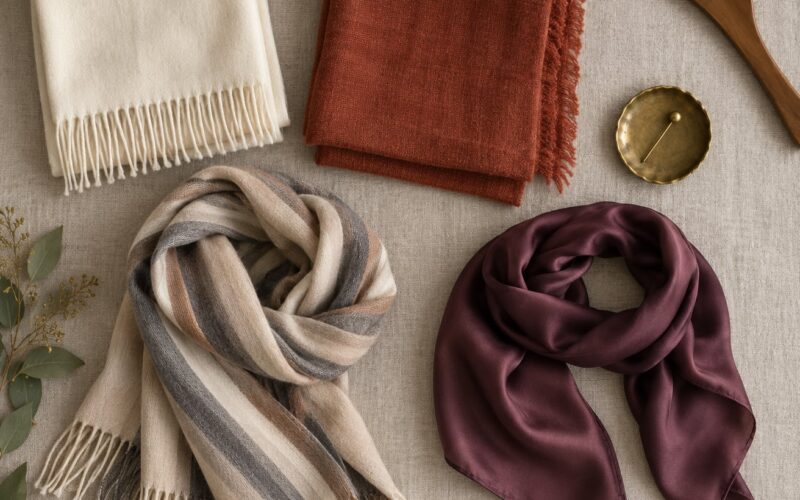
Two neutrals and one accent is the simplest reliable formula. Navy plus beige plus rust gives you warm and cool options, and everything reads as intentional. Black plus grey plus any accent is safer but flatter, and it hides dust on day six.
The 80/20 split matters. Roughly 80 percent of your capsule should be neutral so that the accent pieces look like a decision rather than leftovers from someone else’s capsule. Keep prints to one small-scale pattern; two competing prints break the palette faster than any wrong color.
Match footwear and bags to the neutrals. A sandal that only works with the rust is the piece that forces you to repeat an outfit.
3. Select Your Core Building Blocks
Foundation pieces do the heavy lifting: tops, bottoms, a lightweight layer, outerwear, and shoes chosen for the activities you actually have.
Build tops around a mix. Two simple crew or boat-neck tops, one shirt or blouse that works tucked or loose, and one with sleeves for cool evenings and flights. Bottoms usually need less variety: one pair of trousers that reads smart, one pair of jeans or chinos for daytime, and one skirt or second trouser for variety. Swap the second bottom for shorts if the trip is hot.
Add one layer that works three ways: a cardigan over a tee for dinner, a merino or lightweight long sleeve under a shell on a cool morning, and a throw over the shoulders in an air-conditioned restaurant.
Two pairs of shoes is the practical maximum. One broken-in walking shoe and one that handles what the trip demands, whether that is a flat sandal, a loafers-and-sneaker pair for a city, or a proper shoe for a dinner. Third shoes eat bag space and rarely get more than one outing.
On fabric, choose what survives a suitcase. Wrinkle-resistant synthetics and merino come out of a bag looking like they were never packed, dry overnight in a sink, and resist odor. Lightweight cotton breathes in heat but creases badly and stays damp longer.
4. Add One or Two High-Impact Pieces
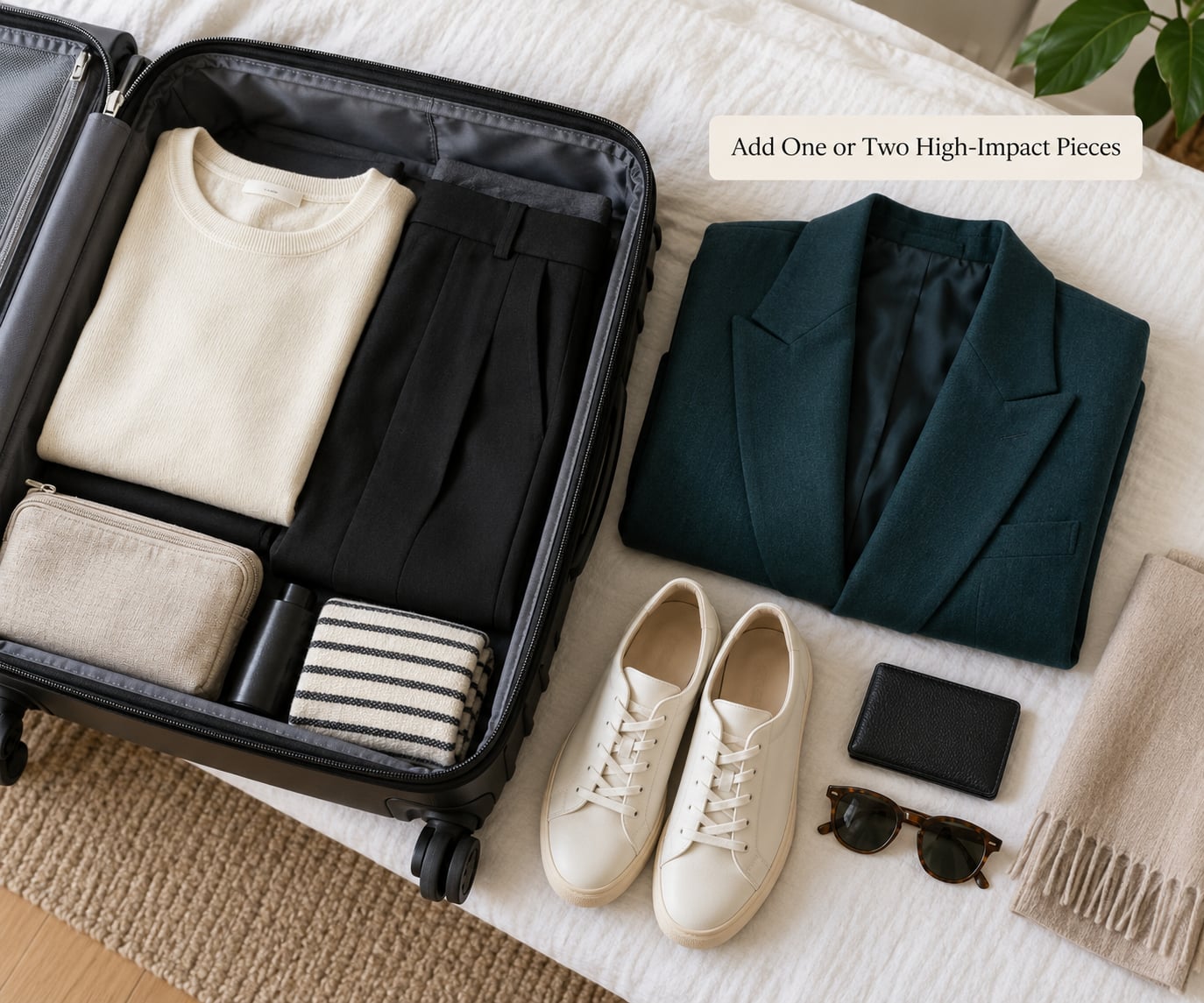
Foundation pieces all look a bit safe together, so add one or two things that change the register: a polished top, a midi dress, a tailored jumpsuit, or a blazer in your accent color.
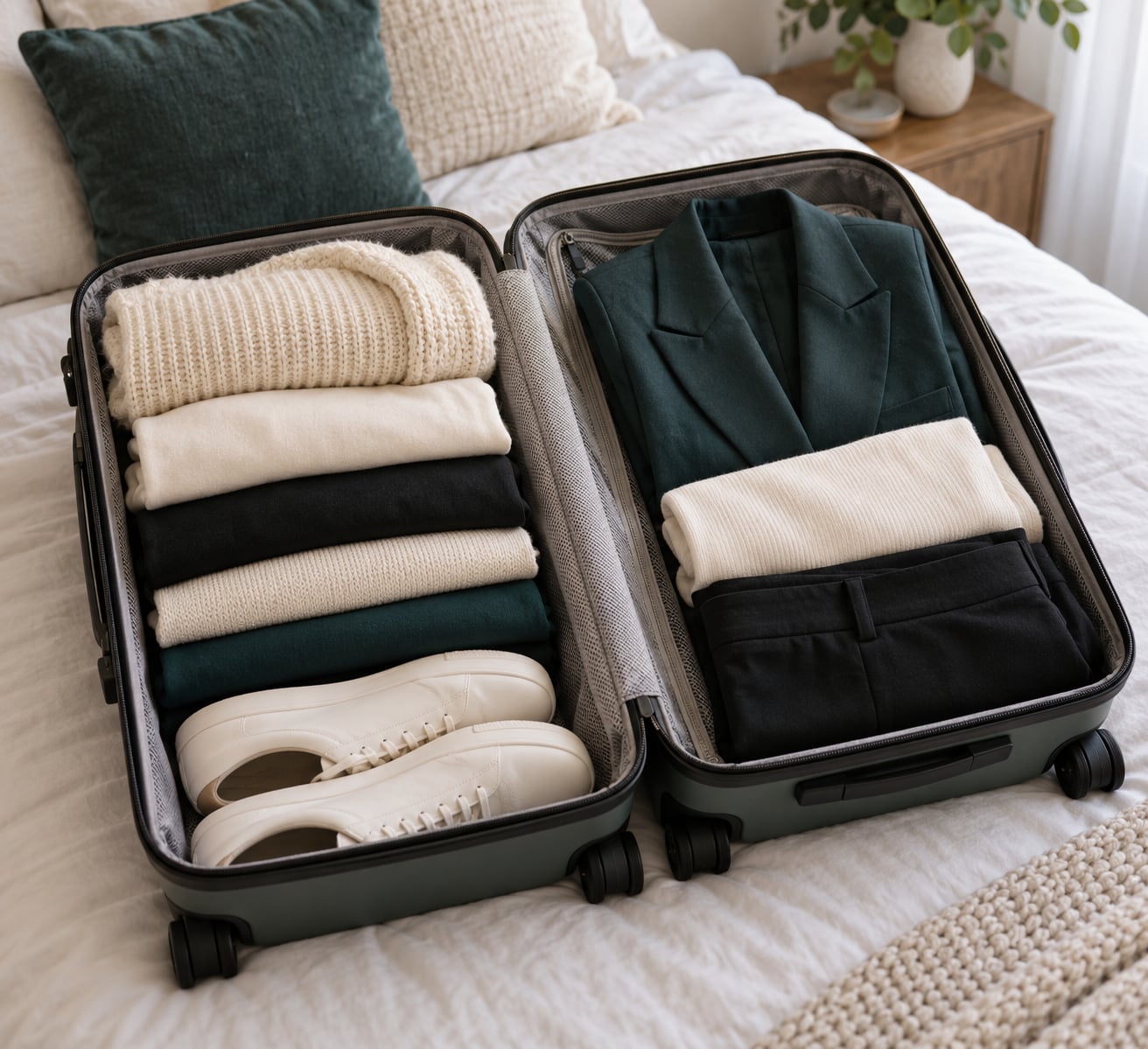
One well-chosen piece does more work than three extra basics. A dark teal blazer turns a cream top and black trousers into a meeting outfit, a dinner outfit, and a gallery outfit depending on what is underneath.
Check the fabric is in your palette and that it is not high-maintenance. A piece you have to steam before every outing loses its value the moment the trip gets busy.
5. Plan Outfits Before You Pack
Map your pieces to a week. Write each day’s outfit as a combination of named pieces, then mark which pieces repeat in consecutive days. A repeat within 48 hours is what makes a capsule look thin to you, even when it looks varied to everyone else.
Now run the combination math. Tops multiplied by bottoms multiplied by shoes gives you the ceiling, not the count. Two bottoms with five tops and two pairs of shoes is 20 combinations, which is more than any week needs. Anyone learning how to build a travel capsule wardrobe for the first time usually overestimates how many outfits a single trip requires.
Look for gaps at this stage. If day six has no answer, the fix is usually an accessory, a layer, or one more bottom, not a third pair of shoes.
6. Test, Refine, and Pack by Category
Lay the full capsule out on the bed or photograph it. A photo is genuinely useful on the road; it is how you remember what is in the suitcase when the bag is buried under a jacket at the bottom of a closet.
Swap out weak combinations now, while replacing costs nothing. Then pack by category in cubes: tops, bottoms, layers, underwear and swim, shoes at the bottom of the bag or worn on the flight.
Roll knits and fitted pieces, fold wrinkle-prone cotton flat, and use the garment bag only for the one or two structured items that would not survive compression. Most experienced packers roll rather than fold, mostly because compressed rolls do not develop the deep creases that folding does.
Leave real space in the suitcase. Local markets, souvenirs, and the jacket you buy on day two all need somewhere to go, and a full bag means a trip spent rearranging.
Common Mistakes
Almost every failed capsule comes down to one of five habits. Each has a specific correction.
Packing One Outfit Per Day
This is the biggest one. Twelve outfits for twelve days means twelve tops and nothing to mix. Correction: build the combinations list first and let the day count follow from it. A ten-day trip usually needs 20 to 24 pieces for full rotation and 15 for a capsule with one wash stop.
Ignoring Footwear Until the Last Minute
Shoes take a disproportionate amount of bag volume and get worn hard. Correction: decide your two pairs while choosing the rest of the capsule, then wear the bulkier pair in transit if the airline allows it.
Choosing Fabrics That Behave Badly on the Road
Cotton and linen crease in a way that quietly ruins the polish of the whole capsule. Correction: check each piece against three criteria, wrinkle resistance, dry time, and odor resistance. Merino and modern synthetics score well; rayon and silk do not travel well.
Overloading on Special Pieces
Two or three “only for nice dinners” items means the same photo outfit two nights running. Correction: one high-impact piece plus a changed base layer and changed shoes reads as a different outfit.
Fighting the Destination
A city capsule in a humid, uncooled room will be miserable by day three. Correction: check the climate before the palette, and adapt. There are trips where a capsule is the wrong strategy.
Multi-city itineraries with one laundry stop, ski trips with technical outerwear, humid summer trips where nothing dries, and week-long trips with no washer anywhere are the four cases where rigid formulas break. In humid climates, plan for twice the underwear and sleepwear you think, because laundry happens overnight or not at all. On a dress-code-heavy cruise, add two occasion pieces rather than shrinking everything else.
Frequently Asked Questions
How many pieces should be in a travel capsule wardrobe?
For a one to two week trip, 15 to 20 clothing pieces is the working range. The 5-4-3-2-1 method gives you 15: five tops, four bottoms, three dresses or one-pieces, two outerwear or accessories, and one hat. Add underwear, socks, and sleepwear on top, count underwear for your actual trip length, and add one base layer if the forecast dips.
How many outfits can a 20-piece travel capsule make?
Far more than days. Multiply tops by bottoms, then by pairs of shoes, to get your ceiling: five tops, three bottoms, and two pairs of shoes is 30 combinations before layering. Realistically you will wear about 12 to 16 distinct outfits on a ten-day trip with one wash stop, because accessories and layers change an outfit without adding a garment.
Can I build a travel capsule wardrobe with only carry-on luggage?
Yes, and a capsule is usually the easiest wardrobe to fit in one. Check your airline’s carry-on dimensions in centimeters first, since limits are enforced at the gate. Using packing cubes, two pairs of shoes worn or placed at the bottom, and compression on soft items, 15 to 20 pieces fit comfortably. Leave a quarter of the space empty for purchases and souvenirs.
What should I pack for a work trip with a business dress code?
Build around one neutral suit separates set: tailored trousers, a crisp blouse or shirt, and a structured blazer in a neutral or one accent color. Add a midi or straight dress that works with the blazer for client dinners, a knit layer for air conditioning, and loafers or low heels with enough comfort for a full day of walking. Keep jewelry to one watch and one small pair of earrings.
How do I pack a capsule wardrobe for hot and cold weather?
Build for the widest swing and use layers instead of heavy garments. Start with a lightweight merino or synthetic base layer, add a mid-weight sweater or overshirt, then a packable shell or packable down layer. Wear the thickest piece in transit. In cold climates swap the second pair of trousers for leggings under a skirt or trousers, and pack twice the socks you expect to need.
Can I do laundry and still use a small travel capsule?
Yes, and one planned wash stop roughly halves what you pack. A ten-day trip becomes six days of clothing plus one load. Use a sink and a few drops of detergent for underwear, socks, and tops in most accommodations, and carry a waterproof laundry bag. Skip the plan entirely if your hotel has no washer and no nearby laundromat, or if you simply do not want to.
Conclusion: Start With Your Next Trip
Start with arithmetic, not shopping. Count the days you cannot wash clothes, check the forecast and the dress codes, then open your closet and count what already passes a two-neutral palette test. Buy only the pieces that create three or more outfits each, and the packing list writes itself.
If one trip is not enough motivation, run the same method for your everyday closet before you go. A capsule you have already worn is a capsule you can pack on a whim.