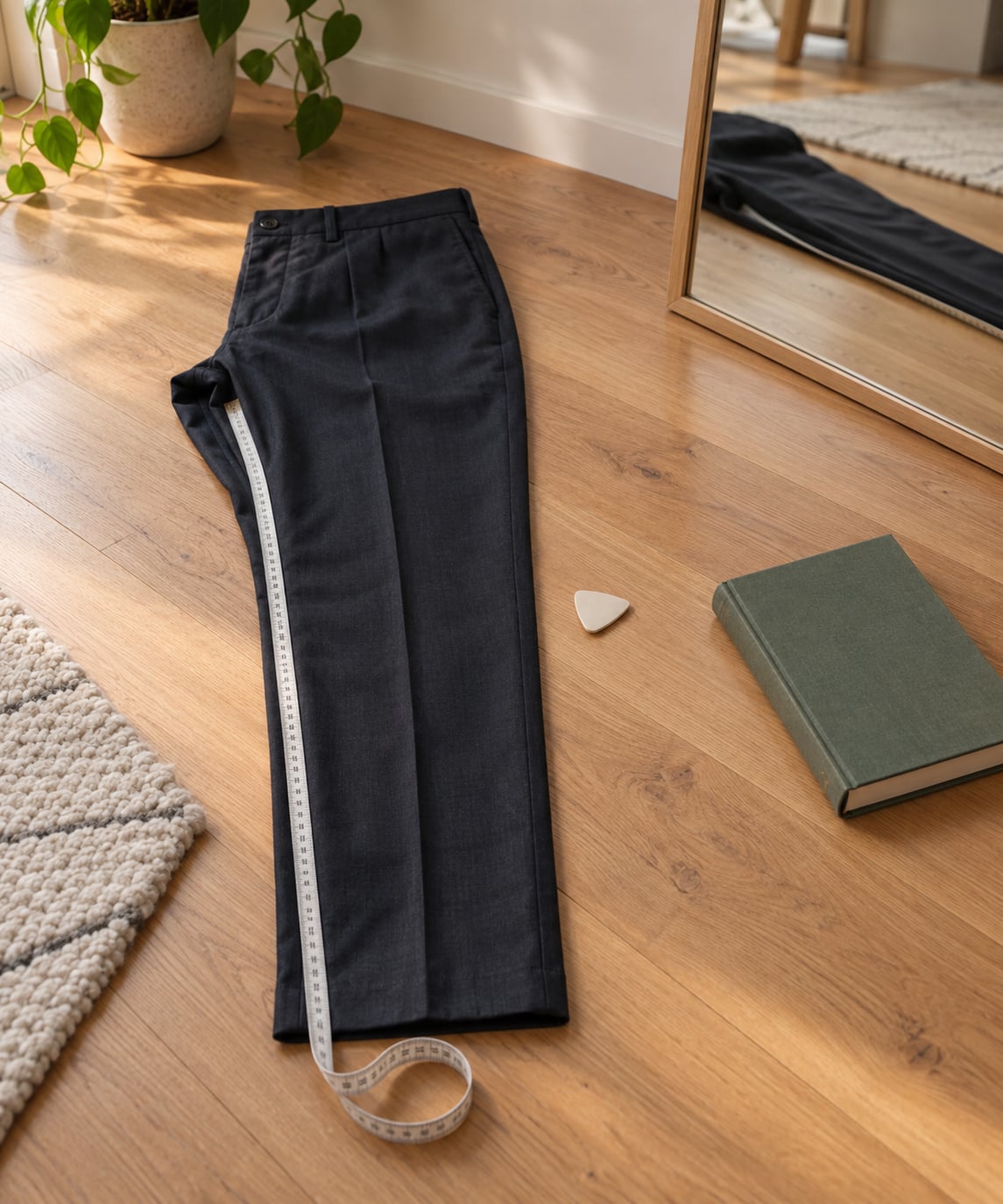
An inseam is the length of the inside of your leg, measured from the crotch seam straight down to the ankle bone or the point where the hem should finish. To measure it, stand tall with your feet slightly apart, anchor a soft tape at the crotch seam, run the tape down the inside of your leg to the ankle bone, and write the number down.
That is the whole task, and it takes about three minutes. The reason people get it wrong is rarely the tape, it is where the tape starts. Knowing how to measure inseam correctly means nailing that starting point, keeping the tape vertical, and then checking the result against a pair of pants that already fit the way you want.
This guide covers the solo method, the faster reference-garment method, the mistakes that quietly add or subtract an inch, and what to do with the number once you have it.
Table of Contents
- What You Need
- Step-by-Step: How to Measure Inseam Correctly
- Step 1: Prepare the Right Reference Garment
- Step 2: Locate the Correct Starting Point
- Step 3: How to Measure the Inside Leg Without Tilting the Tape
- Step 4: Confirm and Record the Measurement
- Common Inseam Measurement Mistakes
- Measuring on the outer seam
- Anchoring the tape at the wrong height
- Pulling the tape tight
- Letting the tape tilt
- Bending the knees or shifting weight
- Measuring over bulky clothing
- Confusing a body measurement with a garment measurement
- How to Use Your Inseam Measurement When Shopping
- Reading a brand size chart
- Inseam lengths by height
- Choosing between two lengths
- Frequently Asked Questions
- How do I measure my inseam without a helper?
- Where do I start measuring inseam on high-waisted pants?
- Is inseam the same as pant rise?
- What should my inseam be if I am 5 foot 2?
- Is a 30 inch inseam long or short?
- How do I convert inseam measurements from centimeters to inches?
- Conclusion
What You Need
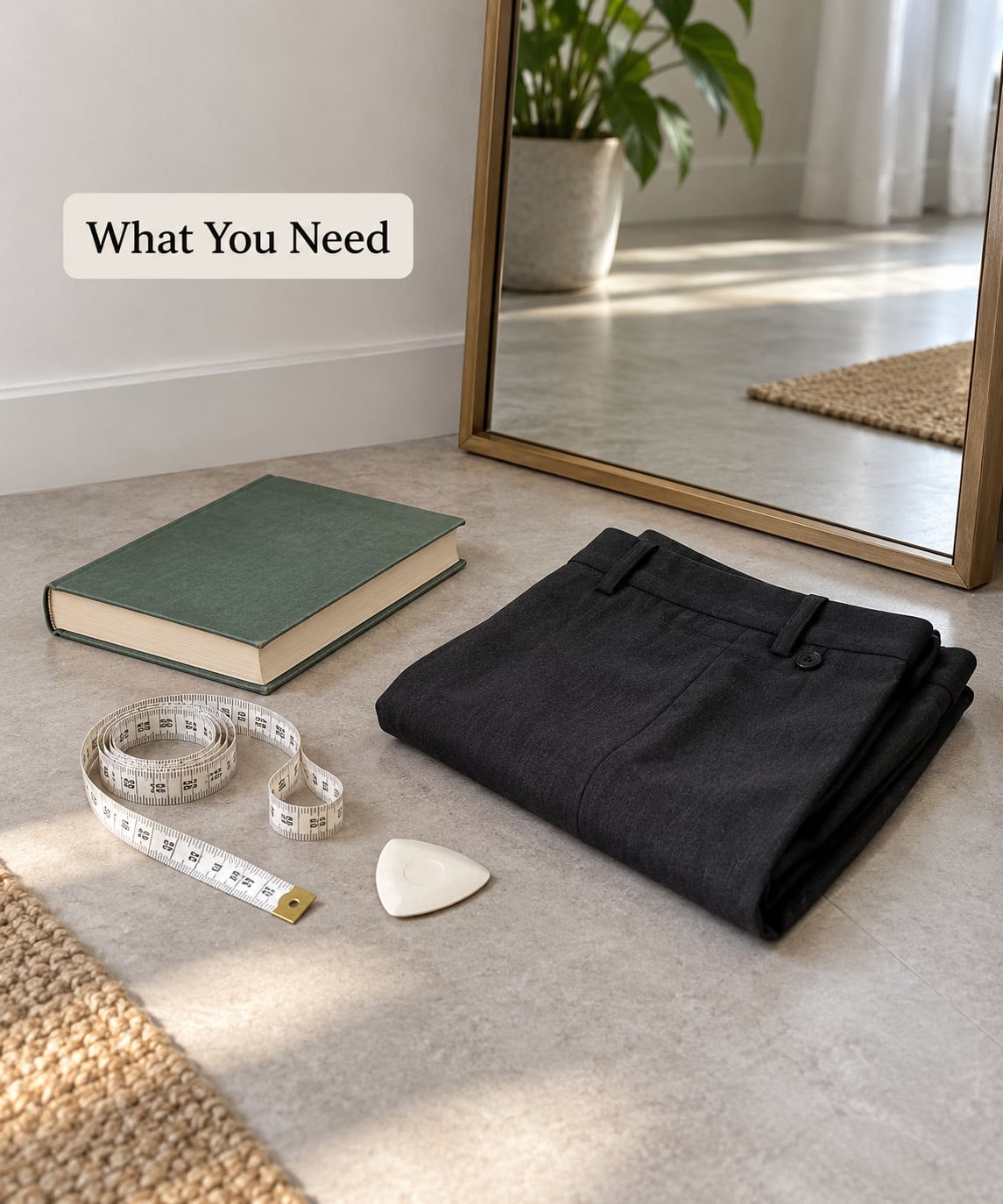
You need very little, and all of it is cheap. The only tool you genuinely cannot do without is a flexible measuring tape that does not stretch.
- A soft or flexible measuring tape. The cheap stitched fabric kind, not a rigid plastic or metal tape. A tape that pulls will give you a shorter number than reality. Retractable tape measures are usable in a pinch but the little hook at the end rarely sits at a true zero.
- A mirror. A full-length one if you have it, so you can see your feet and the tape’s end point at the same time. A hand mirror on the floor works almost as well.
- A firm floor and a wall or door to stand against. You want a hard surface under your feet, not carpet, because carpet compresses and quietly shortens the measurement.
- A pair of pants that already fit you well. This is the single most useful item in the list, and most people skip it. The crotch seam of a well-fitting garment is a perfect physical marker for where the tape starts.
- A phone or notebook. You will want to record the number, the date, and the shoes you were wearing.
- Tailor’s chalk or a small piece of tape. Useful for marking the crotch on your body, and essential if you are going to hem the pants yourself later.
- A helper, if one is available. Optional, not required. There is a solid solo method below.
Step-by-Step: How to Measure Inseam Correctly
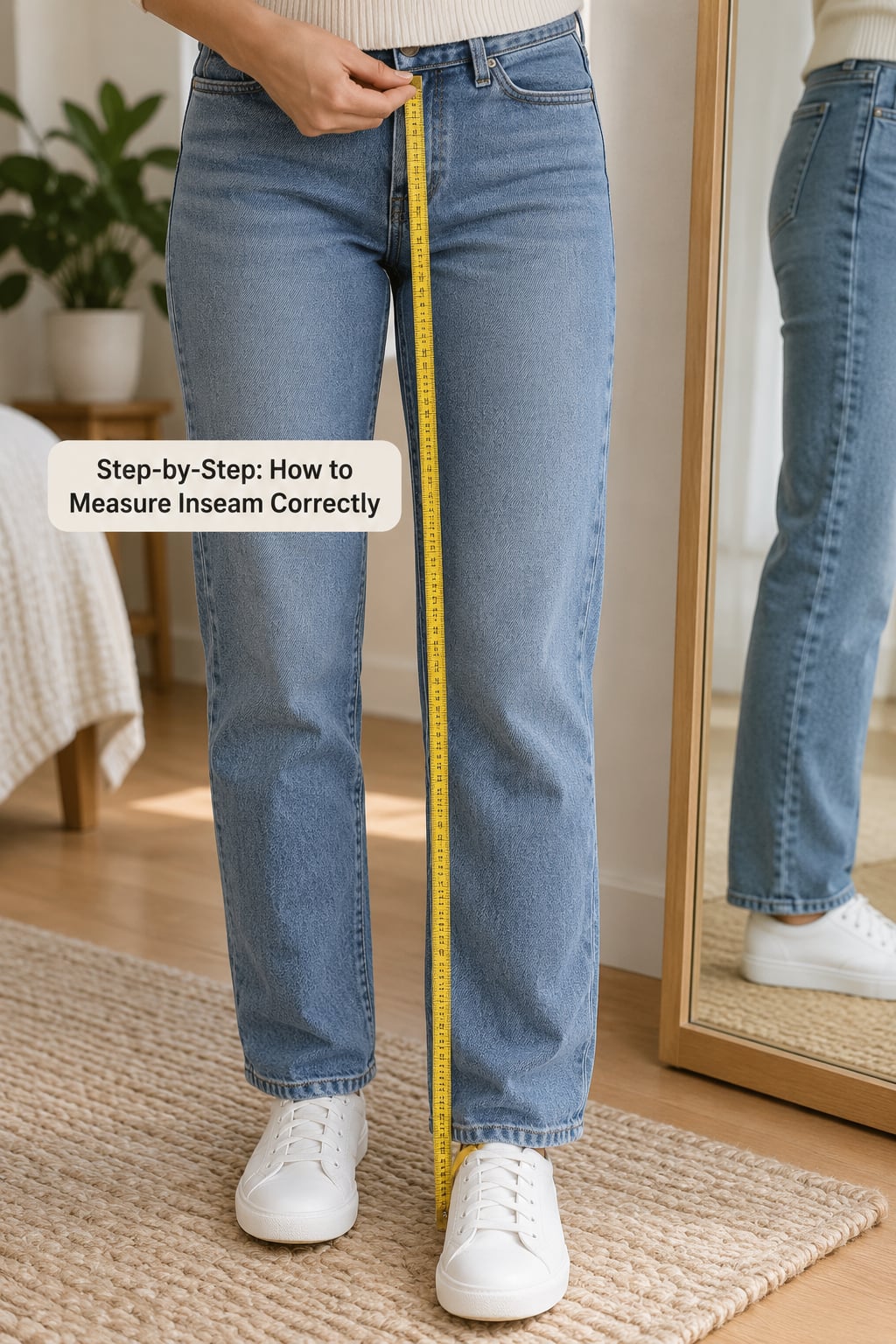
Step 1: Prepare the Right Reference Garment
Put on the pants you measure against before you put the tape anywhere. Ideally this is the pair you already own and love the length of, because that is the number you are trying to reproduce.
What to look for in that reference pair: the waistband sits where you like it, the leg does not pool or cut off, and the fabric is not stretched or relaxed. Jeans that have been worn a few times and stretched out will read long. Elastic-waist joggers and anything with elastane in it will read short once the stretch relaxes on you.
Wear the shoes you plan to wear most with the trousers, or at least the shoes with the same heel height. A boot adds roughly an inch of height, and it hides an inch of inseam. Measuring in bare feet and then shopping for boot-cut trousers is how people end up hemming twice.
Step 2: Locate the Correct Starting Point
Start at the crotch seam, which is the point where the front and back of the pants meet between your legs. It sits slightly below the natural crease of your buttock and slightly above the fullest part of your thigh. That is the standard start for inseam, and it is the one that matches what brands print on their size charts.
Two other starting points come up, and both produce a different number. Measuring from the inner waistband gives you what some brands call the inner leg length, a measurement that runs roughly an inch and a half to three inches longer than a true inseam. Measuring from your natural waist on your body gives you a figure that includes part of the rise, and it is not what a retailer means by inseam.
If you are standing there with no reference pants, you can mark your own crotch point. Stand in front of the mirror, hold a hardcover book spine-down between your thighs with the bottom edge at the base of the crotch, and hold the book in place. That gives you a firm, unmoving edge at the correct height. Chalk the spot on the inside of each thigh before you take the tape out.
Step 3: How to Measure the Inside Leg Without Tilting the Tape
With the start point fixed, run the tape straight down the inside of the leg. Not down the middle of the leg, and not along the curve of the calf. The inside seam of a trouser leg is the straightest line from crotch to ankle, so that is your guide.
Four things keep the number honest. Keep the tape vertical, held against the leg rather than hanging in the air. Keep it snug but never pulled tight, because a stretched tape reads short. Keep both legs still and your weight even, since shifting onto one hip drops the other side by an inch. And decide where the tape stops before you look, rather than adjusting the end until it feels right.
On where to stop: the ankle bone is the standard end point, and it is what most size charts use. The floor is wrong, because it adds your shoe height to nothing useful. The top of the shoe is the practical end point if you want a specific break. Measure to the ankle bone first and then note how much you want to drop below it.
Step 4: Confirm and Record the Measurement
Measure the second leg. On most people the two differ by a quarter inch or less, and the larger number is the one to shop with, because a hem cut to the short side will ride up on the long side when you walk.
Then run the flat-lay check. Take the reference pants off, lay them flat and smooth on a table, and measure the seam from the crotch seam to the hem. That garment measurement is the ground truth. If your body number and the garment number disagree by more than half an inch, the tape drifted somewhere and it is worth doing both again.
Write it down with the date, the shoe type, and a note about the fit, for example 31.5 inches measured barefoot, same length as the grey chinos. Re-measuring takes a minute, and it saves you from arguing with a return policy later.
Common Inseam Measurement Mistakes
Almost every bad inseam number comes from one of a handful of small errors. Each of these is easy to fix once you know it is happening.
Measuring on the outer seam
The outseam runs from the top of the waist down the outside of the leg to the hem, and it includes the rise. Using it produces a number two to four inches longer than your inseam, which is why plenty of people believe they need a 36 inch inseam when they need a 32. Follow the inside seam, and if in doubt, start your tape at the crotch seam rather than at the waistband.
Anchoring the tape at the wrong height
Starting too high adds length, starting too low subtracts it. This is the most common source of a one-inch error, and it is exactly the step people rush. Wearing the reference pants solves it; failing that, use the book method before you remove it.
Pulling the tape tight
Fabric tape stretches, and a stretched tape gives a smaller number. Rest the tape against your leg and let it lie there. If you can slide a finger under the tape without it sagging, the tension is about right.
Letting the tape tilt
A tape that drifts outward toward the ankle is longer than it looks, and one that drifts inward is shorter. A helper is genuinely useful here, because they can eyeball the vertical. Alone, stand with your toes pointed straight ahead and use the shin as your reference line.
Bending the knees or shifting weight
Crouching shortens the leg by an inch or more. Standing with all your weight on one leg raises the hip on the other side. Stand up straight with feet hip-width apart and let both legs carry you equally.
Measuring over bulky clothing
A sweatshirt bunched at the crotch adds fabric you do not want in the total. Measure over the reference pants and nothing thick underneath.
Confusing a body measurement with a garment measurement
These are different numbers and they are not interchangeable. Your body inseam is where the tape starts on you. A garment inseam is the seam on a finished pair, which includes seam allowance and the effect of the cut. Brand charts usually list the garment number, and sewists draft patterns from something closer to the body number, which is where a quarter-inch mismatch between the two traditions comes from.
How to Use Your Inseam Measurement When Shopping
Knowing the difference between the three leg measurements stops most of the guessing that comes after the measuring session.
| Measurement | Where it starts | Where it ends | Typical use |
|---|---|---|---|
| Inseam | Crotch seam | Ankle bone or hem | Choosing trouser and jeans length |
| Outseam | Top of the waistband | Hem | Matching vintage or secondhand pieces |
| Front rise | Front waistband | Crotch seam | Checking whether a rise feels high or low |
| Back rise | Back waistband | Crotch seam | Checking the fit when you sit down |
Front and back rise are rarely equal, and a pair that works standing up can feel badly low the moment you sit. If a brand lists only one rise figure, assume it is the front.
Reading a brand size chart
Before you trust a chart, work out whether it lists body measurements or garment measurements. Body charts usually say the number is measured on the person, often with wording like model measurements or body. Garment charts give the flat dimensions of the finished trouser, measured flat on a table and usually doubled for the waist.
That distinction is the answer to whether a pair of 32 inch waist trousers are actually 32 inches. A waist listed at 32 is nearly always the flat garment measurement, which is roughly 16 inches of fabric relaxed before it is on you. It is not the distance around your body.
One more warning about charts: resale communities and secondhand shoppers consistently report that listed inseams do not match the garments. When you buy used or vintage denim, measure the pair flat yourself and trust the seam over the tag.
Inseam lengths by height
Height is a rough guide only. People with the same height can differ by two full inches of inseam, and a long torso with shorter legs will land at the low end of any band below.
| Your height | Usual inseam range | Notes |
|---|---|---|
| 5 ft 2 in | 26 to 28 in | Petite lengths; most brands stop at 28 |
| 5 ft 5 in | 27 to 29 in | Short lengths are widely stocked |
| 5 ft 8 in | 29 to 31 in | Sits near the standard 30 inch offering |
| 5 ft 11 in | 31 to 33 in | Most brands run out of length around 32 |
| 6 ft 2 in | 33 to 35 in | Tall lines or alterations are usually needed |
| 6 ft 5 in and above | 35 to 38 in | Tall or extra-tall lines only |
So is a 27 inch inseam long? Only for someone around 5 ft 3 in or under. Is a 30 inch inseam long or short? It is standard for a 5 ft 8 in or 5 ft 10 in frame and short for anyone past about 6 ft. A 34 inch inseam is long: very few people below 6 ft 4 in need it, and if you are shorter than that, it is a sign you should be shopping petite lines instead of upsizing.
Choosing between two lengths
When you are deciding between a 30 and a 32 inch inseam, decide by how you want the hem to look, not by the number itself. Take the ankle bone measurement and add or subtract the break you want.
- No break, clean finish at the ankle: measure to the ankle bone and take nothing off. Works best with a slim or straight leg and a low shoe.
- A small break over the shoe: add a quarter inch for a loafer, half an inch for a sneaker, and around three-quarters for a boot.
- Full break: add one to one and a half inches, which suits wide legs, pleated trousers and dress shoes.
- Cropped or cuffed: subtract one to three inches, and add the cuff width back on if you plan to fold it.
Rise changes the picture. A high rise sits higher on the waist, so the same inseam reads longer on the leg and the crotch seam starts further up the body. Compare an inseam only against other trousers with a similar rise.
Stretch matters too. Denim with elastane relaxes a little in wear, so a pair that fits slightly long on day one may be right by week two. Cut the hem a quarter inch longer than you want if you are buying a stretch fabric new.
Jeans add one more wrinkle: the front and back inseam are different lengths on the same pair, because the back panel is cut with a rise. On a curved-leg jean the difference can run to a quarter inch or more. Hems are cut to the shorter, front measurement, which is why jeans so often look fine standing and short when you sit.
Two situations call for a tailor rather than a size search. The first is a rise you have never found in a ready-made pair, which no inseam number can fix. The second is a length that no brand in your size carries, which happens constantly above 6 ft and below 5 ft 3 in. Buying the closest available length and having it hemmed is faster and cheaper than waiting for a restock.
One last disambiguation, because this query gets searched for bikes. If you are setting saddle height rather than buying trousers, a fashion inseam is not what you need. Fitters use standover height and a formula based on your leg bone, and many riders treat raw body inseam as unreliable because femur angle, pelvic rotation and soft tissue all shift the result. If that is you, the trouser measurement on this page will not set your saddle.
Frequently Asked Questions
How do I measure my inseam without a helper?
Stand in front of a mirror in the pants you are measuring against, slide a hardcover book spine-down between your thighs with the bottom edge at the base of the crotch, and mark that height on each thigh with tailor’s chalk. Then run the tape straight down the inside seam from the mark to the ankle bone. Holding the book still with your thighs is what a helper’s hands would otherwise do, and it is accurate to well under a quarter inch.
Where do I start measuring inseam on high-waisted pants?
Still at the crotch seam, not the waistband. A high waistband sits higher on the body, so starting there adds the front rise, usually two to four inches, and gives you a number that matches nothing on a size chart. If the trousers are high-waisted, the crotch seam is simply further up your body, and the same rule applies. The alternative, measuring down from the inner waistband, is a different measurement called inner leg length and is used for slim and tailored trousers.
Is inseam the same as pant rise?
No, they measure different things entirely. Inseam runs from the crotch seam down the inside of the leg to the ankle bone, while rise runs from the waistband down to the crotch seam, measured at the front and again at the back. Together they describe a full trouser leg. That is why a high rise with a 30 inch inseam can look and feel completely different from a mid rise with the same inseam, and why inseam is not enough on its own to predict fit.
What should my inseam be if I am 5 foot 2?
Most people around 5 ft 2 in measure between 26 and 28 inches, and that is where petite ranges usually sit. Below 28 inches you are outside what most brands stock, so plan to start with a 26 or 27 and have longer pairs hemmed rather than sizing up. The exception is a body with a long torso and shorter legs, which can sit two inches under the usual band even at the same height. Measure rather than assume, since the number you lose is a whole inch of hemming.
Is a 30 inch inseam long or short?
For a 5 ft 8 in to 5 ft 10 in frame, 30 inches is the standard middle length and it will look normal with a small break. For anyone around 5 ft 5 in it is long, and for anyone past 6 ft it is short, which is why tall and petite lines exist. Judge the number against the ankle bone rather than against your height, and remember that a 30 inch inseam on a 6 ft 1 in body will pool at the shoe every time you walk.
How do I convert inseam measurements from centimeters to inches?
Divide the centimeter figure by 2.54. So 78 cm is 30.7 inches, 76 cm is 29.9 inches, and 71 cm is 28 inches. Multiply the inch figure by 2.54 to go the other way, which is what most European size charts need. Record both numbers when you write the measurement down, because European listings rarely give you an inch figure and US listings almost never give you a centimeter one, and you will meet both.
Conclusion
Start tonight: put on the pair of trousers whose length you already like, stand barefoot in front of a mirror, and measure from the crotch seam to the ankle bone with a soft tape. Do both legs, check the number against the flat garment measurement, and write it down with the date and the shoes.
That is the first action, and it takes three minutes. Measure it a second time a week later before you shop for anything, because most of the frustration people have with pant length comes from a number that was never verified. Re-measure whenever you change shoes, change your preferred break, or notice that a pair you liked last year no longer finishes where it used to.