What to say at a hair salon to get what you want comes down to four things: a length named against a body landmark, a shape named out loud, your real daily routine, and a plain statement of which mistake you would rather make. A haircut is the one beauty service nobody can undo, so vague requests get interpreted as the safest option, and the safest option is rarely the fun one.
Here is the practical version. Most of what follows is language you can open in your notes app, read at the chair, and let the stylist work from. You do not need any salon vocabulary to use it. Stylists answering questions on r/AskHairstylists repeat the same thing: the clients who get closest to their reference photos are the ones who give a number, a landmark, and a direction about which way they would rather be wrong.
Table of Contents
- What You Need
- Step-by-Step: How to Get the Right Haircut
- 1. Describe Your Goal in Everyday Terms
- 2. Show References Without Relying on Them
- 3. Talk About Your Hair’s Starting Point
- 4. Tell the Stylist How You Actually Wear Your Hair
- 5. Ask About Maintenance Before You Commit
- 6. Confirm the Plan Before the Service
- Step-by-Step: What to Say About Hair Color
- 7. Specify the Color Result, Not Just the Color Name
- 8. Ask What Maintenance and Commitments Are Required
- 9. Confirm the Color Plan in Natural Light
- Step-by-Step: Ask for a Style You Can Recreate
- 10. Describe the Finish and the Time You Have
- Common Mistakes
- Frequently Asked Questions
- What if my stylist does not understand what I want?
- How do I explain a haircut without using technical terms?
- What should I bring to a hair salon consultation?
- How do I tell my stylist that my hair is damaged?
- How can I get a haircut that works with curly or textured hair?
- What if I do not like the haircut after I get home?
- Conclusion
What You Need
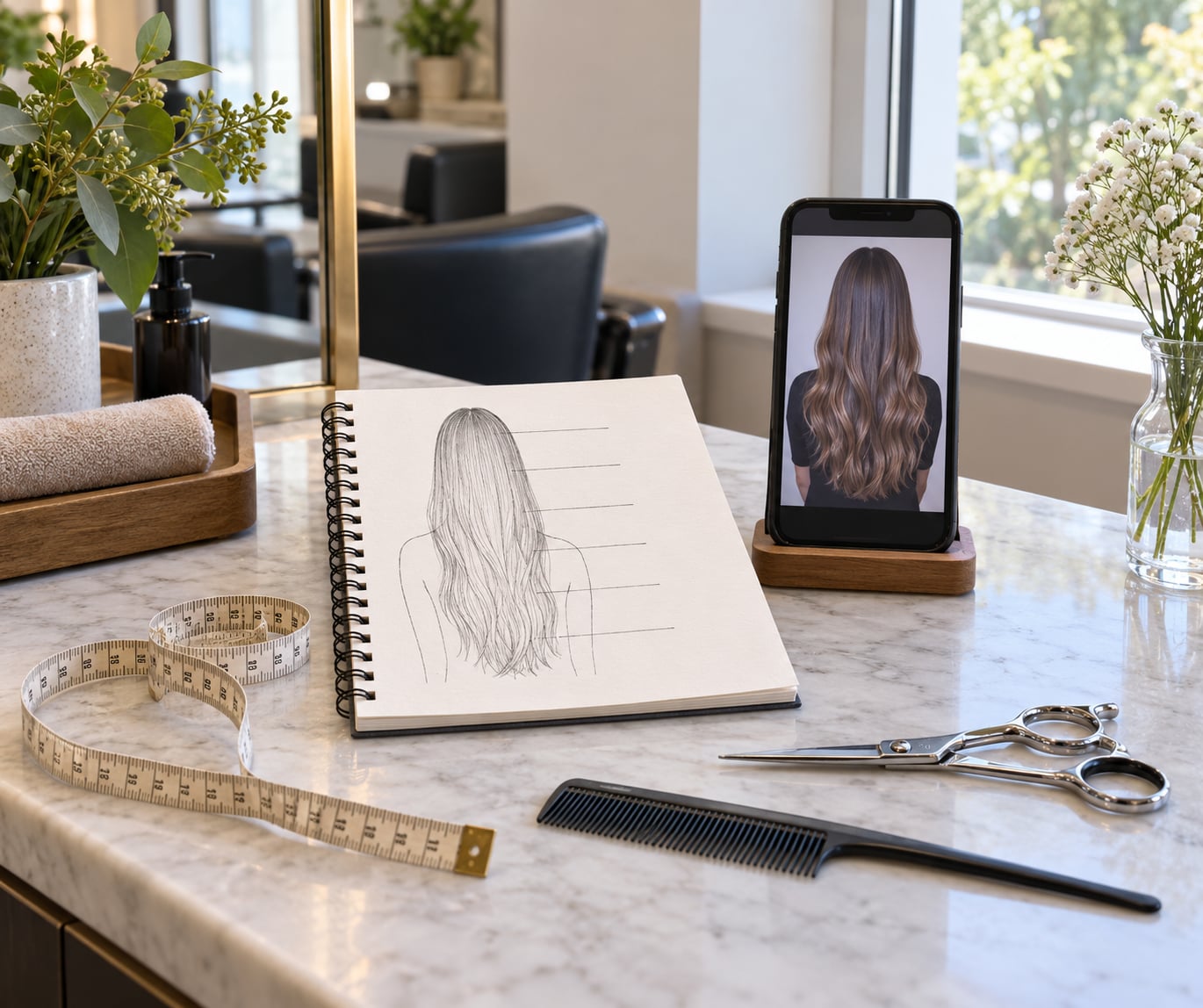
You need three reference photos, not one. Grab a front view, a back view and a side view of the same cut. Stylists report that one glamor shot leads to disappointment, while three angles of one haircut get results that are dramatically closer to the image.
You also need to know your own starting point, even loosely. How thick your hair is, whether it holds a curl or goes straight, whether it has been bleached or colored before, and roughly how much length you are willing to lose. Any of those answers changes what the stylist can actually do.
Then decide two practical numbers: how many minutes you can honestly spend styling each morning, and how much upkeep you are willing to accept between appointments. Those two answers do more to shape the final cut than any photo you bring.
One more thing to bring: any scalp, sensitivity or product-reaction history worth knowing. If a previous color service left your ends weak, say so now rather than halfway through the appointment.
You do not need to learn the vocabulary. A good stylist will translate what you say into terms they use, and if you use a word wrong they will correct you without any judgment. The section on stylist jargon later exists so you recognize a term when you hear one, not so you can impress anyone.
Step-by-Step: How to Get the Right Haircut
Work through these six in order. Each one shortens the gap between what you pictured and what lands in the mirror.
1. Describe Your Goal in Everyday Terms
Start with the finished result, not the technique. Say things like “I want it to look put together with nothing more than a blow-dry,” or “I want the kind of cut that looks good air-dried and I can still pull up on a busy morning.” That sentence tells the stylist more than a page of technical requests would.
Then say how short you are willing to go and which way you would rather err. The single most useful sentence in a salon is this: “If it has to be one or the other, I would rather be a little too short than too long.” Stylists cut slightly longer than asked on purpose, because hair grows back and a too-short cut does not. Naming your direction takes that caution off their shoulders, and they will go shorter because they can now.
You can tell whether you are on the same page in one sentence: “So you are picturing it landing around here, not three inches lower?” If the answer is a hedge, keep pushing. People on the salon floor report that the questions that sound obsessive are usually the ones that prevent a redo.
2. Show References Without Relying on Them
Photos set the target, but you need to know what to take from each one. Point at specific parts and name them: “I like the shape at the front here, I like how the ends look on this one, I do not want the layers on this photo.” Translating a picture into hair details is the whole skill.
Check the model before you check the style. If the hair in the photo is straight and fine and yours is thick and wavy, the identical cut will land very differently. Say it out loud: “Mine is thicker and coarser than hers, so what will that change?” Stylists answer that question far more usefully than they can answer “will it look like the photo?”
Be careful with AI-generated reference images. The hair in them has no flyaways, no texture, no real growth pattern, and a strangely perfect finish that does not exist on a head. One salon blog flagged it as the fastest way to end up disappointed, and stylist-side advice agrees: a real phone photo of a real person beats a generated image every time.
3. Talk About Your Hair’s Starting Point
This is the step clients skip, and it is where good cuts get decided. Say what your hair actually does instead of describing it in flattering terms.
- “My hair is fine and it shows a lot of scalp when it is parted, so I am trying to avoid heavy layers at the top.”
- “It is thick and coarse and it shrinks about two inches when it dries, so please account for that.”
- “I get a lot of volume at the roots and almost none at the ends.”
- “The last four inches are pretty damaged from a previous bleach, so I would rather cut them off than try to save the length.”
- “It is naturally wavy and I would like to keep the texture rather than have it smoothed out.”
Add what happened before. Grown-out highlights, a box dye, a relaxer, a bad bleach, a cut that already took out more length than you meant. A stylist who knows the history can work with it, and one who does not will happily make the same mistake twice.
You can also ask the question that unlocks real expertise: “What is the shortest you can confidently cut this to, given how my hair behaves?” It invites the stylist to advise you instead of just execute, and clients report it changes the whole tone of the appointment.
4. Tell the Stylist How You Actually Wear Your Hair
A great cut on paper that you cannot live with is a failed cut. Your routine is a design constraint, so state it early: “I work out most mornings and my hair is wet for an hour,” or “I almost always wear it in a low ponytail,” or “I have a five-minute limit on weekday mornings.”
Mention the things that change the shape. A helmet, a hood, a bun that gets tighter each day, a child who grabs it, swimming, a job with a dress code, an event coming up in six weeks. If you only ever blow-dry with a round brush, ask for a cut that also behaves with a flat iron or with nothing at all.
Say what you refuse to do. “I am not going to flat-iron every morning” is a real design brief. So is “I do not want to use a blow-dryer on the roots.” A stylist who knows your limits will design around them instead of handing you a look that needs twenty minutes of work.
5. Ask About Maintenance Before You Commit
Ask the upkeep question before the scissors come out, not after. Useful questions: how often should I come in for a trim, how much product does this need, what is the shortest I can let it get between appointments, and what will this look like in eight weeks when it has grown out?
The last question is the most revealing. A good stylist will tell you honestly that the shape softens, that the fringe will need attention in about six weeks, that a layered cut collapses for a while once you stop getting it shaped. If the answer is that the style will hold indefinitely, ask what that means for your trims.
Then test the reality. “Be honest, is this something I can do on my own between visits, or does it need a salon every time?” If the answer is that the look needs professional blow-dries to hold its shape, that is useful information, and cheaper now than after you have been living with it.
6. Confirm the Plan Before the Service
Before cutting begins, ask the stylist to summarize the plan back to you. Clients who do this catch nearly every mismatch: “So it is a blunt cut to just below the jawline, no layers, with a fringe, and we are keeping the length at the front longer.” Hearing it repeated out loud makes any drift obvious while it is still free to change.
Use landmarks instead of numbers where numbers fail you. “Just below the ear,” “at the jawline,” “brushing the collarbone,” “an inch and a half past the shoulder.” Finger-widths are another reliable unit and most people find them easier than inches, which is why the table below pairs both.
| Where the hair should land | What to say at the chair | How that grows out |
|---|---|---|
| At or above the ear | “Take it up to just above the ear, I am ready for it short.” | Needs a trim every four to six weeks |
| At the jawline | “Bring the back down to my jawline, keep it a little longer at the front.” | Shows the cut line fastest of any length |
| At the shoulder | “Land it right on the shoulder, blunt, so I can still pull it up.” | A blunt edge shows every missed trim |
| At the collarbone | “Just past the collarbone, and I want it to look fine air-dried.” | Longest length that still shows its shape |
| Mid-back | “Only trim the ends, roughly an inch, even all around.” | Grows out into the shape you started with |
Two phrases handle the mid-cut check that clients find hardest. “How does this look so far?” gets you an honest mirror without committing anyone. And if it still feels long: “I know you are protecting me, but I really do want it shorter than this.” Naming what the stylist is doing as kindness rather than doubt usually gets the scissors moving.
Step-by-Step: What to Say About Hair Color
Color consultations fail in a predictable way: everyone describes what they want with a single word. “Blonde,” “red” and “brown” mean something different to you and something else entirely to the person holding the foils, so describe the result instead of the name.
7. Specify the Color Result, Not Just the Color Name
Describe where the color is strongest and how it should behave in daylight. “I do not want a uniform block of color, I want brightness on the top layer and my natural depth underneath.” “I want it bright at the face and softer everywhere else, so it grows out without a hard line.” “I want a cool, ashy tone, nothing brassy or orange.”
Tell them what you are trying to hide or soften. Grays at the temples, a grown-out box line, a wide part, a hard transition at the roots. Saying “I want the grey blended in rather than covered so it does not look flat” opens a completely different conversation than “cover my greys,” and the blended version usually ages better.
Always disclose the history. Current box color, previous bleach, a highlight you regret, a stylist who over-processed you. “I was highlighted about six weeks ago and my ends were already bleached before that” tells the stylist to plan the lift. Leaving it out is how hair gets double-processed and breaks.
Ask what happens to your current color. Will it need lifting first, will you need a filler, and will your natural depth be left in the back to blend against? A stylist who volunteers the plan before you ask is usually the one who has thought it through.
8. Ask What Maintenance and Commitments Are Required
Color results drift, so the honest question is about the schedule, not the color. Ask how long this result lasts before it reads as grown out, how often you will need a root touch-up, a gloss or a toner, and what the home routine has to look like to keep it.
Try: “How often will I be back here, and what can I do at home between visits to make this last?” Balayage, which is painted freehand, spreads out faster than a full highlight but needs fewer touch-ups. A high-contrast blonde needs a salon visit every four to six weeks. A gloss is a small appointment that buys you weeks. Understanding the difference before you commit is the difference between a color you love and one you resent.
Balance the answer against your own tolerance. If the required schedule is four weeks and you are the sort of person who will not book a calendar reminder, pick the version with more room. “Which of these two options would need fewer appointments for the look I described?” is a fair, non-rude question, and the answer usually changes the recommendation.
For blonde specifically, ask what your hair can take in this session rather than this year: “Can I get there in one appointment, or does my length need two?” Then ask about a plan to get back to your natural colour if you change your mind. That question is normal, and a confident stylist will have a straight answer.
9. Confirm the Color Plan in Natural Light
Salon lighting is chosen to flatter, and it is usually warmer than daylight. Ask to see the shade guide, the swatch or the lightened strands in a window or under a neutral light source before anything is applied.
Say: “Can we check this in daylight before we lock it in?” A good stylist will hold up the strand, walk you to the window, or hold the swatch under a lamp with a cool bulb. If your whole consultation happens under warm bulbs in a dim room, the result can look warmer and darker at home than it did in the chair.
Also ask what the color will do in a week. Fresh color is at its brightest when it goes in, and blondes especially settle and cool down. “Will this look the same in a week, or does it shift?” tells you whether to expect a change or a surprise.
Step-by-Step: Ask for a Style You Can Recreate
Blowouts and event hair fail for one reason: nobody ever asked how long you have. The same fifteen-minute salon result can take an hour at home, and knowing which one you are buying changes what you should ask for.
10. Describe the Finish and the Time You Have
Name the surface you want: smooth with movement, volume at the roots, a defined curl pattern, a matte finish, shine without looking wet, or a style that survives a commute and a wind. Then give the time: “I have about ten minutes and one round brush,” or “I can use a diffuser for twenty minutes on weekends.”
Ask the stylist to check their plan against your actual skill. “Walk me through how I would do this at home with what I own.” Where they skip steps is exactly where the salon version and your version will drift apart. If you have never used a round brush, say so, and ask for the version that comes out of a dryer and a brush you already own.
For bangs, event hair and updos, be specific about the moment. “This is for a Saturday evening, then it only has to last one night” gets a much better result than a vague request, because a one-night style can be pinned, sprayed and sacrificed. For bangs, ask how long the fringe will suit you, whether it will need trimming between cuts, and whether you can grow it out without a visible gap.
For curly and textured hair, tell them how you style it at home and ask them to cut it dry if they can. A dry cut shows the true shape and length, and it stops the shrink surprise on wash day. Say: “Can we do this dry so I can see the real length?” It takes a little longer and it removes a whole category of disappointment.
Common Mistakes
The most common mistake is using emotional requests instead of directional ones. “Just a trim” and “something shorter” give the stylist nothing to aim at, so they choose the option that cannot go wrong, which is the smallest change. The fix is a landmark and a number, even a rough one: “an inch off, even, and shorter at the back.”
| Instead of saying | Say this |
|---|---|
| “Just a trim.” | “About an inch off the ends, blunt, and take the back up a bit more.” |
| “I want it shorter.” | “Take it to the jawline at the front, and I would rather be a touch short than long.” |
| “Something fun.” | “A shag with face-framing layers, medium length at the front, shorter at the back.” |
| “Make it look natural.” | “Low maintenance, grown out to about shoulder length, and no visible line where it stops.” |
| “Blonde.” | “Bright, cool-toned, dimensional through the mid-lengths, with my natural depth left at the roots.” |
| “Cover my greys.” | “Blend them so the coverage does not look flat, and show me what grows out looks like.” |
| “Blow it straight.” | “Smooth to my natural part, not bone straight, and I need it to last about a day.” |
| “Just take off the fuzzy bits.” | “Only the dry, split ends, and please keep the length everywhere else.” |
The second common error is bringing one beautiful photo of hair nothing like yours. A straight-fine bob photographed in studio light behaves completely differently on thick, wavy hair. Fix it by bringing three angles of one real person with roughly your texture, and by saying out loud where the difference sits.
Third: never mentioning damage, previous color or a bad past experience. Clients protect themselves by over-explaining, and stylists cannot read any of it if it is buried under an apology. Say the information plainly: “I had this bleached and it broke off last year,” or “my last cut took out more than I expected.”
Fourth: staying silent because you are afraid of sounding difficult. The chair conversation is not a test, and a stylist would far rather hear a precise request than absorb an unhappy silence and guess. A three-word sentence at the wrong moment saves everyone six weeks.
Fifth: saying yes to every suggestion in the moment. The polite “I guess that could work” is the second most expensive sentence in a salon after “just do whatever you think.” It is fine to try a fringe twice, but say “I want to think about that one” out loud. Stylists expect it and nobody minds.
Sixth: skipping the price conversation. Ask at the start of the consultation, not at the counter: “Roughly what will this be today, including the products?” Fixing a result you are unhappy with costs more time and money than deciding honestly at the booking stage.
Seventh: bringing AI-generated images. The hair in them has no texture, no flyaways, no real pattern, so a stylist is working from a picture of something that does not exist. Use real photos of real heads, ideally people you can name as a rough match.
Eighth: forgetting to ask about upkeep until the cut has grown out. Every style has an interval, and knowing it in advance is the difference between a maintenance plan and a rescue job.
A few things that help more than you would expect. Reading your request from a phone note at the chair is reported to end the back-and-forth entirely, because you are not trying to remember wording while wet-haired and nervous. Ask for a summary of the plan before the scissors start. And say the stylist’s name to the assistant at check-in if they have been mentioning someone, because most salons will match you with the person you asked for.
Frequently Asked Questions
What if my stylist does not understand what I want?
Say it a second way instead of louder. Most mismatches come from a single ambiguous word, so swap in a landmark: I do not mean a chin-length bob, I mean the length that ends at my jawline on the side and a touch lower in the back. Then ask the stylist to describe the plan back to you before they start. If the summary is still off after two attempts, that is information about the fit, and a second opinion or a different stylist is a reasonable next step.
How do I explain a haircut without using technical terms?
You do not need any. Describe length against a body landmark, describe the shape by what it looks like, and describe your daily routine. Landmarks work: at the ear, at the jawline, on the shoulder, at the collarbone. Shapes work too: a straight-edged line at the ends, or a cut that thins out as it goes up. Finish with the practical detail that matters most to you, such as whether you need it to look good air-dried, and a stylist can build a real cut from that.
What should I bring to a hair salon consultation?
Bring three reference photos of the same cut: front, back and side, ideally of someone with a similar hair texture and density to yours. Add a short note of your own words describing length and shape, plus your history: previous box color, highlights, bleach, relaxers or a bad cut. Note how long you spend styling each morning, and any scalp sensitivity. That last group matters more than people expect, because it decides what products and processes the stylist can safely use.
How do I tell my stylist that my hair is damaged?
Describe what you can see rather than diagnosing it. Say: the last four inches feel like they stretch and snap, they have been bleached twice, or my ends are splitting halfway up the length. Add whether you heat-style daily, how often, and what products you already use. Then ask directly: is it better to cut this length off, or can it be saved? A stylist will respect the direct question, and the answer saves you from paying for a service that cannot work.
How can I get a haircut that works with curly or textured hair?
Say that you want the cut done dry, so you can see the true length and shape, and ask the stylist to work from your natural texture rather than stretching it. Tell them how you style at home, whether you diffuse, scrunch or twist, and ask for a shape that holds when you do that. Mention whether you get braids, twists or a protective style, because the line between those sections is where a badly placed cut shows up worst.
What if I do not like the haircut after I get home?
Wait a few days before deciding. Fresh cuts settle and shrink, and blow-dry styling changes the shape more than most people expect on day one. Style it your own way twice, then go back and describe the specific problem: the length is longer than I asked for, or the layers are heavier than I wanted. Most stylists adjust or correct what they can within a reasonable window, and many fix length complaints at no charge. A stylist who argues with you is telling you something useful about your next appointment.
Conclusion
Before your next appointment, do one thing: write down your length as a landmark, your shape in plain words, your morning styling time, and whether you would rather be too short than too long. Read those four lines at the chair, then ask the stylist to summarize the plan back to you before any cutting starts.
Every stylist is working with the same limited information you are, and they would rather have a clear request than a hopeful guess. Treat the consultation as a conversation about your actual life, not a test you can fail. The 2026 version of that conversation is the one where you leave with hair you stop thinking about.