Most makeup does not fail at nine in the morning. It fails around half past eleven, when the T-zone goes shiny and foundation starts gathering at the chin. The cure is almost never a heavier product.
Knowing how to make makeup last a full workday comes down to four levers: light, well-absorbed skincare; a gripping primer; thin layers of base set where skin actually creases; and a finishing spray applied at the right moment. Each one slows a different force working against you — sebum, sweat, and friction from your own hands.
One honest caveat up front. No routine keeps makeup flawless for twelve hours on oily skin in summer humidity, and no routine beats a good skincare base. What a good routine does is make a normal day unremarkable: you look put-together at three in the afternoon without a bathroom sink break.
This guide is written for an eight to ten hour office stretch, whether you sit under air conditioning all day or commute in the heat. Work through the steps in order once, then adjust the amounts rather than the sequence.
Table of Contents
- What You Need
- Step-by-Step: How to Make Makeup Last a Full Workday
- 1. Prepare Skin Without Creating Excess Oil
- 2. Use Primer to Fill Texture and Anchor Base Makeup
- 3. Apply Foundation in Thin Layers
- 4. Place Concealer Only Where It Will Wear Best
- 5. Set the Areas That Create Oil and Hold
- 6. Lock the Look Without Making It Heavy
- 7. Carry Only the Products Needed for a Refresher
- Common Mistakes
- Frequently Asked Questions
- What is the fastest way to make makeup last a full workday?
- Is setting spray necessary for makeup?
- Do you apply setting spray before or after makeup?
- Why does my makeup not last past lunchtime?
- How do I apply foundation without looking cakey?
- Can makeup last for 12 hours?
- Start With a Thin Base and Set the Crease Zones
What You Need
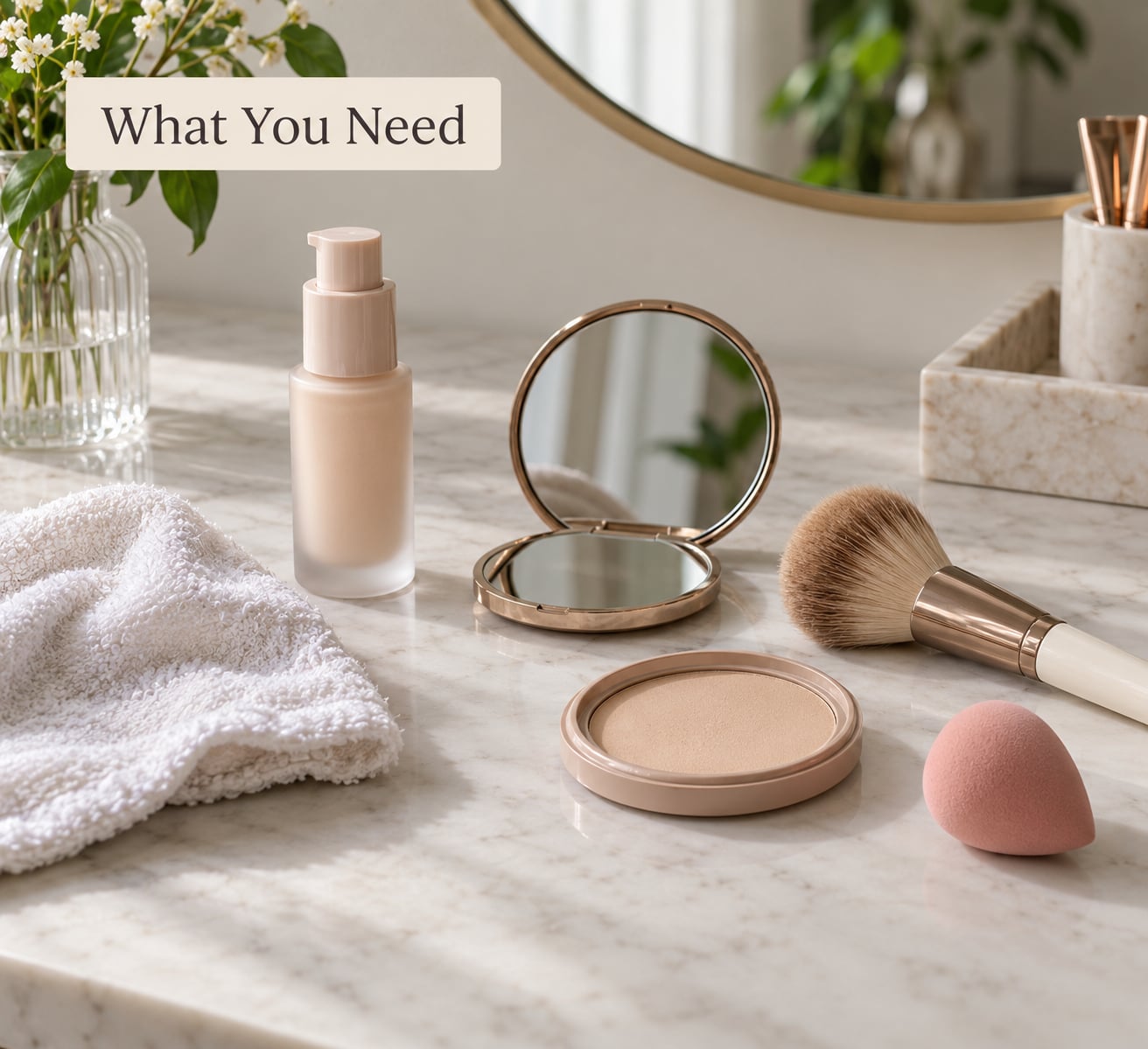
Long wear depends more on technique than on labels, so you can build this list from what you already own and upgrade one piece at a time.
Skincare that absorbs. A cleanser, a light moisturizer matched to your skin type, and a sunscreen. If your products are still sitting on the surface ten minutes later, that is the problem, not the primer.
A primer with a purpose. Gripping or mattifying for oily and combination skin, hydrating or smoothing for dry skin. Silicone pore-blurring primers make a camera face, not an all-day face.
A long-wearing base and a matching concealer. Foundation is the layer that decides how your skin looks at four in the afternoon. Concealer belongs only where you need it.
One setting powder and one setting spray. Translucent loose powder for shine zones, a pressed powder for touch-ups. A spray with a film-forming polymer rather than a drying alcohol base.
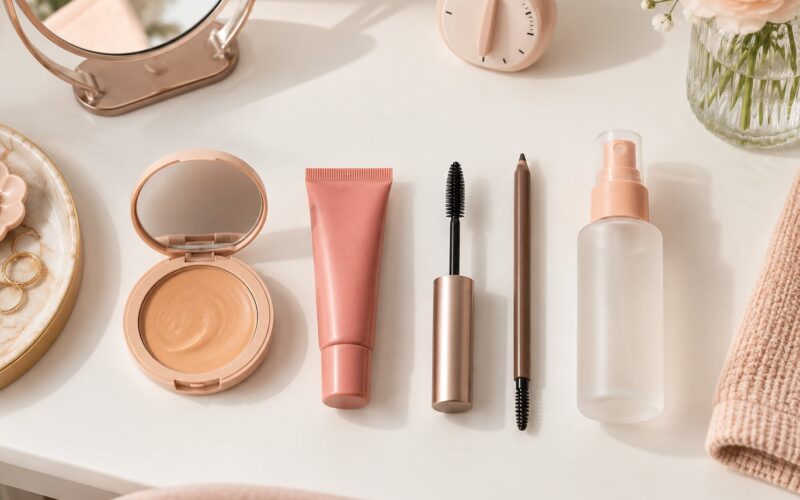
A five-item touch-up kit. Blotting paper, a pressed powder compact, a cream or liquid concealer, a tinted balm or lip pencil, and a small vial of setting spray. That is the whole bag.
Step-by-Step: How to Make Makeup Last a Full Workday
1. Prepare Skin Without Creating Excess Oil
Cleanse, moisturize, apply sunscreen, then wait. Sixty to ninety seconds, or longer if your moisturizer is rich. Makeup applied over damp or slick layers has nothing to grip and slides the moment body heat rises.
Match the moisturizer to your skin. Gel or lotion for oily and combination skin, cream for dry skin. Skip anything silicone-heavy before base, and patch test anything new on your jaw for 24 hours before you rely on it for a full day.
You know it worked when your skin feels comfortable but slightly thirsty, and when you can barely see shine on a tissue pressed to your forehead.
2. Use Primer to Fill Texture and Anchor Base Makeup
Primer is a thin layer that gives foundation something to hold onto. Apply a pea-sized amount over the areas you are about to cover, not all over, and let it sit for a minute. Stacking three primers makes a sticky film that pills under foundation.
| Primer type | What it does | Best for | Failure mode |
|---|---|---|---|
| Gripping or sticky | Creates a tacky film foundation grips | Oily and combination skin, long days | Patches if applied thick or not blended |
| Mattifying | Absorbs oil at the surface | Oily T-zone | Can look grey or flat in daylight |
| Pore-blurring silicone | Fills texture visually | Photos and close-ups | Slides once skin warms underneath |
| Hydrating gel | Plumps and smooths | Dry or dehydrated skin | Not enough grip for a long day |
You know it worked when foundation spreads easily and does not drag under the sponge.
3. Apply Foundation in Thin Layers
A small amount with a damp sponge or a dense brush, worked from the centre of the face outward, gives you more control than one thick coat. Build coverage only where you need it and leave the rest sheer.
Less product applied properly wears better than a heavy layer that cakes around the mouth or separates at the jaw. If your foundation oxidizes darker through the day, check the shade against your neck in daylight, not against your hand.
Keep foundation off the crease-heavy folds around the nose and mouth. Those areas move constantly, and any product sitting there will migrate.
4. Place Concealer Only Where It Will Wear Best
Under-eye brightening goes on the thin skin of the inner corner and along the lower lash line, tapped with a fingertip rather than dragged. Blemishes and redness get a small amount, feathered at the edges. Anything you place broadly will crease.
Set the thinnest areas first, before you add powder. A light dusting of translucent powder under the eyes, applied immediately, is what keeps concealer from folding into a line by lunchtime.
You know it worked when the brightness still shows at two in the afternoon without a grey shadow under the eye.
5. Set the Areas That Create Oil and Hold
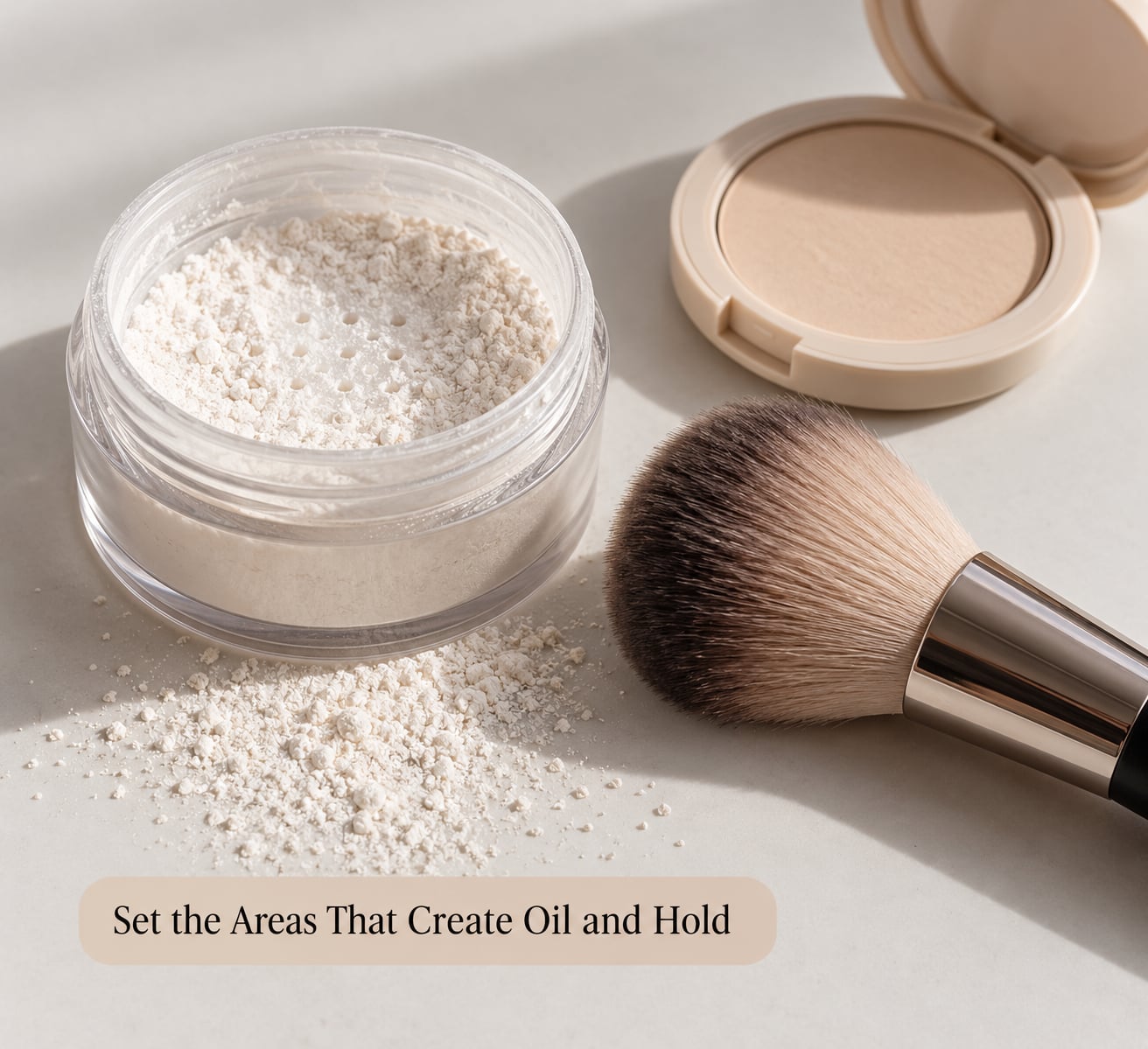
Setting powder is not a mask. Press a small amount onto the T-zone, the chin, under the eyes and anywhere that creases. Leave the cheeks and jaw bare if they do not shine, because powder on dry skin is what makes foundation look cakey.
Oily skin benefits from loose translucent powder, pressed on with a brush rather than dusted. Dry or mature skin gets a much lighter hand, ideally a finely milled powder applied only where lines collect. Combination skin gets both, split by zone.
One caution for deeper skin tones: a translucent powder can look ashy in daylight. A powder matched to your undertone does the same setting job without the cast.
6. Lock the Look Without Making It Heavy
Setting spray goes on last, about ten to twelve inches from your face, as a fine mist. Hold your breath and stay still while it dries, which takes roughly a minute. Waving your hands in front of your face spreads it too thin to do anything.
Look for a spray built around a film-forming polymer and skip the ones that list high amounts of alcohol. Alcohol-heavy formulas dry the surface, which tightens the look briefly and then leaves skin tight and flaky by late afternoon. That is the complaint you will see repeated in forum threads about setting sprays, and it is a real one rather than a placebo effect.
Dry or air-conditioned office skin needs a spray with glycerin or hyaluronic acid in it. Oily skin does fine with a straightforward matte spray. If your skin stings, do not push through it.
7. Carry Only the Products Needed for a Refresher
Blotting paper beats powder for midday shine. Press it down, do not rub, and let it lift the oil instead of dragging your foundation with it. Rubbing is what produces that grey, patchy look under the nose and across the chin.
Then a light press of the compact powder on the areas that still shine, a tap of concealer where a crease has formed, and lip colour or a tinted balm to bring the mouth back. A small spritz of setting spray over the touched-up zones re-seals them.
Sometimes the right move is to do nothing. If the look is merely faded rather than patchy, leave it. Half-reapplied makeup usually looks worse than makeup that has simply softened.
Common Mistakes
Nearly every wear-off problem traces back to one of five habits.
Touching your face. Every time your hand reaches your cheek, it lifts foundation and pushes it into lines. Put your hands in your lap and give it a week.
Using too much product. Primer, foundation and powder all stack. Heavy layers dry, then crack and separate as your skin moves underneath them.
Applying primer over skin that is not properly absorbed. This is the single most common cause of makeup sliding, and it comes up constantly in makeup forum threads. Moisturizer and heavy sunscreen still sitting on the surface give foundation nothing to hold.
Skipping sunscreen. Do not skip it. Let it set for several minutes before you prime, and expect a white cast from some mineral formulas to sit under the base.
Over-powdering. Powder everywhere reads as a heavy finish and clings to dry patches. Set the zones, then stop.
| What you see | Likely cause | Fix |
|---|---|---|
| Shiny T-zone by 11am | Over-moisturized skin or the wrong primer | Skip the mattifying primer and use a gripping one, or add powder only to the T-zone |
| Patchy chin and jaw | Oxidation or a too-thick application | Use less product, blend the edges, and check your shade in daylight |
| Mascara under the eyes | Non-waterproof formula plus rubbing | Use waterproof mascara and blot the under-eye area within the first minute |
| Foundation gathering around the mouth | Too much product over a high-movement area | Keep foundation off the folds and set lightly with powder |
| Concealer creasing | Thin, mobile skin under the eye | Use less, tap rather than drag, and powder immediately |
| Lip colour gone by lunch | Bare lips with no base | Fill with a lip liner or tinted balm first, then apply colour |
| Makeup looking tight and dry by 4pm | Alcohol-based spray plus heavy powder | Switch to a hydrating spray and powder only the crease zones |
Frequently Asked Questions
What is the fastest way to make makeup last a full workday?
Prep your skin the night before, keep morning skincare light and fully absorbed, apply a gripping primer only where you need coverage, then use two thin layers of long-wearing foundation and set the T-zone and under-eyes with powder. Finish with a polymer-based setting spray and carry blotting paper for midday. Technique beats product here: the same routine in thin layers outlasts one heavy coat on any skin type.
Is setting spray necessary for makeup?
No, it is optional, but it helps most when you have already set your cream products with powder. Spray adds a thin polymer film that reduces rubbing and transfer. It matters more on normal or dry skin and less on very oily skin, where powder does the real work. If your skin stings or feels tight afterwards, try an alcohol-free formula instead of forcing it.
Do you apply setting spray before or after makeup?
After, always. The spray is the final layer, applied once your powder and cream products are in place. Hold it ten to twelve inches from your face, mist lightly rather than soaking, then stay still for about a minute while it dries. Some people mist a light layer before powder as well, which can reduce how well the powder grabs, so a single finish step works better.
Why does my makeup not last past lunchtime?
Nine things cause it, and they are easy to check in order: leftover skincare oil, the wrong primer, too much product, powder applied everywhere, transfer from touching your face, a foundation shade that oxidizes, low-quality mascara on the lashes, missing lip liner, and a humid or hot environment. Patchy chin with a shiny T-zone usually points to over-application plus wrong primer rather than a bad foundation.
How do I apply foundation without looking cakey?
Use less than you think you need and apply it with a damp sponge, tapping rather than dragging. Build thin layers and leave the jawline and mouth area light, since those fold. Keep powder to the T-zone and under-eyes instead of the whole face. If you are on dry or mature skin, a finely milled powder pressed on lightly is safer than a loose powder dusted everywhere.
Can makeup last for 12 hours?
On normal skin in a climate-controlled room, a well-set face can hold a full working day and part of an evening. On oily skin in summer heat, expect eight solid hours and a targeted touch-up rather than a perfect twelve. Extended wear means setting more carefully, not applying more, so a thick layer will not get you there; it just moves and separates faster.
Start With a Thin Base and Set the Crease Zones
If you change one thing tomorrow morning, make it this: less skincare, a gripping primer, and a genuinely thin layer of base. Then set only the places that crease or produce oil, and stop.
Long wear is a technique, not a heavier finish. Get the preparation right and makeup that lasts a full workday takes care of itself through the afternoon.