
How to handle being the youngest person on a team comes down to three habits: watch how your colleagues actually work before you copy their style, arrive with something useful rather than an opinion, and make your points with calm specifics. Credibility on a team of older colleagues is built from consistent output and professional communication, never from age or from trying to sound more senior than you are.
That answer takes about ten seconds. The uncomfortable part is that the first month still feels like being slightly behind, and no amount of confidence exercises skip over that stretch.
The people who struggle most are rarely the least capable ones. They are the ones who assume the room already decided what they are, and then spend their time managing that verdict instead of doing the work.
In fashion, beauty and creative teams the gap is often wider than in other industries. You might join a brand team where the average age sits in the forties, walk into a studio where nobody else has worked a normal nine-to-five, or be the only junior analyst in a group of ten senior people. The mechanics below are the same in every case, because the pattern underneath is the same: authority gets assigned by years of exposure long before anyone checks your work.
Table of Contents
- What You Need
- How to Handle Being the Youngest Person on a Team: Step-by-Step
- 1. Learn the team’s norms before you try to stand out
- 2. Prepare useful work before you ask for attention
- 3. Speak with calm specificity
- 4. Build credibility through small, reliable contributions
- 5. Ask for context, not permission
- 6. Set boundaries without making age the issue
- Common Mistakes
- Frequently Asked Questions
- How do I handle being talked over because I am the youngest person on the team?
- Should I point out that an experienced colleague dismissed my idea?
- How can I build credibility when I am younger than everyone on my team?
- How do I receive feedback without becoming defensive?
- When should I speak up in a meeting if I am the most junior employee?
- Does being the youngest person make it harder to earn a promotion?
- Conclusion
What You Need
Preparation is most of the work here, because your instinct on day one will be to prove yourself and proving is exactly what makes a room treat you as the junior person. You need a few specific things first.
- Clarity on expectations. Before you start, write down what success looks like in your first ninety days in your own words. Ask your manager to correct it. Most young hires carry an assumption that good work means being visibly busy, and nobody corrects it for them.
- A read on the team’s norms. How do decisions actually get made here? Who gets asked and who gets told? How long does feedback usually take to come back? Two weeks of watching answers more than any onboarding document.
- One skill the team visibly lacks. It might be the platform they keep postponing migrating to, the spreadsheet nobody wants to rebuild, the shoot schedule that lives in three people’s heads. Pick the one nobody has time to do.
- A short question list. Five or six written questions beats five or six forgotten ones in the corridor.
- A plan you can defend. Not a career plan. A thirty, sixty and ninety day plan for your own output, so you can talk about your work without overselling it.
Notice what is missing: confidence. You do not need to walk in feeling ready. You need something useful prepared and a reason to be in the conversation.
How to Handle Being the Youngest Person on a Team: Step-by-Step
1. Learn the team’s norms before you try to stand out
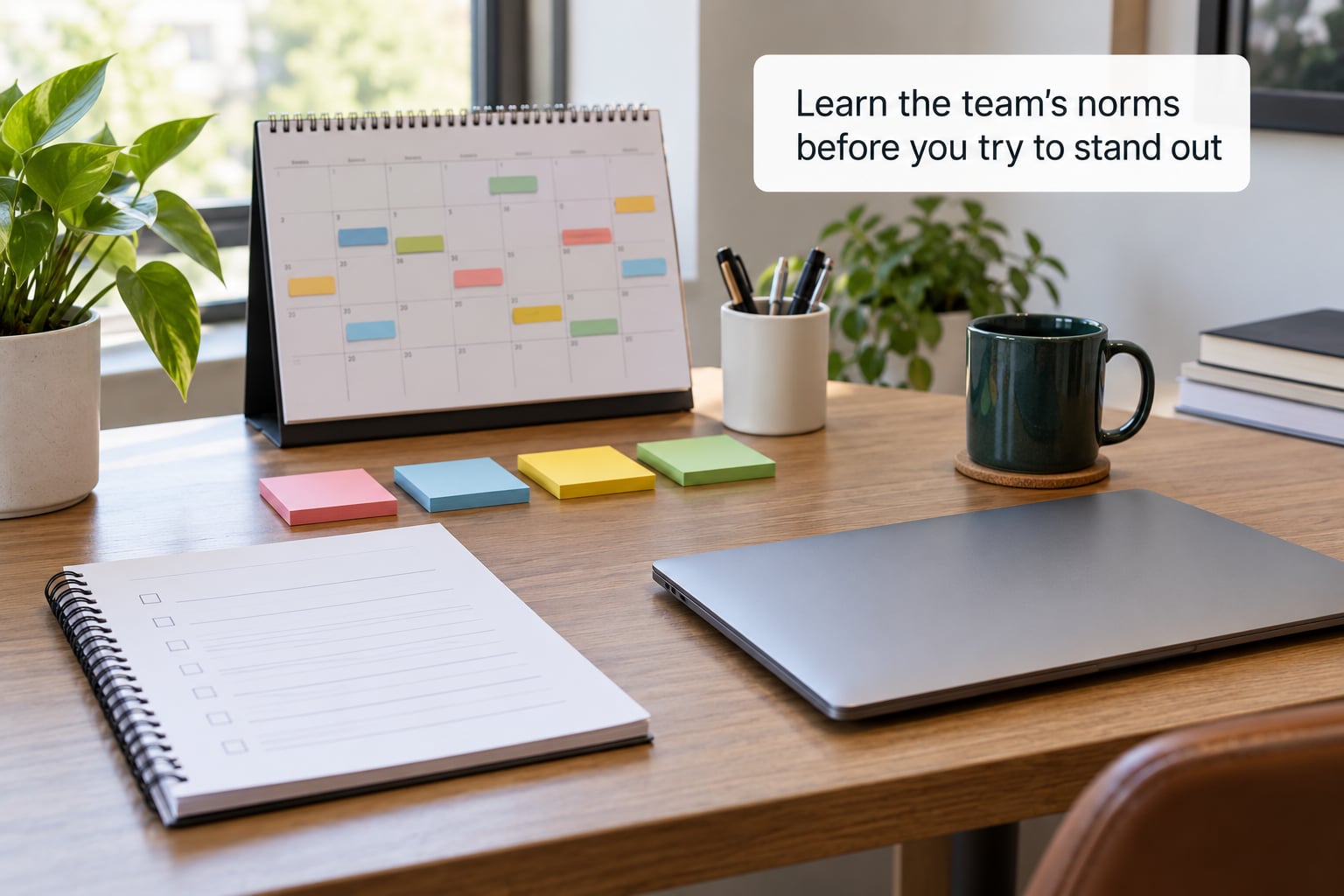
Watch how your colleagues communicate, make decisions, give feedback, handle disagreement and share credit. Not what the handbook says, what people actually do on a Thursday afternoon when a shipment is late.
Useful questions to ask in week one:
- How do you usually want updates, and how often?
- When a decision looks wrong to you, how does someone raise it here without it turning into a fight?
- Who needs to know when I finish a piece of work, and who just needs to hear about it after?
- What does the team do when someone makes a mistake?
The signal that you have adapted is visible and quiet: you stop asking people to repeat things, your emails get shorter because you have matched the house style, and you bring the format of information they already expect.
2. Prepare useful work before you ask for attention
Enthusiasm is cheap on a team of ten people who have all had it. Prepared work is not.
When a creative director asks how the new season campaign should look, the youngest person in the room who opens with “I have some ideas” has already lost. The one who opens with three options, a rough cost for each, and a recommendation has changed the shape of the meeting.
Bring research, options and a point of view. Two options are unhelpfully thin. Three or four, each with a reason and a trade-off, tells a senior colleague you understand that every choice costs something. You are not expected to have the right answer. You are expected to have done the work of narrowing it down.
3. Speak with calm specificity
Volume is not the lever people expect it to be. Being younger in the room means you will be interrupted, and interrupting back makes it worse. Specificity survives the interruption.
Useful phrases:
- Introducing an idea: “Based on the last three campaigns, the second option is the one I would test first, because it costs less to produce and we already have the footage.”
- When you are cut off: “I will hold that thought, I want to finish the number I am quoting.”
- Disagreeing: “I see it differently, and here is the reason. If we do this, the delivery slips by a week.”
- Responding to pushback: “That makes sense. What I am not sure about is the second step, can I show you the example?”
- Asking for feedback: “Does this land the way you expected, or did I miss something?”
Notice what none of those do. None of them apologise for existing, and none of them argue the person is wrong. They move the conversation back to the work, which is the only place you actually have standing in month one.
4. Build credibility through small, reliable contributions
Trust at work is mostly a boring accumulation. Do what you said you would do, by when you said you would do it, and tell someone before you are late rather than after.
A person who owns one small thing and never drops it gains more authority in a quarter than a person who volunteers for six projects and completes two. Pick a task that is nobody’s favourite: the archive that needs reorganising, the sample tracking sheet, the delivery calendar nobody trusts. Do it properly. Tell three people you did it. Then ask for the next thing.
Responsibility grows the same way every time, through a sequence of finished work rather than a single conversation about your potential.

5. Ask for context, not permission
This is the step most young hires get backwards. They ask senior colleagues for decisions so they can never be blamed, and within two months nobody trusts their judgment because they never had any.
Better to ask for context and keep the decision: “You have run this show before, what usually goes wrong at this stage?” or “Before I send this, does the client expect a three-option presentation or a single recommendation?” You get their experience and you keep ownership of your work, which is exactly what both of you want.
Real mentorship looks like someone giving you the trade-off they would not put in a process document, and then letting you choose. Vague direction, or approving every comma in your email, is micromanagement dressed up as interest. One is worth accepting, the other is worth naming out loud: “I would rather send it and get your notes than check each line first, if that works for you.”
6. Set boundaries without making age the issue
You can decline work, redirect a joke, or correct a colleague without ever mentioning your age. That is the version that works, because it leaves both of you somewhere to go.
Firm, professional options:
- Declining extra: “I can take this on if the shoot list moves by Tuesday, otherwise it will slip. Which do you want?”
- Being called “kid” or asked when you are getting a real job: “I am two years into this, so let us talk about the schedule instead.” Then move on. Do not wait for a laugh.
- Being talked over: “Let me add the one thing from the client call, then I will stop you.”
- Getting a support task because of an assumption: “Happy to help with that, and I would also like to be in on the presentation for the next one.”
One question separates banter from something you should act on: would you say this in front of your manager if they were the subject of the joke, and would you say it if the roles were reversed? If the answer is no, it is not friendly, and you are allowed to treat it as a workplace problem.
If it continues, write down what was said, when, and by whom. Then take it to your manager or your HR partner as a pattern of behaviour rather than a complaint about a personality. That framing is much harder for anyone to wave away.
Common Mistakes
Almost every mistake here is an attempt to solve a real problem with the wrong tool. You want respect and visibility, so you reach for volume, hours or confrontation, and each one costs you the thing you were trying to buy.
Trying to prove seniority through volume. Talking more in meetings does not add weight to what you say. It adds noise, and senior colleagues read noise as eagerness. Fix: aim to make one prepared point per meeting, and let it stand.
Apologising for being young. Opening with “I don’t know if this is my place, but…” pre-empts the objection you were worried about. Fix: delete the apology from your first sentence and keep the substance.
Avoiding disagreement entirely. Agreeing publicly with something you think is wrong makes you agreeable, which is not the same as trustworthy. Fix: disagree on the record, briefly, with a reason attached.
Overworking to compensate. Staying late to prove commitment rarely works and reliably costs you sleep, judgement and the relationships that make a career. Someone on r/corporate described the fear plainly: being the youngest means being easy to take advantage of. Unpaid extra hours are one of the ways that happens. Fix: agree scope and hours in writing before you start something.
Copying a senior colleague’s style. Mimicking someone’s voice or their humour to seem like them reads as inauthentic, and people are good at spotting it. Fix: keep your own voice, adopt their standards of preparation.
Treating feedback as a personal attack. The comment is usually about the work. It feels personal because you are new and it lands on an existing insecurity. Fix: repeat the feedback back in your own words, agree with one part, and leave.
| Unhelpful mindset | What it looks like | Helpful mindset | What to do instead |
|---|---|---|---|
| I have to prove I belong | Working visibly longer, over-explaining, apologising constantly | My output is the argument | Ship one reliable thing a week and let the record speak |
| They know more, so they win | Deferring every decision to the most senior person in the room | Experience is context, not a verdict | Ask for the trade-off, then make the call yourself |
| I should not mind being interrupted | Going quiet and letting your point disappear | Interruption is a scheduling problem | Name the number you are quoting and finish it |
| Age jokes are just jokes | Laughing along so you fit in | You can tell the difference | Redirect to the work and move on, once |
| I will be taken seriously eventually | Waiting for a title change to change how you are treated | Credibility is built in public, early | Own a small task, then ask for the next one |
One more thing worth naming. You are allowed to be colleagues rather than friends. Most people who find the age gap uncomfortable are trying to force a friendship that would not exist at the same age, and it exhausts them. People on the other side of the gap usually have the same problem in reverse, and a working relationship is a complete answer.
Frequently Asked Questions
How do I handle being talked over because I am the youngest person on the team?
Preparation is the fix, not volume. Bring a number, a date or a named risk to your point, so an interruption cannot easily absorb it. If you are cut off anyway, say: let me finish this number and then I will stop you. Once, calmly. Repeat the pattern two or three times and it stops. If it keeps happening after that, write down the meetings and the specific interruptions, and raise it with your manager as a pattern rather than a complaint.
Should I point out that an experienced colleague dismissed my idea?
Not the person, and not in front of the room. Choose your moment. After the meeting, ask what they meant by it, which is a neutral question that often reveals the gap in their thinking rather than yours. If the dismissal was repeated or blocked your work, name it in your next one-to-one: I brought the revised supplier timeline on Tuesday and it did not come up, can you tell me what I missed? Specific, factual, and very hard to argue with.
How can I build credibility when I am younger than everyone on my team?
Consistency is the whole answer. Do what you said you would do, by the date you gave, and tell someone before you are late rather than after. Own one small piece of work nobody else wants and finish it well, then tell three people it is done and ask for the next piece. That sequence has produced more authority in a quarter than most confident performance ever does. Credibility attached to a name and a deadline beats credibility attached to a personality.
How do I receive feedback without becoming defensive?
Repeat the feedback back in your own words before you respond at all. Say: so what you want is a tighter opening paragraph and fewer assumptions about the client’s budget. That does two useful things. It proves you actually heard it, and it often reveals that the note was about something narrower than it sounded. Agree with the part that is fair, ask for one example if the rest is unclear, and save your disagreement for a later conversation rather than the meeting itself.
When should I speak up in a meeting if I am the most junior employee?
Speak when you have something specific that changes the decision, and hold the rest. A useful test: would this be worth an email after the meeting? If yes, it is worth thirty seconds in the room, and asking that question first keeps you from filling silence. Use the first thirty seconds of the meeting to find out what the decision actually is, since most people who avoid speaking up simply did not know what was being decided until the meeting was over.
Does being the youngest person make it harder to earn a promotion?
It can, mostly through assumptions rather than rules. People tend to assign more interesting work to people they assume can handle it, and people with less interesting work find it harder to demonstrate readiness. Research on age discrimination commonly finds a U-shaped pattern, with the youngest and oldest workers facing the most stereotyping, which puts you in the group that is most often underestimated. The practical counter is to ask for stretch work out loud, by name, with a date attached.
Conclusion
Being the youngest person on a team is a condition, not a verdict, and it fades faster than most people expect. Do three things this week: write down how your team actually communicates, prepare one useful piece of work nobody has asked you for, and make your next point in a meeting with a specific detail attached to it.
That is how credibility gets built, year after year of a career. Not by being older, louder or more confident on day one, but by being the person whose work turns up, on time, exactly as promised.