
To raise your prices without losing clients, you need four things: proof of what your work is worth, a realistic percentage, 30 to 60 days of written notice, and a tiered offer so clients can choose rather than feel priced out. The prep takes an afternoon. The conversations take courage, not luck.
Most freelancers lose sleep over the wrong half of this problem. They agonise over the number and then send an apologetic email that undermines everything. The number is the easy part. Keeping the relationship is about framing, notice, and giving people a real option.
So here is how to raise your prices without losing clients: work out the rate you actually earn, decide how much more you want, say it plainly with an effective date, and be ready for the conversation when someone pushes back. Then repeat it on a schedule instead of waiting for courage.
Table of Contents
- What You Need
- Step-by-Step: Raising Prices Without Losing Clients
- Step 1: Audit Your Current Pricing and Results
- Step 2: Decide How Much to Increase Your Rate
- Step 3: Reframe the Price Around the Outcome
- Step 4: Prepare a Clear Increase Proposal
- Step 5: Tell Existing Clients Before They See a New Invoice
- Step 6: Raise Prices for New Clients
- Step 7: Review the Results and Refine Your Pricing
- Common Mistakes That Cost Freelancers Clients
- Frequently Asked Questions
- How much should I raise my prices by?
- Is a 10% price increase too much for clients?
- How do I let clients know you are raising prices?
- Can I keep existing clients at their old rate?
- What do I say when a client says my price is too high?
- How often should I review my pricing?
- Conclusion: Start With One Clear Increase
What You Need
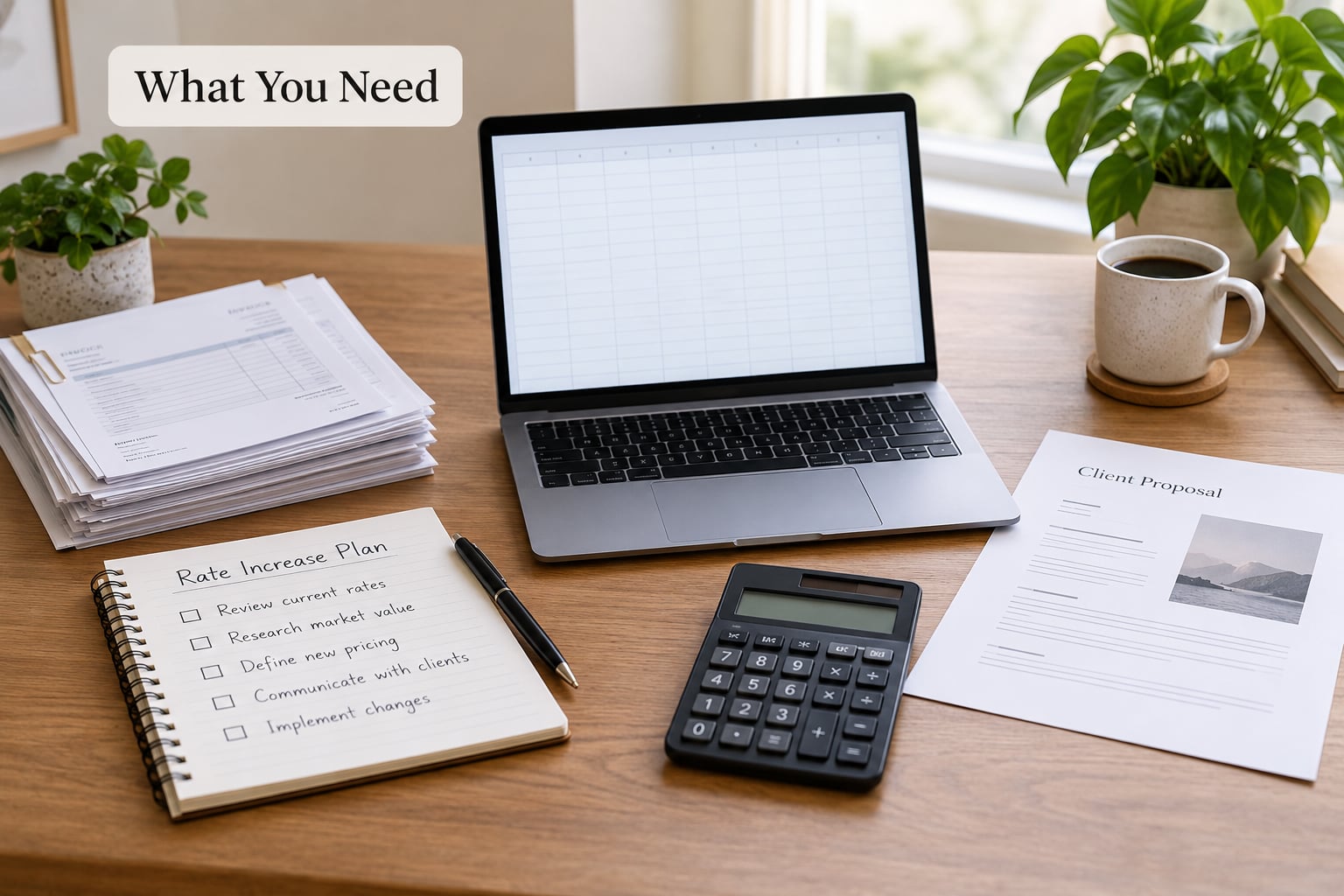
None of this needs software you do not already have. A spreadsheet, a document and a calendar will do. What you do need is the raw material, and most of it is sitting in your last twelve months of work.
- A current rate card. Every service you offer and exactly what is included in each one. If you have to check your own contract to remember, that is a sign the card is out of date too.
- Twelve months of invoices. Total billed, and total collected. This is the number that stops a raise from feeling like a fantasy.
- Real hours per project type. Not just the visible work. Count the brief calls, the revisions nobody paid extra for, the sourcing, the invoicing, the chasing, the admin.
- Three to five results you can name. A launch that sold out, a client who rebooked four times, a room that filled, a campaign that doubled replies. Specific beats impressive.
- Your costs. Software subscriptions, insurance, equipment, studio or chair rental, commission splits, an accountant, insurance on the gear. This is the floor under your price.
- Three to five comparable competitors. Their published entry-level price, their package structure, what they appear to include. You need the number, not their Instagram.
- One paragraph of positioning. The sentence you would use to explain to a stranger what you do and who it is for, in plain language.
- A date and a policy. An effective date, and a decision about who moves to the new rate and who stays put. Decide both before you write a word.
Write all of it down in one document. When a client asks why your price is going up, you will want a sentence ready, not an argument you have to build while they wait.
Step-by-Step: Raising Prices Without Losing Clients
Step 1: Audit Your Current Pricing and Results
Start by dividing your total fee by every hour the project actually took you, not the hours you invoiced. If a project was billed at your standard fee and it consumed five hours of visible work plus five hours of admin, half the rate on your card never existed. Most freelancers overestimate their rate because they count only the part that looks like work.
Do this for three or four of your most common project types. Then look at repeat business: how many clients came back, how many brought referrals, and how many of your worst hours belonged to your lowest-paying clients. That last number is usually the uncomfortable one, and it is the strongest argument for the change.
How to tell it worked: you finish the audit able to state your real rate per project type in one sentence each, and you can point to at least three client outcomes that justify a higher price without you having to oversell it.
Step 2: Decide How Much to Increase Your Rate
Pick an increase you can defend with the audit, not with your rent. Below are the three bands most freelancers land in, and the trigger for each.
| Increase | Use it when | What to expect |
|---|---|---|
| 10 to 20% | You are slightly under market, your offer is unchanged, and clients rarely haggle | Most clients stay. A small number of price-first clients drift away quietly. |
| 25 to 40% | Your audit shows a real rate well below your market rate, or costs have climbed for two years running | You lose some volume and gain margin. Good clients tend to stay, sometimes happier. |
| 50% or more | You are changing what you deliver, who you work with, or how you position yourself | Expect a third or more of your client list to go. That is normal for a repositioning, not a failure. |
A long-running thread in r/SaaS about a jump from a low tier to roughly double produced about 50% churn, and the comments split between people who said the higher price brought better customers and people who wished the owner had stepped up in smaller moves. Both reactions are the same fact seen from opposite ends: a big jump changes who you are working with.
Two other methods are worth running. Value-based pricing anchors the fee to the outcome you produce rather than the hours you spend, which suits anyone whose results vary a lot. Minimum project fees stop small engagements from eating the days you wanted for good ones. Set a floor: your costs plus the income you need, and refuse work below it.
How to tell it worked: you can say the new rate out loud without wincing, and you know which clients will hear it as reasonable.
Step 3: Reframe the Price Around the Outcome
Nobody buys hours. They buy a shoot that fills the room, a set of looks they can actually wear, a launch that lands. Before you tell anyone a number, write one sentence about what the client gets that they would not have had otherwise, using a result rather than a deliverable.
The shift is small in wording and large in effect. Freelancers in r/videography threads describe moving from quoting an hourly rate to describing what they help clients make or save, and report that the conversations got easier because the client stopped comparing numbers and started comparing outcomes.
Add value before you add the number if you can. A shorter turnaround, a second revision round that used to cost extra, a small guarantee, a clearer report at the end. You are not padding the invoice. You are making the increase something other than a cost.
Step 4: Prepare a Clear Increase Proposal
Your written notice should be short and contain five things: what the current rate is, what the new rate is, the date it takes effect, what is still included, and what is genuinely new. Vagueness is what makes these emails feel personal and awful, so leave nothing for the client to imagine.
Add the housekeeping you have been avoiding at the same time: deposit terms, the rebooking window, a late-cancellation or no-show fee, and how many revisions are included. For stylists and chair renters, the split with the salon or suite and any retail commission belong in the same conversation, because they change the economics the client is actually paying for.
Keep it to one page. Read it once for tone. If it sounds apologetic, it is not ready.
Step 5: Tell Existing Clients Before They See a New Invoice
Timing matters more than wording. Announce it 30 to 60 days out, personally, and never on the day an invoice lands. The worst version of this conversation is a client discovering a new number on a line item, because then the increase is not your decision, it is a surprise.
A script that works for most service businesses:
Subject: My rates are changing on [date]
Hi [name], a quick note about my schedule. From [date] my project rate moves from [current rate] to [new rate]. Everything currently included stays included, and I am adding [one concrete addition].
I wanted you to hear it from me first, and with enough time to plan around it. If you would like to talk through scope or timing before then, I am happy to set up a call this week.
Thanks for the work we have done together so far. It has been good.
When a client genuinely cannot absorb the new rate, a smaller scoped option is a better answer than a discount. Fewer deliverables, a shorter timeline, a smaller scope. A discount teaches the client that your price is negotiable, which is a lesson you cannot un-teach.
How to tell it worked: replies come back with questions about scope and timing, not with a one-word no. Questions mean interest.
Step 6: Raise Prices for New Clients
New business is the easy half. Update the pricing page, the rate sheet, the proposal template, the contract, and what you say on a discovery call, so the new number is the only number in the room. If a prospect hears your old rate first, every future negotiation starts from a place you do not want to be in.
Put the terms in writing before work starts: deposit, revision count, rebooking window, cancellation fee, and a clause that rates are subject to change with 30 days written notice. That clause is what makes your next increase a scheduling decision instead of a confrontation.
Watch which questions come up on calls. If every new client asks about the deposit, the terms are not clear enough. If nobody asks about price at all, your positioning is doing its job.
Step 7: Review the Results and Refine Your Pricing
Give the change 30 to 90 days before you judge it. Track how many clients accepted without a call, how many negotiated hard, how many left, and what the new rate did to your margin and your calendar. A quiet month is not failure if the clients who stayed are the ones you want to work with again.
If the pushback is concentrated in one service, fix the packaging rather than the number. If clients are leaving but quoting is taking longer, your explanation needs work, not your price. If you are turning work away, the next increase is closer than you think.
Then put the next review in the calendar. Every six to twelve months, or at a fixed reset such as the first of 2026, is a defensible rhythm, and a scheduled one stops you from drifting for years.
Common Mistakes That Cost Freelancers Clients
Apologising for the increase. Sorry, but costs have gone up is an apology. It hands the client a reason to feel unlucky on your behalf. Replace it with a statement of what they get, and let the number sit there without an apology attached.
Announcing by mass email to your whole list. A price increase is a one-to-one conversation. Personal email, or a phone call for your biggest accounts, converts far better and costs nothing extra.
Waiting until the invoice. A client who finds a new rate on a bill feels ambushed, and the relationship rarely recovers. Notice first, invoice second, always.
Discounting to save the relationship. The discount solves this month and creates a client who expects it forever, who tells other people, and who is waiting for your next increase. Offer a smaller scope instead.
Moving everyone at once with no reason. A jump with no explanation reads as arbitrary. One reason tied to something the client can see, such as a longer turnaround, new capability, or a fuller calendar, is enough.
Letting a few clients set your price. If the same two clients fill your calendar and they both negotiate, you have built a business on their terms. r/freelance threads treat heavy negotiation from the first message as a warning sign rather than a negotiation, and that read is usually correct.
Three habits help more than any single tactic. Say your rate out loud, in full, without apologising or rushing past it. Raise prices on a schedule so each increase is a policy rather than a crisis. And protect the boundaries while you do it: a deposit, a rebooking window and a no-show fee are not hostile, they are the reason a serious client can book you with confidence.
Finally, decide in advance what happens if a client says no. Losing one client who was paying the lowest rate and demanding the most is a good trade, and treating it as a failure is how freelancers end up stuck at the same number for a decade.
Frequently Asked Questions
How much should I raise my prices by?
Most freelancers start between 10 and 20% when their offer has not changed and they are slightly under market. Go to 25 to 40% when your real rate, counting admin time, sits well below comparable competitors. Anything larger than 50% is a repositioning rather than an increase, and you should expect a meaningful share of clients to leave.
Is a 10% price increase too much for clients?
No. A 10% increase is small enough that most clients absorb it without a conversation, particularly if it lands alongside a real change in what you deliver. The number that causes friction is rarely the percentage. It is the surprise, the timing, and whether the client feels there is a smaller option available to them.
How do I let clients know you are raising prices?
Tell them personally, by email or phone, 30 to 60 days before the new rate takes effect, and never on the day an invoice is issued. Include the current rate, the new rate, the effective date, what stays included, and one concrete addition. Offer a call so anyone who wants to discuss scope has a clear opening.
Can I keep existing clients at their old rate?
You can, and it is often the kindest move for a long-standing client. Set an end date, write it into the offer, and make sure the terms are identical to what new clients receive. Grandfathering without a deadline tends to become permanent, and it quietly puts your older clients on a different deal from everyone else.
What do I say when a client says my price is too high?
Do not discount. Ask what part of the budget is the problem, then offer a smaller scope: fewer deliverables, a shorter timeline, a phased approach. If the budget genuinely does not match the value, that is a mismatch worth discovering early. Price-first clients tend to consume the most time and complain the most.
How often should I review my pricing?
Every six to twelve months, and immediately after any major change such as a new qualification, a studio move, a hire, or a significant jump in your costs. A fixed annual date works well because it makes each increase routine for your clients. Review the number before you need it, never during a month when you are chasing invoices.
Conclusion: Start With One Clear Increase
You do not need a whole new pricing strategy this week. Pick one client, one project type, or one number on your card. Work out what you really earned on that work, decide what you want to earn next, write the sentence explaining the difference, and send it with a date attached.
Give it 30 to 60 days of notice, keep the tone matter-of-fact, and hold the price. Repeat it on a schedule and the question of how to raise your prices without losing clients stops being an event you dread and becomes a line item in a business you run.