
Most people do not struggle with boundary setting because they lack the words. They struggle because being clear gets misread as a personality flaw. How to set work boundaries without seeming difficult comes down to three moves: name the limit in one calm sentence, attach a workable next step, and repeat it without wavering. Ten focused minutes gets you started; the rest is repetition.
A work boundary is a stated limit on your time, availability, workload or behaviour that tells other people what they can expect from you and what they cannot. That is the whole concept. Nobody is asking you to change your personality or become less committed.
The difficulty is rarely the sentence itself. It is the belief that a limit will be read as laziness, a bad attitude or a failure to be a team player, when in most offices what actually gets read as a problem is vagueness. Give people a clear rule and they stop testing it. Leave it implied and they will fill the gap with whatever is convenient for them.
Updated for October 2026.
Table of Contents
- What You Need
- A real picture of your workload
- One nonnegotiable you can hold for a month
- A habit of writing things down
- One rehearsed pause phrase
- Step-by-Step: How to Set Work Boundaries Without Seeming Difficult
- Start With a Boundary You Can Explain Clearly
- State the Boundary Without Blaming or Over-Explaining
- Offer a Next Step Instead of a Reflexive Yes
- Respond to Pressure, Guilt, and Repeated Requests
- Enforce the Boundary Without Surprise or Punishment
- Common Mistakes
- Frequently Asked Questions
- Why is it so hard to set boundaries at work?
- What are the 3 C’s of setting boundaries?
- What do boundaries at work actually look like?
- How do I say no at work without seeming lazy or difficult?
- What if my boss does not respect my boundaries?
- How do I set boundaries when I am a people pleaser?
- Conclusion: Make Your Boundary the First Step
What You Need

Before you write a sentence, you need four things. Without them the boundary comes out as a feeling, and feelings get dismissed.
A real picture of your workload
Write down what you are carrying this week, in hours if you can estimate them honestly. People are frequently surprised by their own list. The point is not to prove anyone is overworking you. It is to know where the actual pinch is, because a boundary pointed at the right pressure spot is easy to defend and one pointed at the wrong one just sounds like an excuse.
One nonnegotiable you can hold for a month
Pick the single limit you could keep for thirty days without breaking it on a bad week. People-pleasers and people-pleasing managers always fail here: they pick the brave-sounding limit, break it once under pressure, and then conclude that boundaries do not work on them. Pick something small enough that a difficult Wednesday does not destroy it.
A habit of writing things down
A verbal boundary is a rumour. An emailed boundary is a record, and records change the conversation because they move it from what you feel to what was agreed. Keep a running note of scope, deadlines, approvals and changes in the thread where the work happens.
One rehearsed pause phrase
The most reusable line in this entire topic is: “Let me check my workload and get back to you.” Say it out loud twice before you need it. Its power comes from removing the pressure to decide instantly, and it works just as well in a Slack thread as it does in a corridor conversation.
Step-by-Step: How to Set Work Boundaries Without Seeming Difficult
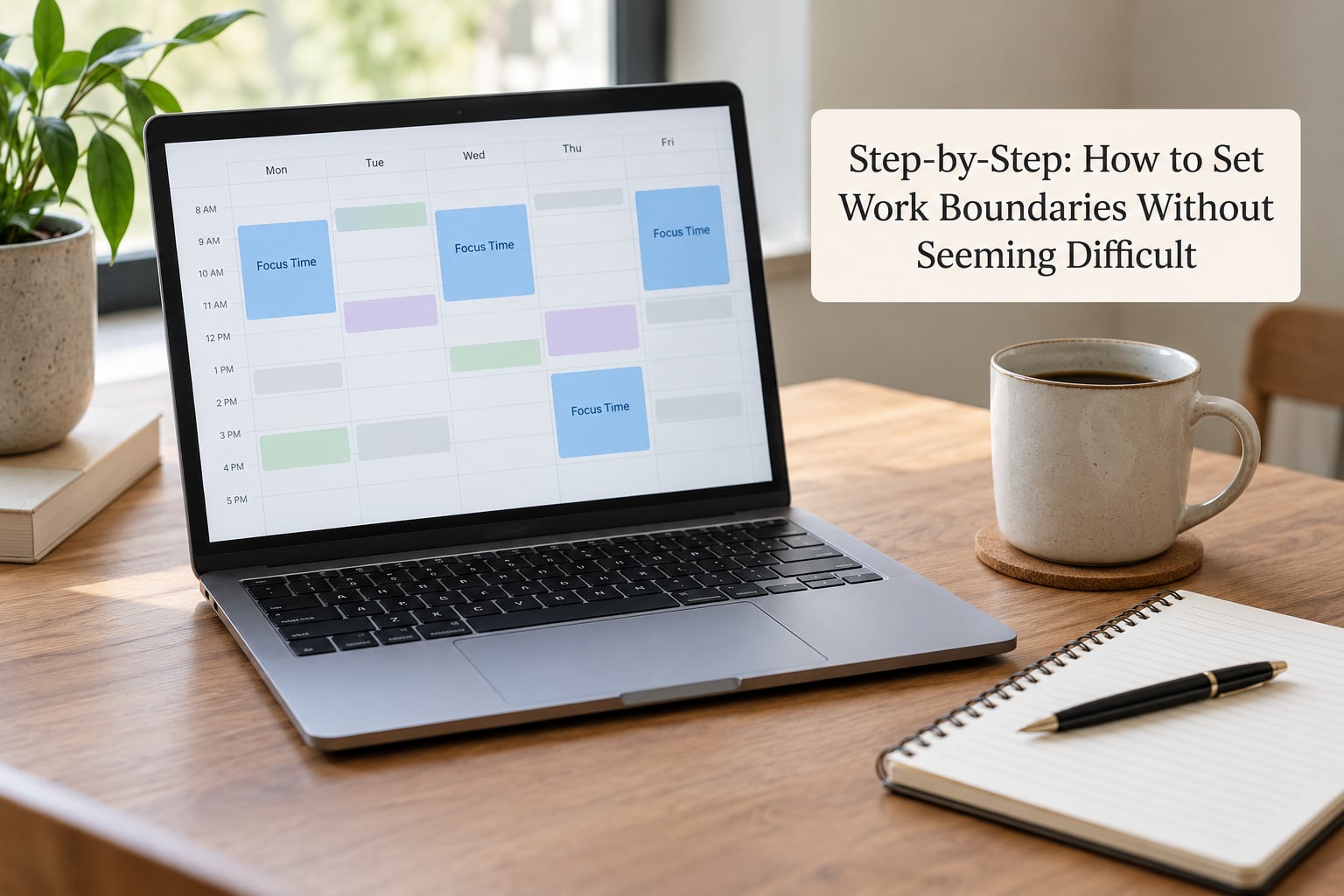
Five moves, in this order. Skipping straight to the no is what makes people come across as difficult, because a refusal with no visible reasoning reads as a mood.
Start With a Boundary You Can Explain Clearly
A boundary you can explain is a boundary you can defend. It names a specific limit and a reason that belongs to you rather than to the other person’s behaviour.
The test: can you say it in one sentence, and does the reason point at capacity, a deliverable or a deadline rather than at a person? “I cannot take that on before Thursday because the lookbook edit is due Wednesday” is a boundary. “You always send things at the last minute” is a complaint, and complaints get argued with instead of acted on.
It also helps to know what you are actually claiming. People get confused here constantly, and the confusion is what makes them sound difficult.
- A boundary is a line you state and hold. You do not ask permission for it.
- A preference is a hope. “I would prefer we do stand-ups at 9:30” leaves room for negotiation, which is fine for preferences.
- A rule is something that already exists, usually written down. Referencing it is not setting a boundary, it is enforcing one.
- A request is a question. If someone says no, nothing has been violated.
If what you have is a preference, say it as one and stop expecting it to hold like a boundary.
State the Boundary Without Blaming or Over-Explaining
Say the limit, the reason, and the alternative, then stop talking. The most common mistake is the apology tour: three paragraphs of justification that trains everyone listening to argue with you.
Use an I-statement so the sentence carries your information rather than an accusation. “I am not able to take on the mood-board rework this week” works because there is nothing in it to disagree with. “You keep adding things after I have already started” does not, because it invites a debate about history.
In writing, three lines is plenty:
“Quick one on the press lookbook. I have the shoot edit due Wednesday and I am not able to pick up the mood-board rework on top of it. Two options: it lands Thursday after the edit, or it goes to someone else this round. Happy with either.”
In person, keep it the same length. Say the sentence, take a breath, and let the other person talk. Silence after a boundary feels unbearable to the person setting it and completely normal to the person hearing it.
One exception worth naming: never attach the reason to another person’s character. Reasons tied to your own capacity are facts. Reasons tied to someone’s motives are opinions, and opinions are the easiest thing in the world to push back on.
Offer a Next Step Instead of a Reflexive Yes
This is the step that does the most work. A boundary with an alternative attached reads as a professional, and a bare no reads as a door closing. You are not withdrawing from the team. You are changing the shape of the delivery.
The alternatives that work most often:
- A different deadline: “I can have that to you Thursday instead of tomorrow.”
- A smaller scope: “I can do the header treatment and leave the rest for the next round.”
- A different owner: “This one sits better with design. Can you loop them in?”
- A scheduled decision: “Give me until Tuesday and I will tell you honestly what I can take.”
Asking a clarifying question is a boundary move too. “Which of these two should drop if I take this on?” reframes an impossible request as a prioritisation decision, and it is very difficult for anyone to argue with.
If the request is genuinely urgent and you genuinely can help, say so plainly and attach a cost: “Yes, I can cover this, but it means the Thursday delivery moves to Monday.” Flexibility offered with a visible trade is fair. Flexibility offered silently is how scope creep works.
Respond to Pressure, Guilt, and Repeated Requests
Most pushback is a test, not a decision. “You are not being a team player” and “everyone else says yes” are pressure tactics that work right up until someone stays calm, and then they stop being used.
Do not write a new answer each time. Write the same one, in the same tone, with the same length. That is what makes it a boundary rather than a negotiation.
- On “why now?”: “It is not a new way of working. It is a limit I should have stated sooner, and I am stating it now.” No apology attached.
- On “others are picking this up”: “That is their call and it is fair. I am at capacity on this, and taking it would mean something else slips.”
- On “you are being difficult”: “That is not what I intend. I am telling you where my limit is so you can plan around it. If the timing does not work, we need to talk about the date.”
- On the guilt trip: “I know this lands badly. I am still not able to take it this week.” Restate. Do not add new reasons, because every new reason is a new thing to negotiate.
If the boundary is ignored a second time, name the pattern once, in writing, with the agreement you are holding to: “I flagged on Tuesday that Friday was full, and it is still on my plate. To keep it consistent, anything after Friday goes to Monday. If that does not work, let me know today so we can plan properly.”
There is a ladder past that point, and it is short. First, restate in writing. Second, send a written status that shows the delay and the cause. Third, ask for a prioritisation decision in a meeting with the person who can actually make it, framed as delivery risk: “Two things are due Friday and one of them will be late, so I need you to pick.” Fourth, and only if your own performance or wellbeing is genuinely at stake, raise it formally. Going above a manager is a last resort and a decision with career consequences, not a reflex.
Enforce the Boundary Without Surprise or Punishment
The last piece is administration, and it does more work than any conversation. Put the limit where it does not need you to enforce it.
Concrete settings that hold boundaries without you having to ask:
- Block focus time on the shared calendar with a real title, so booking over it requires a deliberate act rather than an accidental one.
- Set Slack and Teams status to a schedule, and switch off notifications outside it. Tell people once, in the channel, that you are off, rather than explaining it every evening.
- Put your hours and response-time expectation in your email signature. This is the cheapest boundary available and it works without a single conversation.
- Use a delayed-send or scheduled message for anything written at 11pm, so nothing lands on a colleague’s phone at 11:02.
- Log scope changes, approvals and new deadlines in the thread where the work already lives.
Two rules for the enforcement phase. Announce changes early rather than at the moment of impact, because a deadline you did not know about feels like a personal attack even when it is not. And never use a boundary as leverage: withholding a reply to win an argument costs you far more credibility than the argument was ever worth.
Expect the first two weeks to be the hard part. That discomfort is not a sign that you did it badly. It is the reaction that usually fades once people get used to the new shape of things, and most people who quit at week three quit just before it settles.
Common Mistakes
These are the ones that turn a reasonable boundary into a difficult reputation. Each has a fix, and each fix takes about five minutes.
- Over-explaining until the boundary disappears. Five sentences of justification invites five objections. Fix: one sentence of reason, one sentence of alternative, then stop. If you find yourself saying “and also, and also”, you have left the boundary and entered the negotiation.
- Leading with an apology. “Sorry, I know this is a pain, but I just wanted to say that probably I might not be able to…” apologises for the act of having a limit. Fix: drop the sorry. You are not inconveniencing anyone by describing your capacity.
- Answering on the spot. The yes you regret was usually given under the pressure of the moment. Fix: make your pause phrase non-negotiable, and use it every time, even when you already know the answer.
- Making one exception and never re-stating the rule. This is the single most common way boundaries erode. The boundary works fine for weeks, one deadline slips, everyone moves on, and quietly it stops existing. Fix: after any exception, re-state it in the next message: “Thanks for the flexibility on Friday. To keep this predictable, back to normal hours from Monday.”
- Framing it as your hours instead of your output. “I am not working past six” sounds territorial. “Here is the delivery plan for the week, and here is what moves if anything else lands” sounds like someone running a project. Fix: always attach the boundary to a result.
- Holding the line silently out of spite. Doing the minimum to make a point is the fastest way to be labelled difficult, and it is usually accurate. Fix: meet every boundary you set, fully and on time. The message is the limit, not the quality of the work.
- Announcing a boundary after the deadline has passed. Retrospective boundaries get treated as a complaint. Fix: raise it while the deadline is still movable, which is the only time it is genuinely a boundary.
Two smaller habits are worth adding. Record what you delivered alongside what you declined, because the conversation you want to be having is about output, and results are the evidence. And start with the smallest boundary you can think of: one channel, one evening, one recurring meeting. Small boundaries that hold become the credibility you use to hold larger ones.
Frequently Asked Questions
Why is it so hard to set boundaries at work?
Usually it is not a skill gap. People have absorbed the idea that being helpful means being available, and that a clear limit signals laziness or a weak team spirit even when the work is being delivered. Fear of the label, plus not having a rehearsed sentence, does the rest. Naming the limit in advance and attaching a workable alternative removes most of the difficulty.
What are the 3 C’s of setting boundaries?
Clear, consistent and courageous. Clear means the limit is stated in one specific sentence rather than hinted at. Consistent means you say the same thing each time it comes up, without adding new justifications. Courageous is the first two under pressure, when saying something costs you socially. Some versions add a fourth C for courteous, which is tone rather than substance.
What do boundaries at work actually look like?
They fall into a handful of types: time (when you are available), task (what you will and will not take on), communication (which channel, how fast), emotional (how much of other people’s stress you absorb), physical (your space and belongings), and digital (notifications, status, presence indicators). Most real cases are combinations, such as a communication boundary with a time component attached.
How do I say no at work without seeming lazy or difficult?
Say no to the task, never to the person, and give a reason that belongs to you. Try: I am not able to take that on this week because of the Thursday delivery, but I can do it Monday or it could go to design. One sentence of reason, one sentence of alternative, then stop talking. That structure reads as a professional constraint rather than a refusal, because it gives the other person something to work with.
What if my boss does not respect my boundaries?
Move the conversation from your preferences to the work itself. Restate the limit in writing, send a status showing what is at risk, and ask for a prioritisation decision framed as delivery, not as availability. Keep a written record of scope, approvals and changes. If your own output or wellbeing is genuinely at stake after that, raising it formally is a deliberate decision with career consequences, not a next automatic step.
How do I set boundaries when I am a people pleaser?
Start smaller than feels useful. Pick one recurring pressure point, such as evening messages or a weekly meeting, and hold only that for thirty days. Use a written pause phrase so you are not deciding under pressure. Expect discomfort in the first fortnight; that reaction is the habit loosening, not evidence that you have done something wrong. Most people need one boundary that visibly holds before they attempt the next one.
Conclusion: Make Your Boundary the First Step
Pick the one pressure point that costs you the most every week, write a single sentence for it, and say it out loud to the person who benefits most from the current arrangement. Include the reason and one workable alternative, then put it in writing in the thread where the work happens.
Hold it for thirty days, re-state it after any exception, and let the rest arrive later. Being clear about your limits is a professional skill, not a personality flaw, and it is far easier to learn from one boundary that sticks than from a whole policy you abandon in week four.