
A content calendar for a small brand is one spreadsheet that records what you will post, on which channel, on what date and in what format. You set it up once, then run it with a weekly batch session and a monthly review. That is the whole system.
If your brand is run by one to three people with no content team, you do not need a marketing plan. You need somewhere to write down the work so you stop deciding what to post every single morning. This guide shows how to build that spreadsheet, how to fill it, and how to keep running it after the novelty wears off.
It takes an afternoon to set up and about 30 minutes a week to keep it alive.
Table of Contents
- What You Need Before You Build a Content Calendar for a Small Brand
- Spreadsheet first, scheduling tool later
- Step-by-Step: Running a Content Calendar on a Small Team
- 1. Set Three Clear Content Goals
- 2. Map the Brand’s Core Content Pillars
- 3. Choose a Publishing Rhythm Your Small Brand Can Keep
- 4. Build the Calendar in Weekly Blocks
- 5. Assign an Owner, Status, and Deadline
- 6. Create Simple Content Templates
- 7. Review Performance and Adjust Monthly
- Common Mistakes That Kill a Small Brand Calendar
- Frequently Asked Questions
- How often should a small brand post on social media?
- What is the best tool for creating a content calendar?
- What is the 70/20/10 rule for social media?
- What is the 5-3-2 rule for social media posts?
- What should I do when I fall behind on my content calendar?
- Do I need a content calendar if I am a one-person brand?
- A Simple Content Calendar Is a Business System
What You Need Before You Build a Content Calendar for a Small Brand
Gather five things before you open a blank spreadsheet. Anything missing will show up as an empty row three weeks into the month.
- Three goals. Awareness, engagement or community, and sales. Three is enough for a small brand.
- Audience detail. Who buys from you, what they ask you in DMs, and the words they use for your products.
- Your platforms. Two or three that you will actually keep up. Not every platform your competitors are on.
- Brand voice. Three sentences: who you are, how you sound, what you never say.
- A baseline. Follower count, average post reach and monthly DMs, written down before you start so you can compare later.
That voice document does not need to be a mood board. Write it as sentences a new hire could follow. “Warm, specific, a little dry. Never shouty, never use the word luxe.” Put it in the top of the calendar file so anyone who opens the spreadsheet sees it.
Spreadsheet first, scheduling tool later
Most small brands do not have a tool problem. They have an opening-it problem. Build in Google Sheets, Notion or Trello first, and only move to a scheduling app when the writing, approvals and scheduling are genuinely manual work.
| Option | Learning curve | Best for |
|---|---|---|
| Google Sheets or Excel | Low | One to two people, a handful of posts a week |
| Notion | Medium | Brands that also want briefs, drafts and assets in one place |
| Trello or Asana | Medium | Three or more people who need to see who owns what |
| Buffer or Later | Low | Scheduling-heavy social calendars; free tiers cap posts per month |
| Meta Business Suite | Low | Scheduling Facebook and Instagram posts without another login |
Community consensus on small-brand marketing forums is blunt about this: a plain spreadsheet beats an elaborate app, because the best calendar is the one you actually open. The most commonly shared resource is a Notion template, and the most common regret is paying for a paid tier while posting three times a week.
Step-by-Step: Running a Content Calendar on a Small Team
Building the calendar is the easy half. The process below starts there and then covers the part most guides skip: the weekly batch, the monthly review and the rule for when you fall behind. If you want the short version, do steps one and two properly and treat the rest as a routine you build up over a month.
1. Set Three Clear Content Goals
Pick three goals and attach one number to each. Awareness might be reach per post over the last month. Engagement might be saves and shares. Sales might be link clicks or DMs asking where to buy.
Likes are not on that list, and that is deliberate. A like costs nothing and tells you almost nothing about whether a post moved anyone. Saves and DMs tell you a person cared enough to keep something or start a conversation, and both are far closer to revenue.
Write the numbers down before month one starts. Otherwise you are guessing at change later.
2. Map the Brand’s Core Content Pillars
Three to five pillars is the workable range. Fewer and the feed gets repetitive. More and you lose focus. Every post belongs to a pillar, and the pillar lives in its own column.
For a small fashion or lifestyle brand, four pillars might be styling ideas, behind the scenes in the studio or studio-adjacent work, product education such as fit and fabric, and founder perspective. A beauty brand might swap styling ideas for tutorials and ingredient or technique education. Find your pillars in the questions your inbox already answers rather than brainstorming from scratch.
3. Choose a Publishing Rhythm Your Small Brand Can Keep
Pick a frequency you can hit in a bad week, not a good one. Owners who plan daily posting in month one fall behind in week three and abandon the calendar completely, so benchmark low and honest numbers.
| Platform | Realistic weekly rhythm for a small brand |
|---|---|
| Instagram feed | 3 to 4 posts |
| Instagram Stories | Most days, from a batch you shoot once |
| TikTok | 2 to 3 short videos |
| 2 to 3 posts | |
| Email newsletter | 1 to 2 sends |
| Blog | 1 post every two weeks |
The three ratio rules you will hear everywhere control different things, and mixing them up is why so many calendars feel off.
| Rule | What it controls | How to read it |
|---|---|---|
| 70/20/10 | Value mix over a month | 70% educate, inspire or entertain; 20% community and proof; 10% direct promotion |
| 5-3-2 | Format mix over a week | 5 pieces of original content, 3 curated or community posts, 2 promotional posts |
| 5-5-5 | A monthly production target | 5 posts, 5 stories sets, 5 emails or videos per month, as a minimum rather than a target to beat |
Use 70/20/10 as your month-level check, 5-3-2 as your weekly check, and treat 5-5-5 as a floor for a low-capacity month. Then split your calendar about 80/20: roughly 80% planned in advance, 20% kept open for real-time and reactive moments.
4. Build the Calendar in Weekly Blocks
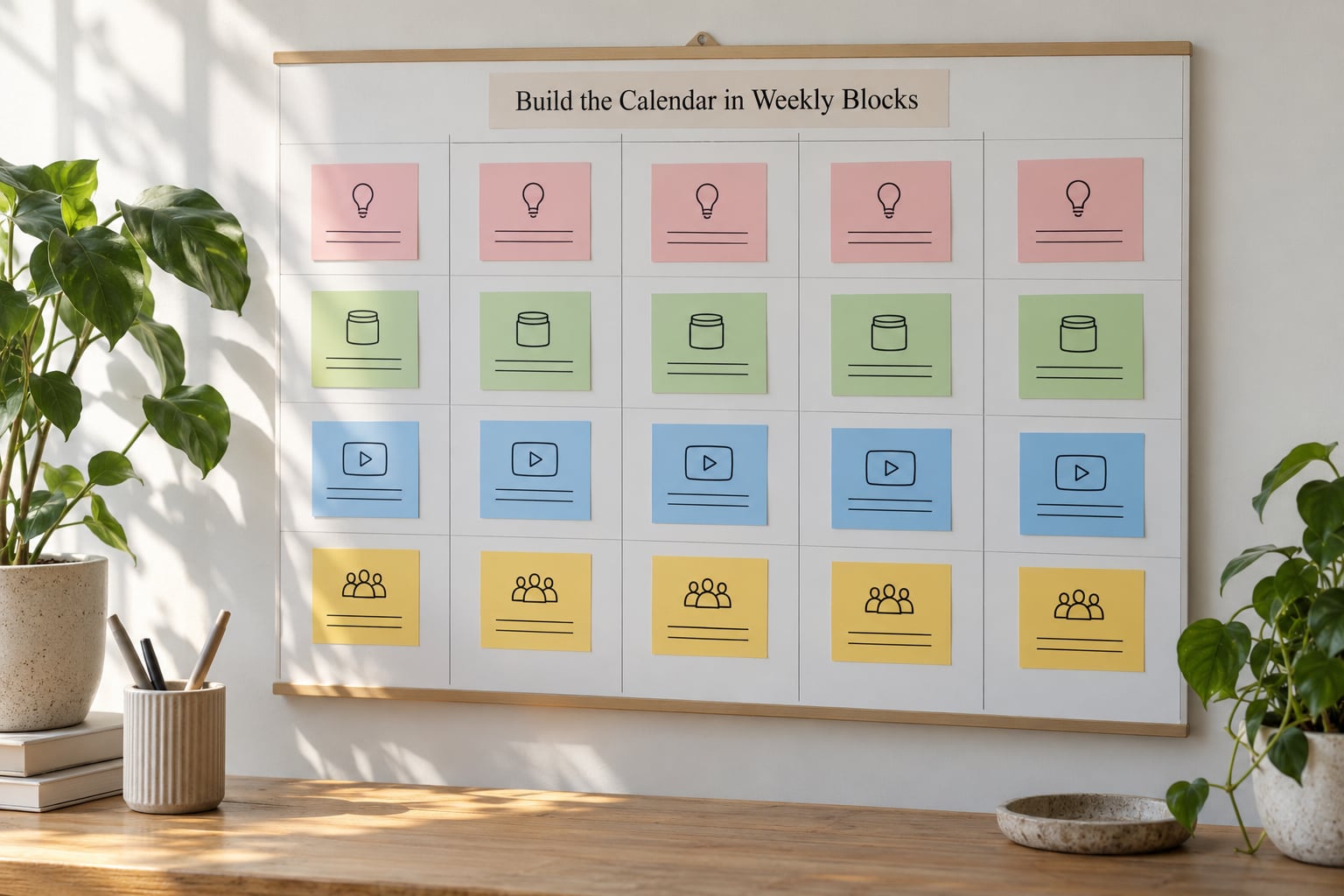
Divide the month into four weekly blocks and plan each one as a unit. Blocking by week stops the calendar becoming a single undifferentiated list and makes it obvious which week needs shooting.
Copy these columns into your spreadsheet. Seven columns is the useful maximum; a wider grid stops being readable on a phone.
| Date | Platform | Pillar | Format | Hook or caption | Status | Call to action |
|---|---|---|---|---|---|---|
| Tue 7 | Styling | Carousel, 6 slides | Three ways to wear the linen shirt | Draft | Save this for later | |
| Wed 8 | Founder | Newsletter | Why I set the price this way | Idea | Reply and tell me |
Batch planning two to four weeks ahead is the rhythm small brands report as most sustainable. Full-month-ahead planning is cleaner on paper and much harder to keep current, because the best reactive ideas only show up once you are in the week.
5. Assign an Owner, Status, and Deadline
Every row needs three fields beyond the content itself: who owns it, where it sits, and when it is due. Five status values are plenty: Idea, Draft, Needs review, Scheduled, Published.
Set the deadline two days before the publish date. For a one-person brand the owner column is the same name on every row, and that is fine. It keeps the habit of looking at the calendar intact even when you are the only one who ever fills it in.
Give yourself one approval step, not four. If you work with a freelancer, set a single review window, such as Monday afternoons, and hold everything else until the next window.
6. Create Simple Content Templates
Three reusable formats will carry most of a small brand’s month. A styling tip, a behind-the-scenes post and a product drop. Write the structure of each one once so you are not rewriting the caption from scratch every time.
- Hook list. Ten opening lines you can rotate, saved in the top sheet.
- Caption skeleton. Hook, one paragraph, one question to the reader, link or call to action.
- Shot list. The four or five frames you need for a carousel, so a shoot takes twenty minutes rather than an hour.
Templates should speed you up, not make you repetitive. If six posts in a row sound identical, you have turned a format into a script.
One shoot can genuinely become four posts: a carousel from the hero shots, a short video of you talking through the styling, three Stories cut from the same footage, and a founder note about why you made it. That is where the frequency numbers above become affordable.
7. Review Performance and Adjust Monthly
Spend 30 minutes at the end of each month on three things: which posts earned saves, shares and DMs; which format you produced most easily; and which posts brought link clicks or sales questions.
Then change exactly one thing in next month’s calendar. Double down on the pillar that saved well, drop the one that produced nothing, and change only a single variable so you know what caused the result.
Once a quarter, revisit the pillars and the goals themselves. Audiences shift and the calendar should too. Owners who lose momentum after month one usually stop checking because nothing told them whether it worked, so keep the review on the calendar as a row like any other.
Common Mistakes That Kill a Small Brand Calendar
Almost every abandoned calendar fails the same way. These are the six I see most, each with the fix that keeps it alive.
- Planning more posts than you can produce. Cut the monthly count by a third and fill the gap with reactive slots. A calendar you hit beats one you abandon.
- Running four channels at once. Pick two, run them well for a quarter, then add a third. Depth on two channels beats shallow on five.
- No batching day. Block 90 minutes a week, in writing, as an appointment. Everything else on that calendar is a standing commitment.
- Approvals that stall for days. Set one review window and one deadline. Anything late waits for the next window rather than blocking the week.
- Every post is a promotion. Run the 70/20/10 check. If your month is mostly product posts, the audience tunes out and reach drops.
- Dropping the review after month one. Put the 30-minute review in the calendar as a recurring row. It is the step that decides whether the rest is worth doing.
Two more that come up constantly. The first is having nowhere to put ideas, which is why half of every calendar ends up empty, so keep an ideas column that nobody is allowed to delete from. The second is expecting the calendar to fix a weak offer. It will not. It makes whatever you already do visible and consistent, and that is all.
Frequently Asked Questions
How often should a small brand post on social media?
Enough to stay visible and low enough to sustain in a bad week. For a one to three person brand, three or four Instagram feed posts a week, Stories on most days from a single batch, two or three short videos, and one or two emails is a realistic starting point. Raise volume only after two months of hitting your current number.
What is the best tool for creating a content calendar?
A spreadsheet is the right answer for most small brands. Google Sheets or Excel has almost no learning curve and no limits that matter at five posts a week. Move to Notion when you want briefs and assets beside the calendar, and to Buffer, Later or Meta Business Suite only when scheduling has become manual work.
What is the 70/20/10 rule for social media?
It is a month-level value mix: 70% of your content educates, inspires or entertains, 20% builds community or offers proof such as reviews and customer photos, and 10% promotes directly. Small brands tend to invert it, posting mostly product content, which is why reach tends to fall once the audience sees the same pitch repeatedly.
What is the 5-3-2 rule for social media posts?
It is a weekly format mix rather than a value mix: 5 pieces of original content, 3 curated or community posts, and 2 promotional posts. Use 70/20/10 to check what your month is made of, and 5-3-2 to check how a given week reads. Running both together is what keeps a feed from feeling like a catalogue.
What should I do when I fall behind on my content calendar?
Do not try to catch up. Pick the two best posts still sitting in Draft, schedule them for this week, and move the rest into next month. Then cut your monthly count by a third so the calendar matches your real capacity. A smaller calendar you actually finish rebuilds the habit that a missed month already broke.
Do I need a content calendar if I am a one-person brand?
Yes, and a solo founder arguably needs it more. The calendar removes the daily decision of what to post, which is the part that quietly eats a founder’s product time. Keep it simple: one spreadsheet, three pillars, a weekly batch session and a 30-minute monthly review. That is a complete system for a one-person brand.
A Simple Content Calendar Is a Business System
Start with one month, three goals, three pillars and a rhythm you can keep in a bad week. Write it in a spreadsheet, block 90 minutes a week to batch the next two weeks, and put the 30-minute review in the calendar like any other row.
That is a complete content calendar for a small brand. Everything after that, extra channels, extra platforms, fancier tools, is something you add once the habit is already in place.