
To become a technical designer in apparel, you need to learn to sew and draft patterns, write production-ready spec sheets and tech packs, get fluent in Illustrator plus a CAD or PLM system, build three portfolio projects that show your reasoning, and apply for assistant technical designer roles or internships. Most people who get hired are pattern-literate and can explain a fit decision out loud without hedging.
This guide is written for candidates in the U.S., whether you are finishing school, switching from another industry, or already sewing and just need the technical design layer. Ask three people doing the job now what a week actually looks like and the honest answer is that technical design is more sample room and spreadsheet than people expect. If you want the sketching-and-trend half of fashion, this is the wrong path. If you want the part where a garment actually gets made right, the pay and the job security are real.
One thing worth saying up front: the title is inconsistent across companies. The same work shows up as technical designer, tech designer, product development technician, or fit engineer. Search by task, not by title.
Table of Contents
- What You Need
- Technical knowledge to have in your head
- Software worth learning
- Portfolio materials to assemble
- Traits hiring managers look for
- Step-by-Step: From Aspiring Candidate to Hired Technical Designer
- How to Become a Technical Designer in Apparel: Start With the Role
- Build the Right Education and Skill Set
- Learn the Tools Apparel Employers Expect
- Practice on Real Apparel Development Projects
- Create a Portfolio That Demonstrates Your Thinking
- Practice Communication and Vendor Collaboration
- Build a Resume and Professional Portfolio Site
- Apply Strategically and Prepare for Interviews
- Grow Into Your First Role and Advance
- Common Mistakes
- Frequently Asked Questions
- Do I need a fashion degree to become an apparel technical designer?
- Can I become a technical designer without sewing or patternmaking experience?
- What software should I learn for technical design jobs?
- How many portfolio projects do employers expect?
- What does a technical designer interview test?
- How long does it take to become an apparel technical designer?
- Conclusion
What You Need

You need four things before you apply: construction knowledge you can defend in conversation, a small set of software skills, finished portfolio pieces, and a temperament for documentation. Candidates who have only one of the four stall somewhere in the interview loop.
Technical knowledge to have in your head
- Patternmaking and pattern drafting. Drafting a basic block, understanding grainline, ease, seam allowance, and how a pattern change moves a measurement on the body.
- Garment construction. Stitch types, overlock versus flatlock versus coverstitch, seam finishes, and how a factory will actually build the callout you wrote.
- Measurement and specification. Points of measure, tolerance, finished garment measurements versus body measurements, graded specs, and a shrinkage allowance.
- Fabric behavior. Drape, weight in GSM, stretch and recovery, and how knit versus woven changes every decision downstream.
- Fit vocabulary. Drag lines, balance, ease distribution, and the difference between a tolerance problem and a construction problem.
Software worth learning
- Adobe Illustrator for tech flats. Non-negotiable; this is the one that gets tested.
- Microsoft Excel or Google Sheets for spec sheets, fit comment logs, and measurement charts.
- Garment CAD such as AccuMark, Lectra Modaris, Gerber, or Optitex, for pattern work and grading.
- 3D fit software like CLO 3D, where virtual sampling is replacing early physical samples at many brands.
- PLM systems for version control, because the tech pack is a living document and revisions live or die by tracking.
Portfolio materials to assemble
Three finished tech packs for three different garment categories. Each one needs front and back technical flats, a points-of-measure chart with tolerances, construction callouts, a bill of materials, and a short written explanation of a fit or construction decision you made. Interviewers flip through these fast, so clarity beats volume.
Traits hiring managers look for
Document discipline, the ability to write a fit comment that cannot be misread, and calm in front of a factory. Technical design hiring managers often say the same thing about screening: experienced candidates can talk a good game and still fail a patternmaking test, and the person who can balance a pattern stands out immediately. Pattern balance is not a party trick. It is a screening test.
Step-by-Step: From Aspiring Candidate to Hired Technical Designer
The steps below run in order because each one supplies the evidence the next one needs. Skipping ahead is how candidates end up with a beautiful portfolio and no interviews, or a job offer they cannot explain in a fit session.
How to Become a Technical Designer in Apparel: Start With the Role
Start by understanding that a technical designer owns the translation of a creative sketch into a product a factory can build consistently. Daily work covers fit reviews, spec sheets, tech packs, CAD, vendor communication, and problem-solving when a sample comes back wrong.
The garment life cycle, described by working technical designers on The Fashion Spot forums, runs like this: the designer submits a sketch with fabric or yarn direction, the technical designer prepares a spec sheet with finished measurements in a base size, the factory returns a first fit or proto sample, it gets measured and fitted on a live model with the design and production teams, fit comments go back to the vendor, a second fit sample follows, and the loop repeats until fit is approved. Then comes a pre-production sample, graded specs issued from the base size, and a size run that gets measured rather than fitted.
Here is what that looks like in practice. A straight-leg denim comes back from the first fit pulling across the knee and bagging at the thigh. A designer chasing the bag would add side seam. A technical designer measures the inseam rise and the thigh circumference, checks the pattern balance, sees that the front rise is drafted short for the intended rise, and revises the spec plus the pattern, then explains it in writing so the factory does not simply narrow the leg. Same silhouette, different fix, and the fix is defensible on a spreadsheet.
Checkpoint: you can explain the difference between a proto, a pre-production sample, and a size run without pausing.
Build the Right Education and Skill Set
There are four routes, and they differ mostly in time, cost, and how much of the fit room you get to stand in.
- Associate degree (about two years). Fastest structured option, often the most practical, and it qualifies you for assistant-level roles.
- Bachelor’s degree (about four years). Deeper coverage of merchandising, textiles, costing, and production, plus a longer runway into brand-side roles. A program’s technical design track typically stacks hands-on patternmaking, specification review, technical sketching, live model fittings, PLM, computerized pattern making, 3D fit, and a required internship.
- Certificate programs. Shorter and cheaper than a degree. Worth it if you already sew and want the technical layer, weak if you are starting from zero.
- Self-taught. Real, harder, and it works. People on Reddit’s r/fashiondesigner describe the exact trap: not in fashion school, no formal training, barely know how to sew, no idea how to draft. The route out is not more online courses, it is sewing hours and finished garments.
Whichever route you pick, layer in the fundamentals people skip. Textile science, garment construction, and basic cost math separate candidates who can copy a spec sheet from candidates who can defend one. Communication matters as much as any of it, because you will spend your career writing to people who do not speak your first language.
Checkpoint: draft a complete spec sheet for one simple style, measure a finished garment to your own points of measure, and land every number inside a tolerance you set. If you miss one, you found your gap before a hiring manager did.
Learn the Tools Apparel Employers Expect
Learn the tools in the order employers test them: Illustrator, then Excel, then CAD, then whatever 3D and PLM stack the company runs.
What you demonstrate depends on who is hiring. A small brand or startup cares that you can produce a clean tech pack in a day, name a shade lot, and write a BOM without a template. A mid-size or corporate brand expects you to already know the template and wants to see you drive a fit session and a factory conversation. A large company runs on licensed software, so name the category accurately: AccuMark, Lectra, Gerber, or Optitex, plus PLM for revision control and CLO 3D where virtual sampling is in place.
What is a real cost signal is a candidate who says they use a tool nobody in the industry has heard of. Do not use software shortcuts on a company machine. Get your own tools, know the licensing rules, and never take files off a work computer.
Checkpoint: hand someone a digital tech pack with no missing callout, no orphan revision, and no ambiguous measurement. If they can build the garment from it without asking you a question, your tool skills are job-ready.
Practice on Real Apparel Development Projects
Pick a garment category and go deep rather than sampling everything. Activewear, swimwear, denim, and intimates each have distinct construction logic and each attracts a different set of brands.
Work the project like a real style: collect reference samples, take them apart seam by seam, photograph the construction, and document how the garment is built rather than only how it looks. Record fit concerns in garment language, propose a specific revision, and then show what the revision does. The chain that matters is visible construction problem to justified specification or design change. Sketch pretty garments without that chain and you have an art portfolio, not a technical design portfolio.
Two or three well-documented projects beat ten flat drawings. A hiring lead reading your PDF would rather see three styles where a reader can follow the decision and the result than a hundred illustrations that say nothing about how the garment is made.
Checkpoint: your write-up answers why, not just what, in under 150 words.
Create a Portfolio That Demonstrates Your Thinking
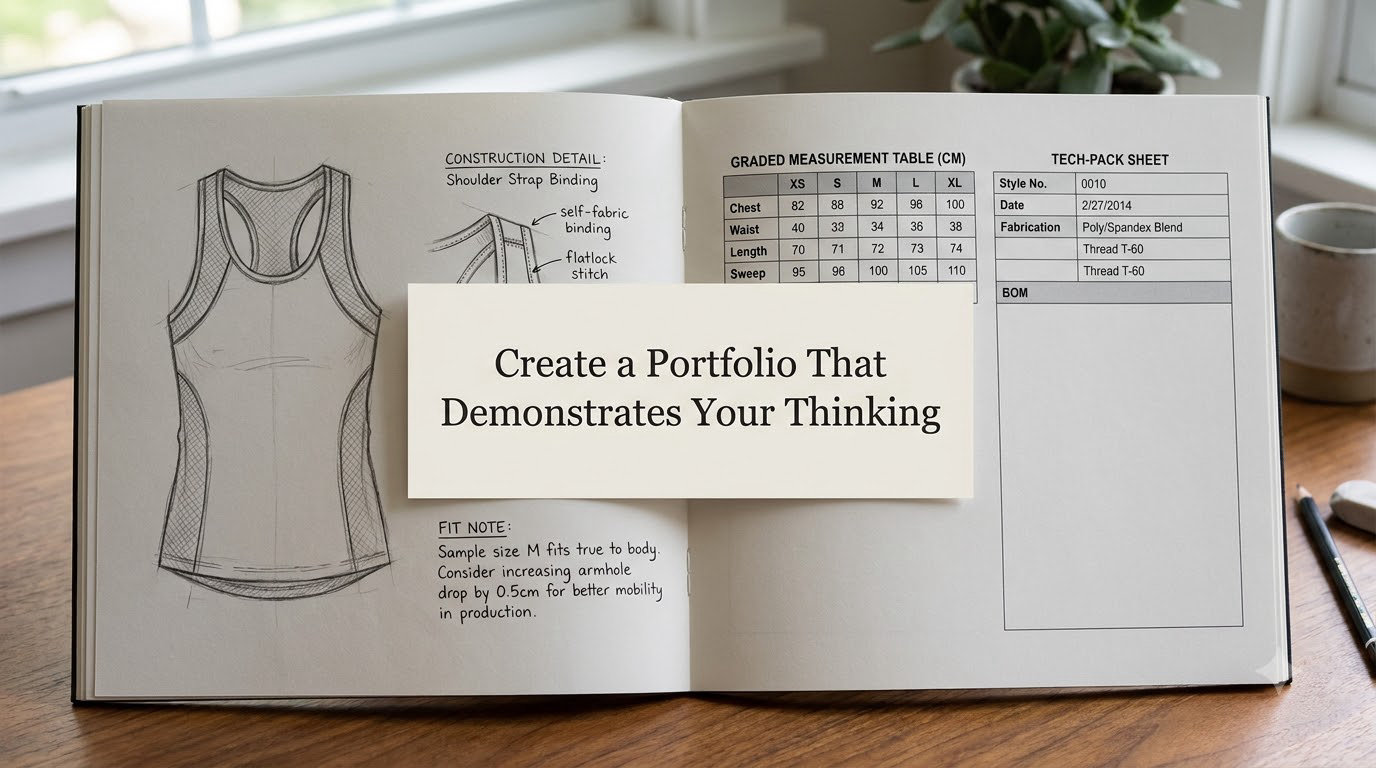
A portfolio should have three focused projects, each with annotated sketches, flat drawings, measurement specifications, construction details, before-and-after fit observations, the tech pack itself, and a short case-study explanation.
The test is simple: a stranger should understand your decision and your result without hearing you explain it. Front-load the reasoning, not the artwork. Show the failed version alongside the corrected one; that comparison is the most persuasive page in the whole document.
Export as PDF so fonts and callout weights survive, name files by style number and revision, and keep a clean folder structure. Recruiters and design leads move between the resume, the portfolio site, and the file quickly. If your samples are three clicks deep, they never get opened.
Checkpoint: someone outside fashion can read one page and name the problem you solved.
Practice Communication and Vendor Collaboration
Most of technical design is writing. You write fit comments, revision requests, spec clarifications, and approval notes, and a badly written fit comment costs a full sample round.
Compare these two. Bad: “Knee too tight, please fix.” Better: “Sample 1 shows pulling across the right knee with a drag line running from the inseam to the hem. Please add 1.5 cm to the thigh circumference and 0.5 cm to the knee width, and re-balance the front and back inseams. Revised spec attached. Please confirm before cutting sample 2.” Same observation, but the second one removes every question the factory could have asked.
Practice the hard version: two people requesting measurements that conflict. Resolve it in writing, name which request wins and why, and state the cost or timing impact. That resolution is the actual job. Style teams, patternmakers, factories, and sales all pull in different directions, and the technical designer is usually the one who holds the line on what gets built.
Checkpoint: a colleague can read your comment and act on it without asking a single follow-up question.
Build a Resume and Professional Portfolio Site
Tailor the resume to the job description’s language. Search listings for phrases like create detailed, production-ready tech packs, evaluate apparel merchandise in terms of style, measurement and construction, and communicate with overseas garment factories, then make sure your resume uses comparable words.
Keep one page, put your three projects at the top with links, and list software accurately with the version you actually used. A portfolio site or a profile on a design platform works well; a clean folder structure matters more than the platform. Samples must be one click from the resume.
Check every claim before you send it. Recruiters do surface candidates whose polished paperwork does not match their actual trade skill, and the first interview exposes the gap. Better to say you drafted patterns under supervision than to claim a full style you cannot discuss.
Checkpoint: your three strongest samples open from your resume in a single click on a phone.
Apply Strategically and Prepare for Interviews
Research the company before you apply. Know whether it owns factories, travels for fittings, or works with vendors overseas, because that changes the job more than the logo does.
Apply where you have a real shot. Large brands hire juniors in cohorts and are a reasonable first target after a degree. Small brands will hire a self-taught pattern-literate person faster, but the mentorship can be thin and the pay is often lower. Startups are a gamble with good upside. Apply to each with a portfolio trimmed to that company’s category.
Prepare for practical work, not just behavioral questions. Expect a flat sketch exercise, a spec accuracy check, and often a pattern or pattern-balance question. Candidates prepping for an assistant technical design interview are usually advised to emphasize flat sketching speed and accuracy, since calling out every stitch line signals technical competence to the person grading you. Have three stories ready about your own decisions: a spec you changed, a fit problem you solved, and a disagreement you resolved in writing.
Checkpoint: you can draw a garment flat in under twenty minutes and explain each callout as you go.
Grow Into Your First Role and Advance
The first six months are about learning the company’s templates, sample room, and factory relationships. Join fit reviews early, take notes on what experienced technical designers write, and ask to own one style end to end.
Progression runs assistant technical designer, technical designer, then senior technical designer, and the jump is earned through ownership rather than time served. Ownership means you set the spec, approve the fit, and answer the factory’s questions without escalation. Senior roles add judgment calls: cost-down engineering, size inclusivity, cross-category consistency, and mentoring.
Compensation tracks responsibility and category, and it varies a lot by company, city, and whether the role is brand-side or vendor-side. Check current Occupational Outlook data from the U.S. Bureau of Labor Statistics for apparel roles alongside a salary aggregator for technical designer specifics, and read both with a date attached. One recurring complaint from practitioners is that companies expect experienced-level output at entry-level pay, which is worth factoring into any offer you weigh. Other titles carry the same work: fit engineer, specification technician, technical assistant to product developer.
Checkpoint: you are the person the designer and the factory both call first on a new style.
Common Mistakes
These are the errors that show up again and again, with the correction attached.
- Focusing only on drawings. Pretty flats with no construction reasoning. Fix: for every illustration, add the callout, the point of measure, and one sentence on why the spec reads that way.
- Neglecting construction knowledge. A spec a factory cannot build is a wish. Fix: take three garments apart and photograph the seam finishes.
- Submitting a generic portfolio. Five styles in five unrelated categories, none explained. Fix: three projects in one category, each with a written decision.
- Avoiding Excel. Tech packs, fit logs, and measurement charts are all spreadsheets. Fix: rebuild one spec sheet in Excel from scratch and learn the lookup and reference basics.
- Skipping fit explanations. Showing before and after without saying what changed and why. Fix: write the fit comment as if the factory had to act on it alone.
- Using unapproved software or shortcuts. File handling rules are real and firing reasons. Fix: keep your own licensed tools and never pull files from a work computer.
- Translating work into nothing. A beautiful sample with no business outcome. Fix: say what your change reduced: fewer fit rounds, a shorter sample timeline, or a lower return rate.
Frequently Asked Questions
Do I need a fashion degree to become an apparel technical designer?
No. Plenty of working technical designers came up through patternmaking, production, or factory work, and small brands hire on skill. A degree makes the first job easier and opens brand-side roles faster. If you skip it, your portfolio and a pattern test matter more, so budget your time for real sewing and drafting hours.
Can I become a technical designer without sewing or patternmaking experience?
It is possible, but you will be starting from behind. Sewing and pattern drafting are how you learn why a spec behaves the way it does on a body. Most candidates who skip it hit a wall in the fit session, where the discussion is about balance, ease, and how a pattern change moves a measurement. Start with a year of making garments.
What software should I learn for technical design jobs?
Start with Adobe Illustrator for tech flats and Excel for spec sheets, since those two are tested everywhere. Then add garment CAD such as AccuMark, Lectra Modaris, Gerber, or Optitex. Learn 3D fit tools like CLO 3D and a PLM system once you are interviewing, because which ones you need depends on the company’s stack.
How many portfolio projects do employers expect?
Three well-documented projects is the working standard. Each one should carry front and back flats, a points-of-measure chart with tolerances, construction callouts, a bill of materials, and a short explanation of a decision you made. Quantity rarely helps. A stranger should be able to follow your reasoning and your result without hearing you explain it.
What does a technical designer interview test?
Most interviews mix conversation with practical work. Expect a flat sketch exercise under time pressure, a spec accuracy check, and often a pattern or pattern-balance question, plus discussion of fit, specifications, vendor communication, and problem-solving. Have three stories about your own decisions ready, and be able to explain every callout on your drawing out loud.
How long does it take to become an apparel technical designer?
With a two-year degree plus an internship, roughly three years to a first full role. Self-taught candidates usually spend longer, often two to three years of evenings building sewing, drafting, and software skill while assembling projects. Experience is what moves you from assistant to technical designer, and the jump to senior is earned by owning styles rather than by years served.
Conclusion
The path is narrower than it looks. Learn to sew and draft, master the spec sheet and tech pack, get fluent in Illustrator, Excel, and one CAD system, then prove your thinking in three documented projects. Most people get hired on the strength of a pattern test and a fit conversation, not a diploma.
Start today by choosing one garment you already own, taking it apart seam by seam, and building a complete sample tech pack from it. That one project teaches construction, measurement, and documentation at the same time, and it gives you the first entry in a portfolio that is actually worth opening.