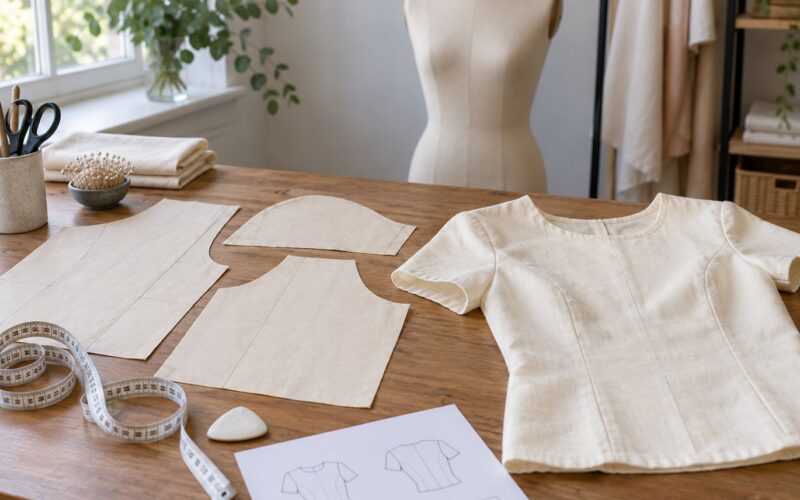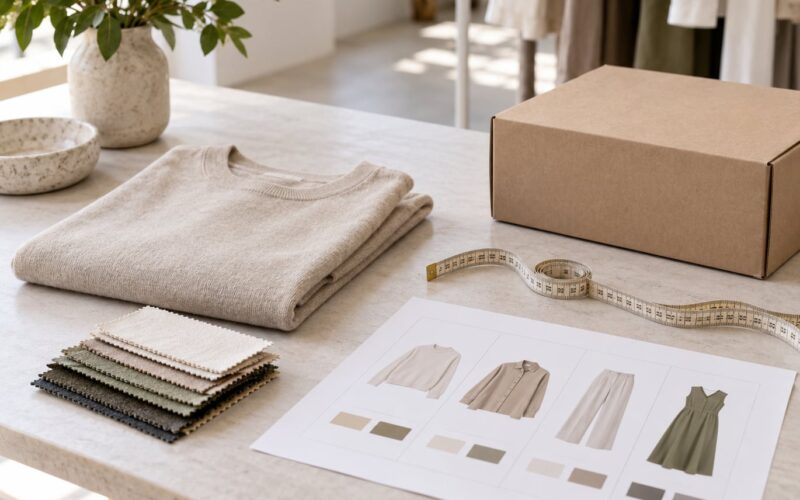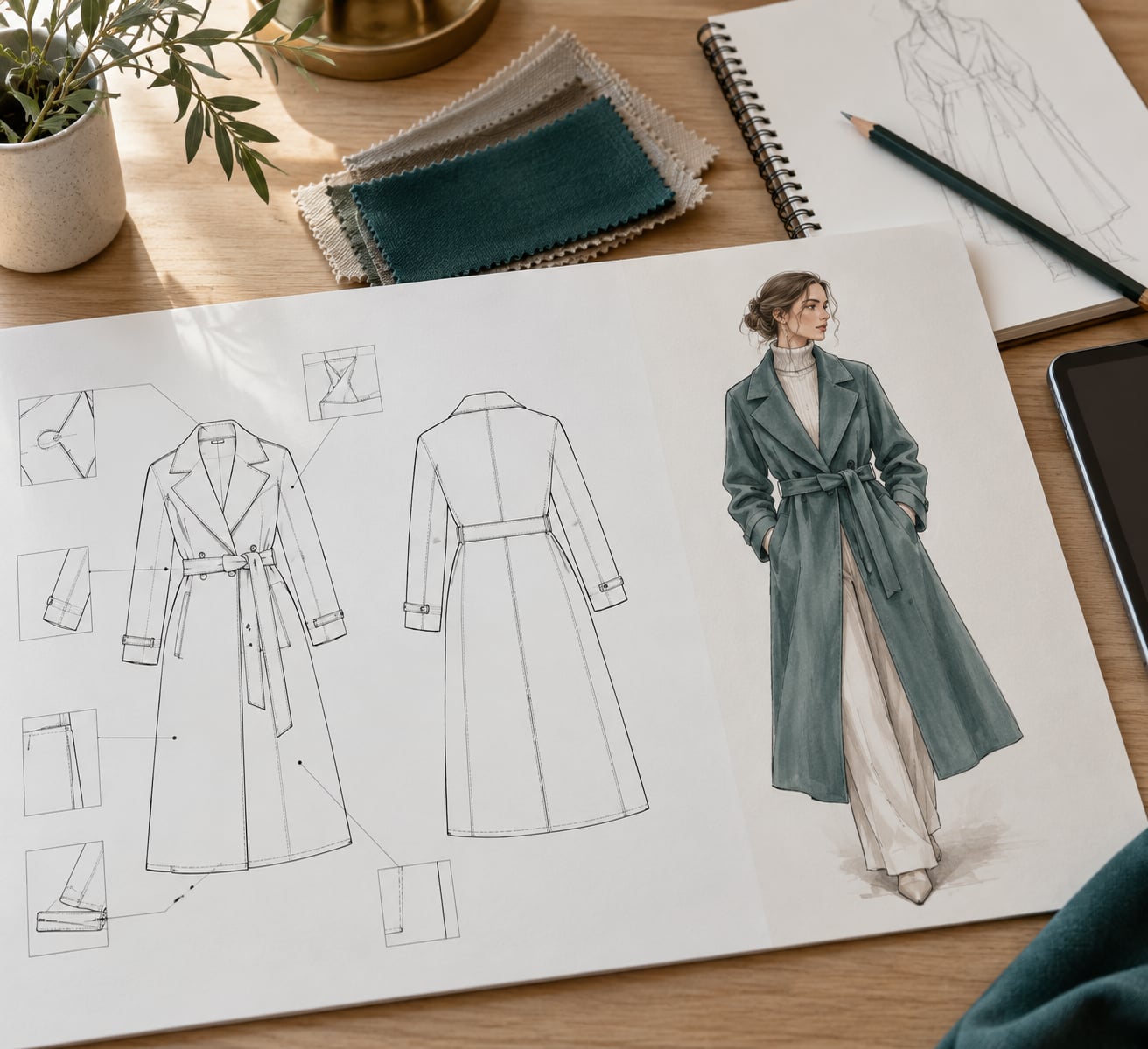
A tech sketch, also called a technical sketch, technical drawing or fashion flat, is an unshaded line drawing of a garment that shows construction for production. A fashion illustration is a rendered drawing of the same garment on a posed figure, used to communicate the idea and mood. One builds the sample; the other sells the design.
Both drawings exist inside the same tech pack, and most designers make dozens of one and a handful of the other. Knowing which is which stops a client conversation turning into a factory email full of questions.
Table of Contents
- Tech Sketch vs Fashion Illustration at a Glance
- What Is a Tech Sketch?
- What a Tech Sketch Is Actually For
- What Is a Fashion Illustration?
- Purpose and Design Development
- Where the Illustration Comes First
- Where the Tech Sketch Comes First
- Line Quality and Shape Construction
- Detail, Fabrics, and Construction Features
- Color and Rendering
- Tools, Skills, and Workflow
- What Each Format Asks of Your Hands
- The Hand Sketch to Vector Workflow
- Which Should You Choose?
- If You Are Starting Out
- Frequently Asked Questions
- Is a tech sketch the same thing as a fashion flat?
- Which should I draw first as a beginner in fashion design?
- Can a factory make a garment from a fashion illustration?
- What does a fashion tech pack contain?
- Do I need both in my fashion design portfolio?
- What software should I use for tech sketches and illustrations?
- Conclusion: Choose the Drawing That Fits Your Goal
Tech Sketch vs Fashion Illustration at a Glance
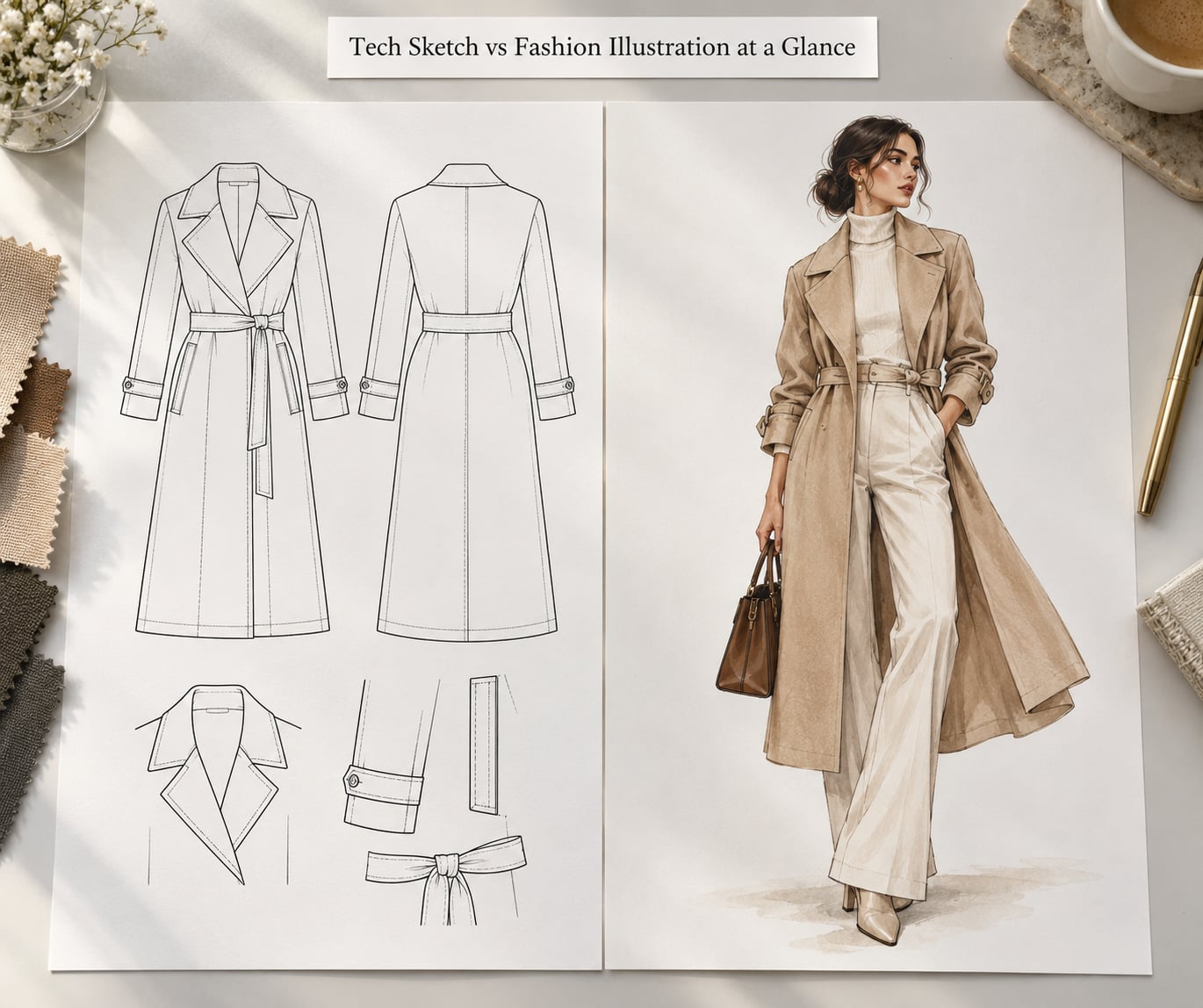
| Attribute | Tech Sketch (Technical Flat) | Fashion Illustration |
|---|---|---|
| Primary purpose | Construction and production | Concept, mood and presentation |
| Figure used | No figure, garment drawn alone | Croquis or model figure |
| Pose | Straight, symmetrical, static | Angled, moving, mid-stride |
| Color | Usually black on white, optional | Often coloured, not required |
| Shading | None | Shading, highlights, texture |
| Line weight | Even throughout | Varied for depth |
| Viewpoint | Front, back, side, laid flat | Single chosen view |
| Detail focus | Seams, closures, stitching, trims | Silhouette, drape, styling |
| Audience | Pattern maker, factory, costing team | Client, buyer, showroom |
| Process stage | Development to production | Ideation to approval |
| Skill type | Objective, measurable, learnable | Stylistic, personal, developed over time |
| Typical output volume | Batched, one per style per view | One-off per look |
Read the table vertically and one pattern shows up: every technical attribute is measurable, and every illustrative attribute is a decision about mood. That split is the reason both drawings survive into the same folder.
What Is a Tech Sketch?
A tech sketch is a precise, unshaded drawing of a garment shown on its own, front, back and side, so a pattern maker can build it without guessing. In apparel production it works like a blueprint: it answers how something is assembled, not how it looks on a person.
The terminology trips people up, so here is the whole chain in one line. Tech sketch, technical sketch, technical drawing, fashion flat and flat sketch all name the same deliverable. If a job posting asks for flats, that is the drawing described here.
What lands on the page or screen depends on the stage. Early versions carry silhouette, proportion and the key design details. Later versions add seam callouts, topstitching, closures, hardware, labels and notes about lining or interlining. Once sizes are graded, the same drawing exists as a set of nested versions, one per size.
What a Tech Sketch Is Actually For
Three jobs, mainly. It settles construction decisions while they are still cheap to change, it hands the pattern maker unambiguous information, and it becomes the reference page inside the tech pack that the factory works from.
What Is a Fashion Illustration?
A fashion illustration is a picture of the design as it would look worn. It places the garment on a croquis, a simplified figure you draw yourself in your own proportions, and it uses pose, colour and rendering to set the tone of the collection.
The illustration is where proportion gets tested. A designer stretches the leg, drops the shoulder or shortens the sleeve on the figure before committing anything to a flat, because changing it later costs a sample round trip.
It is also the drawing clients react to. Buyers, press and showroom staff read an illustration in seconds and feel the collection from it, which is why illustrators spend hours on a single look when the flats for that look take twenty minutes.
Purpose and Design Development
The two formats sit at opposite ends of the timeline. Illustrations carry a design from a scribble to a yes, and tech sketches carry that yes all the way to a sewn sample.
Where the Illustration Comes First
During ideation, a designer produces volume: dozens of quick sketches, then a handful of selected illustrations for the collection direction. These drawings answer whether the idea is exciting, and they carry the styling, accessories and mood that the flat deliberately strips out.
Where the Tech Sketch Comes First
Once a look is approved, the flat does the work. Every seam that needs explaining is called out, every closure is drawn open or closed as intended, and the drawing is built so someone who has never seen the original sketch can make the garment correctly.
That is the whole tech sketch vs fashion illustration difference in one sentence. The practical consequence runs straight through the industry: illustrations can change a design in a meeting, flats lock it down. A factory cannot measure a shaded drawing, so when one arrives instead of a flat, sampling errors, extra revision rounds and delayed deliveries follow.
Line Quality and Shape Construction
Tech sketch lines are uniform in weight from neckline to hem. Consistency matters more than beauty here: a pattern maker reads every line as a boundary, and a line that fades out halfway down a seam is a question nobody can answer from the page.
Fashion illustration lines do the opposite. Weight varies deliberately, with a heavier stroke for the outer silhouette and finer lines for interior detail, which is how a flat drawing starts to look dimensional. Gesture and a little looseness read as confidence and energy.
Shape construction follows suit. Flats are built from symmetry and proportion against a grid, often from a template, so both sides of the garment match. Illustrations are built on a figure with real anatomy and an attitude, so proportion can be deliberately pushed.
One practical consequence: a flat can look awkward and still be a good flat, while an illustration can be beautiful and useless to a factory. Those are separate skills, and most designers are stronger at one of them than they expect to be for years.
Detail, Fabrics, and Construction Features
A tech sketch concentrates on what the garment does. Seams and their placement, closures, topstitching lines, pleats, pockets, hardware, thread colour notes and the way a lining is finished all get drawn or annotated.
Measurements live beside it. Points of measure, the named locations a size is taken from, attach to the flat and travel with it into the tech pack so every factory measures the same way. Tolerance notes say how much variation is acceptable at each point.
An illustration concentrates on what the garment feels like. Fabric drape, the weight of the fabric, texture, layering and the styling around the look get all the attention. Surface pattern and print get rendered carefully, because that print is usually the point of the garment.
The overlap is worth naming. A designer drawing a gathered sleeve has to decide whether the gathers are the story or the construction. If they are the story, they show up in the illustration; if they are structural, they are called out on the flat. Most looks need both.
Color and Rendering
Colour is optional in a tech sketch and normal in an illustration, though plenty of illustrators work in black and white for speed. A flat that carries colour usually does so with flat fills and no gradients, because a factory matches cloth and trims, not lighting.
Rendering is where the formats separate most visibly. Shading, highlights, cast shadows and texture rendering have no place on a flat and carry the whole emotional weight on an illustration. A well-rendered illustration tells you the fabric weight before a word of the collection text is read.
Two exceptions worth knowing. Some brands render flats in colour as a specification aid, and some illustrators finish in monochrome. Neither changes the underlying job of each drawing.
Tools, Skills, and Workflow
Tech sketches are made with a pencil, fine liner or marker on layout paper, or in Adobe Illustrator on a vector grid where each line stays editable and scales cleanly. CLO 3D fits here too, since a 3D garment can be flattened into technical views before sampling exists.
Fashion illustrations get made with pencils, fineliners, markers, watercolour or coloured pencil on paper, and digitally with Adobe Illustrator, Procreate, Photoshop or a tablet and stylus. Most working illustrators mix both, sketching rough on paper and finishing the colour digitally.
What Each Format Asks of Your Hands
Illustration is a style you develop, and progress looks like more confident marks and a recognisable hand. Flats are a construction discipline, and progress looks like accurate proportion, clean symmetry and correct seam placement. Learning apparel construction matters more for the second than any amount of shading practice.
The Hand Sketch to Vector Workflow
The usual route between the two formats is straightforward. Draw the design on paper, trace or place it in Illustrator as a template, redraw it with the pen tool as clean vector paths, then add callouts and detail. Beginners often skip the redraw and trace the whole sketch, which produces a flat that inherits every wobble from the original.
Which Should You Choose?
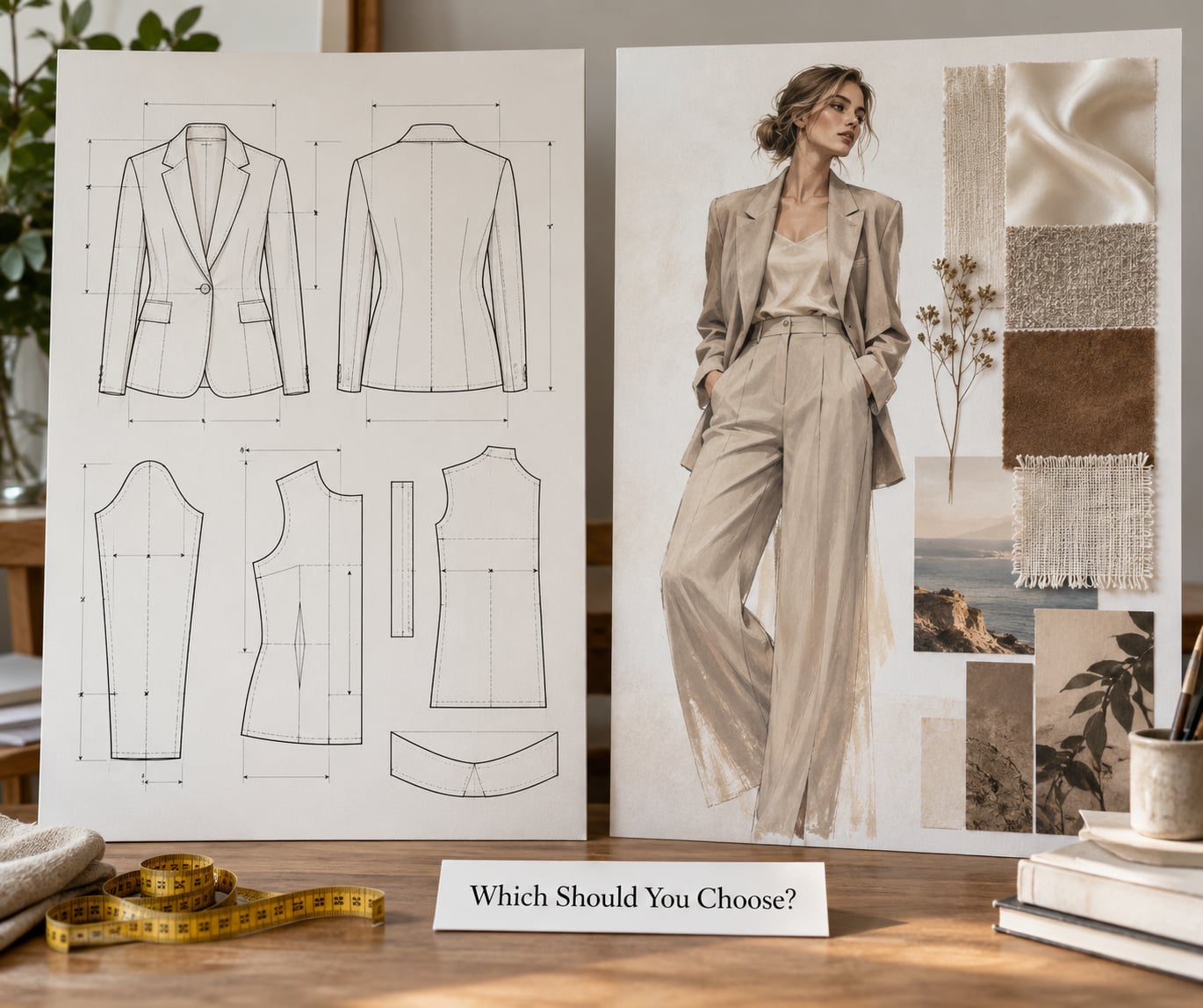
Choose a tech sketch when the reader has to make or approve the garment: a pattern maker, a factory, a costing team or a sampling round. Choose a fashion illustration when the reader has to feel the design: a client pitch, a mood board, a lookbook, a showroom sell.
If You Are Starting Out
Learn the flat first, and this is not a close call. A flat is objective, so it can be checked against a real garment, and it teaches construction that an illustration never forces you to learn. Plenty of designers are hired on construction skill and add illustration style later.
For a portfolio, show both, with the flat alongside its illustration on the same board. Reviewers want to see that you can move between an idea and a buildable garment, and one look presented both ways proves it faster than two separate pages.
For a client meeting, lead with illustrations and keep flats in the back pocket. For a factory handoff, send flats with points of measure and tolerances attached. A complete professional presentation carries both, and the full tech pack usually contains the illustration as a reference page next to the flat that governs production.
Frequently Asked Questions
Is a tech sketch the same thing as a fashion flat?
Yes. Tech sketch, technical sketch, technical drawing, fashion flat and flat sketch are all names for the same deliverable: an unshaded line drawing of a garment shown in front, back and side views for construction and production. Which term a brand uses says more about its in-house vocabulary than about a different drawing type. What separates a flat from an illustration is not the label but the intent behind the line.
Which should I draw first as a beginner in fashion design?
Learn the tech sketch first. It is objective, which means you can check your work against a real garment and know whether you were right, and it teaches seam placement, proportion and construction knowledge. Illustration is a personal style that takes longer to develop and hides weak construction behind good drawing. Many working designers describe the flat as the skill that got them hired and the illustration as the one they practise for years.
Can a factory make a garment from a fashion illustration?
Not reliably. An illustration is stylised, shaded and usually posed, so a factory cannot take measurements from it or tell which folds are construction and which are drawing. Sending one in place of a flat usually produces sampling errors, extra revision rounds and delays. Illustrations travel with a tech pack as a reference page so the factory understands the intent, while the flat plus points of measure governs what is actually made.
What does a fashion tech pack contain?
A typical tech pack holds the technical sketch or flats in front, back and side views, a bill of materials listing every fabric, trim and label, the points of measure with graded sizes and tolerances, construction notes covering seams, closures and stitching, trim and hardware references, and reference photography. Presentation illustrations are often included too, so the factory can see the intended look. The pack is the document the whole production team works from.
Do I need both in my fashion design portfolio?
Yes, and showing one look in both formats on the same board is the strongest way to present them. A portfolio full of illustrations alone reads as drawing ability; a portfolio full of flats alone reads as technical skill without taste. Paired, they show you can move from an idea to a buildable garment, which is exactly what a design team needs to hire. Keep the flat accurate and let the illustration carry the personality.
What software should I use for tech sketches and illustrations?
For tech sketches, Adobe Illustrator on a vector grid is the industry default because lines stay editable and scale for graded sizes. For digital illustration, Procreate and Photoshop suit rendering, and Illustrator suits flat vector work. Manual drafting with pencil, fineliners or markers still builds the strongest construction instinct, and most professionals sketch on paper before finishing digitally. CLO 3D adds 3D garment views when you need to check drape before a sample exists.
Conclusion: Choose the Drawing That Fits Your Goal
A tech sketch shows how a garment is built, and a fashion illustration shows how it feels to wear. Everything else, from line weight to colour to audience, follows from that one difference.
Start with the drawing you owe someone. Building to a factory, a pattern maker or a costing sheet, make the flat. Pitching a collection, showing a mood or building a portfolio, make the illustration. Once both feel natural, you stop choosing between them and just use the right one.