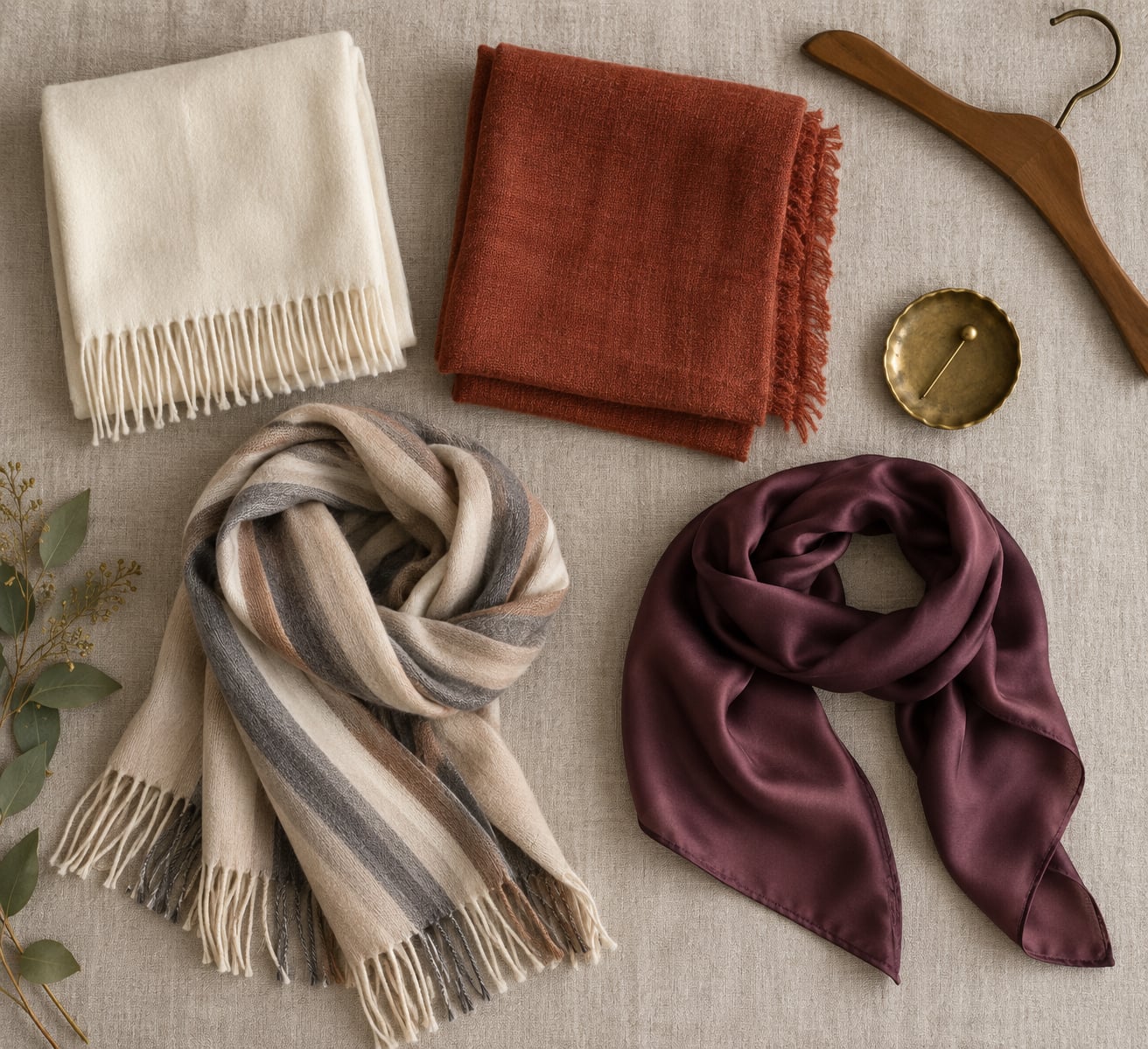
Learning how to tie a scarf several ways comes down to one thing: the technique has to match the scarf’s shape and size. A narrow rectangle folded thin makes a neat choker, a large square makes a shawl, and the same loop you wear on a weekend works over a coat in cold weather. Ten techniques below cover every scarf most people actually own.
Every tie here is written out in full steps, so you can follow along without rewinding a video. Each one names the scarf it needs, says what the finished look should be, and tells you how to fix it when the ends slip or the whole thing collapses ten minutes later.
Table of Contents
- How To Tie a Scarf Several Ways: Quick Style Guide
- How to tie a scarf several ways by scarf shape and occasion
- 1. How To Tie a Scarf in a Simple Neck Loop
- 2. How To Tie a Scarf in a Chunky Oversized Knot
- 3. How To Tie a Scarf in a French Knot
- 4. How To Tie a Scarf as a Neckerchief
- 5. How To Tie a Scarf in an Infinity Loop
- 6. How To Tie a Scarf in a Draped Front Loop
- 7. How To Tie a Scarf as a Belt-Style Waist Wrap
- 8. How To Tie a Scarf as a Headband
- 9. How To Tie a Scarf in a Ponytail Wrap
- 10. How To Tie a Scarf in a Loose Cape-Style Drape
- Frequently Asked Questions
- What size scarf is best for tying?
- What are the different types of scarves?
- How do I stop a scarf knot from slipping?
- How do I tie a scarf without adding bulk at the neck?
- What scarf knot is most stylish?
- Conclusion
How To Tie a Scarf Several Ways: Quick Style Guide
The table below is the shortcut: find your scarf, find the knot, and go. Difficulty runs from a two-step loop to a four-step wrap, so start at the left if you have never tied a scarf before.
How to tie a scarf several ways by scarf shape and occasion
| Tie | Best scarf shape | Difficulty | Suits |
|---|---|---|---|
| Simple neck loop | Medium or large rectangle | Easy | Everyday, work, weekend |
| Chunky oversized knot | Large lightweight rectangle | Easy | Cold weather, knitwear, coats |
| French knot | Lightweight square, silk | Medium | Tailored outfits, blazers, dinners |
| Neckerchief | Small square, silk | Medium | Shirts, boat necks, casual polish |
| Infinity loop | Long rectangle or pashmina | Easy | Layering over jumpers, uniform looks |
| Draped front loop | Long rectangular scarf | Easy | Open necklines, wide coats, colour pop |
| Belt-style waist wrap | Long thin rectangle | Medium | Waisted coats, dresses, jumpsuits |
| Headband | Narrow rectangle | Easy | Cold mornings, hair down days |
| Ponytail wrap | Small square | Easy | Workouts, errands, summer |
| Cape-style drape | Very large square or rectangle | Easy | Dressy events, travel, statement dressing |
Fold changes everything, and it is the step people skip. Rolling a rectangle into thirds before you drape it turns a snouty scarf into a tidy wrap, and folding a square into a triangle keeps the point where you want it instead of letting it flop.
1. How To Tie a Scarf in a Simple Neck Loop
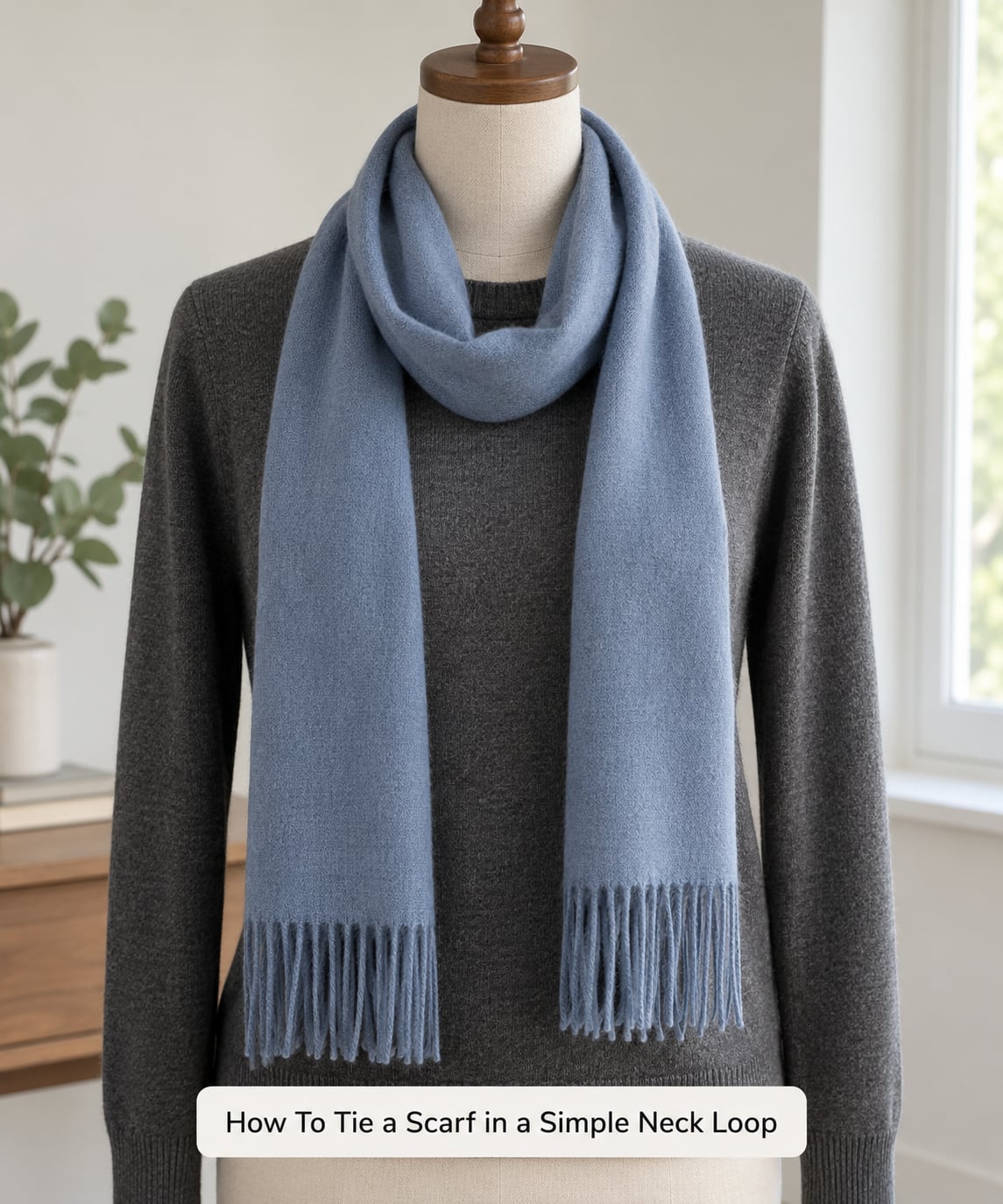
This is the everyday tie: a soft oval of scarf sitting at the collarbone with two ends down the front. It works on any rectangle that is at least medium sized, and it is the fastest way to make a plain knit look considered.
- Fold the scarf in half lengthwise, then open the fold and hold it as a long band.
- Drape it around the back of your neck with one end in each hand.
- Slide both ends forward and under, so the scarf makes one loose turn at the throat.
- Pull the ends down and outward until the loop sits flat on your collarbone, not up under your chin.
- Match the two ends by eye at chest level, then fluff the loop with your fingers to soften the roll.
If the loop sits high and crowds your chin, you wrapped too tightly. Pull the whole thing down and forward in one go, then reshape. The scarf should rest on the collarbone, where a crew neck would sit.
2. How To Tie a Scarf in a Chunky Oversized Knot
You need a large, lightweight scarf for this, ideally a rectangle over 70 cm on the long side. The result is a big soft knot at the front with volume everywhere else, and it is the tie that makes a heavy knit or a plain coat look deliberate.
- Fold the scarf in half and loop it once around your neck, with the fold sitting at the front.
- Take the two loose ends together and pass one end through the loop you just made.
- Pull both ends through the loop to form one generous knot at your chest.
- Tighten by pulling the ends sideways rather than downward, which keeps the loop at the front instead of sliding it around.
- Fluff the fold and the two tails so the volume spreads instead of sitting in one lump.
Oversized scarves swallow petite wearers, and a front knot makes it worse. Fold the scarf into thirds before draping so the working length is halved, and the volume spreads across the shoulders rather than hanging in one heavy column.
3. How To Tie a Scarf in a French Knot
The polished one. Use a lightweight square or a slim silk rectangle, because a heavy wool square will not sit flat and a big one overwhelms the look. The finish is a small neat knot at the throat with the ends running flat down the shirt front.
- Fold the square in half on the diagonal to make a triangle, then roll the two long edges toward each other until the roll is about as wide as your thumb.
- Place the rolled scarf around your neck with the seam facing your skin, so nothing shows on the outside.
- Take the right end over the left, then bring the right end back under itself to make a square knot.
- Repeat left over right and pull both ends down gently until the knot sits snugly at the base of the throat.
- Adjust the seam and check from the front that the roll sits flat, then spread the ends so they hang at matching lengths.
Slipping means the knot is sitting too low or the roll is too thick. A thick rolled edge slides out of a square knot, so roll thinner, and move the knot up to the hollow of the throat where there is no collar in the way. Uneven ends are the other common tell, and they are fixed at the end, not the knot.
4. How To Tie a Scarf as a Neckerchief
A small square scarf tied at the front and pointed down reads retro and sharp, and it fills an open neckline that would otherwise look bare. Use a small square in silk or cotton, about 40 to 55 cm.
- Fold the square in half on the diagonal to make a triangle, then roll the two long edges toward each other to make a band.
- Place the middle of the band at the nape of your neck with both ends coming to the front.
- Cross the left end over the right at the base of the throat, then tuck the left end behind the right.
- Bring the right end up through the small opening and pull it down to lock the knot in place.
- Pull both ends down so the triangle points toward your chest, then flatten and square the fold.
If the point flops over, you tied the knot too high. Move it down a couple of centimetres so the triangle has room to hang. A hidden safety pin behind the knot keeps it steady through wind or a long day out.
5. How To Tie a Scarf in an Infinity Loop
This is the two-loop method, and it is the tidiest way to wear a long rectangle or a pashmina. The result is a symmetrical double loop at the front, no knot in sight, and the same loop reads neatly over a jumper or under a coat.
- Fold the scarf in half lengthwise, then fold it in half again so you have four layers with two loose ends together.
- Wrap the folded scarf around your neck and pass the loose ends forward under the standing loop.
- Slide your hands through the loop, forming a second loop inside the first, and put your neck into the second loop only.
- Pull the first loop forward over the second and rotate it until the two layers are even and centred.
- Match the two ends at your chest and roll the folds once to fatten the loop evenly.
Twisting is the usual complaint, and it comes from wrapping the ends at different lengths. Start with the ends exactly even, and check that both loops are the same width before you leave the mirror. If the scarf twists as you walk, unloop it and start again rather than fighting it.
6. How To Tie a Scarf in a Draped Front Loop
A long rectangular scarf draped so one end crosses the other and both fall to the front is the least technical of the elegant looks. It suits open necklines, wide coats and turtlenecks where a knot would add too much bulk.
- Hold the scarf by its middle behind your neck, with one end about 15 cm longer than the other.
- Let the shorter end fall over your left shoulder and the longer end over your right.
- Cross the long end over the short one, then bring it back under and let it fall slightly lower.
- Pull the short end back across the front so both ends sit at different lengths, the longer one lower.
- Spread the scarf flat across the chest and step back to check the two lengths are deliberate, not accidental.
This tie fails when the scarf is too short, because there is nothing to drape. A scarf under about 90 cm has to be folded into thirds first, which gives you the same fall with half the fabric.
7. How To Tie a Scarf as a Belt-Style Waist Wrap
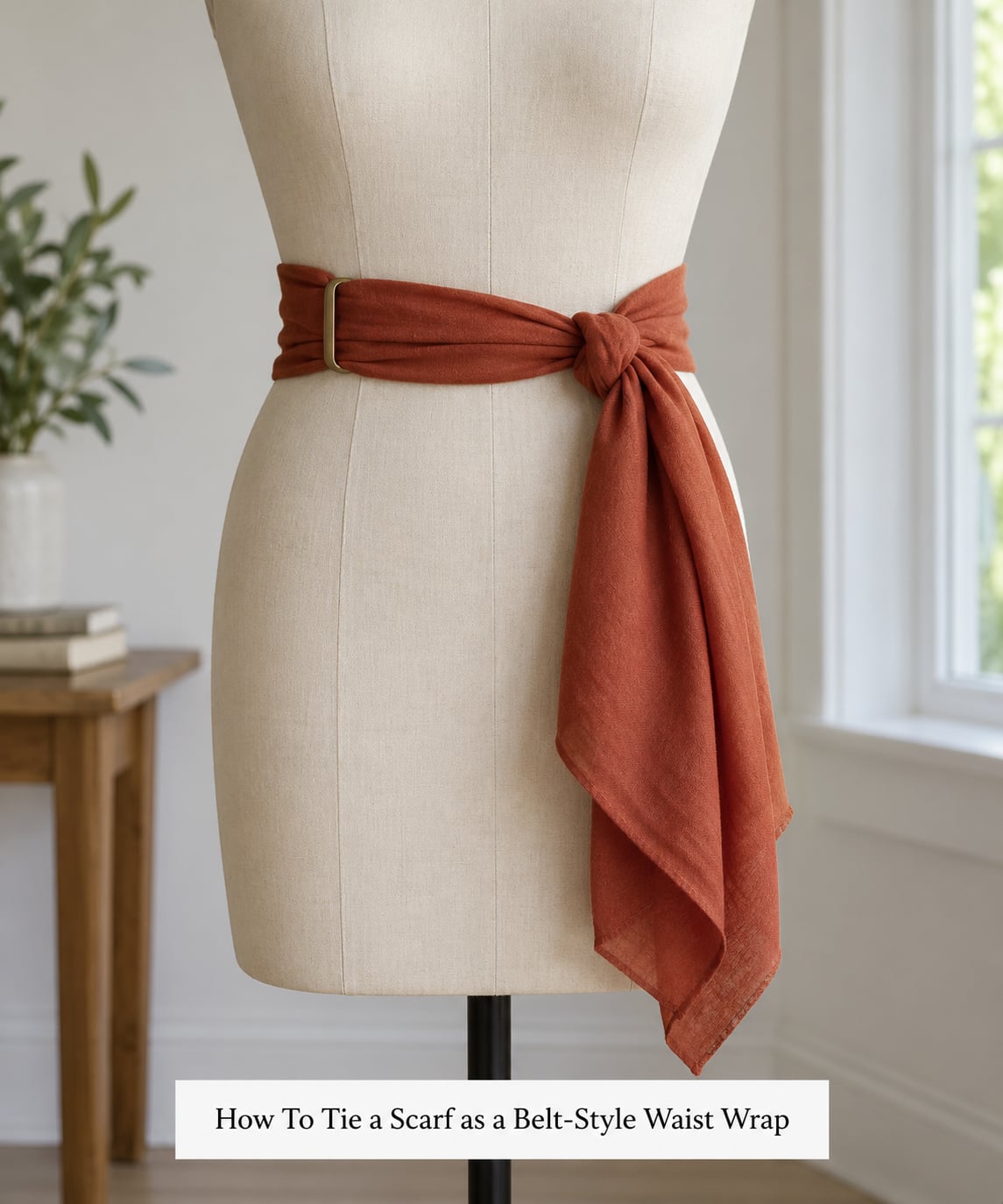
Use a long thin rectangle, and this turns a shapeless coat or a straight dress into something that looks considered. It is the tie people rarely think of and then use every winter.
- Fold the scarf into a narrow band and hold one end against your waist on the left side.
- Wrap the band around your waist once, keeping it at the narrowest point or at the top of the hip.
- Thread the working end through a belt loop, then through the next loop along, to anchor the scarf.
- Come back around the front and tie one loose asymmetrical knot slightly off centre, one tail short and one long.
- Pull the tails to the same thickness and smooth the band so it lies flat rather than rolled at the edges.
If the band rides up, you are wrapping too high or too tight. Anchor it through two belt loops and leave about a finger of space under the band. A thin silk scarf works here as well as a wool one, and a bright colour gives an all-black outfit a single strong accent.
8. How To Tie a Scarf as a Headband
A narrow rectangular scarf makes a headband that stays on through a windy morning, and it keeps hair out of your face while you are working. Fold a thin rectangle lengthwise into a band about 5 cm wide.
- Fold the scarf lengthwise into a flat band, hiding the raw edges on the inside.
- Place the band across your forehead just above the eyebrows, with the seam facing down and away from your hairline.
- Cross the ends at the nape of your neck, with the left end over the right.
- Bring the right end under and up through the loop, then pull both ends sideways to tighten.
- Stop tightening the moment the band feels snug, then flatten the fold across your temples.
A headband that slips has been pulled too tight, because a tight band slides over the crown. Leave a finger of space at the temples, and tie the knot slightly lower at the nape so it anchors rather than climbs.
9. How To Tie a Scarf in a Ponytail Wrap
A small square scarf tied over a ponytail covers the elastic and turns a gym top into a finished look. Any small square works, and silk stays in place better than a slippery synthetic.
- Hold a small square scarf by two opposite corners and roll each corner inward to make a tube.
- Place the middle of the tube over the top of your ponytail, just above the elastic, with the ends hanging down.
- Wrap both ends underneath the ponytail and bring them back up to the front.
- Tie them in a small knot at the base of the ponytail, or wrap them around the hair tie twice and tuck them in.
- Pull the scarf up slightly so it covers the elastic completely, then fan the ends flat.
Tucking beats knotting on fine hair, because a knot tends to slide straight down. Wrap the ends around the elastic once, tuck the loose corners inside the tube of hair, and the scarf will stay put through a workout.
10. How To Tie a Scarf in a Loose Cape-Style Drape
This is for a very large square or a big rectangle, roughly 140 cm or more, and it is the most dramatic of the ten. The result sits across the shoulders with the fabric pooling slightly in front, which is why it works over a plain column dress or a simple coat.
- Lay the scarf across your shoulders with the centre sitting at the back of your neck, even on both sides.
- Bring both ends to the front and hold them together at mid-chest, with the scarf lying flat across the collarbones.
- Tuck the ends under themselves at the centre to make a soft front closure rather than a knot.
- Pull each end down slightly so the two tails hang at matching lengths and the front sits symmetrical.
- Spread the fabric over both shoulders and check from the side that the back of the neck is covered without crowding your chin.
A very large scarf needs a fix or it walks. Tuck a brooch or a hidden safety pin through both layers at the centre closure, and the drape holds for the whole evening. If it still feels heavy, use a large square rather than an oversized rectangle so the weight sits on the shoulders instead of the front.
Frequently Asked Questions
What size scarf is best for tying?
A medium rectangle of about 70 by 35 cm handles most ties, from the simple neck loop to the French knot. A large square of 90 cm or more is needed for shawls and the cape-style drape, and a small square under 55 cm suits the neckerchief and ponytail wrap. Very large scarves work once you fold them into thirds to shorten the working length.
What are the different types of scarves?
There are four main shapes: a long rectangle, a large square, a small square, and a pre-sewn infinity scarf. Rectangles are the most versatile and handle loops, drapes and the French knot. Large squares make shawls and capes. Small squares in silk or cotton are for neckerchiefs, headbands and ponytails. Infinity scarves are looped and only need arranging, not tying.
How do I stop a scarf knot from slipping?
Most slips come from tying too low or too thick, so move the knot up to the hollow of the throat and roll the fold thinner. A hidden safety pin anchored to your collar or top stops a slide through a whole day. Anchoring a second loop through your belt loops works for waist wraps, and tying a double knot holds on soft silk.
How do I tie a scarf without adding bulk at the neck?
Keep the fold narrow and the loop resting on the collarbone rather than under the chin. Use a thinner fabric for a thicker look, and save heavy knits for a half-drape where the bulk sits on the shoulders. A long scarf worn under a coat collar adds almost nothing visually, which is the easiest way to stay warm without volume.
What scarf knot is most stylish?
For a tailored or dressy outfit, the French knot on a lightweight square is the most polished and works with a blazer or a shirt. For everyday wear, the simple neck loop in a medium rectangle is harder to get wrong. The draped front loop is the best of both, since it reads as effortful without needing any knot at all.
Conclusion
Start with the simple neck loop and the infinity loop, because both are hard to get wrong and between them they cover an ordinary rectangle in about a minute. Once those sit comfortably, add the French knot for tailored outfits and the waist wrap for coats, which are the two that change how an outfit reads most.
Choose by three things: the scarf’s shape and size, the neckline underneath, and how much drama you actually want. A small square cannot make a shawl and a large rectangle will not sit flat as a choker, so match the technique to the fabric you already own rather than buying for the tie. The rest is just practice in front of a mirror until the ends match on the first try.