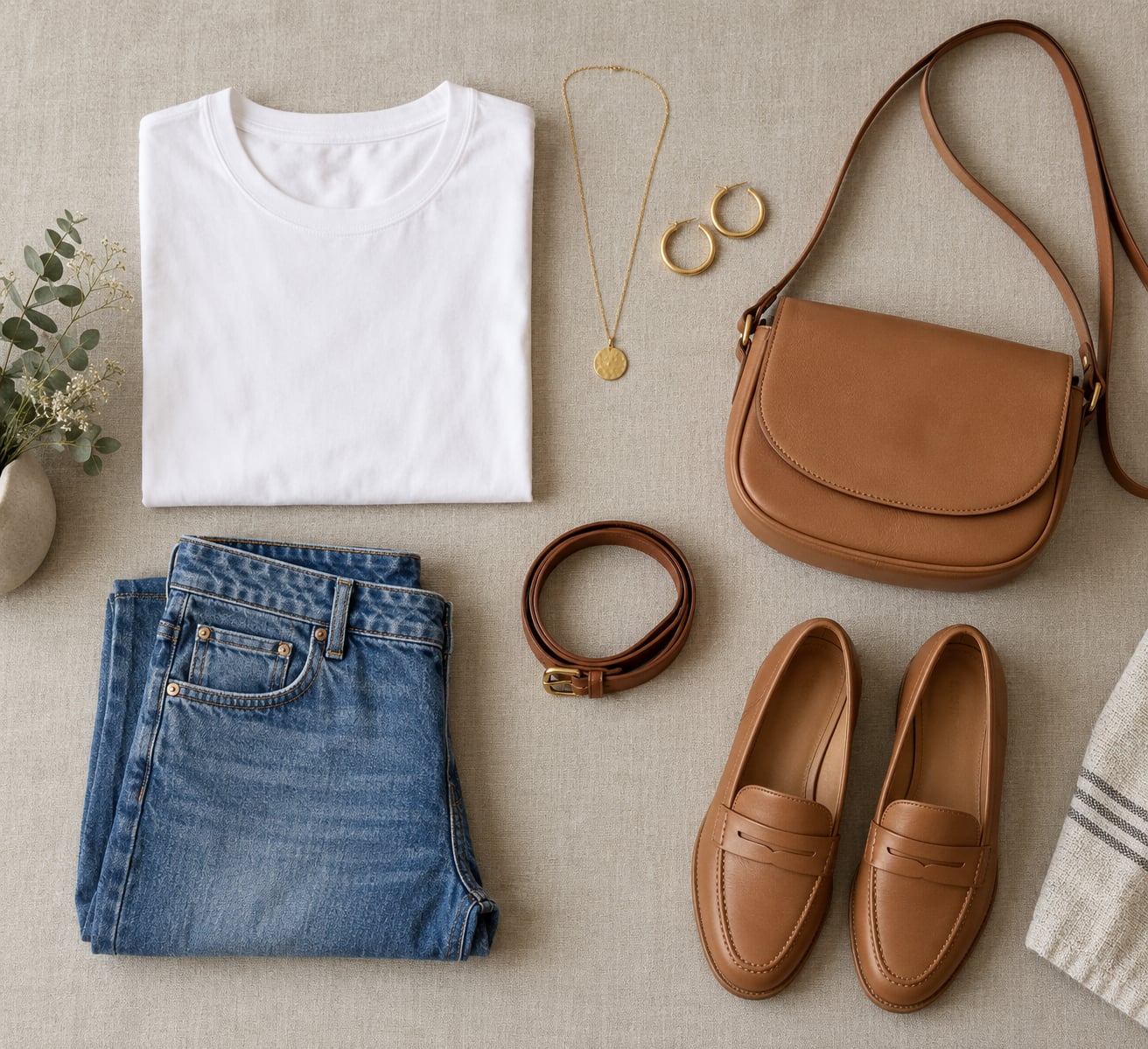
To accessorize a simple outfit, pick one focal piece — statement earrings, a chain necklace, or a good bag — then add one or two supporting accessories in a coordinating color and finish with footwear. That is the whole method, and it takes about five minutes once you know the order.
It works whether you own thirty outfits or three. Most of the confusion I see comes from adding accessories in random order instead of deciding what the outfit’s strongest feature is first.
Table of Contents
- What You Need to Accessorize a Simple Outfit
- How to Accessorize a Simple Outfit: A Six-Step Formula
- 1. Start With the Outfit’s Main Feature
- 2. Choose Jewelry That Matches the Neckline
- 3. Add a Bag with the Right Scale
- 4. Use Shoes to Anchor the Outfit
- 5. Add One Functional or Signature Detail
- 6. Check Color, Texture, and Visual Balance
- Common Mistakes and How to Fix Them
- Frequently Asked Questions
- How many accessories should I wear with a simple outfit?
- What accessories go well with a plain black outfit?
- What kind of jewelry should I wear with different necklines?
- Should my handbag and shoes match?
- How can I accessorize a simple outfit on a budget?
- Conclusion
What You Need to Accessorize a Simple Outfit
A simple outfit — a white tee and jeans, a black slip dress, a plain knit with wide-leg trousers — already does most of the work. It has no pattern competing for attention and no complicated silhouette to decode, which means accessories have room to be the interesting part.
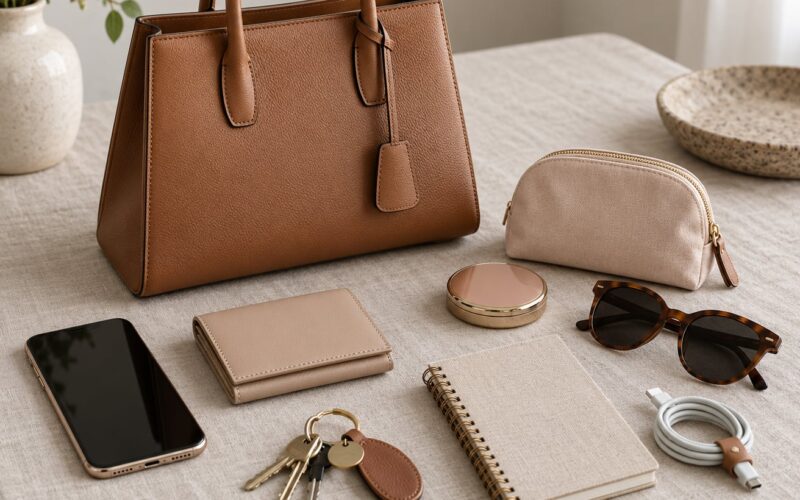
That gives you a short list of categories worth shopping. Jewelry works hardest: hoops, a pendant, a bracelet stack, stacked rings. A bag changes the formality of an outfit more than anything else you can add. Shoes shift the whole tone, casual to sharp. A belt defines a waist and can split a long top into two shorter lines.
Then there are the situational pieces: a silk scarf, sunglasses, a watch, a hat, a brooch. Those aren’t required. They come in after the basics are working.
If you want a buying order, start here: one pair of hoops, one chain, one belt, one bag, one good pair of shoes. Add everything else later. If you buy in that order you’ll never end up with twelve necklaces and nothing to wear them with.
One more thing to check before you start shopping. When the clothing already has strong color, pattern, volume, or detail, use fewer accessories, not more. A bright floral dress with layered necklaces and stacked bangles has nowhere to go.
How to Accessorize a Simple Outfit: A Six-Step Formula
This is the order I work in, and it’s the same order every time so you stop making decisions. Start with the outfit’s feature, add jewelry, choose the bag, settle the shoes, add one functional detail, then check the balance.
1. Start With the Outfit’s Main Feature
Before adding anything, name the one element the eye lands on. It’s usually color, silhouette, neckline, or fabric texture. Everything else you add should support that element rather than start a competition with it.
A monochrome outfit in black and white has no color story, so the accessories can carry one. Add a single red bag or a gold pendant and the look has a point of view. With a bright basic — a cobalt sweater, a saturated skirt — keep accessories quiet so the color stays the loudest thing in the room. A textured neutral outfit like a cable-knit or a linen set already has visual interest, so jewelry should stay fine and close to the body.
Two focal points is the most that usually works. Three is where outfits start looking accidental.
2. Choose Jewelry That Matches the Neckline
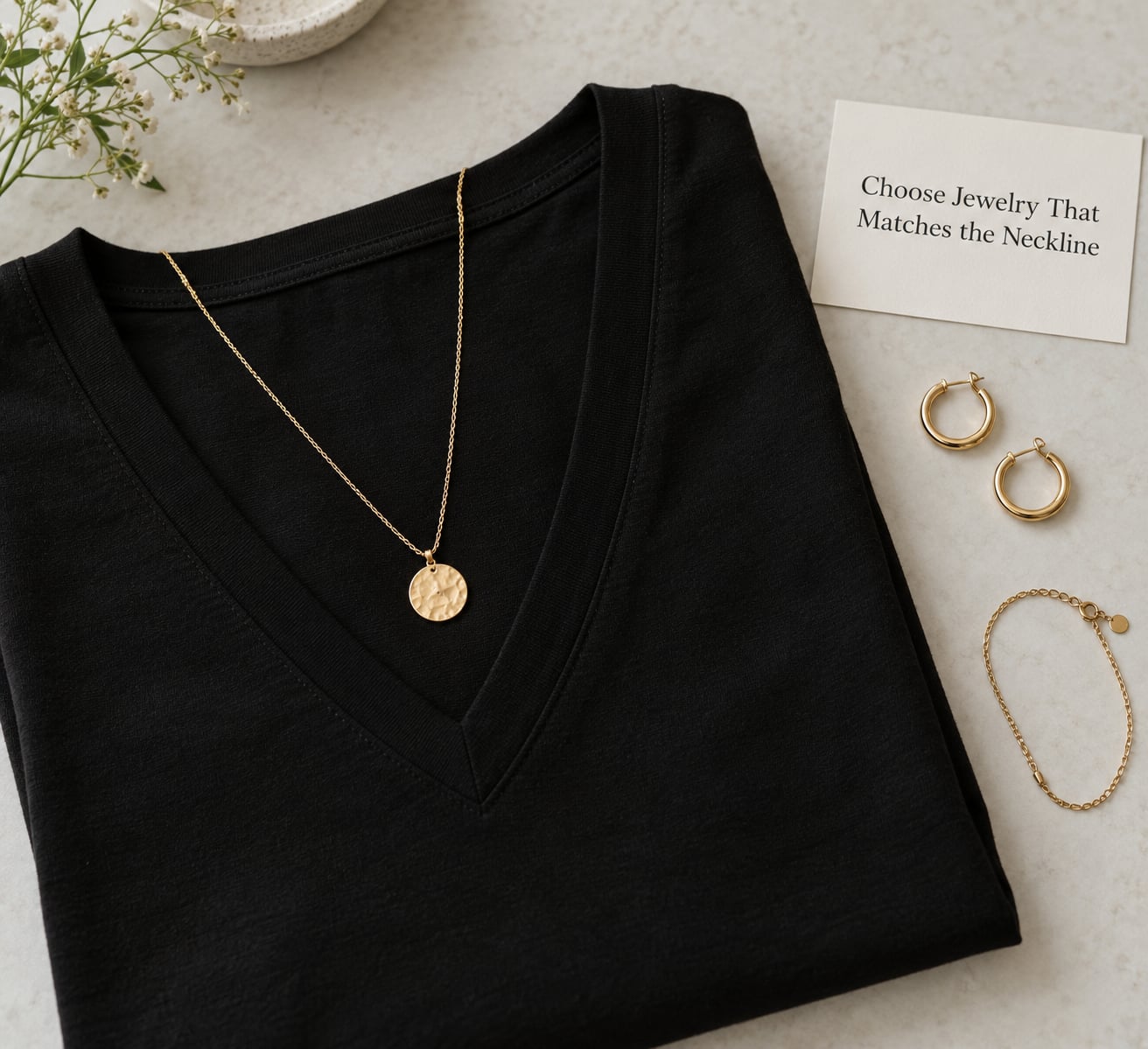
Neckline decides necklace length. A crew neck sits close to the base of the throat, so a pendant at that same height crowds it. Move the chain down: a Y-shape, a 16 to 18 inch chain, or a longer pendant that lands over the chest. A V-neck opens the chest, so a shorter chain that sits inside the V or a collarbone-length bar necklace balances it.
A shirt collar wants a necklace that clears the collar points or disappears under it. A boat neck runs wide and horizontal across the shoulders, so a longer chain or a bold pair of earrings works better than a short pendant that gets lost. With a sleeveless top or bare arms, you have more room — a bracelet or stacked rings can carry more weight than they would over long sleeves.
On metal, matching is the safe default. If you want to mix gold and silver, keep one metal dominant and the other as an accent, ideally on a different part of the body so they don’t argue on the same line of sight.
And when you own good earrings, skip the necklace. One prominent piece beats three delicate layers every time.
3. Add a Bag with the Right Scale
Bag size should roughly match your frame and the volume of the clothing. A mini bag on someone tall and broad reads as an afterthought. An oversized tote on a petite frame swallows the outfit.
Shape matters as much as size. Structured bags read formal and put a line through an otherwise shapeless outfit. Slouchy and relaxed bags suit soft fabrics and weekend clothes. Compact crossbody bags keep hands free and work with anything. A statement bag with an unusual color or texture does the focal-point job on its own.
Handle length is the detail people miss. A top-handle bag sits at the hand and shortens the visible line of the torso. A shoulder strap lengthens it. Both are fine — just decide which one you want.
Color is simpler than most guides make it sound. Either pick the bag in a neutral that appears somewhere in the outfit already, or pick one contrasting color deliberately. Deliberate contrast is a choice. Accidental contrast is a mistake.
4. Use Shoes to Anchor the Outfit
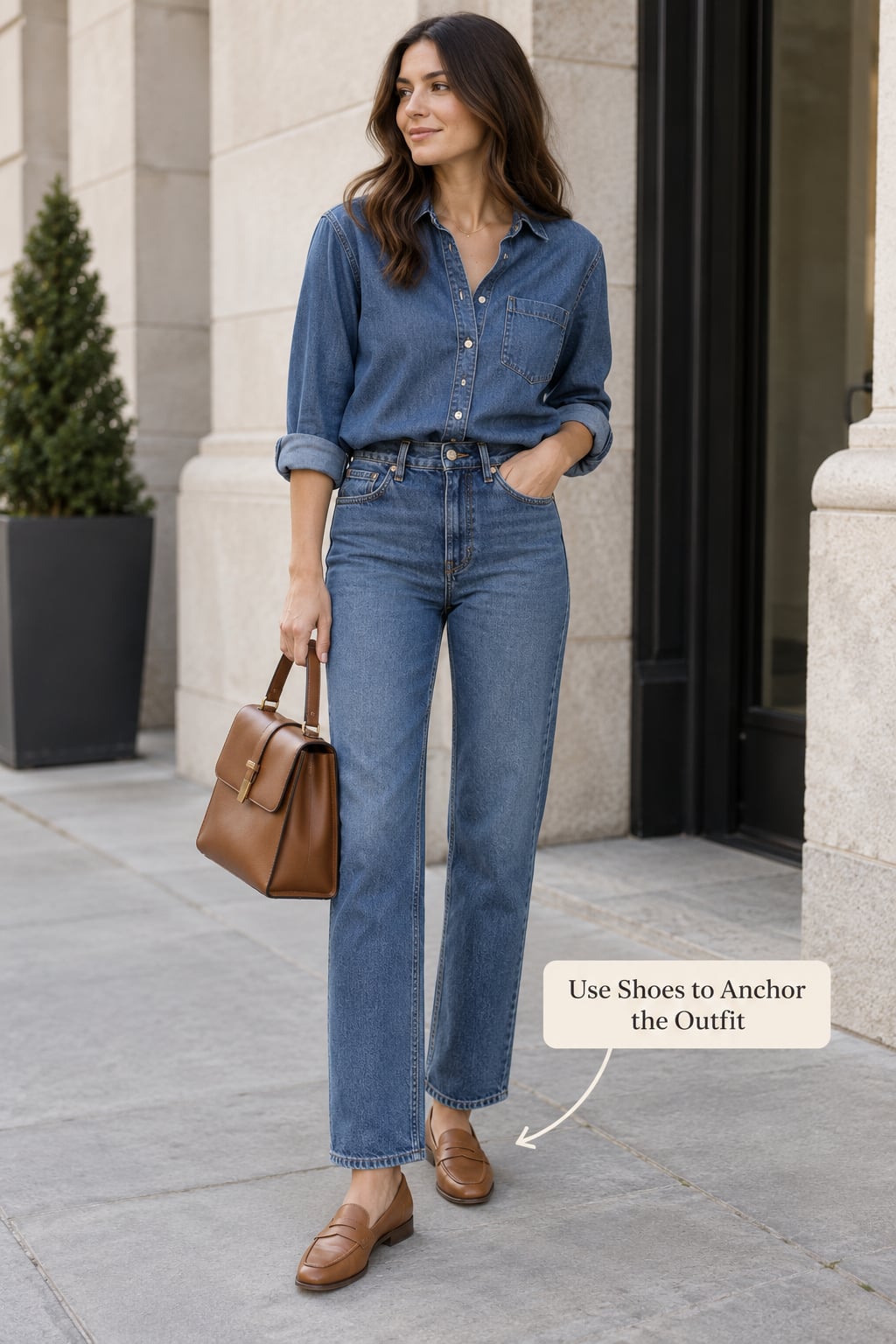
Shoes are the most underused accessory. They’re also the one people notice first, because the eye travels down. Same-tone shoes in a similar material to the bag create one unbroken line, and that alone makes a plain outfit look considered.
Coordinate the tone first: tan belt, tan loafers, brown bag, and the outfit reads as designed. Black-and-white basics with black loafers and a structured black bag look sharper. Wearing white sneakers with a tonal outfit keeps it casual; wearing them with a midi skirt and blazer creates a deliberate contrast that works in 2026.
The shape of the shoe sets the formality. Flats and loafers say relaxed. Heels and boots say dressed up. Sneakers say off-duty. If you want one pair that handles most of a simple wardrobe, a clean leather loafer or a low ankle boot covers more ground than you’d think.
5. Add One Functional or Signature Detail
Now the optional layer: a belt, a scarf, a watch, sunglasses, a hat, a brooch. Pick one, not all five. This is where outfits tip from polished into over-accessorized.
The test is repetition. Wherever you choose your color, your material, or your metal, echo it somewhere else in the outfit. Warm brown leather shoes with a brown belt and a tan bag is three small repetitions that read as one decision. The same three accessories in three unrelated finishes look like three separate purchases.
A belt is the most functional of these. It gives shape to a straight or oversized top, and it works with the shoes you already picked. A scarf adds color to a neutral without needing a whole new outfit.
The same logic applies to menswear basics, and it’s worth saying because most guides skip it. A plain white shirt and chinos need a watch, a good belt, and either a clean pair of sunglasses or a knit tie. That’s a complete accessory framework in three pieces. Cufflinks, a pocket square, and a simple chain cover the dressier end.
6. Check Color, Texture, and Visual Balance
Final pass. Count colors: a simple outfit should land at two or three, including the accessories. Then check texture. One dominant texture — suede, leather, knit, silk — plus something smoother keeps it interesting without turning noisy.
Balance is about where the weight sits. If everything is up top — big earrings, a chunky necklace, a bold bag, a bright hat — the bottom looks unfinished. Move one piece down, usually the bag, and the whole look settles.
Two shortcuts help. The first is the three-piece limit: no more than three noticeable accessories at once, and never more than three of anything in the same color family. The second is the focal point rule, which is simpler — one accessory does the talking, everything else agrees.
Then do the 10-foot check. Squint at yourself from across the room and notice what jumps out first. If it’s not what you meant to emphasize, remove or shrink that piece. Finish at a mirror and check the reverse — the back of the outfit matters in photos and in real life.
Finally, adjust for context. Work pulls toward fewer, quieter pieces. Evenings and events can carry more. Cold weather turns a bag and jewelry into layers. Formality usually means smaller bags, closed-toe shoes, and less metal.
Common Mistakes and How to Fix Them
Over-accessorizing. Six visible accessories at once is a lot for a simple outfit. Fix: cap it at three noticeable pieces — jewelry, bag, and one other — and take the rest off.
Proportions that don’t agree. A chunky bag with a chunky belt and chunky jewelry triples the visual weight. Fix: vary the scale. Heavy earrings, then a slim belt and flat shoes.
Competing focal points. Patterned skirt, statement necklace, bright bag, bold earrings. Fix: pick the one you care most about and mute the rest to a neutral or a smaller size.
Color that doesn’t connect. The outfit, bag, and shoes each pull from a different part of the spectrum. Fix: repeat one color from the clothing somewhere in the accessories, and let the rest stay neutral.
Mixed metals without a plan. Gold necklace, silver hoops, gold watch, silver ring, all on different lines. Fix: pick one metal as the main and make the other a single accent.
The wrong occasion. A canvas tote and chunky trainers at a wedding, or a micro bag and stilettos for a client call. Fix: decide the formality before you accessorize, not after.
Pieces that only work once. An accessory that pairs with one specific top is a costume, not a wardrobe piece. Fix: before buying, name three outfits it would work with.
A few tips that hold across all of it. Start with the outfit’s strongest feature and support it. Choose fewer pieces and make each one count. Repeat a color or material somewhere so the outfit reads as a single decision. And when in doubt, remove one accessory.
Frequently Asked Questions
How many accessories should I wear with a simple outfit?
Three noticeable pieces is the sweet spot for most simple outfits: one piece of jewelry or a hero accessory, a bag, and shoes. You can layer beyond that as long as it reads as one group, such as stacked rings or a short necklace chain. If you are unsure, take one accessory off and check yourself from ten feet away. If the first thing you notice is the right thing, the balance works.
What accessories go well with a plain black outfit?
A plain black outfit has no color, so accessories can carry it. Gold or silver metal, a colored bag, a patterned silk scarf, or textured leather all work because they introduce something the clothing does not have. The main thing to avoid is adding two accessories that fight for attention, such as a bright bag and heavy statement earrings. One loud piece plus quiet supporting pieces is the safer formula.
What kind of jewelry should I wear with different necklines?
Match necklace length to how much skin the neckline shows. A crew or scoop neck suits longer chains and pendants that sit below the collarbone. A V-neck takes a shorter chain that sits inside the V, or a collarbone-length bar. A shirt collar wants a necklace that clears or hides under the collar points. A boat neck, with its wide horizontal line, pairs best with longer chains or bold earrings.
Should my handbag and shoes match?
Matching tone is easy and always safe: tan shoes with a tan or brown bag, black with black, so the outfit reads as one continuous line. Matching exactly is not required. A contrast works well when it is deliberate, such as a cream outfit with black loafers and a black bag, or white sneakers under a tonal outfit. The rule is that the shoe and bag should relate to each other, whether by color, material, or both.
How can I accessorize a simple outfit on a budget?
Start with five things that work with everything you already own: one pair of hoops, one simple chain, one belt, one structured bag, and one clean pair of shoes. Secondhand is a reasonable place for these, since classic shapes hold up. Skip trendy pieces until you know which accessories you actually reach for. The most useful budget move is keeping, not buying: wear the pieces you own in new combinations first.
Conclusion
Start with one accessory category that supports whatever your simple outfit already does best — its color, its neckline, or its silhouette. Then add one supporting piece, settle the shoes, and step back. Edit for balance before anything else goes on.