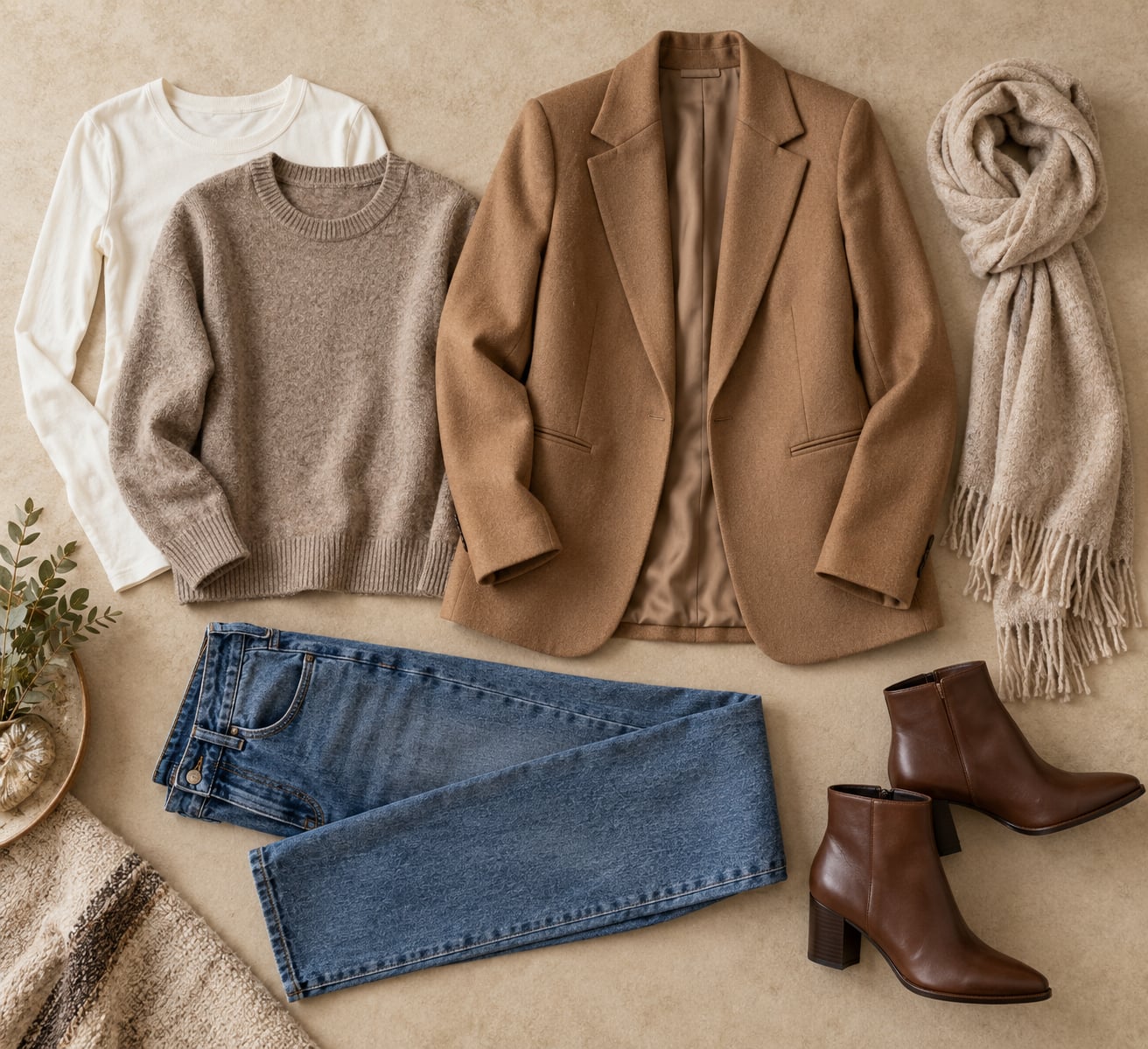
The trick to layering without looking bulky is contrast, not volume: start with a thin base layer, add one mid layer that fits your shoulders rather than hanging off them, and finish with an outer layer that stays open so the layers underneath are still visible. If every piece is the same weight, the same length and the same shape, the eye reads one shapeless mass.
Most bulky layering fails for the same three reasons. Too much fabric lands in one place, usually the waist and upper arms. Every layer hits at the same length, so the eye gets no break. Or the base layer is hidden completely, which wastes the whole point of the system.
It takes about five minutes to build a layered outfit properly, and the only real skill involved is deciding where the volume goes before you put anything on.
Table of Contents
- What You Need to Layer Clothes Without Looking Bulky
- How to Layer Clothes Step by Step
- 1. Start With a Slim Base Layer
- 2. Add Definition at the Middle Layer
- 3. Keep the Outer Layer the Lightest Layer
- 4. Balance Volume From Top to Bottom
- 5. Create a Long, Clean Vertical Line
- 6. Check the Fit in Motion
- What to wear at each temperature
- Common Layering Mistakes That Make You Look Bulky
- Frequently Asked Questions
- How do I layer clothes in winter without looking bulky?
- What is the best base layer for everyday outfits?
- Should I wear the same color for every layer?
- How can I layer clothes without making my waist look wider?
- Can I layer a chunky sweater under a blazer?
- How do I make layered outfits look less casual at work?
- Start With the Layer Closest to You
What You Need to Layer Clothes Without Looking Bulky
Every layered outfit is three pieces in a fixed order, and the order does the work. The base layer sits against your skin and does nothing but move sweat and add a little warmth. The mid layer is where the insulation lives. The outer layer blocks wind and takes the visual weight of the outfit.
The rule underneath all three: each layer should be thinner and lighter than the one over it. Reverse that order and the bulk climbs.
Here is what is worth owning in each slot.
- Base layer: a fitted long-sleeve top in cotton, bamboo or a fine merino wool, a ribbed tank, or a thin thermal for genuinely cold mornings.
- Mid layer: a fine-gauge crewneck or V-neck sweater, a button-down shirt, a sweater vest, or a cropped cardigan.
- Outer layer: a structured blazer, a denim or leather jacket, a shacket, a tailored coat, or a longer cardigan worn open.
Before dressing, run two checks on the outer layer. Can you close it comfortably over a sweater without pulling across the shoulders? Can you get your arms fully overhead? If the answer is no to either, that jacket is a mid layer, not an outer layer.
How to Layer Clothes Step by Step
1. Start With a Slim Base Layer
Choose a base layer that follows your body without gripping it. A fitted long-sleeve or a fine-gauge knit sits smooth under everything else and does not add a single centimetre of visual width.
Merino wool and bamboo are the two fabrics I reach for most. Merino moves moisture away from skin and stays warm when damp, and bamboo feels cool enough to wear indoors. Cotton is fine for three seasons but holds dampness, which makes you colder later in the day.
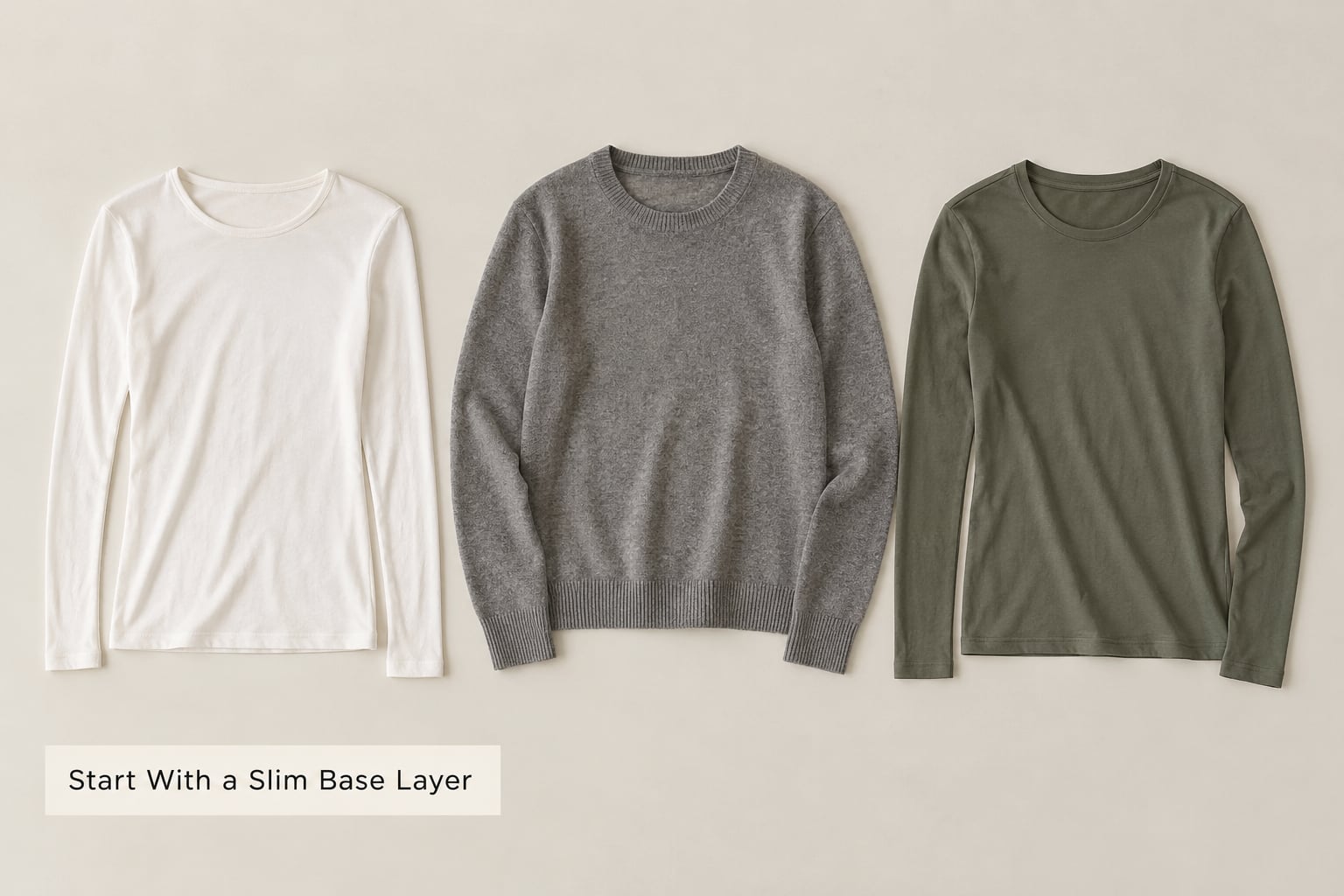
Two things to avoid. Skip thick ribbed thermals under a chunky sweater, because the ribbing compresses and shows through as lumps. And skip a baggy base layer; anything loose under a sweater reappears as bunching at the waist and across the back.
How do you stop a sweater from bunching under a jacket? Keep the base layer shorter than the mid layer, and choose a mid layer with a smooth, flat front rather than a bulky knit you have to fold.
2. Add Definition at the Middle Layer
The mid layer is where the shape of the outfit is decided, so it should be the one piece that has structure. A button-down shirt with a collar, a fine-gauge sweater, a fitted cardigan, or a vest gives the eye something to hold on to.
Leave yourself room around the torso and the upper arms. You want to be able to cross your arms without the fabric straining at the biceps, and you want roughly two fingers of space between the mid layer and the outer one.
Necklines are the free lever here. A turtleneck under a V-neck opens the chest and adds height. A collared shirt under a crewneck makes a small frame look deliberate. A scoop neck under a blazer keeps the front from reading as one solid block.
Textiles also matter more than most people expect. A smooth jersey or a fine rib is easier to layer than a heavy cable knit, because the outer layer lies flat over it.
3. Keep the Outer Layer the Lightest Layer
This is the step most people skip, and it is the one that decides whether the outfit looks finished. The outermost garment should be the roomiest and the most open, with the front left unbuttoned or unfastened so the middle layer is visible down the centre.
An oversized blazer, a long open cardigan or a shirt-jacket all work, because they hang rather than cling. What does not work is a boxy padded jacket closed to the top button on top of a chunky knit, because then you have two bulky layers facing the same direction with nothing in between.
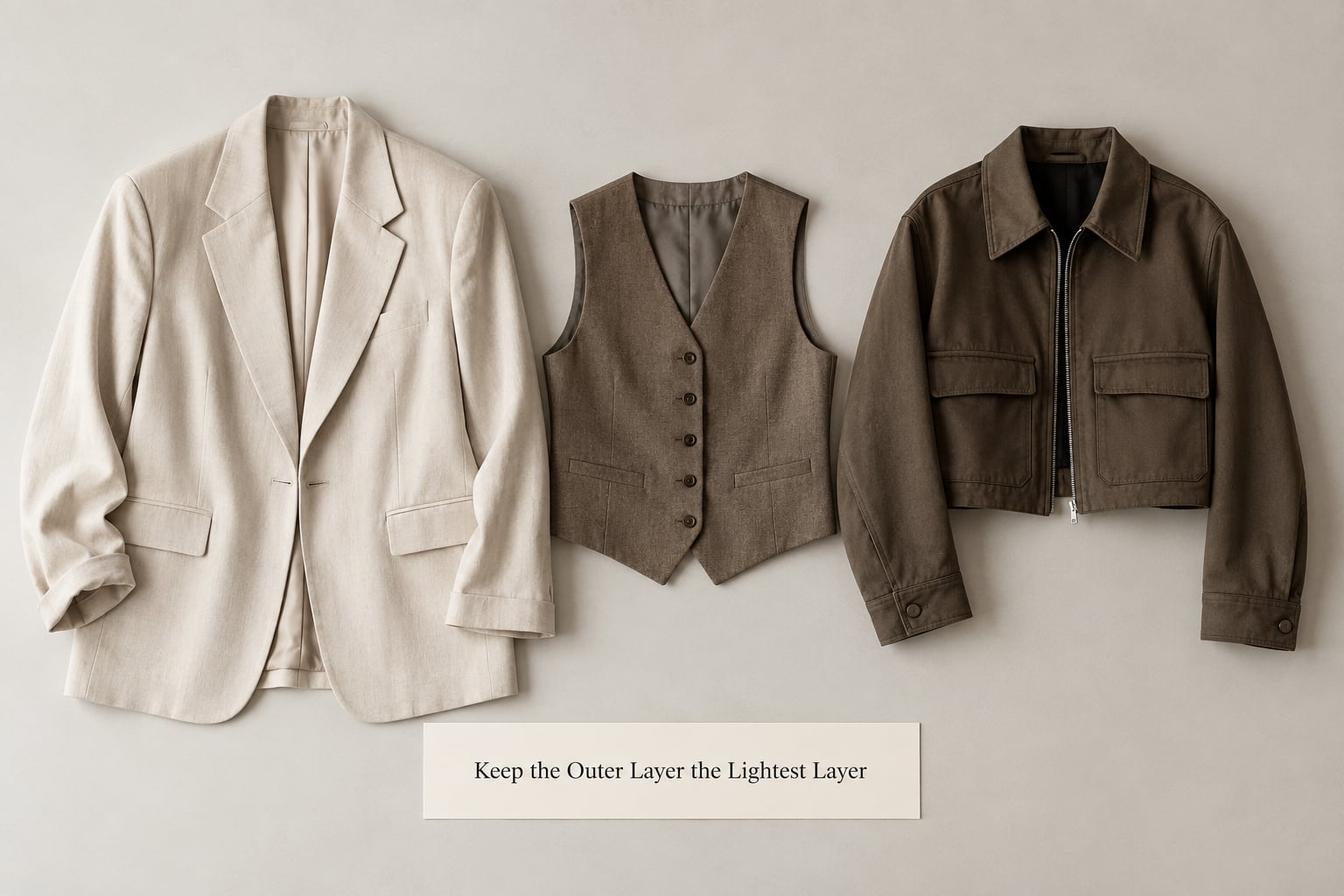
Control the hemline. A mid layer that ends at the waist under a hip-length coat gives you two horizontal lines close together and shortens the torso. A mid layer that ends at the hip under a long coat leaves one line and lets the coat read as a single column.
4. Balance Volume From Top to Bottom
Never stack the bulk on both halves of your body at once. If your top half is carrying a chunky sweater, a scarf and an oversized coat, put something streamlined on the bottom: straight-leg jeans, a slim skirt, a slip skirt, a clean boot, a flat shoe.
The reverse works too. Wide-leg denim or a full skirt with a fitted top and a long open coat keeps the volume low and the upper body sharp.
For anyone layering over a dress, the same logic holds. A slip or jersey dress under a fine-gauge sweater and an open coat stays slim, while a bodycon or knit dress under a chunky sweater under a jacket disappears entirely.
How do I stop my waist from looking wider? Belt the mid layer rather than the coat, or pick outerwear that closes at the waist instead of straight down the side. Volume that is cinched once reads as shape; volume that is loose everywhere reads as mass.
5. Create a Long, Clean Vertical Line
Open layers are your most useful styling tool. When a coat, cardigan or overshirt hangs open, the two front edges form two vertical lines, and the eye follows them downward and reads the outfit as longer.
Keep those edges visible. If the base layer is longer than the mid layer, the lines break. If the mid layer is tucked or gathered, the lines stop at the waist.
Colour does the same job as cut. A monochromatic outfit, or one built from two shades of the same neutral, turns a stack of pieces into a single block with no visual edges. Add one accent and put it where you want the eye to land, usually near the face.
How to wear oversize without looking bigger? Wear one oversized piece, keep the other two close to the body, and add one vertical line through the front opening, a long necklace, or a scarf that hangs straight down.
6. Check the Fit in Motion
Standing still is the least useful test. Sit down, cross your arms, bend forward and reach for something on a high shelf. This is the check that tells you whether the layers will survive a real day.
Look for four things. Fabric pulling across the back of the shoulders means the mid layer is too thick or the outer one is too small. Fabric spilling over the waistband means the base layer is too long. A gap at the back of the neck means the outer layer will gap further when you move. And sleeves that stop well above the cuff of the outer layer make the whole stack look borrowed.
What should I size up for when layering? Only the outermost shell. Travellers who pack light make the same call, sizing up for a rain jacket and keeping their normal fit everywhere underneath.
A note for cold days indoors: choose layers you can unzip and tie around your waist or fold into a bag without ruining the outfit underneath. A thermal top that disappears under a shirt works far better than a chunky sweater you have to peel off at the door.
What to wear at each temperature
| Temperature | Base layer | Mid layer | Outer layer |
|---|---|---|---|
| Around 60F | Fitted long-sleeve top | Lightweight knit or button shirt | Denim jacket or shacket, open |
| Around 45F | Fine-gauge merino or bamboo top | Crewneck sweater or cardigan | Open blazer or trench |
| Around 30F | Thin thermal with a long-sleeve over it | Fine-gauge sweater | Tailored wool coat, open |
| Teens | Thermal top and thermal leggings | Chunky knit worn on its own or under a coat | Insulated parka with a straight hem |
In the teens, the bulky piece moves to the outside. Below freezing that is the only honest way to stay warm, and a coat that hangs straight is what keeps it from looking marshmallow-shaped.
Common Layering Mistakes That Make You Look Bulky
These six account for nearly every layered outfit I have seen go wrong, and each one has a straightforward fix.
- Choosing every layer too large. A garment cut for layering should be close-fitting on its own. Buy your normal size in knits, and only size up in a shell you plan to wear over everything.
- Making all layers the same length. Three hems at the same spot create a stack of horizontal lines. Mix a cropped or tucked mid layer with a long outer layer, or a hip-length sweater with a cropped jacket.
- Hiding the base layer completely. If nothing shows, you are wearing one thick top instead of a system. Let a collar, a hem or a neckline peek out so the layers read as separate.
- Adding bulk at the waist. Thick fabrics gathered or tucked at the midsection add volume to the one place most people already have enough. Let the mid layer fall straight, or cinch it with a belt to turn the same fabric into shape.
- Stacking a chunky knit under a padded outer. Two heavy layers in the same place is the single fastest route to looking shapeless. Keep the chunky piece as the outer layer and make everything underneath fine-gauge.
- Never checking the outfit while moving. Sit, stand, walk and reach before you leave. A combination that looks good standing still often pulls across the back after ten minutes of sitting.
A few extras that come up constantly. If you are overheating the moment you walk inside, the base layer is too warm rather than too cold, and swapping a thermal for a merino top fixes it. If you layer mostly over a fuller bust, keep the texture on the lower half and leave the upper body in flat colour. If your midsection is the fuller area, put the volume on your legs and keep the top narrow.
The same advice works for menswear, where the usual mistake is adding a chunky knit under a bulky field jacket. A thermal or a fine-gauge roll neck under a denim jacket or a chore coat, left open, keeps the same warmth and reads far cleaner.
One last piece of maintenance: layered knits pill fastest where they rub, so turn them inside out and wash them cold, or use a pilling comb every few wears. Fabric that has gone fuzzy adds exactly the visual bulk you were trying to avoid.
Frequently Asked Questions
How do I layer clothes in winter without looking bulky?
Keep each layer thinner and lighter than the one over it: a fitted merino or bamboo base, a fine-gauge mid layer, and one roomy outer piece worn open. Avoid two heavy layers in the same spot, keep hems at different lengths, and let a vertical line run down the front so the eye reads length rather than width.
What is the best base layer for everyday outfits?
A fitted long-sleeve top in fine merino wool or bamboo is the most useful base layer for most days. Merino moves moisture off the skin and stays warm when damp, while bamboo feels cool enough indoors. Keep it smooth and avoid thick ribbed thermals, which compress under a sweater and show as lumps.
Should I wear the same color for every layer?
Matching or staying within one shade of the same neutral creates one continuous block of colour, so the layers stop reading as separate pieces. That is the easiest way to look taller and leaner. Add a single accent colour near the face or at the feet to give the eye somewhere deliberate to land.
How can I layer clothes without making my waist look wider?
Keep the mid layer straight through the midsection instead of tucking or gathering it, and avoid thick fabrics that bunch at the waistband. If you want shape back, belt the mid layer or choose an outer layer that closes at the waist. Push the volume to the legs so only one half of the outfit is full.
Can I layer a chunky sweater under a blazer?
Yes, if the blazer is cut with room and you keep the base layer thin. A fitted tee or a fine-gauge roll neck under the chunky knit, then a blazer worn open, works well because the front edges make a vertical line. What does not work is closing the blazer, which traps and doubles the bulk.
How do I make layered outfits look less casual at work?
Swap the outer layer for something structured such as a tailored coat or a blazer, and choose a mid layer with a collar rather than a hoodie. Keep the palette to two neutrals, add a belt at the waist, and finish with structured shoes and a structured bag. The silhouette does the work, not the number of pieces.
Start With the Layer Closest to You
Begin with a smooth, fitted base layer in a breathable fabric, then add one mid layer that gives the outfit structure, and finish with the roomiest piece worn open. Check the outfit while you move before you walk out the door.
That is the whole method. Thin, structured, open, and different lengths, with the volume sitting on only one half of your body at a time.