You should replace makeup every 3 months to 24 months after opening, depending on the product. Eye products sit at the short end, powders and intact sealed items at the long end, and anything that smells off, separates or changes texture goes sooner than the date says.
The dates printed on the box are a starting point, not the whole story. Most cosmetics carry a small open-jar symbol rather than a real expiration date, because the clock only starts once the product meets air, fingers and a bathroom window.
I keep a note on the back of my bathroom mirror with the month I opened each product. It takes ten minutes to set up and it removes most of the guesswork that makes people either panic-discard good makeup or keep a clumpy mascara for a year.
Last reviewed in 2026. Guidance below follows the open-jar symbol on packaging, FDA advice on cosmetics shelf life and standard dermatologist guidance on skin and eye health.
Table of Contents
- How Often to Replace Makeup Products: Quick Shelf-Life Guide
- Eye makeup
- Face makeup
- Lip products
- Tools
- What Determines When Makeup Goes Bad?
- Moisture is the deciding factor
- Preservatives weaken over time
- What the 6M, 12M and 24M symbols mean
- Unopened versus opened: what actually changes
- Why the numbers you read online disagree
- Replacement Times by Makeup Type
- How to Tell When a Makeup Product Has Expired
- Five signs worth binning on sight
- When to stop using it immediately
- How to Store Makeup for Longer
- Skip the bathroom
- Keep it dark, cool and closed
- Choose packaging over fingers
- How to Replace Makeup Without Wasting It
- Tools and applicators have their own schedule
- Track the open date in thirty seconds
- Adapting the intervals if you do not wear makeup daily
- Frequently Asked Questions
- What does the 6M symbol on makeup mean?
- How often should I change my mascara?
- Is it okay to use 10 year old eyeshadow?
- What are the side effects of using expired makeup?
- How often are you supposed to replace makeup brushes?
- Is there an app that can tell me if my makeup has expired?
- A Simple Makeup Replacement Checklist
How Often to Replace Makeup Products: Quick Shelf-Life Guide
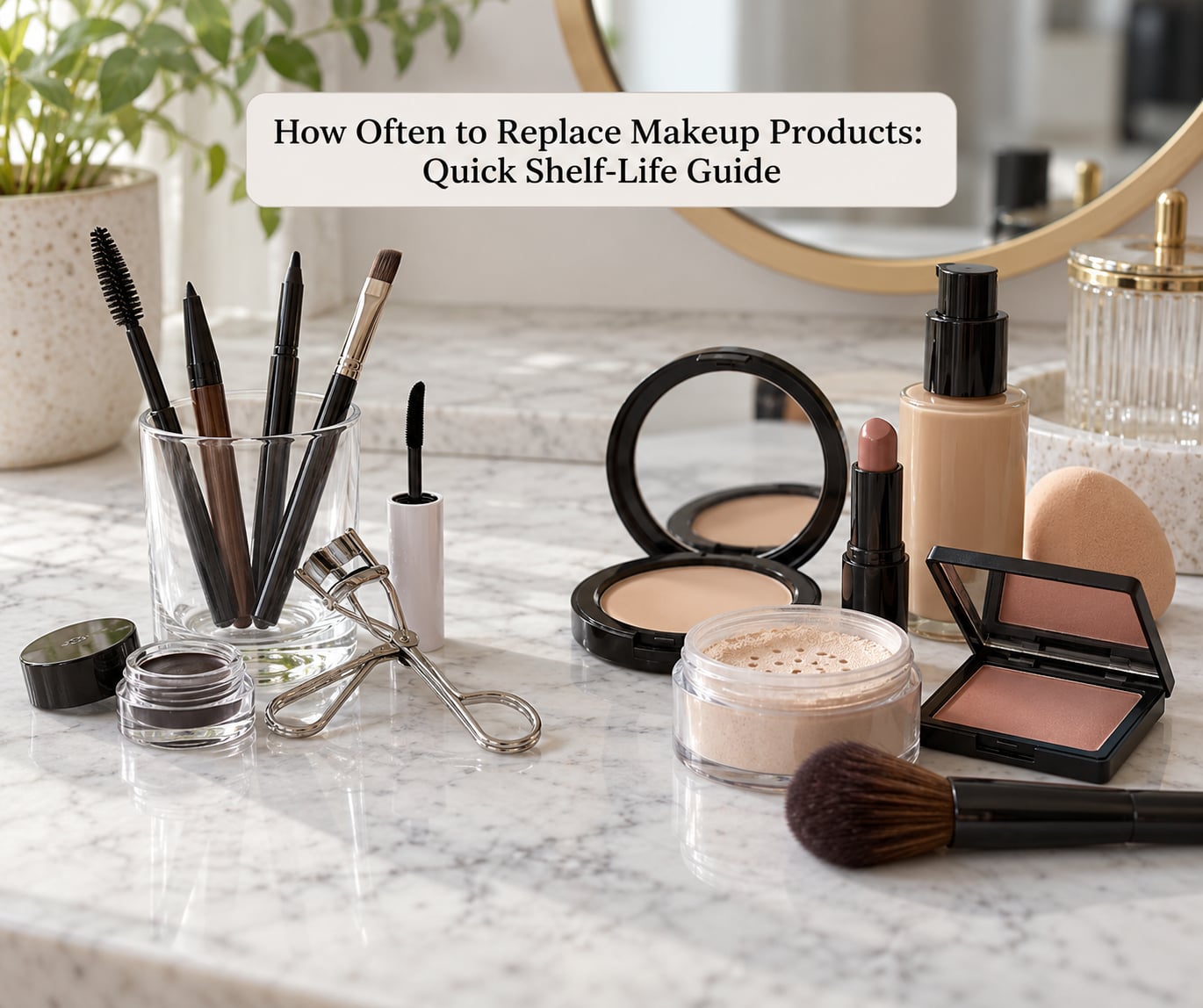
The fastest way to sort your bag is by formula, not by product name. Anything water-based or cream-based lives in months; anything dry and anhydrous lives in years.
Eye makeup
Mascara gets about 3 months because the wand goes near your lashes and eyelids every time you use it. Liquid and gel eyeliner sit near 3 to 6 months for the same reason. Pencil eyeliner is drier and usually good for 12 to 24 months if you keep sharpening it cleanly.
Face makeup
Liquid and cream foundation run 6 to 12 months. Concealer in a tube does fine at about 12 months, while concealer in a wide jar ages faster because fingers go straight in. Cream blush and cream bronzer last roughly 12 months, and pressed powder blush, bronzer, highlighter and setting powder stretch to about 24 months.
Lip products
Lipstick, lip gloss and lip liner are usually good for 12 to 24 months. Liquid lip colours tend to be the exception in the other direction, since their thin film dries out faster than a solid bullet.
Tools
Makeup brushes that are cleaned regularly last 2 to 3 years, and blenders and sponges are single-use items, replaced every couple of months at most.
What Determines When Makeup Goes Bad?
Shelf life comes down to how much water a formula holds, what keeps that water safe, and how much contact the product has with your skin. Change any one of those and the timeline moves.
Moisture is the deciding factor
Bacteria and fungi need water to grow. That single fact explains nearly every number in this guide. Pressed powder is essentially anhydrous, so it can sit for years without feeding anything. Cream foundation and liquid eyeliner are mostly water, which is exactly what microbes want.
Preservatives weaken over time
Every water-based formula is dosed with preservatives that keep it stable for a set window. Heat, light and air break those preservatives down faster than a cool, dark drawer would. When they stop working, the product can still look perfect and still be carrying more organisms than it should.
What the 6M, 12M and 24M symbols mean
That little open-jar icon with a number and a letter is the period-after-opening symbol, and it is the most reliable number on the packaging. 6M means use within 6 months of opening, 12M means 12 months, 24M means 24 months. Count from the day it was first opened, not the day it was bought.
If the symbol is missing or rubbed off, fall back on the category guidance in the table below.
Unopened versus opened: what actually changes
An unopened product is protected by its seal and often has 2 to 3 years before it needs replacing, sometimes longer for powders. Opened, the same product drops to months because the preservatives are now doing active work against everything you introduced with your fingers and applicators.
This answers the question people keep searching with. Can you use 20 year old makeup? If it is sealed, it is probably fine, though check the smell and texture before you trust it. If it has been open for a decade, throw it out, whatever it looks like.
Why the numbers you read online disagree
They disagree because they are answering slightly different questions. One source counts shelf life from the batch date, another from first use. Some are conservative guidelines written for daily wearers, others for occasional ones. And a few are just old.
Here is the tie-break I use: the open-jar symbol on the bottle beats every website, then the manufacturer’s written directions, then the category table in this article. Smell, texture and how your skin reacts beat all three.
Replacement Times by Makeup Type
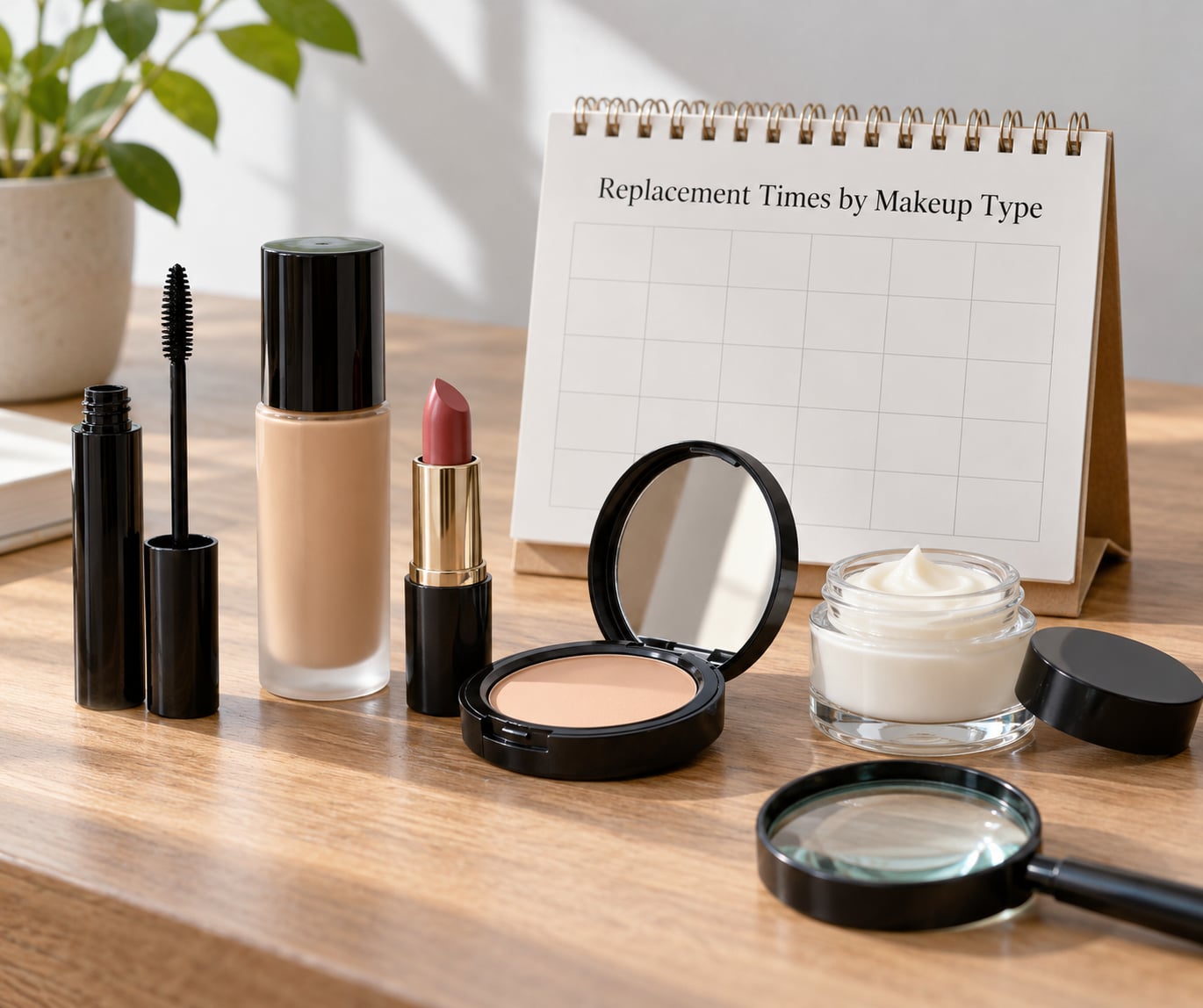
These intervals assume normal storage and at least occasional use. They are the reference I would print and stick inside a drawer.
| Product | Replace after opening | Tell-tale sign it has gone |
|---|---|---|
| Mascara and mascara primer | 3 months | Clumping, dryness, faint smell |
| Liquid and gel eyeliner | 3 to 6 months | Separation, dried tip |
| Pencil eyeliner | 12 to 24 months | Crumbling point, waxy drag |
| Powder eyeshadow | 18 to 24 months | Hard pan, chalking pigment |
| Cream and liquid eyeshadow | 6 to 12 months | Oily separation, sour smell |
| Liquid and cream foundation | 6 to 12 months | Orange cast, layer separation |
| Powder foundation | 12 to 24 months | Dry, uneven spread |
| Concealer | 12 months | Thin, watery, separated |
| Cream blush and bronzer | 12 months | Oily beads on the surface |
| Powder blush, bronzer, highlighter | 18 to 24 months | Chalky, patchy colour |
| Setting powder and spray | 12 to 24 months | Weak hold, sticky residue |
| Lipstick and lip gloss | 12 to 24 months | Sweating, smell change |
| Liquid lip colour | 6 to 12 months | Tacky, patchy wear |
| Nail polish | 12 to 24 months | Bubbling, stringy formula |
| Perfume | 2 to 5 years | Flat scent, darkened liquid |
| Makeup brushes | 2 to 3 years | Frayed tips, persistent odour |
| Blenders and sponges | 2 months | Torn surface, black spots |
Two entries on that list carry more disagreement than the rest. Pencil eyeliner is quoted anywhere from 1 to 2 years, and perfume anywhere from 3 to 10 years. For the eyeliner, treat the lower end as the answer if you have an eye infection history, and the higher end only if you sharpen it after every use. For perfume, smell decides, since alcohol-based formulas slow down considerably but still fade.
Nail polish is the odd one out because it is largely immune to microbial risk. Old polish streaks, bubbles and goes thick, which is a waste problem rather than a health one.
How to Tell When a Makeup Product Has Expired
The date gets you close. Your senses finish the job, and they are more reliable than most printed guidance.
Five signs worth binning on sight
It smells different. Cosmetics should have almost no scent. Anything sour, sharp or faintly chemical means the preservatives are done.
The texture moved. Liquid foundation that splits into a watery layer and a dense one will not mix back together. Thin, watery concealer is the same signal.
The colour shifted. Foundation that turns orange or darker is oxidising, not merely settling. Lipstick that beads up into oily droplets has separated.
Powder turned chalky or hard. A pressed pan that will not buff smoothly has lost its binders and its payoff.
Application changed. Mascara that flakes, eyeliner that skips instead of drawing a line, blush that drags. Performance drops before the formula turns dangerous, and that is your clean exit.
When to stop using it immediately
Performance problems are a performance problem. Irritation is not. Stop at the first sign of a rash, burning, itching or swelling, and throw the product away rather than waiting for the interval to end.
Around the eyes, a red, tender bump on the lid can be a stye, and persistent crusting or red eyes point to blepharitis or conjunctivitis. On the face, new breakouts in a pattern where you apply product, small itchy bumps consistent with folliculitis, or impetigo-style crusting are all reasons to bin the bottle and, if they persist, to see a clinician.
How to Store Makeup for Longer
Most of the difference between a product that lasts six months and one that lasts twelve is where you kept it.
Skip the bathroom
Bathrooms are warm and humid, and heat plus moisture is the worst possible combination for a water-based formula. A bedroom dresser or a closed vanity away from a window does far more for your shelf life than any preservative.
Keep it dark, cool and closed
Sunlight degrades pigment and fades fragrance fast. Cars are worse than bathrooms, since a parked car gets extremely hot. Close lids properly and store products flat or upright according to their design rather than loose in a bag.
Choose packaging over fingers
Pumps and tubes protect a formula; wide jars do not. Every scoop with a fingertip introduces water, oil and bacteria to the whole pot. Decant a small amount onto the back of your hand or into a separate dish and use a clean tool.
Humid summers and heated indoor air shorten timelines across the board, so move anything open past its interval forward by a couple of months if you live somewhere warm.
How to Replace Makeup Without Wasting It
Most expired makeup was never going to be used. It was bought on impulse, duplicated, and then replaced again when the original looked suspiciously old.
Tools and applicators have their own schedule
Brushes cleaned weekly with a mild cleanser and dried flat can last 2 to 3 years. Frayed or splayed bristles do not blend properly, and they trap old product, which is why they stop looking clean even after washing. Replace them when the shape fails, not on a calendar.
Sponges and blenders are disposable. Two months is a reasonable ceiling and many people get through several in a year. Retire one the moment it tears or grows dark spots that washing does not shift. Sharpeners for pencil liners are cheap and worth replacing every few months, since a dull blade drags bacteria-laden fragments across the tip.
Track the open date in thirty seconds
Write the opening month on the base of the tube with a fine-tip marker. For anything that will not take ink, a small dab of removable tape on the jar base works. This beats any app, because it is the record you can actually find at the moment you need it.
If the open date was never recorded, work backwards from smell and texture rather than guessing at a birthday. If a product smells clean and performs normally, it is not automatically unsafe.
Adapting the intervals if you do not wear makeup daily
The 3-month mascara rule assumes regular contact with your lashes. If you wear mascara two or three times a year, the clock runs when the wand touches the brush, so a tube opened in spring and untouched until November is far less exposed than one used every morning. Write the date of last use when you put it away and treat intervals as exposure markers.
Use-it-up discipline matters more than the intervals. Before buying a replacement, put the old one in the bag and use up what you have. In makeup declutter communities, the recurring finding is that overbuying, not slow spoilage, is what creates the pile of half-empty bottles.
Frequently Asked Questions
What does the 6M symbol on makeup mean?
The 6M symbol is the period-after-opening mark, printed as an open jar with 6M inside. It means the product should be used within six months of the day you first opened it, not six months from the purchase date. 12M and 24M work the same way with longer windows. Count from first use, and treat the symbol as more reliable than a generic guideline online.
How often should I change my mascara?
Replace mascara every 3 months, and do not stretch that much even if you rarely wear it. The wand lives near warm, moist eyelids, and bacteria can build up in the tube and on the brush between uses. Clumping, a dry brush, or a faint off smell all mean bin it sooner. If you skip mascara for months at a time, note the date you last used it and treat that as the start of the clock.
Is it okay to use 10 year old eyeshadow?
Unopened powder eyeshadow is usually fine after 10 years because the formula is dry and sealed. Opened eyeshadow from a decade ago should go, even if it looks clean, because the preservatives and binders that keep pigment spreadable break down over time and the powder can also carry contamination from brushes. Signs of a spent pan include chalking, a hardened surface, and colour that will not buff on evenly.
What are the side effects of using expired makeup?
The most common effects are cosmetic: clumping, separation, oxidation and poor coverage. Beyond that, degraded preservatives can let bacteria and fungi grow, which shows up as clogged pores, breakouts, skin irritation, folliculitis or impetigo. Near the eyes the risk list is styes, blepharitis and conjunctivitis, and around the mouth, lip infections are more likely on cracked skin. Stop using a product the moment it irritates you.
How often are you supposed to replace makeup brushes?
A brush cleaned after every use and washed weekly should last 2 to 3 years. Replace it sooner when the bristles fray, splay or lose their shape, because a misshapen brush holds old product that washing will not shift. Foundation and powder brushes usually last longer than eye brushes, which get less washing and more pigment build-up. Sponges and blenders should be swapped every 2 months at most.
Is there an app that can tell me if my makeup has expired?
No app can know when you opened a product, because that date is not recorded anywhere except your own memory. The useful habit is a physical one: write the opening month on the base of the tube with a fine-tip marker, or use a small label on jar bottoms. Then check the collection twice a year against your written dates, and let smell and texture override any number.
A Simple Makeup Replacement Checklist
Start with the oldest thing you use most often. Mascara and anything cream near your eyes go first, because they carry the shortest timeline and the highest consequence.
Then work through the bag with your nose rather than the calendar. Anything with a changed smell, a shifted texture, a separated formula or an irritation when you use it comes out, whatever date is printed on the base.
For the rest, trust the open-jar symbol on the pack over any website, including this one. Write the opening month on the bottom of each new product so the next declutter takes ten minutes instead of an afternoon, and if you have reactive skin or an active skin barrier problem, shorten every interval rather than stretch one.