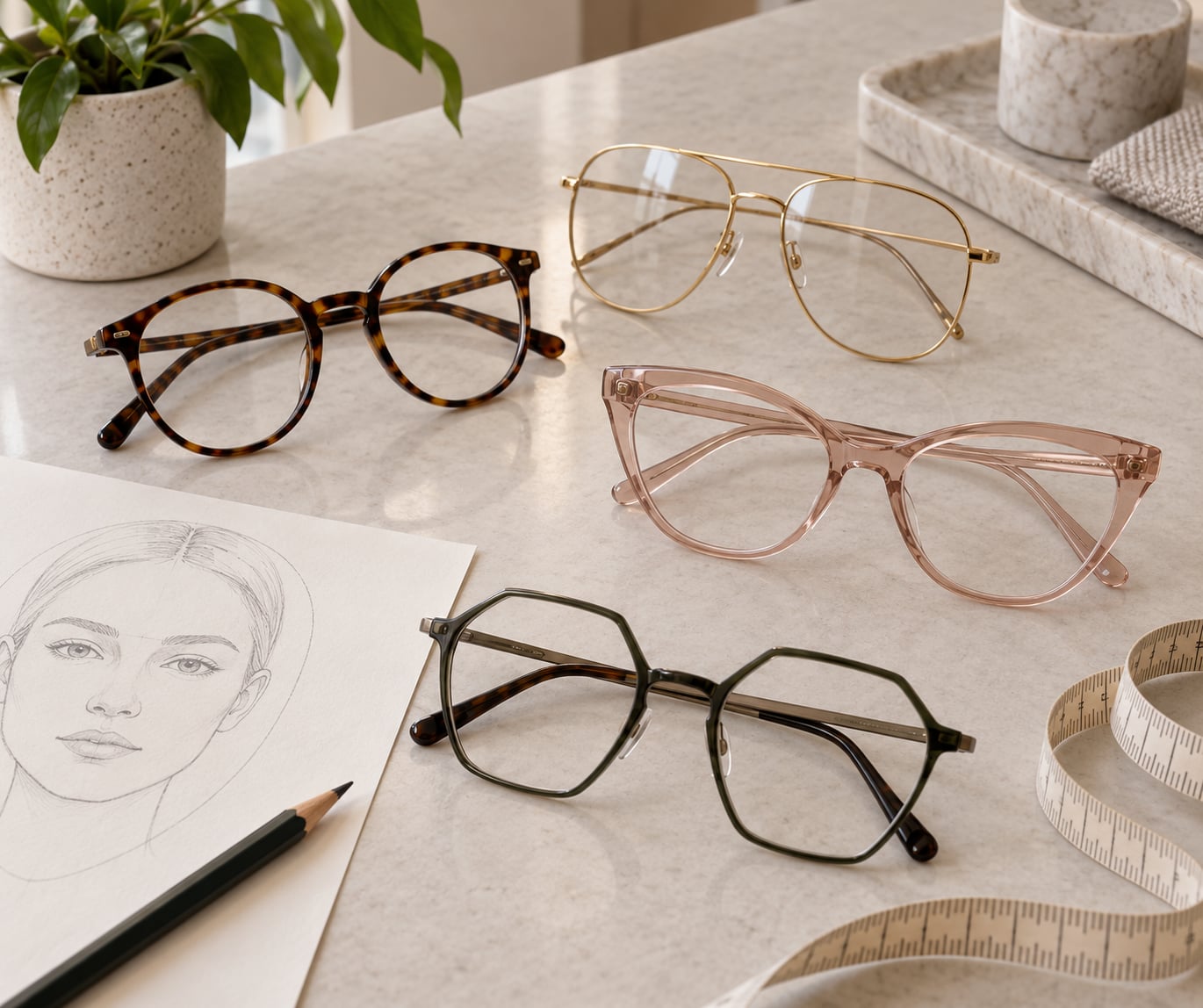
Pick frames whose shape contrasts with your facial angles. Angular faces suit curved, rounded frames; round and soft faces suit structured, geometric ones. That contrast is the whole idea behind how to pick glasses frames for your face shape, and applying it takes about five minutes of measuring plus one honest look in a mirror.
Shape rules are a starting point, not a law. Most people I know end up breaking the rule the moment they try on a frame they love, and they wear it every day. Use the method below to build a shortlist you trust, then let fit and comfort have the final say.
Here is the short version before the detail: measure your face, classify the shape, match the frame outline to the opposite of your angles, check the numbers on the frame, and only then worry about color and material.
Table of Contents
- What You Need
- Step-by-Step: How to Pick Glasses Frames for Your Face Shape
- Identify Your Face Shape
- Measure the Proportions That Matter
- Match Frames to Your Face Shape
- Try Frames On and Check the Balance
- Choose a Frame That Fits Your Style and Prescription
- Common Mistakes
- Frequently Asked Questions
- How can I find eyeglasses that match my face shape?
- How do I tell if frames are too big for my face?
- What should I do if my glasses are too big for my face?
- Should I get 52 or 54 glasses?
- What shape glasses look best on a narrow or oblong face?
- Is there an app that can check my face shape for glasses?
- Are men’s and women’s glasses frames sized differently?
What You Need
None of this requires a special kit. Everything below costs nothing and takes about ten minutes.
- A mirror you can sit close to — a bathroom mirror at eye level, with even light and nothing patterned behind you. A dark shirt on helps when the mirror is tinted.
- A soft tape measure — a tailor’s tape or even a strip of paper and a ruler. Rigid rulers distort the reading across a curve.
- Your phone — for a front-on photo and a profile photo. A photo catches proportion errors your eyes skip in a mirror.
- Your current prescription — the SPH, CYL, ADD and PD numbers, or at least a photo of the last one. This decides which frames are even possible.
- The frames you wear now, if you have them. Hold them beside your face; they are a working baseline for width.
- Two or three outfits you’ll wear with them — because a frame that clashes with everything else never gets worn.
Add a notebook or a notes app. You will try on more pairs than you expect, and you will not remember which was which.
Step-by-Step: How to Pick Glasses Frames for Your Face Shape
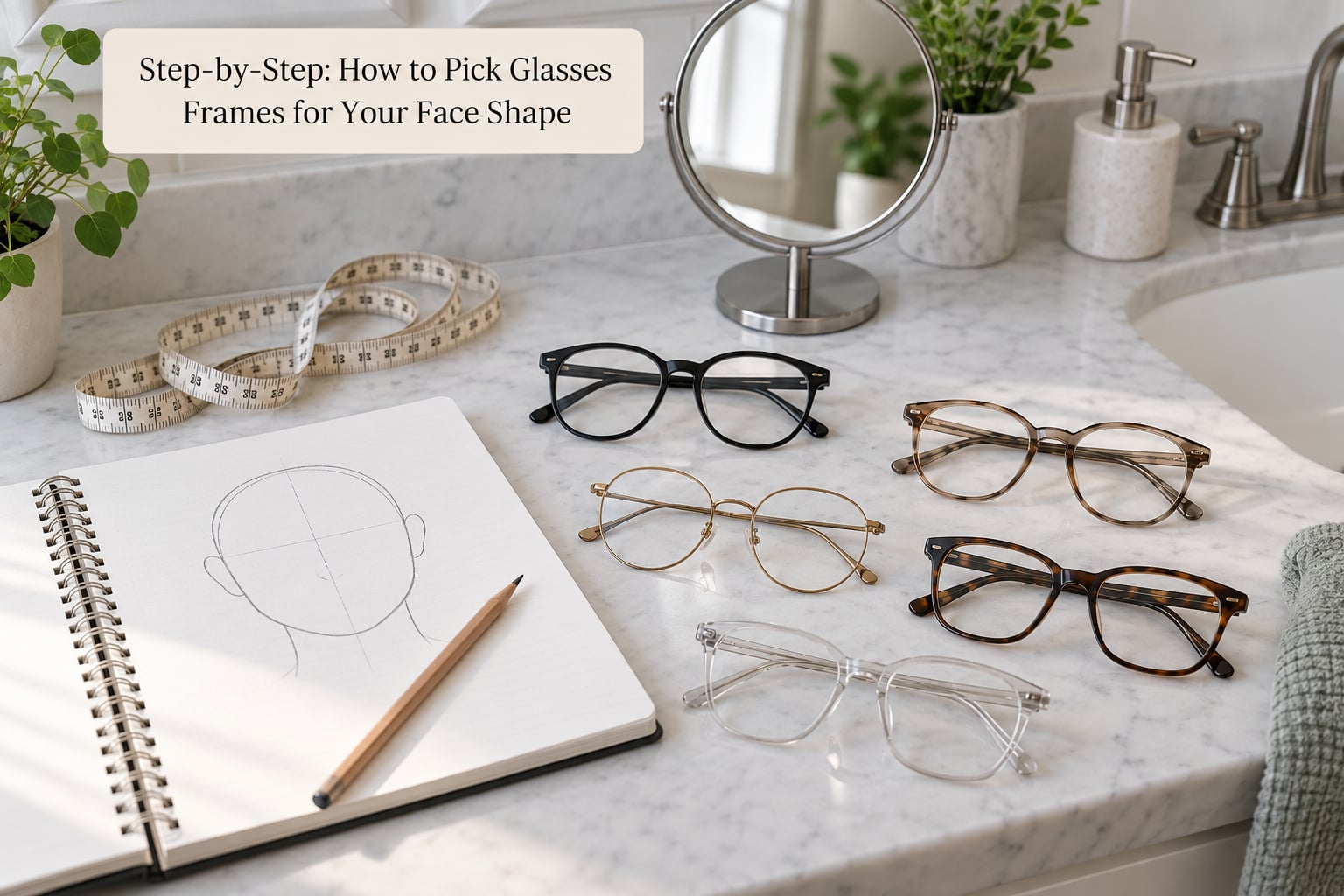
Five steps, in order. Skipping to step four is how people end up with frames that look clever in the store and oversized in a photo.
Identify Your Face Shape
Stand in front of the mirror at arm’s length, pull your hair back off your forehead and jaw, and look straight ahead. Take a photo with no filter and no portrait mode, because portrait mode fakes the face width you are trying to measure.
Now take three width readings with the tape. Measure across the widest part of your forehead, just above the eyebrows. Measure across your cheekbones at the widest point, roughly level with the top of your cheek. Measure across your jaw, at the point where the jaw turns toward your ear. Write all three down in millimetres.
Compare them:
- Forehead and cheeks are the widest, roughly equal, with a jaw that tapers narrower — that is a heart shape.
- Cheekbones are clearly the widest point, with a narrow forehead and a narrow jaw — diamond.
- The jaw is the widest, with a forehead narrower than the jaw — pear, or triangle.
- Forehead, cheeks and jaw are all close to the same width, and the face is longer than it is wide — oblong, sometimes called rectangle.
- All three widths are similar but the face is about one and a half times longer than it is wide, with softer curves — oval.
- Cheeks are the widest and round, the jawline curves rather than angles, and the chin is soft — round.
- All three widths are similar, the jawline is straight, and the corners are visibly squared — square.
Check the length next. Measure chin to hairline, or chin to eyebrow if your hairline is high. If that number is well over 1.5 times your face width, the shape is oblong even when the widths match an oval.
Then confirm with a profile. Stand side-on and look at the forehead, the nose bridge and the chin. A straight or forward-sloping forehead with a defined chin points to square or oblong. A receding or rounded forehead with a pointed chin points to heart or diamond. Most faces are a mix of two, and picking the dominant width pattern is more useful than arguing about the borderline cases.
If you have never worked out how to pick glasses frames for your face shape by measurement, this is the step that replaces guessing, and it is the step most guides skip.
Measure the Proportions That Matter
Frame width is the number people feel first, even when they cannot name it. Measure across your own face at the temples, right above your ears, and note that figure. Your finished frame should be close to it, give or take a few millimetres, and it should not extend far past the outer edge of your face when viewed head-on.
Every frame carries three numbers, printed or stamped inside one temple: eye size, bridge size, temple length. A pair marked 52-18-140 has 52 mm wide lenses, an 18 mm bridge and 140 mm long arms. The first two tell you how the front sits on your face. The third tells you whether the arms reach your ears.
Add the eye size and bridge size for a rough front measurement, then allow a few millimetres for the rims and hinges. A 52-18 frame front is close to 88 mm across the lenses and bridge, which in practice is most of what an optician means by the frame’s front width.
| Frame size | Typical front width | Who it tends to suit |
|---|---|---|
| 48 | Under 86 mm | Narrow faces, small heads, most rimless fits |
| 50 | About 86 to 88 mm | Petite faces, slimmer lens shapes |
| 52 | About 88 to 90 mm | The most common adult size |
| 54 | About 90 to 92 mm | Broader faces, medium to strong prescriptions |
| 56 and up | Over 92 mm | Wide faces and deliberately oversized styles |
These are typical ranges, not measurements pulled from a single brand. Frame sizing in most markets follows a common standard, which is why a 52 fits so many people and still suits plenty of others.
Two more measurements matter. The bridge, the strip between your lenses, either sits on your nose or perches on it; a frame with a bridge wider than yours will slide down, and one much narrower pinches. And lens height, the vertical measurement, decides whether the frame suits your prescription. Ask for it, because most product pages never list it.
Pantoscopic tilt is the last piece. A good fitting tilts the frame so the lower rim sits slightly closer to your cheek than the top, which keeps the optical centre of each lens in front of your pupil. Deep-set frames that sit flat and far from your face often give that slightly-off feeling people blame on a wrong prescription.
Match Frames to Your Face Shape
This is where how to pick glasses frames for your face shape becomes concrete. The contrast rule says the frame’s outline should oppose your outline: add curve to an angular face, add structure to a curved one. A frame that mirrors your face shape usually makes the feature you dislike look bigger.
- Oval face — nearly anything works, which is a problem, not a gift. Start with rectangles and softly rounded squares, then try the styles you would not have picked otherwise. Keep the frame width within a few millimetres of your face width.
- Round face — go angular and rectangular. Flat-top, hexagonal and geometric frames add definition, and a slim bridge stops the middle of the face reading as one round block. Avoid round frames, which echo your cheeks, and avoid anything bottom-heavy.
- Square face — soften it. Round, oval, D-frame and gentle aviator shapes work, and thin metal frames feel lighter against a strong jawline. Avoid thick square acetate in the same proportions as your face, which doubles the angle.
- Heart face — balance a broad forehead with a narrower lower face. Round, oval, D-frame and bottom-heavy frames add width low down. A browline frame sitting lower on the brow also helps. Avoid strong cat-eye upsweeps at the top, which emphasise the widest part.
- Diamond face — the cheeks do the work here. Cat-eye, oval, round and rimless frames leave the cheekbones visible and draw attention to the eyes. Avoid narrow frames that end exactly at your cheekbones, and avoid heavy top-heavy rims.
- Oblong or long face — go wide and short. Deep rectangular, wide square and oversized frames add width and cut apparent length. Browline frames help too. Avoid narrow, tall lenses and small round frames, which lengthen further.
- Pear or triangle face — build the top up. Cat-eye, browline and semi-rimless frames with a strong upper line balance a wider jaw. Aviator shapes also work. Avoid narrow, delicate frames that vanish above a solid jaw.
Two structural details cut across every shape. A high bridge sitting down on your nose reads as bolder and shorter, a low bridge reads softer and longer. And a frame narrower than your face at the temples looks pinched no matter how well the outline matches.
Try Frames On and Check the Balance
Ten seconds in front of a mirror, then ten seconds with your phone camera, catches most problems. Do it in this order.
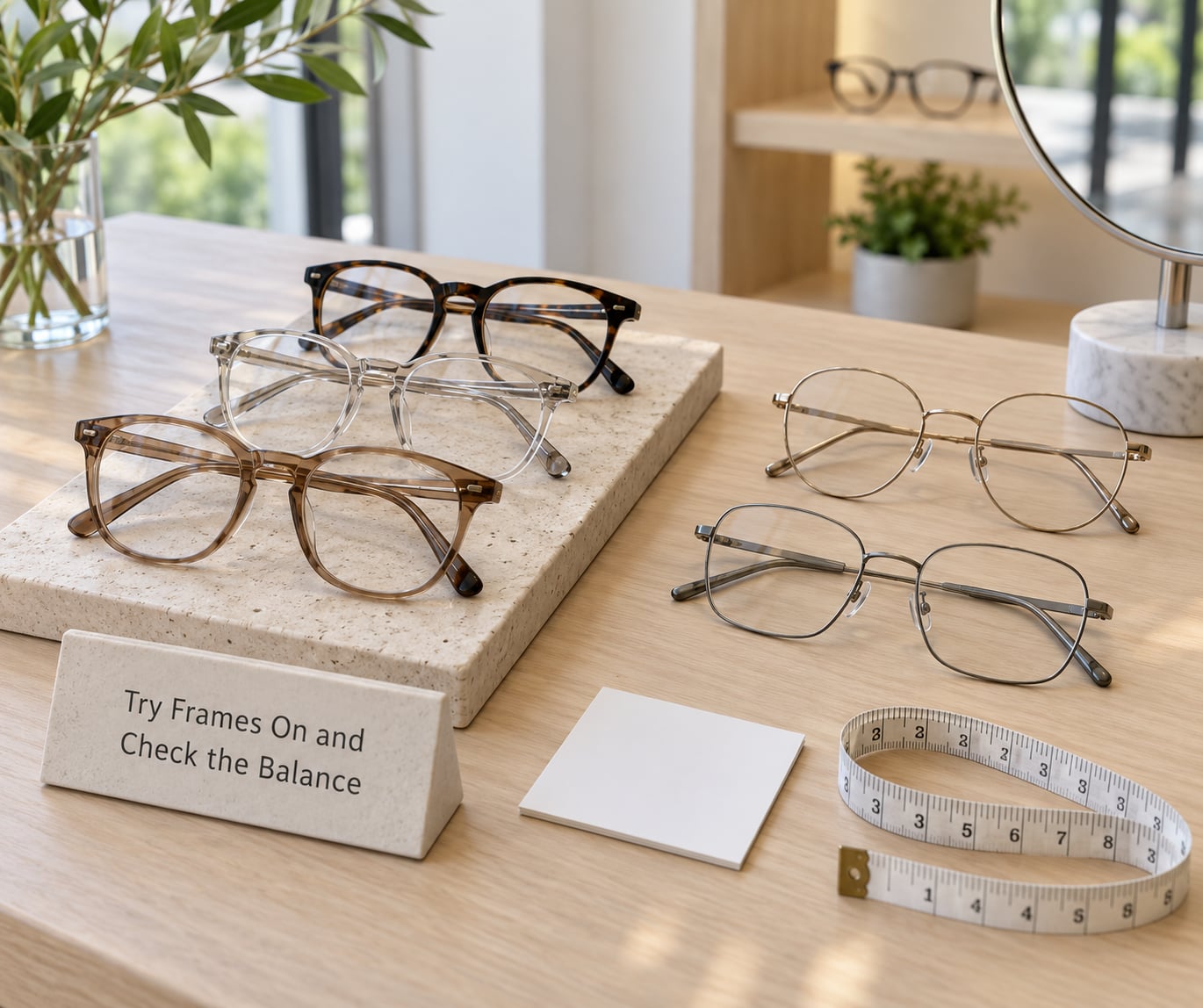
- Pupils. In a normal single-vision frame, your pupils should sit near the vertical centre of the lenses, a shade above the middle. If your pupils sit near the bottom of the lens, the frame is sitting too low.
- Cheek Coverage. The bottom rim should clear your cheekbone. A frame that rests on the cheek is too deep or too tall, and it is the most common complaint people post about frames that look fine in person.
- Temples. Look straight ahead. If the arms flare out from the head, the frame is too wide. If the arms press inward or the top rim bows, it is too narrow.
- Bridge. After a few minutes wearing, not the first ten seconds. A frame that pinches leaves a red mark on the bridge of your nose; one that slides leaves a mark higher up.
- Slide Test. Look down, then shake your head gently. A well-fitted frame stays put with only a hair of movement.
- Photo Check. Take a straight-on photo at arm’s length with no portrait mode, and crop tight to the top of your head and your chin. This is how everyone else sees you, and photos catch the oversized look that a forgiving mirror hides.
If you wear progressives, swap step one. The reading zone has to sit low in the lens, so you need enough vertical depth below your pupils, and the frame has to sit still when you look down. If a frame is right on every other count but the lenses are too shallow, keep looking.
Choose a Frame That Fits Your Style and Prescription
A great shape will not survive an impossible prescription, so check the numbers before you fall in love with a pair.
Strong or high prescriptions push you toward smaller, rounder lenses. Lenses get thicker at the edges in proportion to how much correction they carry, and a big flat lens on a high minus shows it most. High-index lenses thin the material, and small round frames remove the edge thickness you would otherwise be looking at. This often rules out the oversized trend frames, which is a common source of disappointment for people who order them online.
Progressive lenses need depth. Look for a lens height around 32 mm or more, and a frame that fits level and tight enough that it does not slip when you glance down. Bifocals are more forgiving. If you have astigmatism, ask the optician to check lens alignment on any rimless or semi-rimless frame, because a frame that shifts changes how the correction sits in front of your eye.
Material follows lifestyle. Acetate is the heaviest and the most forgiving of adjustment, a good first pair for glasses you will wear daily. Titanium and thin metal sit lighter and suit long days and strong prescriptions. TR90 nylon is light, springy and impact resistant, which suits sports, children and anyone who drops things. Rimless frames look minimal but need an adjustment more often and suit smaller lenses and lower prescriptions.
Color is a skin question more than a style question. Warm undertones — golden, olive, peach — suit tortoiseshell, honey, amber, warm brown and gold metal. Cool undertones — pink, red, blue — suit black, navy, grey, silver and crystal. A quick self-test: veins on the back of your wrist that read green lean warm, blue lean cool, and a mix means neutral, which takes almost anything. Very fair skin can look washed out under heavy solid black, and there is no need to default to black anyway.
Then match the frame to the rest of you. Hair shape matters: a strong fringe or a blunt bob suits narrow frames that stay visible, while longer hair with volume hides small rims. Thick acetate reads casual and a little creative, thin metal reads professional and precise. If you are on camera for work all day, lighter colors and slightly larger lenses avoid glare, and low-contrast rims disappear on a video call in a way that sharp black does not.
Lastly, your own history is data. If you have worn a wide square frame comfortably for five years, the answer is a wide square frame, not a cat-eye because a cat-eye is having a moment.
Common Mistakes
Nearly every regretful frame I have seen traces back to one of these.
- Buying the trend and skipping the measurement. Oversized frames are the current default, and on a narrow or petite face they eat your cheeks. Fix: compare the frame’s front width to your own face width before anything else.
- Treating face shape as a law. The advice online is copy-pasted, which is why it feels hollow. Fix: use shape to build a shortlist, then let try-on behaviour decide.
- Ignoring lens thickness and lens height. A high prescription in a big flat lens looks heavy, and a progressive in a shallow lens is unusable. Fix: check your prescription numbers and required lens height before you narrow by style.
- Buying frames that slide. Sliding changes the optical position of the lens and makes your eyes look tired. Fix: get the fit adjusted first, and if it still slides, move up a size or a bridge width.
- Choosing bottom-heavy frames for a round face. They double the roundness. Fix: keep the visual weight at the top third, with a slim bridge.
- Going all-black on very fair skin. It reads harsh in person and photographs flat. Fix: try tortoise, crystal, navy, or a metal frame in a warm tone.
- Trusting a face-shape quiz alone. Upload apps are useful for a rough label and useless for width, bridge fit and whether the frame is comfortable. Fix: use them to start, then measure and try on.
- Ordering online with no reference. Sizing is invisible in a product photo. Fix: measure your current frames and compare the numbers, and check the return policy before you commit.
The one habit that fixes most of this: try on more than you think you need. People on the r/glasses and r/glassesadvice forums are consistent about one thing — the pairs that actually get worn were the ones they put on in a store with a mirror and a camera, not the ones a chart recommended.
Frequently Asked Questions
How can I find eyeglasses that match my face shape?
Measure forehead, cheek and jaw width with a tape, then pick the widest of the three as your dominant feature. Choose frames whose outline contrasts with that: angular or rectangular frames for round faces, curved and rounded frames for square or heart faces. Check the numbers on the frame against your own face width before you buy, and confirm with a try-on photo.
How do I tell if frames are too big for my face?
Three quick checks. Your pupils should sit near the vertical centre of the lenses rather than low in them. The bottom rim should clear your cheekbone instead of resting on it. And the temple arms should run straight back without flaring outward. If the frame slides when you tilt your head down, it is too large or the bridge is too wide.
What should I do if my glasses are too big for my face?
Try an adjustment first, since a professional can bend the bridge and arms to fit you and most oversized complaints improve that way. If it still slips or the cheeks stay covered, you need a smaller frame or a narrower bridge. Keep lenses, coating and frame style the same and re-order one or two sizes down, for example from 54 to 52.
Should I get 52 or 54 glasses?
Go by your face width, not by trend. Measure across your face at the temples and compare it to the frame front width, which for 52 is around 88 to 90 mm and for 54 around 90 to 92 mm. 52 suits most adult faces and pairs well with higher prescriptions. Choose 54 when your face is broad or you want a wider look and your prescription keeps lens thickness manageable.
What shape glasses look best on a narrow or oblong face?
Wide and short frames shorten a long face, so deep rectangular, wide square and oversized shapes work best. Browline frames add horizontal weight at the brow as well. Avoid narrow, tall lenses, small round frames and anything that extends the face downward, since all of them add length to a face that already has plenty. Sit near the brow, not lower, to keep the effect.
Is there an app that can check my face shape for glasses?
Photo and quiz apps are good for a rough shape label and poor at sizing. They cannot judge bridge fit, how a frame sits on your nose, or how it behaves after twenty minutes of wear, which is what actually decides whether a pair works. Use an app to narrow the options, then measure your face and try frames on, ideally in a store where you can use a mirror and your phone camera.
Are men’s and women’s glasses frames sized differently?
The difference is mostly the bridge, not the length. Frames marketed to women commonly use bridges of 16 to 18 mm, and frames marketed to men commonly use 18 to 22 mm, because those are rough averages of nose width. Lens sizes overlap heavily, and plenty of frames are simply unisex. Measure your own bridge and choose the frame that sits on your nose without pinching or sliding.
Start with the measuring tape, not the shopping. Five minutes of forehead, cheek and jaw measurements tells you your shape, a second measurement tells you the frame width you actually need, and the contrast rule gives you a shortlist in seconds. Then put the shortlist on your face, take one photo, and keep the pair that stays put and does not make you think about your glasses.