Layer your skincare from the thinnest, most watery formula to the thickest, heaviest one, and put broad-spectrum sunscreen on last every morning. Give each layer 30 to 60 seconds to settle before the next one. The full order is cleanser, toner or essence, treatment serum, eye cream, moisturizer, then SPF in the morning, with a cleansing oil before your regular cleanser at night.
That is genuinely the whole technique. Most people who think their products don’t work are using perfectly good ones in the wrong order. Knowing how to layer skincare products correctly takes about a minute of thought the first time and then almost no thought at all.
Table of Contents
- What You Need
- Step-by-Step: How to Layer Skincare Products Correctly
- Step 1: Start With Cleanser or Makeup Remover
- Step 2: Apply Hydrating or Soothing Layers
- Step 3: Apply Treatment Serums (Where Layering Matters Most)
- Step 4: Moisturize the Skin
- Step 5: Finish With Sunscreen
- Rules, Timing and Dosage
- How long to wait between skincare layers
- How much product to use
- The 4-2-4 rule, and what it actually means
- Which serums and actives can share a routine
- How to layer skincare products correctly for your skin type
- Common Mistakes
- Frequently Asked Questions
- Does the order of skincare products actually matter?
- How long should I wait between skincare layers?
- Which two serums cannot be used together?
- Is layering three serums too much?
- Why does my skincare pill under sunscreen and makeup?
- What is the 4-2-4 rule in skincare?
- Conclusion
What You Need
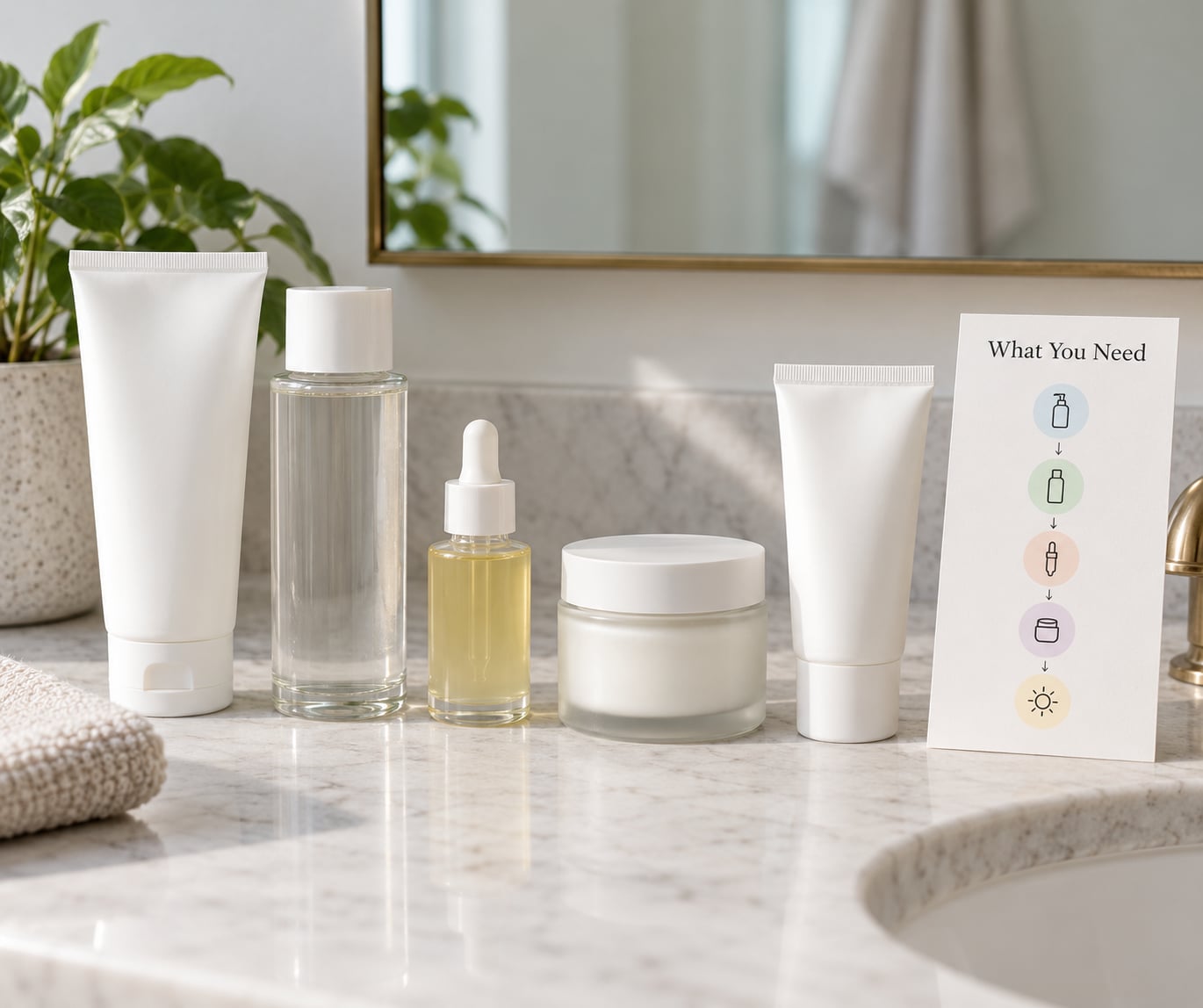
Before you buy anything, know that you do not need the whole shelf. The layering order only matters when you use more than one leave-on product, and a short routine done in the right order beats a ten-step routine done in a random one.
Here are the categories you might own, from thinnest to thickest:
- Cleansing oil or balm — dissolves makeup, sunscreen and sebum. It rinses off in one pass.
- Water-based cleanser — gel, foam or cream. Removes what is left and leaves the surface at a normal pH.
- Toner or essence — watery, alcohol-free, applied with hands or a cotton pad. Mostly humectants and soothing agents.
- Treatment serum — the thinnest thing that carries an active: vitamin C, niacinamide, hyaluronic acid, peptides, retinol, azelaic acid, exfoliating acids.
- Eye cream — light gel or a slightly richer cream, applied with a ring finger.
- Moisturizer — lotion, gel-cream or cream. Humectants pull water in, emollients soften, occlusives seal.
- Facial oil or balm — the heaviest step, always after any water-based cream, never before it.
- Sunscreen — last in the morning. Lotion, stick or fluid, at least broad-spectrum SPF 30.
Two rules do almost all of the work. The first is thin to thick: skin takes up smaller, lighter molecules first, and a rich cream applied early creates a film that a watery serum cannot pass through. The second is lowest pH first: L-ascorbic acid and exfoliating acids need an acidic surface to do their work, so they go on before anything that raises the pH, which includes most cleansers, toners and moisturizers.
Those two rules answer most layering arguments you will ever have. When they disagree — and they sometimes do — thin to thick wins, because a layer that physically cannot reach your skin does nothing at all.
Step-by-Step: How to Layer Skincare Products Correctly
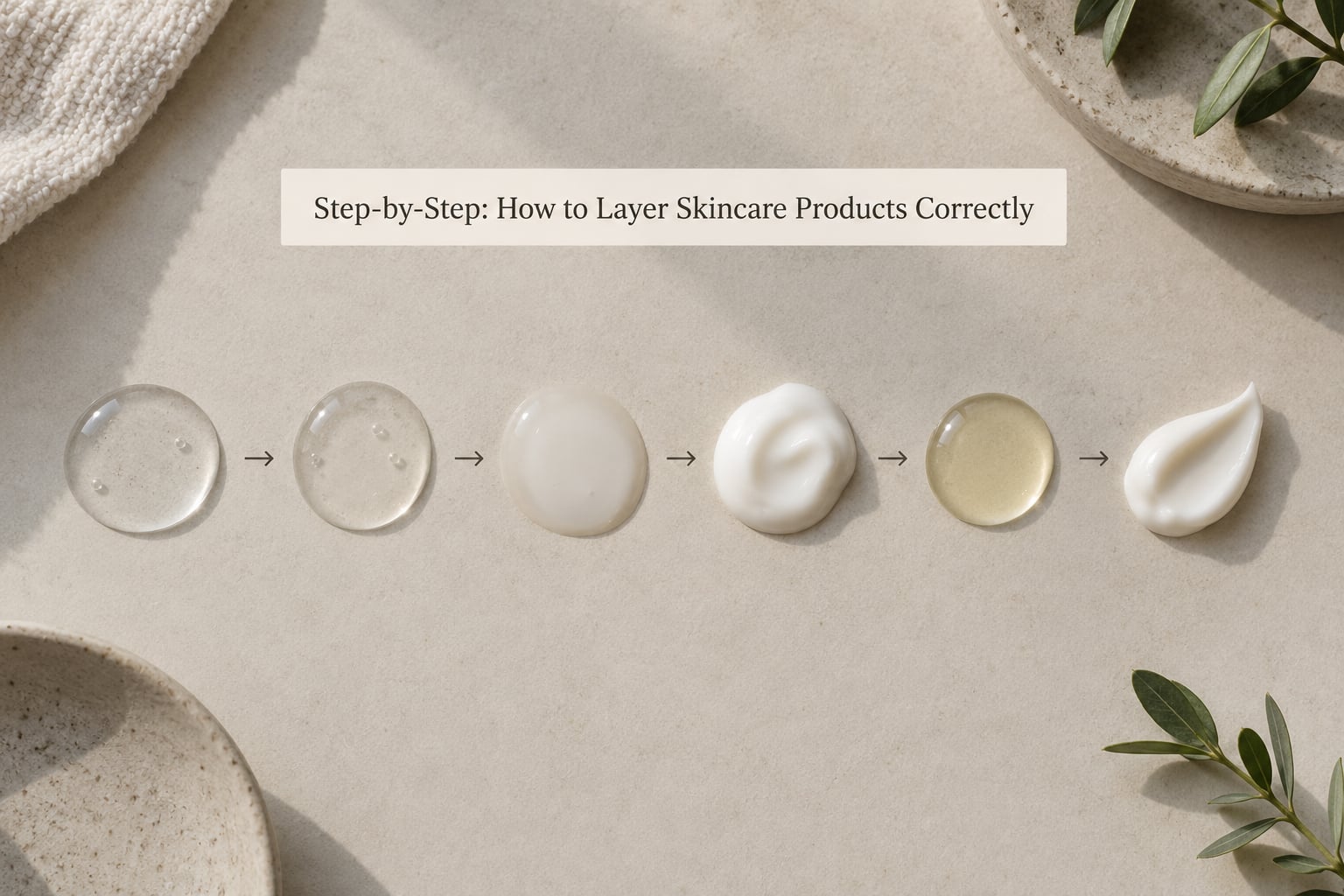
Here is the whole sequence, morning and night, with what each step is for and how to know it is finished.
Step 1: Start With Cleanser or Makeup Remover
At night, if you wore sunscreen or makeup, start with an oil-based cleanser on dry skin. Massage it for 30 seconds, add water to emulsify, then rinse. Follow with your water-based cleanser for the second pass.
In the morning, a single water-based cleanser is usually enough unless your skin is very oily or you wore a heavier sunscreen the day before. Washing twice in quick succession strips the barrier, and most of the tightness people blame on actives is really just over-cleansing.
Lukewarm water, no hot. Pat dry with a clean towel or a single-use face cloth and let your skin finish dripping for about 30 seconds before the next layer. Applying to bone-dry skin sends people reaching for heavier products than they need.
Step 2: Apply Hydrating or Soothing Layers
Toner and essence are the easiest steps to overthink, and they are mostly optional. Apply a watery hydrating toner with your palms rather than a cotton pad — no need to drag it across your face — and press it in.
Layering two or three of these is fine. Their textures are so similar that nothing interferes, and they stack well because they are all water-based humectants drawing moisture toward the surface. Wait 30 seconds each, then move on.
Skip this step entirely if you dislike it. A serum and a moisturizer do the same basic job with fewer steps.
Step 3: Apply Treatment Serums (Where Layering Matters Most)
Press serums on in order of texture, thinnest to thickest. Watery serums like hyaluronic acid go first, thicker ones like niacinamide or peptide formulas next, and oil-based treatment serums last of the three.
Wait 60 seconds after a treatment serum before you apply anything else. This is the one step where impatience genuinely costs you: actives need a few minutes at skin temperature to spread and reach the lower layers, and rubbing moisturizer over them too early is how you end up with actives sitting on top of the surface and doing nothing.
On sensitive or barrier-compromised skin, wait longer. The American Academy of Dermatology’s general guidance is to keep the routine short while the barrier recovers, which usually means one serum at night and nothing else active.
Step 4: Moisturize the Skin
Pick by what your skin does a few minutes after washing: tight and flaky means you need a cream, shiny within an hour means a gel-cream is plenty. If your face feels like nothing after moisturizer, use more of what you have instead of buying something else.
Amount matters more than most people think. A rough guide for a full face is two to three drops of serum, a quarter-sized amount of eye cream per eye, and about two fingertips’ length of moisturizer. For a face oil, three to five drops.
Apply moisturizer by pressing, not rubbing. You have just laid down actives underneath, and dragging the towel of your hand across them moves the ingredients around. Do not scrub off makeup afterward, either — that is what removes the layers you spent two minutes building.
Step 5: Finish With Sunscreen
Sunscreen goes last in the morning because it needs to sit on top of everything else as an unbroken film. Underneath a layer of oil or cream it spreads unevenly, and a patchy film is worse than a thinner, well-spread layer.
Get enough of it. Two finger lengths for the face and neck is the standard approximation, and it is more than most people use. If your sunscreen leaves a white cast, use less rather than more and spread it faster, or switch to a tinted formula.
Wait about two minutes before makeup or before touching your face, so the film sets. When you are outdoors for more than a couple of hours, reapply, and reapply after sweating or swimming regardless of the label.
Rules, Timing and Dosage
Two questions come up more than any other: how long to wait, and how much to use. Both have concrete answers.
How long to wait between skincare layers
| Transition | Wait | The checkpoint |
|---|---|---|
| Cleanser to toner or essence | 30 seconds, or until skin stops dripping | Damp, not wet |
| Toner to serum | 20 to 30 seconds | Absorbed, no shine on the fingertips |
| Serum to next serum | 30 to 60 seconds | No tackiness when you press a finger to your cheekbone |
| Serum to moisturizer | 60 seconds | Skin feels slightly set rather than wet |
| Moisturizer to oil or balm | 60 seconds | Face looks matte, not glossy |
| Any product to sunscreen | 60 to 90 seconds | No visible film under the SPF |
| Sunscreen to makeup | 2 minutes | Makeup glides without dragging |
Thirty to sixty seconds is the range dermatology sources and the AI summaries on this topic agree on, and users on skincare forums quote those same numbers back at each other for a reason. Waiting longer than the table says is fine. Waiting less is what causes most problems.
How much product to use
| Layer | Amount | Method |
|---|---|---|
| Cleanser | A pea-sized blob for a full face | Warm between palms, 30 seconds of massage |
| Toner or essence | Enough to wet the face | Pat with palms |
| Watery serum | 2 to 3 drops | Press on, avoid rubbing |
| Thicker serum | 1 to 2 pumps | Dab dots across the face, press in |
| Eye cream | A grain of rice per eye | Ring finger, tapped not dragged |
| Moisturizer | Two fingertips’ length | Press and sweep outward |
| Facial oil | 3 to 5 drops | Warm between palms, press on |
| Sunscreen | Two finger lengths for face and neck | Spread quickly, in thin even layers |
Too much product is the single most common cause of pilling, and it also pushes everything else up and out of order. More layers do not work faster.
The 4-2-4 rule, and what it actually means
The 4-2-4 rule is a layering shape from the Korean skincare community rather than a guideline from the American Academy of Dermatology, and it is worth knowing because it explains the logic underneath most multi-step routines.
- 4 watery layers — toner, essence, hydrating serum, hydrating gel. These pull water toward the skin.
- 2 treatment layers — one targeted serum and one eye treatment. These are the only two that are actually treating something.
- 4 sealing layers — moisturizer, cream, oil, balm. These slow water leaving your skin, measured as transepidermal water loss.
Read it as a map rather than a shopping list. The 4-2-4 pattern explains why a routine with six watery steps and no cream feels dewy for ten minutes and tight by lunchtime.
Which serums and actives can share a routine
This is where most of the confusion lives. Some of the loudest rules you will hear about layering are myths that got repeated until they sounded like dermatology.
| Pair | Verdict | How to do it |
|---|---|---|
| Retinol + niacinamide | Safe | Same routine is fine, niacinamide first |
| Vitamin C + niacinamide | Safe | Both work at their own pH; separate AM and PM if your skin is reactive |
| Hyaluronic acid + anything | Safe | Apply on damp skin, seal with cream or oil |
| Peptides + most things | Safe | Low-irritation, works in either order |
| AHA + BHA | Usually fine | One exfoliating acid per session is plenty |
| AHA or BHA + retinol | Separate | Alternate nights; together on sensitive skin is a real irritation risk |
| Vitamin C + benzoyl peroxide | Separate | Benzoyl peroxide can oxidize L-ascorbic acid on contact |
| Multiple strong actives at once | Separate | One active, then add the next every few weeks |
Forum consensus matches the dermatology position on this more often than not: retinol with niacinamide is fine, an acid with retinol on the same night is not. The idea that vitamin C and niacinamide cancel each other out is a myth — if separating them costs you nothing, do it, but you are not protecting your skin by refusing to use them together.
Three serums at once is not automatically too much. What matters is whether all three are active. A watery hydrating serum, a niacinamide serum and a peptide serum can share a morning if you wait between each and keep the amounts small. Three exfoliating or brightening actives should never share a session.
How to layer skincare products correctly for your skin type
Oily skin. Fewer occlusive layers. A gel-cream and sunscreen in the morning is a complete routine, and skipping the toner saves a step without a real cost.
Dry skin. More sealing layers, and put serum on damp skin so humectants have water to hold. Facial oil last at night works well here.
Sensitive skin. Strip it back to cleanser, one serum and a moisturizer at night. Add back in one product at a time, every two weeks, and patch-test on the jawline first — skincare that touches skin deserves a patch test, especially anything with an exfoliating acid.
Combination skin. Layer by zone rather than by face. T-zone takes the lighter texture, cheeks take the richer one.
Mature skin. Order matters more, not less, because thinner skin absorbs faster and reacts more readily. Thin to thick, generous moisturizing layers, and sunscreen every morning without exception.
Common Mistakes
Almost every layering complaint traces back to one of six mistakes.
- Rushing between steps. The fix: time each layer. Thirty to sixty seconds, and a full minute before moisturizer goes over an active.
- Using too much of each product. The fix: measure. Two finger lengths of sunscreen, two fingertips of moisturizer, two to three drops of serum.
- Stacking too many actives in one session. The fix: one active per session, rotating across the week rather than layering them together.
- Skipping moisturizer and going straight to SPF. Sunscreen is not a moisturizer. The fix: moisturize, then protect.
- Applying sunscreen too late or in too small an amount. The fix: last step, full amount, two minutes before makeup.
- Oil before water. The fix: facial oil always comes after any water-based product, never before it.
Here is the same thing organized by symptom, since that is usually how people describe the problem rather than by cause.
| Symptom | Likely cause | Fix |
|---|---|---|
| Pilling under sunscreen | Layers too fast, too much product, or silicone-heavy primer over unabsorbed serum | Add 60 seconds, cut the amount, skip the primer or switch to a water-based one |
| Stinging after a product | Acid on damp skin, or actives applied to compromised skin | Wait 10 minutes after cleansing, use one active, stop and patch-test |
| Breakouts along the jaw | Occlusive or heavy layers trapping sebum | Drop the oil and balm steps, keep gel-cream and SPF |
| No results after months | Wrong order, wrong amount, or too many changes at once | Fix the order first, hold it steady 8 to 12 weeks before judging it |
| Makeup sliding off | Sunscreen not set, or too much of it | Two full minutes, thinner and faster-spreading layer |
| Skin tight after cleansing | Over-cleansing, hot water, or no moisturizer | Lukewarm water, one pass, moisturize while damp |
People on skincare forums describe pilling as a technique problem far more often than a product problem, and they are usually right. A routine that pills under makeup gets abandoned, no matter what the products cost.
Frequently Asked Questions
Does the order of skincare products actually matter?
Yes. Skin absorbs smaller, lighter molecules first, so a thick cream applied before a watery serum blocks it from reaching the lower layers. Order also decides whether your active ingredients land on your skin or sit on top of it. If you use more than one leave-on product, the order changes what your routine can do.
How long should I wait between skincare layers?
Thirty to sixty seconds between most layers, with a full minute after any treatment serum before moisturizer, and about two minutes after sunscreen before makeup. The checkpoint is simple: your skin should feel slightly set rather than wet. Waiting longer than that is fine. Waiting less is what causes pilling and product interference.
Which two serums cannot be used together?
The pairing to genuinely separate is an exfoliating acid such as an AHA or BHA with a retinoid. Combining them on the same night raises irritation risk, especially on sensitive skin, so alternate them instead. Benzoyl peroxide with L-ascorbic acid is the other pair worth splitting. Retinol with niacinamide and vitamin C with niacinamide are safe.
Is layering three serums too much?
Not automatically. Three serums can share a routine when they are not all active, for example a hydrating serum, a niacinamide serum and a peptide serum. Wait 30 to 60 seconds between each and keep the amounts small. Three exfoliating or brightening actives at once is the version to avoid, since irritation is what usually ends the experiment.
Why does my skincare pill under sunscreen and makeup?
Pilling is usually technique, not a bad product. You are either moving too fast between layers, using too much of each one, or putting a silicone-rich primer over a serum that has not absorbed. Add a full 60 seconds before the SPF, cut the amount of every layer, and try a water-based primer or no primer for a week to see what changes.
What is the 4-2-4 rule in skincare?
It is a community guideline, not a dermatology one, and it describes the shape of a layered routine: four watery hydrating layers, two treatment layers, then four moisturizing and sealing layers. It is useful as a mental model because it shows why water-based steps belong at the start and oils and balms at the end. It is not a shopping list.
Conclusion
Thinnest to thickest, lowest pH first, SPF last, and 30 to 60 seconds between layers. That is the whole method for how to layer skincare products correctly, and it applies to whatever products you already own.
Tonight, do this: pick the three or four products you actually use most, put them in the order above, and give each one its wait time. Do not buy anything new yet. Fix the order and hold it steady for eight to twelve weeks before you decide anything is broken, and patch-test any new product on your jawline before it goes near your face. If your barrier is already compromised — stinging, redness that will not settle — strip it back to cleanser, moisturizer and morning sunscreen, and see a board-certified dermatologist if it does not calm down.