
To handle a slow season as a freelancer, you stabilize your cash flow first, then spend a fixed number of outreach touches each week on old clients, warm contacts and ideal prospects, and use the leftover hours for assets that raise your rate later. Thirty focused days does more good than three months of refreshing your inbox and hoping.
The feast-or-famine cycle is the pattern where freelance income swings between overloaded months and empty ones, driven by client budgets, project cycles and predictable industry seasons. Calling it a cycle rather than a failure changes what you do next, because cycles respond to planning and personal shortcomings do not.
I have watched plenty of freelancers talk themselves out of a quiet quarter. One stylist I know cut her day rate by a third in February, filled February, and spent the following eight months working at that lower number with clients who treated her as interchangeable. Another one kept her rate, spent her dry months reworking her portfolio, and signed a retainer in April that paid more than the discounted work had.
Same market, different plan. This guide lays out that plan in order, because the sequence matters — financial triage before outreach, outreach before visibility work, and a review date before you change direction.
Table of Contents
- What You Need: How to Handle a Slow Season as a Freelancer
- Step-by-Step
- How to Handle a Slow Season as a Freelancer Without Panic
- Build a Focused Outreach Plan
- Create Visibility Without Waiting for Perfect Work
- Expand Your Service Mix Carefully
- Set a 30-Day Review Point
- Common Mistakes
- Frequently Asked Questions
- How long should I wait before changing my strategy in a slow season?
- Should I lower my rates when freelance work is slow?
- How do I contact former clients after a quiet period without sounding desperate?
- What do I do if I have no savings at all during a dry spell?
- How do I know when to diversify my services?
- Conclusion
What You Need: How to Handle a Slow Season as a Freelancer
Six things. You can gather all of them in a single afternoon, and most of them are already hiding in your existing files.
- A financial buffer number. Not a vague sense of comfort. Divide your essential monthly costs by your average monthly income over the last twelve months, and you get your runway in months. Freelancers earning irregular income usually need closer to twelve months of cover than the three to six months that advice built for salaried workers suggests, because there is no automatic deposit on the first of the month to catch a surprise.
- A simple cash-flow tracker. One spreadsheet, four columns: money in, money out, money set aside for tax, and money still available to you. Tax set-aside belongs in its own column. Skipping it is how a good month turns into a bad one fourteen months later.
- A prioritized target-client list. Twenty to thirty names, ranked. Former clients who liked working with you come first, then warm contacts who have hired freelancers before, then adjacent teams at companies you already understand.
- Portfolio materials you can send today. Three case studies with a problem, what you did and an outcome. If your only proof of work is a mood board from four years ago, that is your first project, not your third.
- Written message templates. Two or three short ones — a re-engagement note, a referral ask, and a check-in with no ask attached. Writing them once means you send them when you feel tired instead of skipping the week.
- A weekly time budget. Decide how many hours a week go to income work before anything else claims them. Ten focused hours spread across five days beats one heroic Saturday that ends in an empty tracker.
Freelancers in r/nocode describe the real blocker as not the craft but the business development side, so treat outreach as billable work, not as something you do after the real work is done.
Step-by-Step
How to Handle a Slow Season as a Freelancer Without Panic

The first three days are for information, not hustle.
Stop the reactive checking. Refreshing your inbox every twenty minutes tells you nothing new and costs you the exact kind of focus that produces something sellable. Pick two check-ins a day, morning and late afternoon, and let it close in between.
Then open the tracker and write down three figures: your runway in months, the average monthly income you actually received over the past year, and the pipeline value you have in play right now. Most freelancers who feel panicked have never done this arithmetic, and a vague dread is far heavier than a number on a screen.
Identify the most realistic revenue path. There is usually exactly one of three, and naming it saves weeks of drift:
- A past client with a project that is genuinely coming up. Highest probability, shortest cycle.
- A warm contact who has budget but no vendor yet. Medium probability, needs a clear one-page offer.
- A cold prospect in a new industry. Lowest probability right now, worth doing but not worth betting the month on.
Finish the first three days with three actions only, written down with a day attached to each. A short list you finish beats an ambitious one you abandon on day nine. One freelance writer described nearly six months of silence as a wall she could not climb; the week she finally wrote three actions with dates on them, the wall became a Tuesday.
Build a Focused Outreach Plan
Volume plus reactivation is what works in a dry spell, according to freelancers writing in about their dry spells, not waiting for the perfect brief. Segment your list into four groups and treat each one differently.
Former clients. They already know how you work, which removes the entire trust-building stage. Message them about something specific: a project they mentioned finishing, a launch date, a season coming up. Reference the actual work you did, in one line.
Warm contacts. People who have never hired you but have hired freelancers, or who work next door to people who do. These need something to react to, so lead with an observation about their world rather than a request.
Adjacent creative teams. The art director you worked with two years ago, now at a different brand. Different company, same professional context. These are the cheapest warm leads you have and the most forgotten.
Ideal prospects. Companies you actually want on your site. Slow going, but this is the group that protects your positioning over a two-year view.
A re-engagement message that works is short and specific. Something like: “The spring shoot went out well — I saw the campaign your team published in March and the styling on it was sharp. I’m booking selectively for the next eight weeks and wanted to check whether anything is on your radar.” It references real work, states availability honestly, and asks an open question. No apology, no explanation of your quiet streak, no paragraph about how much you have changed.
Track replies in the same spreadsheet as your cash flow. One tab, four columns: name, group, date sent, reply. Ten touches a week is a reasonable target that survives contact with a bad week, and it is far more useful than sending forty messages in one panicked afternoon and never following up.
Ask the people who already said yes about you. A specific referral request — naming the type of client you want, and offering to send a short intro blurb they can forward — converts far better than a general “let me know if you hear of anything.”
Create Visibility Without Waiting for Perfect Work
Visibility is what makes the outreach land instead of vanishing. You do not need finished, perfect work to be useful to the market right now.
Update the case studies you already have. Add one sentence of context and one measurable outcome to each. Most portfolios are not weak because the work was weak; they are weak because a stranger reading them has no idea what problem was solved.
Write short observations about your industry. Three posts a week on the platform where your buyers already are beats a monthly essay nobody finishes. Fashion buyers care what is happening with editorial budgets, beauty brands care about launch timelines, photographers care about how shoots are being staffed. Say something specific and slightly useful.
Talk to people who can hire you but have no current need. Buying conversations are not a favour you are asking; the relationship is the deliverable. Ask what has changed on their team since you last spoke, and take notes.
Clean up the small public things that quietly cost you work: a dead link on your site, an out-of-date bio, a portfolio piece nobody can see, an invoice template you still rebuild from scratch. Each one is a ten-minute fix with a real return.
Expand Your Service Mix Carefully
Adding a service is the most useful structural fix for a feast-or-famine cycle, and the easiest way to wreck your positioning. The test is whether the new service reaches the same buyer through the same proof of work.
A campaign stylist who shoots editorial can reasonably add wardrobe planning for a brand shoot. A copywriter whose clients are DTC brands can add a monthly content retainer. Neither of those is a new career. A stylist jumping into brand identity work because it is quiet right now is.
Package it once you decide it belongs. A named offer with a defined deliverable, a defined timeline and a fixed price is easier to say yes to than a rate card, and easier for you to deliver because the edges are defined. Dropping your price for identical scope is the one option that damages both your income and how clients judge your work; reducing scope while holding price is not a discount at all.
Price the added service on scope and value, not on a percentage of what the old one earned. Then give it eight to twelve weeks. If it produces one enquiry, it is a lead source. If it produces two or three in a quarter, it is a real service and belongs in your main offer.
Set a 30-Day Review Point
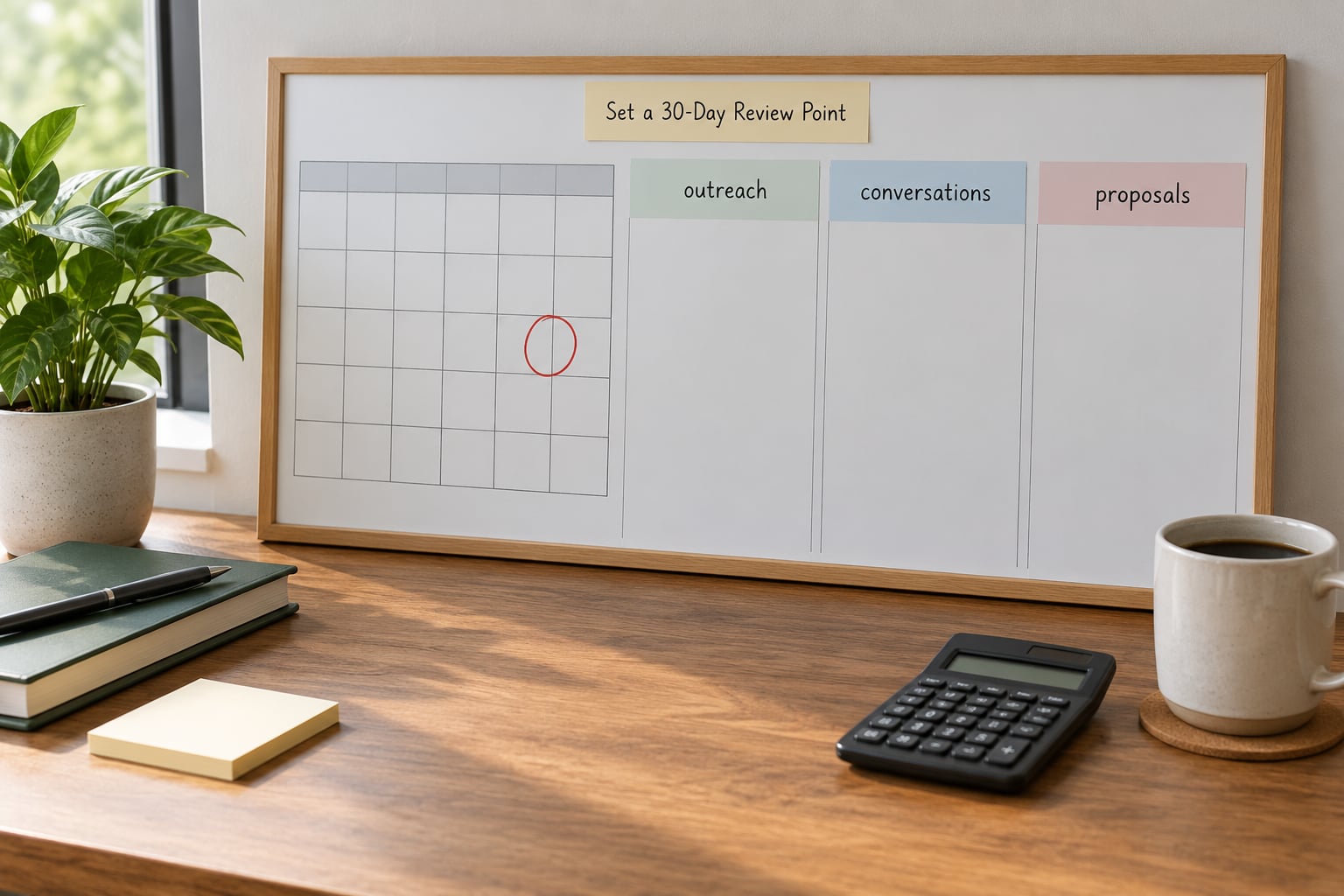
Thirty days is long enough to know whether your actions are working and short enough that you have not wasted a season. Put the date in your calendar when you start, not when you feel ready to look.
Review leading indicators rather than income, because income lags. Count replies, conversations held, proposals sent, referrals received, qualified inquiries and total pipeline value. Ten outreach touches a week for a month gives you roughly forty data points, which is enough to see whether the message is landing even when nothing has signed yet.
Use three simple columns on a page or board: outreach sent, conversations held, proposals out. Then ask one question of each number. Are sends happening at all? Are conversations happening without effort on your part? Do proposals happen but stall, which points at pricing or scope rather than demand?
Those three answers point at three different problems. Almost no sends is a discipline problem. Sends with no replies is a positioning or targeting problem. Replies with no proposals is a trust or proof problem. Proposals with no signatures is a pricing, scope or decision-maker problem.
If income arrived, check which leading indicator predicted it and do more of that. If income has not arrived but the indicators moved in the right direction, you are on track and you continue. If nothing moved, change one variable — the message, the target list or the offer — not all three at once.
Common Mistakes
Nearly every slow-season mistake shares one feature: it is fast, feels productive, and makes the next month harder.
Cutting all marketing. The first month without work feels like a reason to pause promotion. It is the opposite, because inbound takes months to build and you now have the months free. Keep a fixed weekly slot, smaller if necessary.
Lowering rates with no reason. Discounting an unchanged service resets what the market expects to pay and tends to bring in clients who were never going to pay full price. Reduce scope instead, or cut something else in your costs.
Contacting everyone. A blast to a thousand strangers produces a low reply rate and a habit of checking your inbox constantly. Twenty named people with real references beats a thousand nameless ones every month.
Taking unrelated work to fill the gap. A project you did not want, for a client whose values you disagree with, often costs more than the fee once you count the time, the rework and the reference you would rather not have. Cash-flow panic is exactly the state in which people misjudge this.
Ignoring your runway. If your number is under three months, the plan changes: part-time or temporary work, a fixed-scope offer to a past client, or a conversation about a fractional arrangement. Forum threads on freelance dry spells keep asking how to handle the moment the savings genuinely run out, and the honest answer is that it is a decision to make early rather than a cliff you fall off.
Waiting for inspiration. Creativity is not the bottleneck in a dry season. Volume is, and volume responds to a schedule rather than a mood.
Refusing to rest. Fear of falling behind turns a quiet month into a grind that leaves you exhausted in the month work returns. Clients taking vacation during their own quiet months is normal, and freelancers who plan a deliberate break in their slow season report it as the reason they stayed in the business.
One last seasonal reminder: the shape of your slow months is predictable once you map it. Fashion and editorial budgets often freeze in the fourth quarter while teams finish year-end work. Beauty brands cluster launches at specific times of year. Wedding and event work runs on a season that leaves the winter quiet for almost everyone in that niche. If you can name your slow months, you can build the buffer before they start rather than during them.
Frequently Asked Questions
How long should I wait before changing my strategy in a slow season?
Give any strategy thirty days of consistent effort before you judge it, and judge it on leading indicators rather than income. Ten outreach touches a week plus two visibility posts a week gives you around forty data points in a month. If replies and conversations are happening but nothing has signed, your strategy is working and cash is just lagging. If nothing moved at all, change one variable rather than everything at once.
Should I lower my rates when freelance work is slow?
Usually no. Cutting the price of an unchanged service resets what clients expect to pay and tends to attract buyers who were never going to pay full price, so you end up with lower income and worse-fit work. If a client needs a smaller number, reduce the scope and hold the rate. That is not a discount, it is a different offer with a clear deliverable and a clear timeline.
How do I contact former clients after a quiet period without sounding desperate?
Reference one specific piece of work you did for them, mention something current from their business, state your availability plainly, and ask an open question about what is on their radar. Skip the apology and skip any explanation of your quiet streak. Former clients respond well to short, specific, confident messages, and they already trust you, so the reconnection is easier than you expect.
What do I do if I have no savings at all during a dry spell?
Decide early, because the longer you wait the fewer options you have. Part-time or temporary work, a fixed-scope project for a past client, or a fractional day rate arrangement are the usual bridges, and a freelancer friend group or community is where people find the temporary work that never appears on a job board. Keep the same rate floor you would have charged in a busy month, because temporary work still becomes a reference.
How do I know when to diversify my services?
Add a service when it reaches the same buyers through the same proof of work, and when you can name the deliverable, the timeline and a fixed price. Give it eight to twelve weeks and count enquiries. One enquiry means it works as a lead source; two or three in a quarter means it belongs in your main offer. Diversifying into a field where you have no proof of work is a career change, not a slow-season tactic.
Conclusion
The first thing to do is smaller than it feels: calculate your runway in months, pick one revenue target for the next thirty days, and send one reconnection message to a past client today. Then set the review date and judge the month by replies and conversations rather than by the balance.
A slow season is a scheduling problem with a marketing problem inside it. Thirty days of steady, targeted work usually turns it around, and the freelancers who come out the other side usually have a better offer and a fuller pipeline than they had going in.