
Learning how to pitch yourself to podcasts as a guest comes down to one thing: a host is not looking for the most interesting person in the room, they are looking for the most useful person for that specific episode. Write a short email that proves you listened, names one conversation they’d enjoy, offers proof you can deliver it, and makes saying yes easy. Most of this takes an afternoon to set up, then about 30 minutes per pitch.
Here is the uncomfortable part first. Cold pitch emails to podcasts get a reply somewhere in the single digits as a percentage, and the biggest shows reply far less often than the small ones with 3,000 loyal listeners. Podcasters on r/podcasting and hosts in the Buzzsprout community say it plainly: they book episodes four to six months out, they distrust copy-pasted PR pitches, and silence usually means timing rather than a verdict on you. Treat the first ten pitches as practice.
Table of Contents
- What You Need Before You Pitch
- The one story only you can tell
- Three bios, different lengths
- An audience profile in two lines
- Proof links
- A tracking sheet
- How to Pitch Yourself to Podcasts as a Guest: Step by Step
- 1. Define the story only you can tell
- 2. Choose podcasts that fit your audience
- 3. Research the host and recent episodes
- 4. Build a pitch around one specific episode idea
- 5. Write a short, credible pitch email
- 6. Follow up once, then move on
- 7. Prepare to be a useful guest
- Common Pitch Mistakes and How to Fix Them
- Frequently Asked Questions
- Do podcast hosts pay guests?
- How long should a podcast guest pitch email be?
- Should I follow up after a podcast pitch?
- How do I pitch a podcast with no prior appearances?
- How many podcasts should I pitch each week?
- How do podcast hosts choose their guests?
- Conclusion
What You Need Before You Pitch
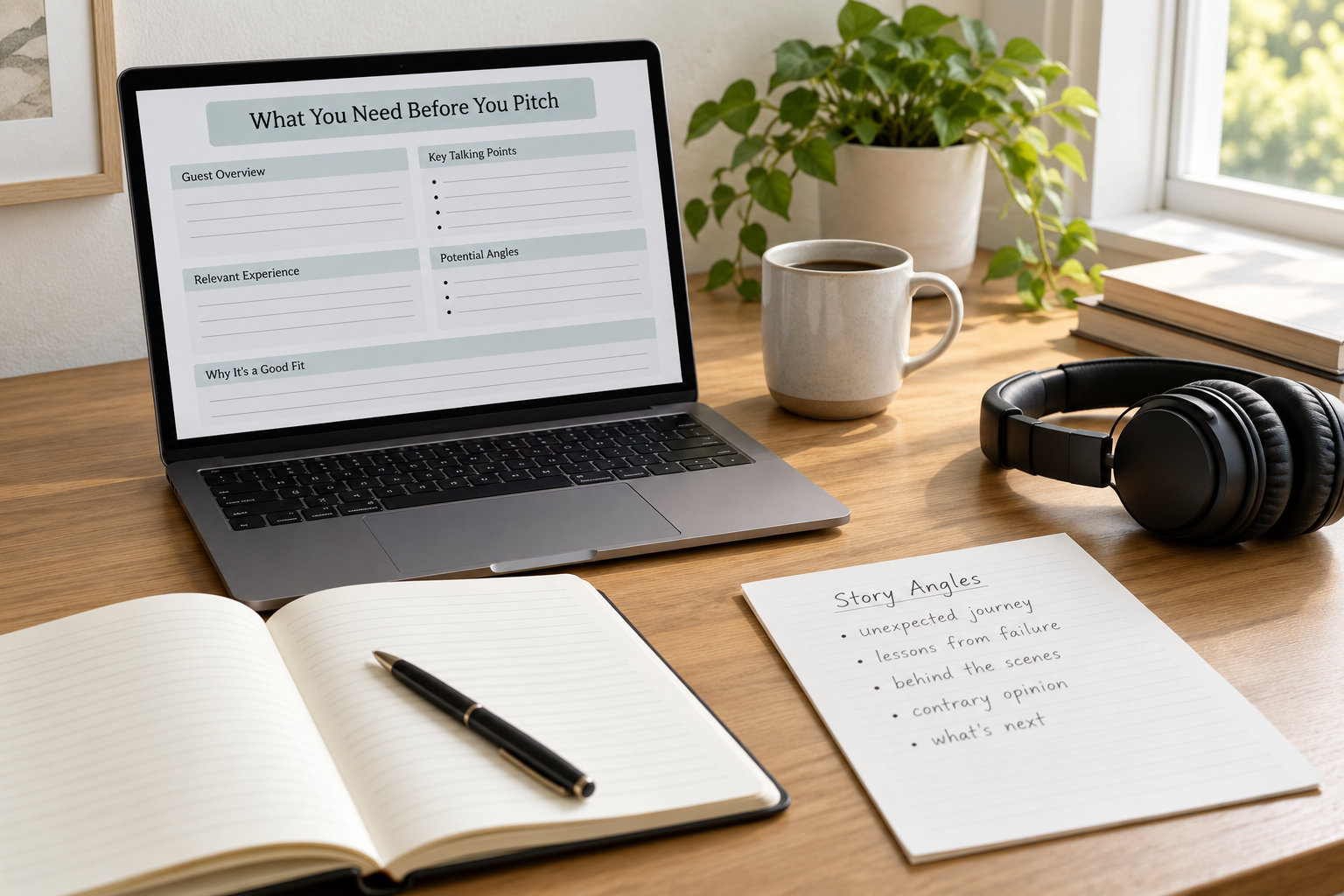
Almost every failed pitch traces back to prep that stopped one step short. Build these five things once and you can send quality pitches for years without rewriting anything.
The one story only you can tell
Not a topic. A story with a turn in it. The client who ignored your first three pitches and then came back, the launch that flopped and what the numbers actually showed, the trend you called early and were wrong about. A host can find a general expert anywhere; they cannot find your specific lesson.
Three bios, different lengths
A one-sentence version, a 40-word version, and a short paragraph with proof. The one-sentence version goes in your subject line or first line. The 40-word version is what most pitches need. Keep credentials factual: publication names, audience sizes, years in the field.
An audience profile in two lines
Who follows you, where they came from, and what they ask you about. “Around 12,000 people read my weekly newsletter, mostly independent stylists and boutique brand owners, and the most common question is how to get on wholesale.” That sentence does more work than any adjective.
Proof links
One prior interview, one press mention, one piece of your own writing, one result. Hosts check these. A landing page that loads slowly or has a dead author page kills pitches that would otherwise have landed, so fix your site before you start sending.
A tracking sheet
Show name, contact, date sent, angle pitched, follow-up dates, response. A plain spreadsheet works. It stops you double-pitching the same show and shows you your reply rate after thirty pitches, which is the only honest measure of your pitch quality.
How to Pitch Yourself to Podcasts as a Guest: Step by Step
1. Define the story only you can tell
Write five candidate stories before you look at a single podcast list. Each one needs a specific situation, something you learned from it, and a reason your listener would care. Then cut it to the one that would hold a listener’s attention in the opening eight minutes of an episode.
2. Choose podcasts that fit your audience
Match beats audience size. Look for shows where the existing guests are people like you, the episode length matches your conversational style, and the format suits your material: an interview show handles stories better than a solo monologue format does. A show about small-business branding is a better fit for a stylist who built a wholesale line than a general business show with two million downloads.
3. Research the host and recent episodes
Listen to two or three episodes, including one older one. You are hunting for repeated themes, questions the host keeps asking, and topics nobody has covered yet. That gap is your pitch. Note how the host talks: some hosts want one clean question at a time, others run fast and loose. Also skip the reflexive “I loved your latest episode” line, because hosts recognise a copied reference instantly and it reads as filler.
4. Build a pitch around one specific episode idea
A strong pitch email proposal has a working title, the listener benefit, one clear takeaway, and two or three honest questions you could actually answer. Keep it to two ideas max; a host with eight guest pitches in their inbox reads the first line of each one.
5. Write a short, credible pitch email
Under 150 words, ideally under 120. It needs a personalised subject line, a reference to one real episode, a proof line, your episode idea, and a sign-off that makes no pressure to reply. Make it easy to say no, because that phrase tells a busy host you respect their time and removes the social awkwardness of declining.
6. Follow up once, then move on
Wait five business days. Send one short bump that adds something new rather than writing “just bumping this”. If there is still nothing after another week, stop. Hosts who wanted to book you have already booked you; the ones who have not are usually sitting on a calendar that was full before your email landed. Two touches is polite, a third is noise.
7. Prepare to be a useful guest
Prepare before you record. Research the show’s audience, write down five stories, know your three strongest numbers, and check your audio setup. Send a short outline in advance if the host asks, and never read your answers off a script. Hosts describe the three Ps as politeness, professionalism, and preparedness, and one host told an unprepared guest mid-interview that they would be invited back after some practice. That happens more often than anyone admits.
Common Pitch Mistakes and How to Fix Them
The life story. Nobody cares that you started in 2014 in a garage. Cut everything before the useful part and lead with the result.
Eight topic ideas. A host with 40 episodes a year cannot choose from a menu that long. Two specific ideas, one line each.
Overclaiming credentials. “Leading voice in sustainable fashion” is filler. “Styled for three independent brands at launch” is checkable.
The wall of text. Long pitches get skimmed. Aim for 120 words and one screen.
Pitching only your book or launch. Hosts repeatedly say this is the fastest way to be ignored. Bring expertise that generalises beyond your product, and mention the book only if it happens to be relevant.
Generic episode flattery. “I loved your episode about growth” tells a host nothing. Reference a specific moment, a specific guest, a specific question they asked.
Attachments. Media kits attached to cold emails land in spam and are rarely opened. Link to a landing page instead, hosted on your own site where it loads fast.
Seven follow-ups. Persistence without new information reads as volume, not interest.
Frequently Asked Questions
Do podcast hosts pay guests?
Most do not. The overwhelming majority of podcast guest appearances are unpaid, because ads and listener support pay the host, not the guest. A few high-profile shows and some business podcasts offer fees, but there is no standard rate and it is rarely advertised in advance. Plan to cover your own travel and your own recording gear.
How long should a podcast guest pitch email be?
Under 150 words, and under 120 is better. That is enough room for a specific episode reference, one line of proof, one episode idea, and a low-pressure sign-off. Length is the single most consistent signal hosts mention about what makes a pitch look respectful. If your draft needs scrolling, it is too long.
Should I follow up after a podcast pitch?
Yes, once. Wait about five business days, then send a short bump that adds a detail rather than repeating yourself, for example a second episode angle or a relevant clip. If nothing comes back after another week, stop and move on. Two touches reads as persistence. A third reads as noise and can cost you a future booking on the same show.
How do I pitch a podcast with no prior appearances?
Lead with proof you do have: a project you ran, a result you can name, published writing, or a personal site with real work on it. Many guests get their first booking on the strength of a story alone. Hosts also respect a short demo reel, so record two minutes answering the kind of question the host asks and host it on your own landing page. Do not send the video as an attachment.
How many podcasts should I pitch each week?
Three to five well-researched pitches a week is a workable pace, because the research is what takes the time. Volume rarely helps, since each pitch should reference a real episode. After thirty pitches you will have a usable reply rate to measure against. Track it, and if you are getting near zero replies, change the angle and the proof rather than the volume.
How do podcast hosts choose their guests?
They choose guests who fit the audience and who can hold a conversation. Hosts are looking for a specific point of view, a real story, and someone who will not waste forty minutes on their own biography. They also worry about preparation, because an unprepared guest costs them an episode they already recorded and scheduled.
Conclusion
Start with one story you could tell in eight minutes without notes, then find three shows whose listeners already care about it. Listen to two episodes from each, write three pitches under 120 words, and send them this week. Treat it as practice until you have sent thirty. How to pitch yourself to podcasts as a guest is not a talent you are born with, it is a sequence you can repeat, and the tracking sheet tells you whether the angle or the volume is the problem. Adjust the angle first, keep the volume steady, and give it thirty pitches before you decide the system is broken.