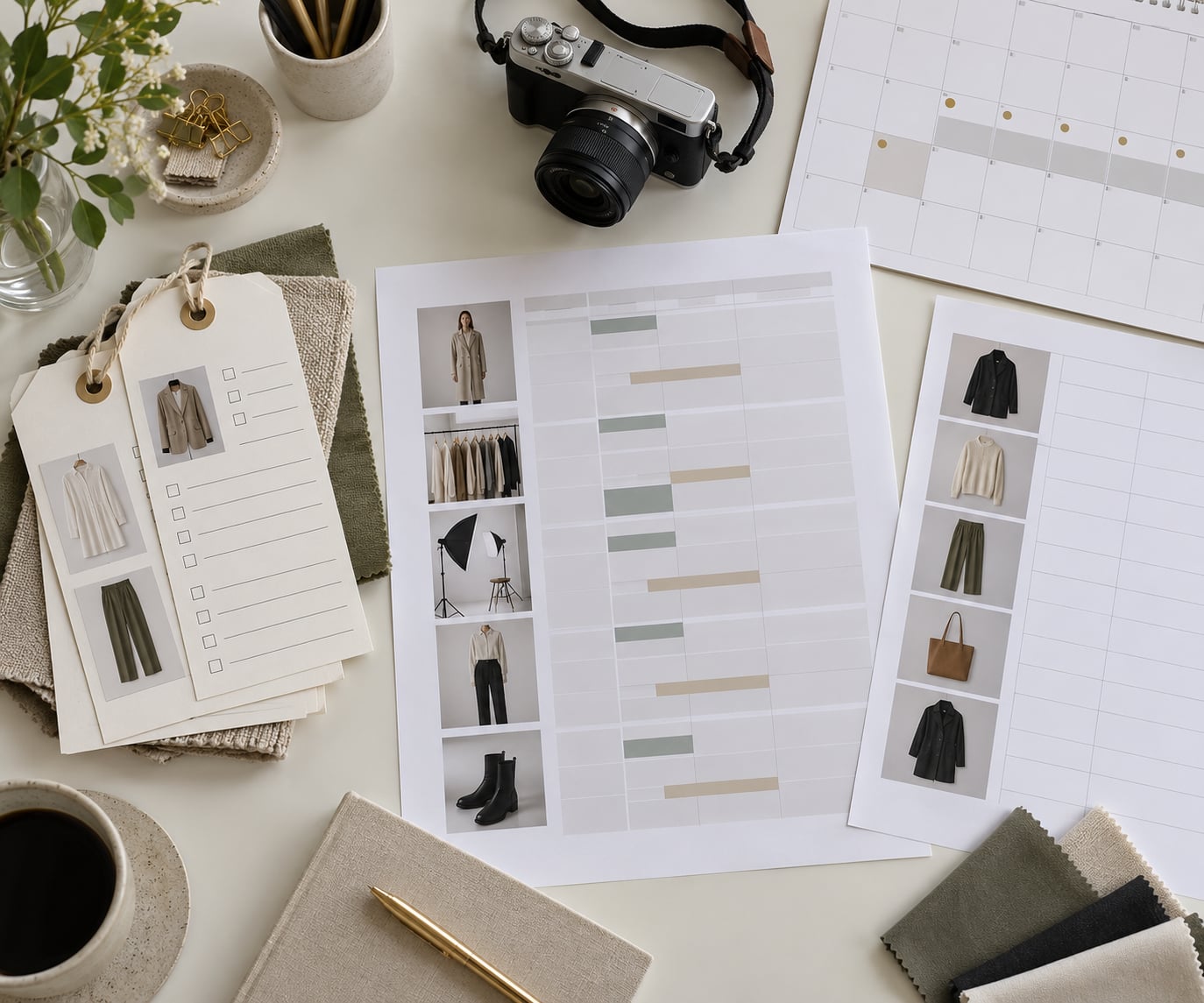
A production coordinator in fashion is the person who turns an approved plan into a running schedule of people, garments, vendors and paperwork. They keep designers, models, stylists, factories and suppliers working off the same deadline and the same budget, and they are usually the first to notice when a schedule starts to slip.
Plenty of job ads use the title loosely, so it helps to know what the title actually covers before you apply. Below is what a production coordinator does in fashion day to day, how the job differs from a production assistant, and how the role changes depending on whether you are coordinating a garment line or a fashion show.
Table of Contents
- What a Production Coordinator Does in Fashion at a Glance
- How Is a Fashion Production Coordinator Different From a Production Assistant?
- What Does a Production Coordinator Do Day to Day?
- What the hours actually look like
- Which Types of Fashion Projects Do Coordinators Manage?
- Editorial and lookbook shoots
- Campaign and brand content
- Runway shows
- Showroom and presentation events
- Store openings and brand activations
- Garment and sample development
- What Skills Does a Fashion Production Coordinator Need?
- Organisation under pressure
- Written and verbal communication
- Negotiation
- Budget awareness
- Technical fluency
- Fashion knowledge
- Adaptability
- Problem-solving
- What Tools and Documents Does a Fashion Production Coordinator Use?
- How Do You Become a Fashion Production Coordinator?
- What Is the Career Path for a Fashion Production Coordinator?
- Frequently Asked Questions
- Do you need a fashion degree to become a production coordinator?
- Is a production coordinator responsible for the whole production?
- What is the most difficult part of being a fashion production coordinator?
- Can production coordinators work freelance?
- How does the role differ at a small fashion brand?
- Conclusion
What a Production Coordinator Does in Fashion at a Glance
In short, a fashion production coordinator owns the schedule, the documents and the moving parts of a production. Creative decisions belong to the designer or creative director. Money above a set threshold belongs to the production manager or the brand. The coordinator is what sits between those two and keeps everyone supplied with what they need, on time.
| Core area | What the coordinator actually does |
|---|---|
| Schedule management | Builds the production timeline, keeps it current, and flags slippage early |
| People and talent | Confirms call times, books models and crew, handles changes and no-shows |
| Samples and assets | Tracks garments through fittings, alterations, shipping and returns |
| Logistics | Arranges couriers, load-ins, equipment, catering, parking and venue access |
| Budget | Tracks spend against the approved number and raises variances before they land |
| Documentation | Owns the call sheet, run of show, sample tracker and final wrap report |
| Problem-solving | Absorbs the late sample, the broken zip, the stuck courier and the missing light |
| Communication | Translates between designers, vendors, agencies and crews without losing the detail |
How Is a Fashion Production Coordinator Different From a Production Assistant?
The gap is ownership. A production assistant executes what they are told. A coordinator decides the order of operations, chases the vendors and tells the rest of the team what is realistic. That is why many production managers spent years as coordinators first.
| Dimension | Production assistant | Production coordinator |
|---|---|---|
| Decision-making | Follows instructions, flags issues | Chooses sequences, methods and vendors within budget |
| Ownership | Supports a task | Owns the schedule and the paperwork end to end |
| Vendor communication | Sends confirmations | Negotiates, chases and holds vendors to deadlines |
| Scheduling | Maintains the calendar | Builds it and re-sequences it when something breaks |
| Budgets | Submits expenses | Tracks spend and forecasts overruns |
| Deliverables | Call sheets, gear lists, admin | Run of show, cost sheets, timelines, wrap reports |
| Typical experience | Entry level or internship | One to three years in production, events or logistics |
What Does a Production Coordinator Do Day to Day?
On a show day, the job starts before anyone else arrives. A typical sequence looks like this.
- 7am, check the schedule. You open the call sheet you sent out yesterday and confirm every name answered. Two people still have not replied, so you start texting before you start driving.
- 8am, walk the venue. Load-in begins. You confirm power, confirm the runway is clear, and check that the rails are where the stylist expects them.
- 9am, confirm talent. Models are booked and on their way. Hair and makeup arrive in a staggered call. You update the run of show in real time so the stylist knows who is next.
- 11am, chase samples. A garment is still at the atelier. You find out whether the courier can make the window, and if not you decide what gets pulled from the opening look.
- 2pm, run the show dry. Timing, look order, transitions. Mark the changes directly on the run of show.
- 3pm, vendors settle. Food, water, power strips, the extra steamer. Someone always needs something at this hour.
- Doors, show, strike. Once the doors open you switch to problem-solving only. Afterwards you strike, count what went missing, and reconcile invoices before you leave the building.
That is a show day. On a garment-line day you would be doing the same kind of coordination in a different direction: pricing from the factory, cost sheets, production timelines, purchase orders and delivery windows rather than a runway.
What the hours actually look like
Regular production weeks are office hours with a phone that never stops. Show weeks are not. Call time on a runway day is usually somewhere between 6am and 8am, and strike often means loading out after midnight, so a show week can run sixteen hours a day for five consecutive days. Brand teams that value people build the strike day or the day after into the schedule; teams under real deadline pressure do not. Ask about overtime practice and comp days in the interview rather than after you have burned a week of sleep.
Which Types of Fashion Projects Do Coordinators Manage?
The same title covers several quite different jobs, and knowing which one you are applying for saves a lot of confusion.
Editorial and lookbook shoots
Coordinating a shoot means locking the shot list, the location, the styling order and the light, then keeping the day on schedule while garments get steamed and re-steamed. The measure of success is how few reshoots you need.
Campaign and brand content
A campaign adds a client layer. You handle approvals, usage rights and version control so marketing gets the crops and formats it asked for, not the ones that happen to exist in the edit.
Runway shows
This is the highest-pressure version. Run of show, model call times, front of house seating, backstage lanes, hair and makeup rotations and a strike that starts the moment the last model walks off. Live trade shows in New York, London, Milan and Paris all run on the same kind of schedule.
Showroom and presentation events
Resort and pre-collection presentations are smaller and more sales-driven. The coordinator manages the appointment list, the room turnover between buyers, and the flow of garments that each one wants to try.
Store openings and brand activations
Here the work leans toward build, logistics and guest management. Permits, delivery windows, queueing, and the unglamorous question of where the coat check is.
Garment and sample development
On the apparel side the coordinator works with the sample room and factories instead of a venue. Fittings, first patterns, fit sessions, quality checks, shipment tracking and delivery dates.
What Skills Does a Fashion Production Coordinator Need?
Job ads ask for “highly organised” and then describe every skill below. Here is what each one looks like in practice.
Organisation under pressure
Not general tidiness. The ability to hold a nine-step process for thirty looks in your head and still know which vendor has not confirmed.
Written and verbal communication
Most of the job is translation. You turn “we need it by Friday” into a courier booking, and you turn a factory’s delay into two sentences the designer can act on.
Negotiation
Vendors are small businesses and you are usually a first-time client. Getting a hold on a fitting slot or an overtime rate without damaging the relationship takes more than asking firmly.
Budget awareness
You rarely control the budget, but you always see it. Knowing which line item is quietly going over before the invoice arrives is the whole game.
Technical fluency
Spreadsheets, shared drives, milestone trackers and whatever project tool the team uses. You do not need to be an expert. You need to be fast and unambiguous.
Fashion knowledge
You do not need to design. You need to know the difference between a proto, a fit sample and a size sample, and why a hem allowance matters when a model is standing on a step.
Adaptability
Plans are written to be revised. The useful question is never whether the day is going wrong, only what the new order of operations should be.
Problem-solving
Every problem in this job has an owner, a deadline and a cost. Your value is finding the cheapest fix that keeps the delivery date.
What Tools and Documents Does a Fashion Production Coordinator Use?
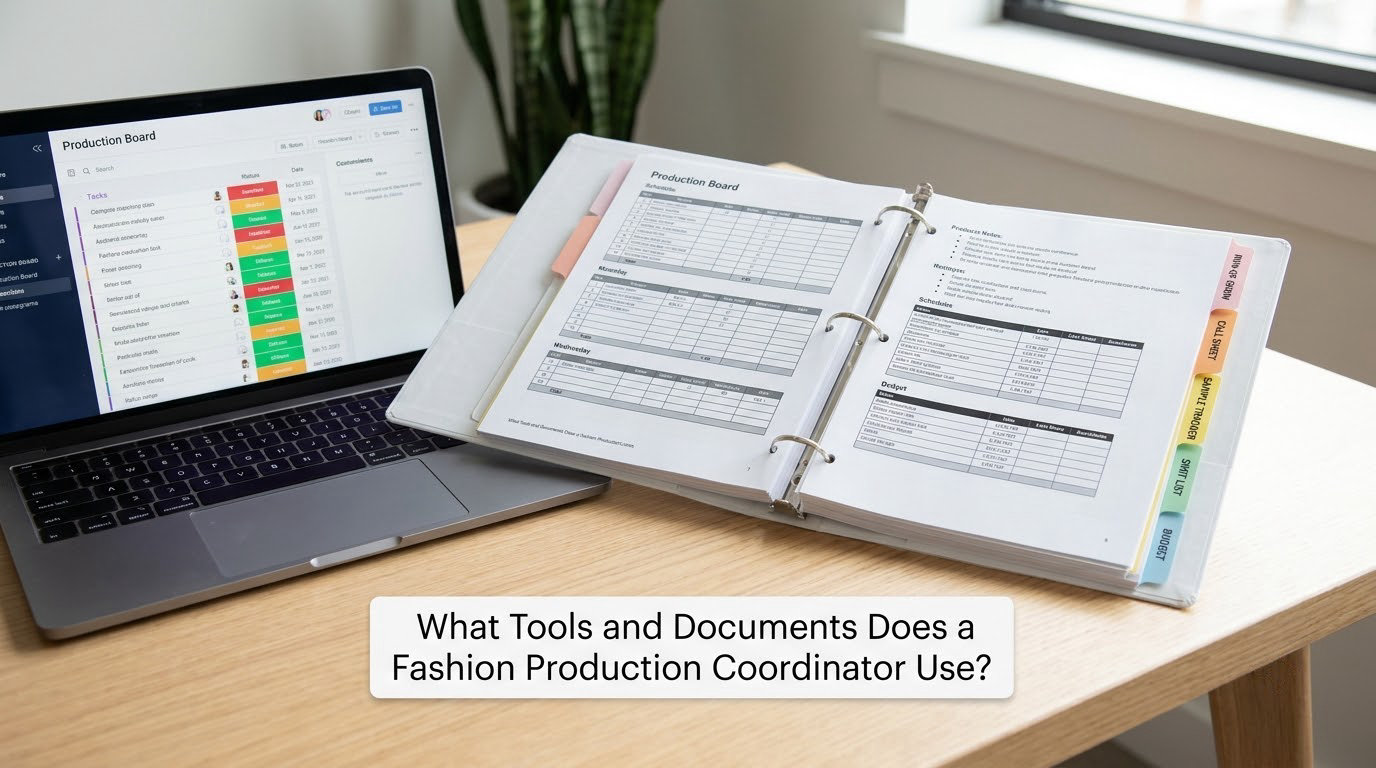
Most of the job is documentation, so the documents are the tools. Here is what a coordinator typically maintains.
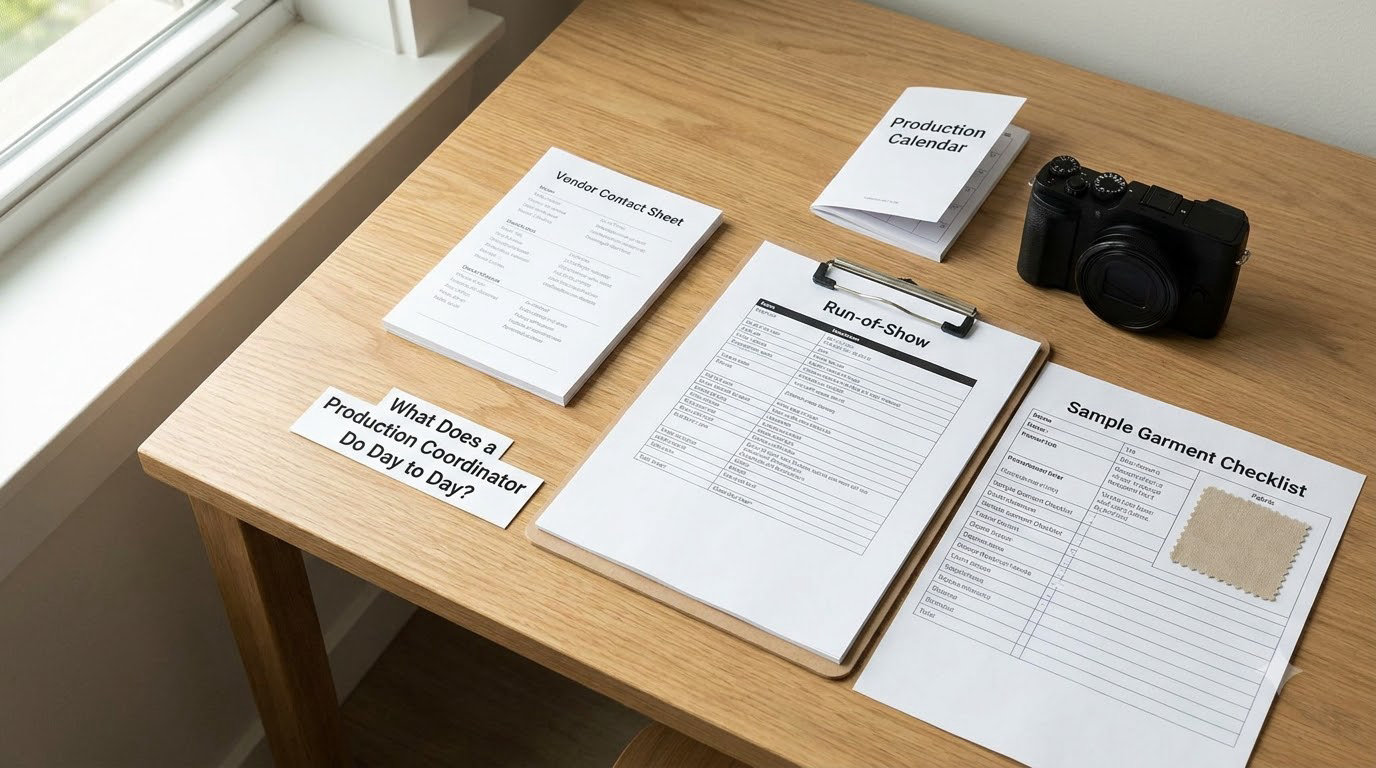
- Production calendar. The master timeline every other document is checked against. If a date is not on the calendar, it does not exist yet.
- Run of show. Minute-by-minute show schedule from load-in to strike, with the look order and any timing changes marked up live.
- Call sheet. Who is called, where, when, what they are bringing and who to call. Usually issued 24 hours out and reissued after changes.
- Contact sheet. Names, roles, agencies, phone numbers and payment terms. Unglamorous and the document that saves a show when somebody cannot be found.
- Sample tracker. Every garment, its size, its status, where it is, and who signed for it. This is where lost stock gets spotted.
- Budget tracker. Spend against the approved number by line item, with committed costs separated from estimates.
- Vendor list. Factories, ateliers, couriers, suppliers and equipment hire, with insurance and compliance notes attached.
- Shot list. For shoots: every frame required, the wardrobe for each, and the time estimate. Built from the mood board, not from scratch.
- Asset management system. Final images, selects and rights metadata, delivered to marketing in the formats they asked for.
- Project management platform. The shared task board. Airtable, Asana, Monday and Notion all turn up, and brand teams usually have their own.
Excel and Google Sheets remain the backbone for cost sheets and production timelines, and any brand that has not moved on still expects you to live in both.
How Do You Become a Fashion Production Coordinator?
Nobody hires you as a coordinator on the strength of a degree alone. Here is the path that works.
- Get close to the work first. A production office internship, a showroom coordinator role, a fashion week volunteer position or an events job at a venue gets you inside a real production with real consequences.
- Learn apparel vocabulary. Proto, fit sample, PP sample, tech pack, line sheet, cost sheet, FOB and landed cost. Job postings use these terms without explaining them, so read them before you apply.
- Get spreadsheet fluent. Build a production timeline from scratch for a collection you admire. It doubles as a portfolio piece.
- Build documents, not just a CV. A sample run of show, a call sheet template and a one-page budget tracker tell an employer more than a list of soft skills.
- Target the right employers. In-house brand production teams, production companies that build shows, agencies and independent producers all hire at this level.
- Use fashion week as a foothold. Volunteering gets you backstage access and a working contact list before anyone is hiring juniors.
- Apply with specifics. Mention the type of production you have coordinated and one thing you fixed when it went wrong.
A short professional summary in the style most hiring managers like: “Production coordinator with experience coordinating editorial and lookbook shoots, sample tracking and vendor scheduling for a twelve-look delivery. Comfortable building production timelines and call sheets from scratch, and accustomed to re-sequencing when samples or vendors slip.”
What Is the Career Path for a Fashion Production Coordinator?
The ladder is short and the exits are clear. Most people move from coordinator to production manager within three to five years, and the difference is responsibility for money and risk rather than for calendars.
| Step | What changes | Signal you are ready |
|---|---|---|
| Production assistant | Executes tasks, supports the team, learns the documents | You are trusted with a call sheet and a vendor list |
| Production coordinator | Owns schedule, vendors and paperwork for one production | You are the one people call when a delivery slips |
| Senior coordinator | Runs several productions and mentors juniors | You are writing the templates others copy |
| Production manager | Approves spend, signs off on budgets and risk | You hold the budget and answer for it |
| Creative producer or brand producer | Shapes the calendar, budget and creative plan with the designer | You are in the collection and campaign planning meetings |
| Freelance producer | Runs your own productions and books your own clients | You have a network and a rate card |
People with film, television, theatre, hospitality or logistics experience transfer into fashion production coordination faster than most job ads suggest, because the mechanics are identical even when the product is different.
Frequently Asked Questions
Do you need a fashion degree to become a production coordinator?
No, and many coordinators do not have one. What matters is that you can build a production timeline, hold vendors to deadlines and stay calm when something breaks. A fashion degree helps you talk to designers and understand fit and fabric, but an events degree, a logistics background or a decade in hospitality will get you just as far. Employers care more about a production you can walk them through than about where you studied.
Is a production coordinator responsible for the whole production?
Responsible for execution, not for everything. You own the schedule, the vendors, the logistics and the paperwork for a production. Creative direction sits with the designer or creative director, and spending above your limit is approved by a production manager or brand. The rule of thumb is that the coordinator gathers the options and keeps the project moving, and the production manager decides which option gets funded.
What is the most difficult part of being a fashion production coordinator?
Holding your nerve while a plan comes apart in public. A sample misses its courier window, a model calls off an hour before the show, and everyone in the room looks at the same person. The technical parts are learnable. The hard skill is deciding quickly between re-sequencing, cutting scope and spending money, then explaining that decision clearly enough that nobody argues with it while the doors are about to open.
Can production coordinators work freelance?
Yes, and it is common once you have run at least one full production for a brand. Freelance producers take on shoots, lookbooks, showroom presentations and small events, and they usually bill by project or by day plus expenses. Building it from a salaried job works best: keep your contacts, get recommendations from clients you actually delivered for, and start with the production types you know cold rather than everything at once.
How does the role differ at a small fashion brand?
At a small brand you wear every hat. A coordinator at a larger company owns one production and delegates the rest, while at a smaller label you may handle samples, fittings, shoot logistics and delivery tracking in the same week, and deal directly with the designer rather than a chain of managers. That breadth is harder work and much faster-paced, and it tends to build ownership skills that larger structures divide across several roles.
Conclusion
What a production coordinator does in fashion comes down to this: you own the schedule, the vendors, the logistics and the paperwork, and you keep a production on plan when it does not want to be. The skills are learnable and the title transfers in from events, hospitality, logistics and film, which widens your options considerably.
Start by picking the kind of production you want to be known for. Learn the documents for that world until you could build a run of show or a cost sheet without a template, then get into a room where those skills are visible: an internship, an assistant role, a volunteer position at fashion week or a freelance job you scope yourself.