To write a newsletter people open, you need three things working together: one specific reader in mind, one promise they can count on, and a structure they can absorb in a couple of minutes. Most inboxes are full, so an email earns attention in about two seconds of scanning. This guide walks through the whole system, from the pre-writing setup to the first 30 days of sends, with the small decisions that decide whether your list reads on Tuesday morning or never touches it again.
Table of Contents
- What You Need
- Step-by-Step: How to Write a Newsletter People Open
- Step 1: Choose one reader and one useful promise
- Step 2: Find a strong opening idea
- Step 3: Write a subject line readers recognize
- Step 4: Build an easy-to-scan structure
- Step 5: Add examples, texture, and a distinct voice
- Step 6: Edit for clarity, warmth, and restraint
- Step 7: Send consistently and learn from the response
- Common mistakes and the fix for each
- Frequently Asked Questions
- What makes a good newsletter subject line?
- How long should a newsletter be?
- How often should I send my newsletter?
- What is a good open rate for a newsletter?
- Should I use plain text or HTML for my newsletter?
- How do I get my first 100 subscribers?
- What is the 3/2/1 newsletter?
- Are newsletters still worth starting?
- Conclusion
What You Need
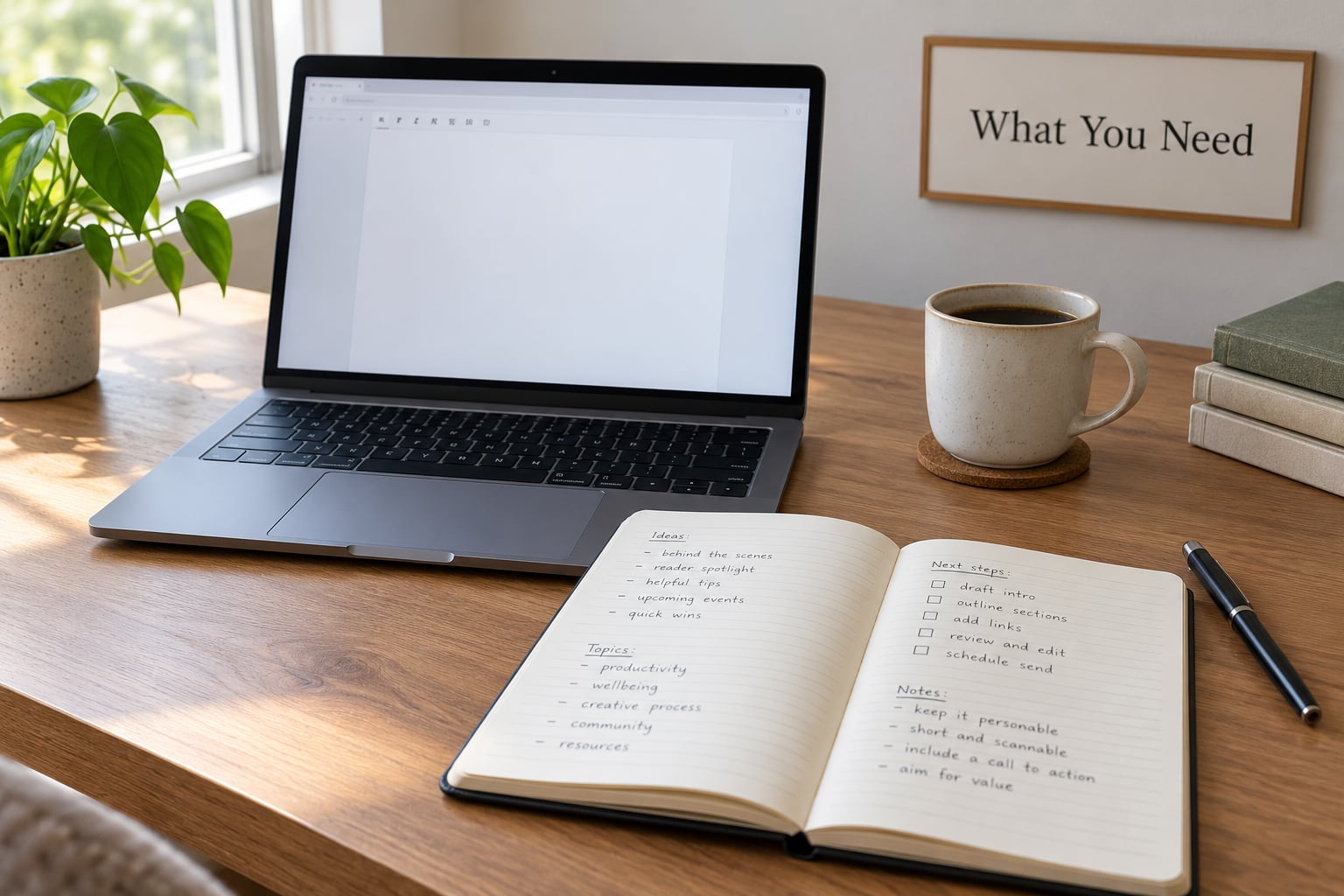
Most people start with a blank document and hope the writing shows up. That backwards order is why newsletters stall. Spend an hour on the setup below and every draft after that gets faster.
You need an audience profile in one sentence: who reads this, what they already know, and what they want that they are not getting. You need a promise they can picture, which is the sentence that would make someone subscribe even if the issue itself did not exist yet. For a styling newsletter, that might be a weekly edit of what is worth buying now and what to ignore.
You also need three voice references, newsletters you like the sound of, saved with a note on what each one does well. Voice is easier to borrow than to invent, and most writers have never formally looked at what their favorite emails share.
Then the working materials: an idea bank, a simple template, and a sending platform. The idea bank can be a single note on your phone, a running list where each line is a subject you would be glad to write about. Five years of random lines will cover a year of weekly issues.
For the platform, the choice matters far less than the habit. Writers on Reddit’s r/Newsletters and r/Emailmarketing describe the same shortlist of tools, and the honest summary is simple: pick one, use it consistently for three months, and only then decide whether it is limiting you. Migrating platforms wastes weeks you could have spent writing.
One last thing: a schedule you can keep when the week goes sideways. Twice a month is more useful than twice a week you only manage for a month.
Step-by-Step: How to Write a Newsletter People Open
Step 1: Choose one reader and one useful promise
Broad audiences get broad, forgettable issues. Narrow ones get replies. Decide who this email is to, then write the promise as a sentence your reader would repeat to a friend.
The test is whether the promise survives a bad week. If your promise is always something fresh and inspiring, it is not a promise, it is a mood. Promises that hold up are structural: a weekly edit, a monthly breakdown, one styling mistake explained, a short read on what the runway is doing.
A stylist might promise to break down one trend each Friday and say whether it flatters real bodies. That sentence tells a reader what arrives, how long it takes, and whether it is for them. Put it in your header, your signup page, and your pinned first issue.
Step 2: Find a strong opening idea
Most blank pages come from demanding a fresh idea every time. The better approach is a smaller list of formats that repeat, so you are refining an angle rather than inventing one.
Formats that work repeatedly: a single item broken down, a question you keep getting answered, a before-and-after, a myth you are tired of hearing, a short list of things worth your attention, a lesson from a shoot that went sideways. Pick two or three and rotate them. Readers like knowing roughly what shape the issue takes, which is part of why they subscribe at all.
When an idea feels thin, it is usually because it is too general. “Skincare trends” is thin. “Which three of this season’s skin trends are making your clients ask the wrong questions” has a person and a tension in it.
Step 3: Write a subject line readers recognize
Your subject line is a promise, not a headline. It should sound like something from you specifically, because your name and your past issues sit right next to it in the inbox.
Four patterns I keep coming back to. The first is a concrete result: “Three layering fixes for spring scarves.” The second names a specific thing: “The 1980s trench is back, and the sizing is wrong.” The third is a question with a real answer inside: “Why does everything look better in the second photo?” The fourth is a short statement of opinion: “Capsule wardrobes were never about minimalism.”
What to avoid is the accidental openers, the mystery without payoff, and the fake urgency. Lines like “You won’t believe this” get clicks once and teach readers that you are not worth opening. If your line has to be vague to land, the issue underneath is usually vague too.
Match word count to value: a short issue earns a short line. Also write a preheader, the grey snippet that follows the subject in most inboxes, and treat it as a second chance rather than repeating the subject.
Step 4: Build an easy-to-scan structure
People scan email on a phone, often while distracted. Give them an order they can follow without effort.
A structure that works for most writers: open with the point in the first two or three sentences, explain why it matters, deliver the detail in short chunks, then end with one clear next step. Keep paragraphs to a few sentences, use subheads so a reader can jump, and cut any sentence that is only there to sound smart.
On formatting, you have two honest options. Plain text feels like a person wrote to you, which suits personal brand newsletters and small lists. Designed HTML lets you show garments, swatches, and side-by-side looks, which suits visual topics like styling and beauty. Pick one per newsletter and learn it properly rather than mixing both halfway.
Whatever you choose, keep the design stable across issues. Same fonts, same widths, same position for your links. Readers open faster when nothing has moved.
Step 5: Add examples, texture, and a distinct voice
Useful advice without examples is a brochure. The specifics are what readers quote back to you in replies, and replies are the real sign your newsletter is working.
Name the garment, the fabric, the room, the client. Describe what it actually looked like: a cream trench in a size 8 with the sleeves pushed to the forearm because the shoulder seam hit wrong. Write about the moment you got it wrong, not just the polished outcome.
The 5 C’s of email etiquette are a good restraint check for any newsletter: be concise, be clear, be correct, be courteous, and be consistent. They are not new, and they still hold. Most editorial feedback comes down to cutting half of it.
On using AI tools, treat them as a first draft or an editing pass, not a voice. Writers in r/writing who leaned on them heavily ended up rewriting more than they saved. If you dictate a rough version and type it back in your own words, you get speed without losing the thing that made people subscribe.
Step 6: Edit for clarity, warmth, and restraint
Set the draft down for a few hours, then read it once for meaning and once for sound. This is the last pass of how to write a newsletter people open, and it catches more than people expect.
Cut these first: throat-clearing openings, hedges stacked on hedges, sentences where you explain your own joke, any paragraph that exists only to prove you wrote. Read the opening aloud. If you stumble, rewrite it.
Then check the promises. Every issue should match the one-sentence promise you wrote in step one. If it does not, readers notice without knowing why, and they stop opening.
Last, proofread on the phone screen where most of your readers will see it. Broken links and awkward line breaks do more damage than a typo.
Step 7: Send consistently and learn from the response
Pick a rhythm you can hold and send at a similar time each issue, so readers learn when to look. Weekly suits most personal brand newsletters, and a monthly issue suits anyone with a busy season. Whatever you choose, readers will forgive a slow month far more easily than a broken promise about cadence.
Open rates get read too anxiously. A steadier signal is how many people reply, click, or forward. Track replies, replies per thousand subscribers, and how many new subscribers arrive from a specific issue. A single issue that brought in 30 signups from 500 readers tells you more than a 55 percent open rate does.
Then prune. Writers on r/Emailmarketing and r/beehiiv treat cutting people who have not opened anything in about two months as respect rather than rejection, and the reported effect is usually healthier deliverability and better inbox placement. Small lists that prune tend to see open rates climb.
Do not chase every metric. Fix the promise, the subject line, and the first paragraph. Those three explain most results.
Common mistakes and the fix for each
Each mistake below has a straightforward repair.
- Too many topics. A newsletter trying to cover runway news, pricing tips, and personal stories competes with itself. Pick the one theme that a reader would describe as what this newsletter is for, and let the rest go for a while.
- Hiding the value. If the payoff only appears in the final paragraph, most readers never reach it. State the useful thing near the top and use the rest for depth.
- Changing voice every issue. Sound differences between issues read as a different person wrote it. Pin two or three sentence openers you like and reuse the shape.
- An overlong introduction. Backstory about why you started the newsletter belongs once, in the first issue. Everything after that opens with the point.
- Vague subject lines. “Weekly thoughts” is a filter reminder, not an invitation. Add the specific thing and the payoff.
- Writing for everyone. Wide subject lines, broad promises, general advice. Narrow them to the people who actually subscribe.
- Sending whenever you finish. Random send times train nobody. Choose a slot and hold it.
- Never pruning. A stale list drags delivery for everyone else. Set a recurring monthly clean-up.
- Neglecting technical setup. Send from a real domain with authentication configured rather than a shared free sending address, or inbox placement becomes a gamble you cannot control.
- Waiting for the perfect idea. Publishing a solid draft on schedule beats an excellent draft three months late.
Frequently Asked Questions
What makes a good newsletter subject line?
A good subject line is specific, accurate, and shaped like the sender. Name the actual thing you are writing about and the payoff the reader gets, then match the length to the value inside. Curiosity helps, but only when the issue really delivers what the line implies. Avoid fake urgency and vague openers, since they win one click and cost you the habit.
How long should a newsletter be?
Long enough to deliver the promise in step one, and not a line longer. Most personal brand newsletters land between 300 and 800 words because readers are on a phone. If an issue runs long, split it into two issues on separate days rather than compressing the writing into something unreadable.
How often should I send my newsletter?
Pick a cadence you can keep on a bad week, then hold it. Weekly suits most personal brands, monthly suits seasonal work, and twice a month is a perfectly solid middle. Consistency in timing matters more than raw frequency, because readers start expecting your email at a particular point in their week.
What is a good open rate for a newsletter?
There is no magic number to chase, because list size, subject, and send time all move the figure. Replies and new subscribers per issue are more useful signals than the open rate on its own, since many people open without ever clicking. If your replies and signups are steady, the open rate is doing its job quietly.
Should I use plain text or HTML for my newsletter?
Plain text feels personal and suits writers whose value is judgment and advice. Designed HTML shows garments, colour, and layout, which suits styling, beauty, and visual topics. Whichever you pick, keep it consistent across issues so readers never have to re-learn how to read your email on a phone.
How do I get my first 100 subscribers?
Start with people who already know your work rather than cold outreach. Ask colleagues, clients, and fellow creators to subscribe, mention the newsletter in every post and video you publish, and run a small lead magnet such as a checklist or a short guide tied to your topic. Cross-recommendation from another small newsletter has often been the fastest source of signups.
What is the 3/2/1 newsletter?
It is a simple content format rather than a rule: three quick observations, two deeper points, and one thing worth acting on. Writers use it to keep issues short and structured without losing substance. Treat it as one format among several, useful when a week does not have room for a single long essay.
Are newsletters still worth starting?
Newsletters are stronger than ever for anyone building a personal brand, because the audience relationship belongs to you rather than to a platform’s algorithm. Most writers report that email remains their most reliable channel for signups, replies, and revenue. The work has changed with better tooling and warmer expectations, but the format itself has not dated.
Conclusion
Learning how to write a newsletter people open comes down to a promise you can keep, a subject line that names it, and a body that shows it early and in plain language. Everything else is refinement.
Do one thing today: write a single sentence naming your reader and what they get every time you write, then draft a full issue around it. Send it before you feel ready, and let the replies tell you what to fix.